.gif)
.gif)
Introduction
Building a grocery price comparison platform in the UK means answering a simple customer question: where is my basket cheapest? Behind that question is a demanding data problem. Product catalogues are huge, prices change often, promotions are complex and the same product has different names at different retailers. This guide explains how Tesco and Ocado data is collected and structured for a grocery comparison platform, and how to handle the issues that decide whether the comparison is trusted or not.
Why Tesco And Ocado
Tesco is the largest UK supermarket, with a very broad range, a strong own-label presence and a loyalty scheme that drives member-only prices. Any comparison platform without Tesco would have little credibility.
Ocado is an online-only grocer with a large, curated range, a strong presence in premium and branded goods and its own delivery model and slots. Its prices, promotions and ranges differ from Tesco's, which makes comparing the two valuable.
Together they give a comparison platform both the mass market and the online specialist.
What A Comparison Platform Needs From The Data
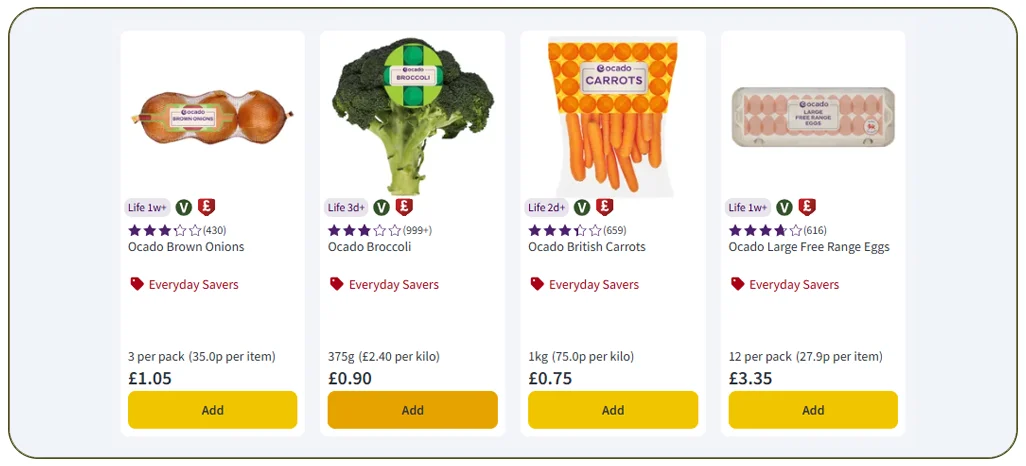
A price comparison platform needs more than a list of prices. It needs data that supports a fair, accurate comparison:
- Product identity: to know that two listings are the same product
- Comparable prices: including unit prices
- Promotion detail: to calculate effective prices
- Availability: to avoid showing products that cannot be bought
- Freshness: to avoid showing outdated prices
- Coverage: enough products to fill real baskets
Data Fields To Collect
For a broader field set across grocery platforms, see our grocery data scraping service, which covers product, price, availability and custom fields.
Product data: retailer product ID, name, brand, size or weight, pack count, category and sub-category, description, ingredients and nutrition where shown, allergens, dietary tags, country of origin and images.
Identification data: barcode (GTIN or EAN) where displayed, which is the best key for matching between retailers.
Price data: shelf price, unit price (price per kilogram, litre, 100 grams or each), was price, promotional price and promotion type.
Promotion data: multi-buy offers such as 2 for a fixed price, meal deals, loyalty-member prices, such as Clubcard prices at Tesco, offer dates and minimum purchase conditions.
Availability data: in stock, out of stock or limited, and substitution policy messages.
Delivery data: delivery slots, minimum basket and delivery charges where shown for a postcode.
Context: postcode or store used, timestamp and category rank.
Postcode And Store Context
Location-aware extraction is also supported through the grocery scraping API, including store or postcode-level collection.
UK grocery sites tailor prices, availability and delivery to the customer's location. Tesco's online pricing is generally consistent but availability can depend on the store that fulfils the order. Ocado serves customers from its own fulfilment centres, with delivery depending on postcode. A comparison platform should therefore collect data for a set of representative postcodes, and record the postcode with each record. For a national comparison, a sample of postcodes across regions, such as London, the Midlands, the North, Scotland and Wales, provides a good view.
Handling Promotions: The Hard Part
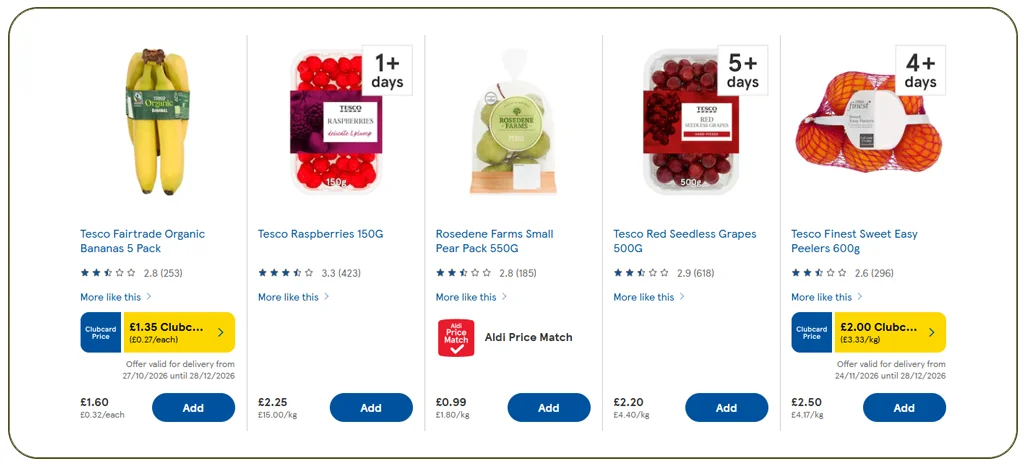
Promotions are the most complex element of grocery pricing, and they are where comparison platforms are most often wrong. Examples include:
- Simple discounts: a reduced price on a single item
- Multi-buy: buy two for a set price, or three for the price of two
- Loyalty prices: a lower price for members, which only applies if the customer has the scheme
- Meal deals: combinations across categories
- Spend thresholds: a discount applied when the basket reaches a set amount
A good data model stores the original promotion text and also parses it into structured fields: promotion type, required quantity, promotional price, whether a loyalty card is required, start and end dates and the effective unit price. A comparison platform can then show both the shelf price and the effective price and explain the conditions to the user.
Product Matching Between Tesco And Ocado
The retailers use different product names and IDs. Matching uses a layered approach: For Tesco-specific extraction, the Tesco grocery scraper can provide structured product fields that support this matching workflow.
- Barcode matching where both sides display GTIN or EAN. This gives the highest accuracy.
- Brand and size matching: normalise brand names and sizes, and match when both are equal and the product names are similar.
- Own-label equivalence: store brands cannot be matched by brand. A comparison platform may instead group them as comparable own-label products by type and size, for example standard whole milk 2 litres.
- Text similarity and attributes: compare names, descriptions and attributes for the rest.
- Confidence scoring and review: low-confidence matches are held for review so that wrong comparisons do not reach users.
How The Scraping Works
- Define the product universe: full catalogue, selected categories or a list of popular products.
- Set the postcode or store context and verify it.
- Map the category tree for each retailer.
- Collect listings by paging through every category, capturing the main fields.
- Open product pages for fuller data such as barcodes, nutrition and ingredients.
- Parse promotions into structured fields.
- Normalise sizes, units and prices to the standard format, calculating unit prices consistently.
- Match across retailers and store the links.
- Validate and publish with change detection so that only changed records are updated.
- Schedule: daily collection for prices and promotions, weekly for full catalogue and attributes.
Technical Challenges
- Anti-bot protection: both retailers limit automated access, so collection needs pacing, rotation and monitoring.
- Dynamic content: product listings and prices load through scripts.
- Large catalogues: each retailer lists tens of thousands of products, so efficient collection and incremental updates are needed.
- Promotion parsing: the text varies widely, so rules must be tested and updated.
- Unit price consistency: different retailers present units differently, so recalculating from price and size is safer than relying on displayed values alone.
- Frequent changes: prices and promotions change often, and sites change layout regularly.
- Own-label comparisons: require careful grouping and clear explanation to users.
Use Cases
- Grocery price comparison websites and apps: the primary use, showing customers the cheapest retailer for their basket.
- Shopping list and meal-planning apps: suggest the cheapest place to buy.
- Cost-of-living and inflation trackers: monitor price changes in common products over time.
- Brands and manufacturers: track how their products are priced and promoted at each retailer.
- Journalists and researchers: study promotion practices and own-label pricing.
Example: Building A Basket Comparison
A comparison start-up builds a basket of 100 common items. For each item, it defines a matched pair or group across Tesco and Ocado. Each day, the platform collects the shelf and promotional prices for chosen postcodes and calculates the basket total at each retailer. It shows users the cheapest option, the difference in pounds and a breakdown showing items where promotions or loyalty prices changed the result.
Example: Price-History Charts
The platform stores daily prices for each product and shows users a price history chart with promotion periods marked. Users see whether today's offer is a genuine saving compared with the usual price, which builds trust. This type of historical feed can also be delivered through a grocery scraping API when the comparison platform needs recurring price updates.
Sample Output
A record may include: retailer, postcode, collection timestamp, product ID, barcode, name, brand, size, unit, category, shelf price, unit price, was price, promotion type, promotion text, promotional price, loyalty required flag, offer start, offer end, effective unit price, availability, product URL, image URL and match group ID. For teams that need ready-made records instead of a live collection workflow, a Tesco grocery dataset or Ocado grocery dataset can also support benchmarking and historical analysis.
Data Quality Checks
- Recalculate unit prices from price and size and compare with displayed values
- Check that promotional prices are lower than shelf prices
- Monitor product counts per category against previous runs
- Track the percentage of products with barcodes and matches
- Review a sample of matches and promotions manually every week
Delivery And Refresh
For Tesco-specific recurring price and availability feeds, the Tesco data API is another relevant implementation option.
Data can be delivered through a REST API, as daily files in cloud storage or loaded directly into a database that powers the platform. Incremental updates, with only changed products delivered each day, keep processing light.
Responsible Data Collection
Collect only public product and price information, avoid personal data, keep request volumes sensible and follow each retailer's terms and applicable laws, including UK database and competition rules. Product images and descriptions are protected, so check usage rights, and consider licensed data sources for a public-facing commercial service. Take legal advice.
Why Choose Real Data API For UK Grocery Data
Real Data API builds retailer-specific scrapers for Tesco and Ocado, parses promotions into structured fields and matches products across retailers with confidence scoring. A pilot for a few categories and postcodes shows the data quality and match rates before you commit to full catalogues.
Conclusion
Tesco and Ocado data scraping gives a UK grocery comparison platform the building blocks for fair comparisons: matched products, comparable unit prices and parsed promotions. With postcode-aware collection, careful matching and daily updates, the platform can give shoppers confidence that its answers are accurate.
Building a grocery comparison platform? Real Data API can deliver a pilot for Tesco, Ocado and other UK retailers.
FAQs
Can you collect Clubcard prices?
Where Tesco shows member prices publicly, they are captured and flagged as requiring membership.
How do you match own-label products?
They are grouped as comparable products by type and size, with the grouping rules documented, and shown to users as comparable rather than identical.
Do prices differ by postcode?
Prices are often consistent nationally, but availability and delivery vary by postcode, so the postcode is stored with each record.
How often should data be refreshed?
Daily for prices and promotions, weekly for full catalogue attributes.
Can more retailers be added?
Yes. The schema and matching approach extend to other supermarkets.
Latest posts
Cashback Rate Tracking for Black Friday 2026: Monitor Competitor Offers & Optimize Promotional Strategies
Skyscanner Flight Price Scraping: Daily Fare Data for European and US Cities
How to Scrape Specific Supermarkets on Instashop: Store-Level Product Data

Luxury Fashion Competitor Data Scraping: Farfetch & Level Shoes Prices, Availability and Catalogue Matching



.png)


