Introduction
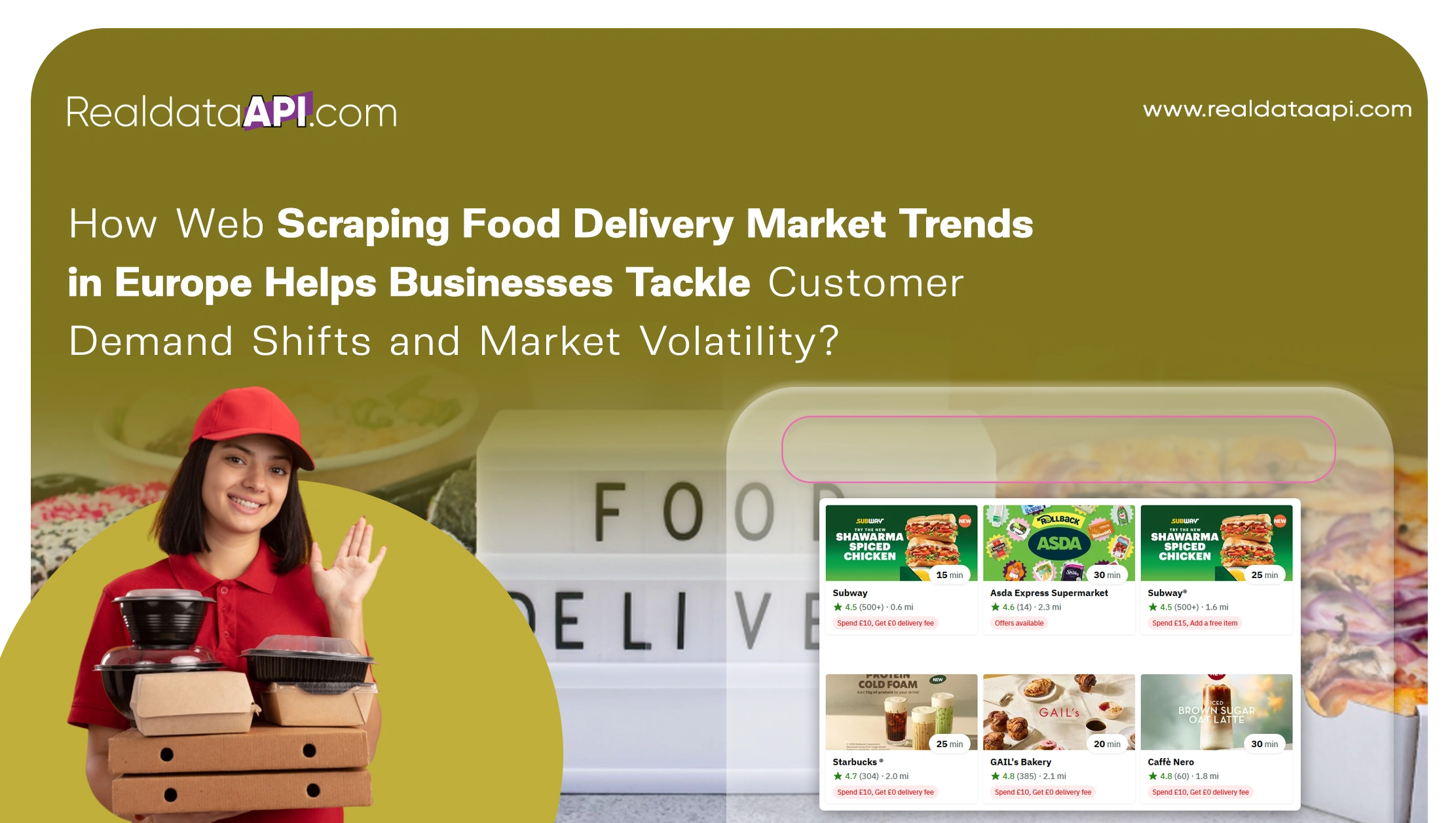
The European food delivery market is evolving at an unprecedented pace, driven by digital transformation, changing consumer behavior, and intense competition among platforms. Businesses are constantly challenged by fluctuating demand, dynamic pricing, and regional preferences that vary significantly across countries. To stay competitive, companies must rely on accurate, real-time insights. This is where Web scraping food delivery market trends in Europe becomes a powerful tool, enabling brands to monitor pricing, track demand shifts, and analyze competitor strategies effectively.
In addition to regional insights, global benchmarking plays a crucial role in building resilient strategies. Many organizations now Scrape QSR Market Trends in Canada and the USA to understand how mature markets respond to volatility and customer expectations. By combining European data with international benchmarks, businesses can refine their pricing models and demand forecasting strategies.
This blog explores how data extraction and analytics help businesses tackle customer demand shifts and market volatility, supported by statistical insights and trends from 2020 to 2026.
Strengthening Market Visibility with Structured Data
To navigate the complexities of the food delivery ecosystem, businesses must extract food delivery and restaurant data for market analysis Europe. Without structured data, companies often operate in silos, making it difficult to understand market trends and competitor behavior.
Between 2020 and 2026, the number of active food delivery users in Europe has grown significantly, leading to a surge in data generation. Businesses that leverage data extraction gain a comprehensive view of market dynamics, enabling better decision-making.
Market Data Growth Overview (2020–2026):
| Year | Active Users (Million) | Orders per User | Data Volume Growth (%) |
|---|---|---|---|
| 2020 | 180 | 12 | 100% |
| 2022 | 210 | 15 | 180% |
| 2024 | 240 | 18 | 260% |
| 2026 (Projected) | 270 | 22 | 340% |
By consolidating data from multiple platforms, businesses can identify trends, monitor competitor performance, and optimize their strategies. This structured approach reduces uncertainty and enhances market visibility.
Adapting to Dynamic Market Conditions with Real-Time Insights
Market volatility requires businesses to act quickly and decisively. A real-time Europe food delivery Data scraper enables companies to capture live data on pricing, availability, and demand patterns.
From 2020 to 2026, real-time data adoption has increased significantly, with businesses prioritizing speed and accuracy in decision-making. Companies that rely on delayed data often miss critical opportunities to adjust pricing or respond to demand fluctuations.
Real-Time Data Impact:
| Year | Real-Time Data Usage (%) | Decision Speed Improvement | Revenue Impact (%) |
|---|---|---|---|
| 2020 | 35% | 20% | 10% |
| 2022 | 50% | 35% | 18% |
| 2024 | 65% | 50% | 25% |
| 2026 (Projected) | 80% | 65% | 32% |
With real-time insights, businesses can adjust pricing dynamically, optimize delivery operations, and respond to customer demand instantly. This agility is essential for staying competitive in a rapidly changing market.
Unlocking Platform-Level Intelligence
Food delivery platforms generate vast amounts of data, from menu listings to customer reviews. Businesses can leverage Europe food delivery app data extraction to gain insights into platform-specific trends and customer behavior.
Between 2020 and 2026, the number of food delivery apps in Europe has increased significantly, intensifying competition. Extracting data from these platforms allows businesses to analyze competitor strategies and identify opportunities for differentiation.
Platform Data Insights:
| Year | Number of Apps | Avg Menu Listings | Customer Reviews (Millions) |
|---|---|---|---|
| 2020 | 25 | 500K | 50 |
| 2022 | 35 | 750K | 80 |
| 2024 | 45 | 1M | 120 |
| 2026 (Projected) | 55 | 1.3M | 160 |
By analyzing this data, businesses can understand customer preferences, optimize their offerings, and improve customer satisfaction.
Gaining Insights into Pricing and Demand Trends
Understanding pricing and demand is critical for optimizing revenue. Businesses can scrape European food menu pricing and demand insights to identify patterns and adjust their strategies accordingly.
From 2020 to 2026, there has been a noticeable shift in consumer preferences, with increased demand for healthy and premium food options. Pricing strategies must adapt to these changes to remain competitive.
Pricing and Demand Trends:
| Category | 2020 Share | 2023 Share | 2026 Forecast |
|---|---|---|---|
| Fast Food | 35% | 38% | 40% |
| Healthy Meals | 18% | 22% | 27% |
| Premium Dining | 15% | 18% | 22% |
By analyzing these trends, businesses can optimize their menus, introduce new offerings, and align pricing with customer expectations. This ensures sustained growth and profitability.
Leveraging Advanced Technology for Scalable Data Extraction
To manage large volumes of data, businesses need scalable solutions like a Food Data Scraping API. These tools automate data collection, ensuring accuracy and efficiency.
Between 2020 and 2026, API adoption in the food delivery industry has increased significantly, driven by the need for real-time insights and automation.
API Adoption Trends:
| Year | API Usage (%) | Data Accuracy Improvement | Time Saved (%) |
|---|---|---|---|
| 2020 | 30% | 15% | 20% |
| 2022 | 45% | 25% | 35% |
| 2024 | 60% | 35% | 50% |
| 2026 | 75% | 50% | 65% |
With API-driven solutions, businesses can integrate data directly into their analytics systems, enabling real-time dashboards and automated decision-making.
Building Data-Driven Strategies with Structured Insights
A well-organized Food Dataset is essential for advanced analytics and predictive modeling. Structured datasets enable businesses to identify long-term trends, forecast demand, and optimize pricing strategies.
From 2020 to 2026, companies using structured datasets have reported significant improvements in forecasting accuracy and operational efficiency.
Dataset Impact Metrics:
| Metric | Without Dataset | With Dataset |
|---|---|---|
| Forecast Accuracy | 60% | 85% |
| Pricing Optimization | Low | High |
| Decision Speed | Slow | Fast |
By leveraging structured data, businesses can make informed decisions, reduce risks, and achieve sustainable growth.
Why Choose Real Data API?
Real Data API is a trusted partner for businesses seeking reliable data solutions and actionable insights. With expertise in Market Research, the platform enables organizations to implement Web scraping food delivery market trends in Europe efficiently and effectively.
Real Data API offers advanced tools, including a powerful Food Data Scraping API, to automate data collection and ensure accuracy. Businesses can monitor competitor pricing, analyze customer behavior, and track market trends in real time.
With scalable solutions and a focus on innovation, Real Data API empowers businesses to stay ahead of the competition and adapt to changing market conditions with confidence.
Conclusion
In an increasingly competitive and dynamic food delivery landscape, data-driven strategies are essential for success. By leveraging Web scraping food delivery market trends in Europe, businesses can gain real-time insights into pricing, demand, and competitor strategies.
These insights help organizations tackle customer demand shifts, respond to market volatility, and optimize their operations for maximum efficiency. With the right tools and structured data, businesses can transform challenges into opportunities and achieve long-term growth.
Ready to stay ahead of market trends and outperform competitors? Partner with Real Data API today and unlock the full potential of data-driven decision-making!
Latest posts
How Ixigo API Helps Businesses Solve Flight, Train, Hotel, Travel, and Pricing Data Challenges
How to Extract Restaurants, Menus, Prices, Ratings, and Business Data for Market Insights
How Brands Track Restaurant, Menu, Pricing, Rating, and Delivery Data for Competitive Intelligence

How Retailers Track Fashion Products, Prices, Brands, and Category Data for Competitive Intelligence Using AJIO API






.png)