.gif)
.gif)

Introduction
Amazon.ae has become one of the most important online marketplaces in the United Arab Emirates. For brands, distributors and sellers, the platform is both a sales channel and a price reference for the whole market. A shopper in Dubai can compare prices from several sellers in seconds, and the Buy Box winner collects the majority of sales. Keeping track of price movements across a list of SKUs is therefore a daily task for pricing and marketplace teams. This guide explains how multi-SKU price tracking on Amazon.ae works, which data to collect and how to turn it into decisions. For teams that need automated Amazon.ae price scraping, structured API delivery can simplify recurring collection.
What Multi-SKU Tracking Means
Multi-SKU tracking is the continuous monitoring of a defined list of products. The list may include your own products, competitors' products and benchmark products in the same category. For each SKU, the tracker records price and related fields at regular intervals. The result is a time series for every SKU that shows how its price, availability, seller and ranking change. This approach can be supported with Amazon product data extraction when the tracking list grows.
A typical list contains from a few dozen to several thousand SKUs. Identification is by ASIN, the Amazon product identifier, or by product URL. If you only have product names or barcodes, a mapping step finds the corresponding ASINs.
Why Amazon.ae Data Matters In The UAE
- Price reference: shoppers and retailers use Amazon.ae prices as a benchmark.
- Dynamic pricing: prices and promotions change often, especially during events such as Ramadan sales, White Friday and summer promotions.
- Seller competition: many sellers compete on the same listing, and the Buy Box shifts between them.
- Delivery promise: Prime-eligible and fast delivery options influence conversion.
- Bilingual market: product pages exist in English and Arabic, and shoppers use both languages.
Data Fields To Collect
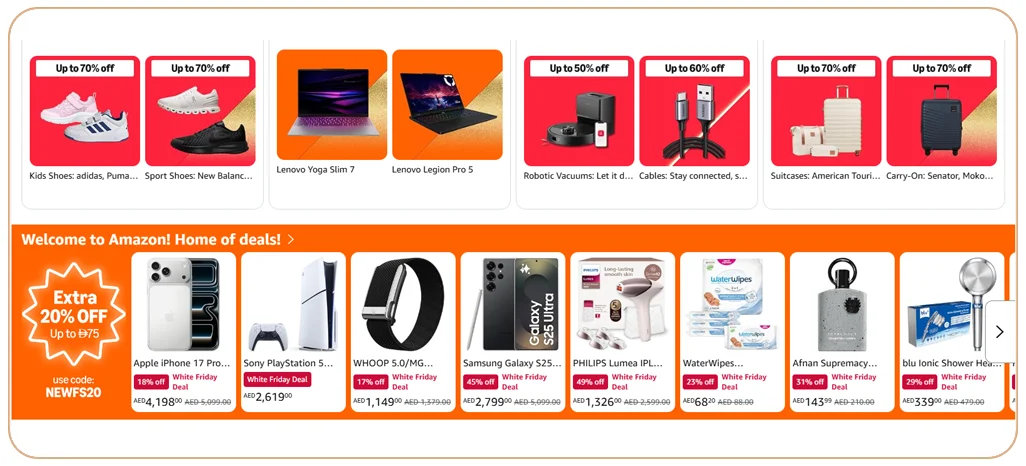
Product identity: ASIN, title (English and Arabic where available), brand, category and sub-category, model number, images and product URL.
Price data: current price in AED, list price or was price, discount percentage, deal labels such as limited-time deals, coupon indicators and price per unit where displayed.
Buy Box and offers: the seller that holds the Buy Box, seller name, seller rating, fulfilment type (fulfilled by Amazon or by the seller), number of other sellers and their prices when the offer list is collected. If you need every competing seller, an Amazon seller scraper can complement the product-level feed.
Availability and delivery: in stock status, low stock messages, delivery estimate for a given location, delivery fee and Prime or fast-delivery indicators.
Customer signals: average rating, number of ratings, number of reviews, best-seller badges and best-seller rank in category. For deeper customer signals, Amazon reviews scraping can add review-level data to the same analysis.
Content signals: number of images, presence of video and enhanced content, and bullet points.
Context: delivery emirate or city used, timestamp and language of the page.
Delivery Location And Its Effect
Amazon.ae shows delivery estimates and, in some cases, availability based on the selected delivery address. For consistent tracking, choose a fixed location, such as Dubai or Abu Dhabi, and apply it in every run. If you sell across emirates, you may track several locations. Always store the location with each record.
How Multi-SKU Tracking Works
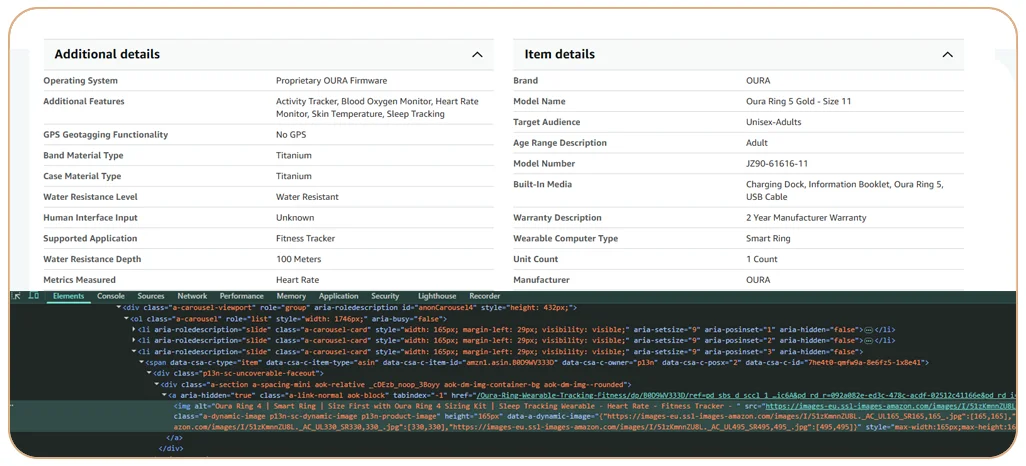
- Build the SKU list. Collect ASINs for all products you want to track. Verify variants, such as colours and sizes, because each can have its own ASIN.
- Set the delivery location and language for the run.
- Open each product page and capture price, Buy Box seller, availability and delivery.
- Collect the seller offers list if you need all competing offers, not only the Buy Box.
- Capture ranking data: best-seller rank, and optionally search rank for chosen keywords. For category-level ranking analysis, Amazon Best Sellers data can be used alongside SKU tracking.
- Normalise and store the results with timestamps.
- Detect changes: compare with the previous run and flag price changes, Buy Box changes and stock changes.
- Deliver data and alerts in the format your team uses.
Frequency
The right frequency depends on how fast your categories move. Fast-moving electronics and fashion often need several checks a day, especially during promotions. Stable categories may need only daily checks. Event periods such as major sales justify more frequent collection. A sensible plan starts with daily tracking and increases frequency for the SKUs where price changes are common. Teams running broader competitor price monitoring programs can use the same change-detection approach across retailers.
Metrics You Can Build
- Price index: your price versus the average or lowest competing price for comparable products
- Buy Box share: the percentage of time your seller account holds the Buy Box for a SKU
- Price volatility: how often and by how much prices change
- Discount depth and duration: the size and length of promotions
- Seller count trend: whether new sellers are entering the listing
- Stock-out rate: the share of checks where the SKU is unavailable
- Delivery promise comparison: the speed of your offer versus competitors
Technical Challenges
- Strong anti-bot protection: Amazon limits automated access. Large-scale tracking needs careful pacing, rotation and monitoring. For large-scale collection, Amazon web scraping services can handle recurring extraction workflows.
- Variation and parent listings: one page can contain many variants, so the tracked ASIN must be identified correctly.
- Dynamic pages: prices, deals and delivery information load through scripts and can differ by session.
- Buy Box volatility: the Buy Box can change several times a day, so sampling frequency affects accuracy.
- Bilingual content: Arabic and English titles need correct encoding and matching.
- Coupons and deals: the effective price can depend on a coupon or deal, which are shown in various places on the page.
- Layout changes: Amazon runs many page experiments, so extraction logic needs regular testing.
Use Cases
- Brands: monitor price compliance, find unauthorised sellers and protect brand value.
- Marketplace sellers: adjust prices to stay competitive and hold the Buy Box.
- Distributors and retailers: compare Amazon.ae prices with their own channel prices and offline shelf prices. This also fits wider e-commerce data scraping programs that compare marketplaces and retail channels.
- Category managers: track promotions and assortment changes by competitors.
- Price-comparison and deal sites: show price histories and drops in the UAE market. A ready-made Amazon e-commerce dataset can also support benchmarking and historical analysis.
- Analysts: study price trends, seasonal patterns and the effect of events.
Example: A Consumer-Electronics Brand
A brand tracks 150 SKUs across headphones, speakers and chargers. Daily data shows that three sellers undercut the recommended price on two products, and that the Buy Box moves to a lower-priced third-party seller on weekends. The brand contacts its distributor about the undercutting, adjusts its own promotional pricing and reports the issue to Amazon if it breaches brand policy.
Example: A Seller Repricing
A seller uses hourly data on 40 SKUs to feed its repricing rules. When a competitor lowers its price, the seller's tool lowers its own price within limits that protect margin. The seller sees its Buy Box share rise while maintaining a minimum profit per unit.
Sample Output
A record may include: timestamp, location, ASIN, title (English), title (Arabic), brand, category, price AED, list price, discount percent, deal label, coupon flag, Buy Box seller, fulfilment type, number of sellers, availability, delivery estimate, delivery fee, rating, rating count, best-seller rank and product URL. A separate offers table lists every seller with price, condition and fulfilment.
Data Quality Checks
- Validate that prices are numeric and in AED
- Check that the tracked ASIN matches the expected variant
- Monitor failure rates and missing fields
- Compare a sample of records with live pages
- Flag extreme price changes for review before they trigger alerts
Delivery And Refresh
Data can be delivered as daily CSV or Excel files, as JSON via API, or loaded into a data warehouse or BI dashboard. Alerts for price drops, Buy Box changes and stock-outs can be sent by email or messaging tools. Real-time updates are possible for a short list of critical SKUs. For broader retail workflows, see our e-commerce data scraping solutions for structured product, pricing and availability data.
Responsible Data Collection
Collect only publicly visible product and offer information, avoid personal data, keep request rates reasonable and follow Amazon's terms and applicable laws. Consider using Amazon's official programmes and APIs where they meet your needs, particularly if you are a registered seller or advertiser. Take legal advice for commercial use of scraped data. For implementation options, our Amazon web scraping services cover product, seller, availability and review data workflows.
Why Choose Real Data API For Amazon.ae Tracking
Real Data API builds multi-SKU trackers for Amazon.ae with fixed location handling, Buy Box and seller-level data, bilingual fields and change alerts. A pilot with 20 to 50 SKUs shows data quality and coverage before you scale to your full list.
Conclusion
Multi-SKU price tracking on Amazon.ae gives UAE brands, sellers and analysts a clear, continuous view of prices, sellers and rankings. With consistent location settings, Buy Box monitoring and timely alerts, pricing decisions can rest on evidence instead of guesswork.
Need Amazon.ae price tracking? Real Data API can deliver a pilot for your SKU list. Amazon API can support the pilot and ongoing refreshes.
FAQs
How many SKUs can be tracked?
From a handful to many thousands. Frequency and number of SKUs together determine cost.
Can you track competitors' products too?
Yes. Provide ASINs or product links, and they are tracked in the same dataset.
Can you capture Buy Box ownership?
Yes. The Buy Box seller is recorded on every run, with change history.
Do you provide Arabic titles?
Where Amazon.ae shows them, yes.
Can I get alerts when a competitor changes its price?
Yes. Rules can notify you of price drops, Buy Box changes and new sellers.
Latest posts
Amazon.ae Multi-SKU Price Tracking for the UAE Market

Mercado Livre Brazil Data Scraping: Daily Hair Dryer Data and How to Handle Rounded sold_quantity Values

Real Estate Data Scraping Across the Middle East and Turkey: A Managed Service for 26 Portals and 22 Million Records a Month

How Real-Time Product Data Scraping Helps Retailers Track Prom.ua Market Trends in 2026?




.png)


