.gif)
.gif)


Introduction
Car rental pricing at airports is a moving target. The price of a compact car at Sydney Airport next week can be very different from the price for the same dates six months from now. It also differs by rental length, supplier and the platform you book through. For rental companies, travel businesses and analysts in Australia, understanding these patterns requires systematic data collection. This guide explains how a project to scrape car rental prices from Booking.com Cars, DiscoverCars and CarJet across eight Australian airports can be designed, what the search matrix looks like, what data to capture and which feasibility questions must be answered first. Projects of this type are often at the research and development stage, so we also describe how to test viability.
The Requirement At A Glance
- Platforms: Booking.com Cars, DiscoverCars and CarJet
- Locations: eight Australian airports, namely Adelaide, Melbourne, Sydney, Brisbane, Perth, Cairns, Hobart and Sunshine Coast
- Pick-up and drop-off: same airport, during normal business hours
- Lead times: 1, 3, 7, 14, 30, 45, 60, 90, 180 and 360 days in advance
- Rental durations: 1, 2, 3, 4, 5, 6, 7, 14, 28, 56 and 90 days
- Data points: supplier name, car category, total price in Australian dollars, daily rate, whether an offer or discount applies, discounted or offer price, and search date and time
- Frequency: different schedules for short-term and longer rentals
Why These Three Platforms
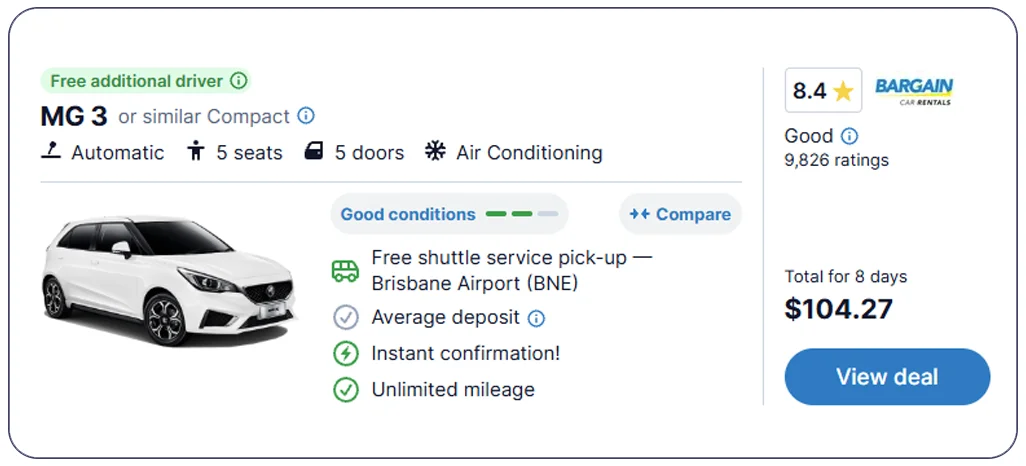
All three are aggregators or brokers. They list offers from many rental suppliers and let customers compare prices by car category, supplier and rental terms. Each has its own interface, supplier coverage and pricing logic, so the same car on the same dates can appear at different prices and with different conditions on each. Comparing them shows the market's range and reveals which platform tends to be cheapest for which type of rental.
For a broader view of how structured rental rates, vehicle categories, supplier details and availability can be collected across rental platforms, see the car rental data scraping solution.
The Search Matrix
The workload comes from combining the dimensions:
- 8 airports
- 10 lead times
- 11 rental durations
- 3 platforms
That makes 8 times 10 times 11 times 3, which equals 2,640 searches for one full run. Each search returns multiple offers, one for each supplier and car category combination. If a run collects 20 offers per search on average, it produces over 50,000 rows. Running every combination daily would yield millions of rows per month, so the schedule must be planned. This is why different frequencies for short-term and long-term rentals make sense.
A Sensible Schedule
The pricing behaviour for different rental types varies:
- Short rentals (1 to 7 days): more sensitive to demand changes and used more by leisure and business travellers. These deserve frequent collection, for example daily or several times a week.
- Long rentals (14, 28, 56 and 90 days): prices change more slowly and often depend on special long-term pricing. Weekly collection may be enough.
- Long lead times (180 and 360 days): prices move slowly and may not be fully loaded, since some suppliers do not publish rates that far ahead. Weekly or even monthly collection can be enough.
A tiered schedule reduces cost and avoids unnecessary load on the platforms.
How A Search Is Defined
Every search needs a complete specification:
- Pick-up and drop-off location, which in this case is the same airport
- Pick-up date, calculated as the search date plus the lead time
- Drop-off date, calculated as the pick-up date plus the duration
- Pick-up and drop-off times, set within normal business hours, such as late morning, and kept consistent
- Driver age, typically in the standard adult bracket, because age affects price
- Country of residence or market setting, since it can change displayed prices and currency
- Currency set to Australian dollars
Every record stores these parameters, since price is meaningless without them.
Data Points
Search context: platform, airport, lead time, duration, pick-up date and time, drop-off date and time, driver age, market and search timestamp.
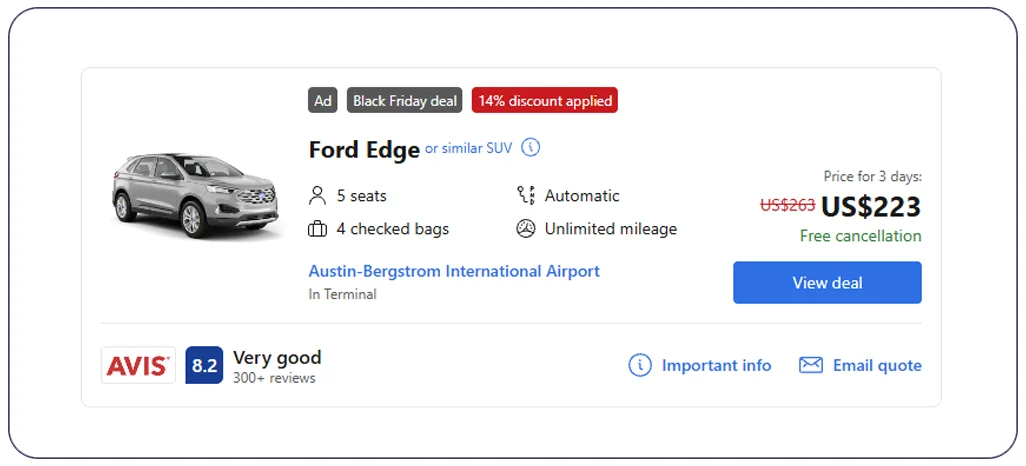
Offer details: supplier name, car category (such as economy, compact, intermediate, full-size, SUV, premium, van), example car model where shown, transmission, fuel policy, mileage limits, number of seats and bags and cancellation terms.
Price data: total price in AUD, daily rate (shown or calculated as total price divided by days), taxes and fees information where shown and insurance inclusions.
Offer and discount data: whether a discount or special offer applies, the original price, the discounted price and the discount label.
Ranking: position of the offer in the results and whether it is labelled best price or recommended.
Calculating Daily Rates
Once daily rates are standardized, teams can use the resulting history to benchmark competitors and inform car rental pricing models, while keeping airport, rental duration and booking lead time as separate comparison dimensions.
Some platforms show the daily rate. Others show only the total. For consistency, store both: the displayed value and a calculated daily rate equal to the total price divided by the number of rental days. Note the definition of a rental day, since suppliers usually charge by 24-hour blocks. Longer rentals often have lower daily rates, which is why the duration dimension is so important.
Technical Challenges
- Strong anti-bot protection: travel aggregators actively defend their pricing data, so collection requires advanced browser automation, session handling and careful pacing. The combination of three platforms and thousands of searches makes this a demanding project.
- Progressive loading: results appear over time as suppliers respond, so the scraper must wait for completion.
- Dynamic pricing: prices can change between searches within minutes, so timestamps matter.
- Availability limits: some lead times, especially 360 days, may return limited or no offers.
- Supplier name and category mapping: each platform names car categories differently, so a mapping table is needed for comparison.
- Taxes, fees and insurance: totals may or may not include them, so a note on inclusions is required for fair comparison.
- Scale and cost: thousands of searches per run require parallel capacity and careful scheduling.
- Terms of use: platforms typically restrict automated access, so legal review is essential.
A wider travel-data workflow may also combine rental rates with flight, hotel, availability and booking signals. The travel scraping API page outlines this broader multi-platform use case.
Why Feasibility Testing Comes First
Projects like this are often classed as under research and development, meaning feasibility has to be proven before committing to a full programme. A feasibility pilot should:
- Test one airport and one platform with a small slice of the matrix, such as three lead times and three durations.
- Measure success rates, meaning the share of searches that return a full set of offers.
- Measure data completeness for the required fields.
- Check stability by repeating searches on consecutive days.
- Estimate cost per search and per run, including the infrastructure needed.
- Test all three platforms, since each may differ in difficulty.
- Review the legal position and consider whether official affiliate or partner feeds exist.
- Decide the scope: which platforms, airports and matrix combinations are feasible, and at what frequency.
The outcome might be a full programme, a reduced matrix or a switch to official data sources for some platforms.
Metrics You Can Build
- Average daily rate by airport, category, lead time and duration
- Lead-time curve: how prices change as pick-up approaches
- Duration curve: how the daily rate falls with longer rentals
- Platform price gap: the difference between platforms for equivalent offers
- Supplier price position: which suppliers are cheapest in each airport
- Discount incidence: how often offers are discounted and by how much
- Seasonality: price differences across months and school holidays
Use Cases
- Rental companies: set and adjust prices by airport, category and lead time.
- Travel agencies and tour operators: benchmark car rental costs in packages.
- Airports and tourism bodies: analyse the cost of travel to regions such as Cairns, Hobart and the Sunshine Coast.
- Investors and analysts: study supplier competition and price trends.
- Aggregators and startups: compare their offers with the market.
For teams that need structured records for downstream analysis rather than only a one-off comparison, car rental datasets can be a useful related resource for examining vehicle categories, pickup locations, rental prices and availability.
Example: Building A Lead-Time Curve
A rental company wants to know how prices for economy cars at Sydney Airport change with lead time. The data shows low prices at 90 to 180 days, a gradual rise in the last 30 days and a steep rise in the last week for 3-day rentals. The company sets a dynamic pricing rule that follows the same curve, adjusted to its own fleet utilisation.
Example: Comparing Platforms
A travel agency compares one-week rentals across the three platforms for all eight airports. It finds that one platform is cheapest at most airports for compact cars, while another leads for SUVs at regional airports. The agency chooses which platform to feature in its packages by category and region.
Sample Output
A row may include: search timestamp, platform, airport, lead time days, duration days, pick-up date and time, drop-off date and time, supplier, car category, car example, transmission, mileage policy, fuel policy, insurance level, total price AUD, daily rate AUD, discount flag, original price, discounted price, offer label, rank and offer URL.
Data Quality Checks
- Validate that total price is greater than zero and that daily rate equals total divided by days within rounding
- Check that pick-up and drop-off dates match the search matrix
- Monitor the number of offers per search against expectations
- Flag outlier prices
- Compare a sample of searches with the live site
The same structured outputs can also be incorporated into a wider travel data scraping workflow when rental pricing needs to be analyzed alongside other travel-market information.
Delivery
Data can be delivered as CSV or Parquet files per run, as JSON via API or into a data warehouse. Dashboards can show price curves by airport and category.
Responsible Data Collection
Collect only publicly visible price information, avoid personal data, keep request volumes reasonable and follow platform terms and applicable laws. Consider official affiliate or partner data where available, especially for production use at this scale.
Why Choose Real Data API For Car Rental Price Data
Real Data API starts with a feasibility pilot, measures success rates and cost, and then designs a tiered schedule for the full matrix. We deliver clean, comparable data with full search context for every record.
Conclusion
Car rental price scraping for Australian airports across Booking.com Cars, DiscoverCars and CarJet can reveal how prices change with airport, lead time, duration and platform. Because the search matrix is large and the platforms are hard to access, a feasibility pilot and a tiered schedule are the keys to a project that is reliable and affordable.
Planning a car rental pricing project? Real Data API can run a feasibility pilot for your airports and platforms.
FAQs
Is the full matrix of 2,640 searches per run realistic?
It can be, but only a pilot can confirm success rates and cost. A tiered schedule keeps it manageable.
Do all three platforms behave the same?
No. Each has different protections and structures, so each is tested separately.
How do you compare car categories across platforms?
Through a category mapping table that links each platform's labels to a standard set.
Can you collect insurance and fee details?
Where shown, yes. Inclusions are recorded so comparisons are fair.
Can you start with fewer airports?
Yes. A pilot at one or two airports is the usual first step.
Latest posts

Amazon.ae Multi-SKU Price Tracking for the UAE Market

Mercado Livre Brazil Data Scraping: Daily Hair Dryer Data and How to Handle Rounded sold_quantity Values

Real Estate Data Scraping Across the Middle East and Turkey: A Managed Service for 26 Portals and 22 Million Records a Month

How Real-Time Product Data Scraping Helps Retailers Track Prom.ua Market Trends in 2026?




.png)


