.gif)
.gif)

Introduction
Property is one of the biggest asset classes in the Middle East and Turkey, and the information about it lives on public portals: millions of listings for sale and rent, with prices, locations, sizes and agent details. Developers, investors, banks, brokers, proptech companies and analysts all want that data, but no single source covers the whole region. A fully managed web data extraction service that collects property listings and market data from around 26 public websites across the UAE, Saudi Arabia, Egypt, Qatar, Bahrain and Turkey, at a volume of about 22 million records per month, is a large engineering and data-quality project. This guide explains how such a service is designed, what data it delivers and what it takes to run it reliably.
Why A Managed Service Rather Than A One-Off Scrape
At this scale, a script run by an analyst will not work. 22 million records a month means roughly 730,000 records per day on average, drawn from 26 sites in six countries and several languages. Sites change layouts, add protections and restructure their data. A managed service takes responsibility for the whole chain: collecting, cleaning, matching, quality control, delivery and maintenance. The client receives clean data on a schedule, without running any infrastructure.
What Is A Record?
The unit of volume must be defined, because it drives cost and architecture. In a property project, a record is typically one listing snapshot: one property listing as seen on one site on one collection date. If the same listing is collected daily for 30 days, that counts as 30 records. So 22 million records a month may correspond to a few million unique listings, observed repeatedly. Agreeing on this definition at the start avoids misunderstandings.
Countries And Portals
For businesses comparing multiple markets, a strong real estate data scraping workflow should combine portal coverage with consistent fields, refresh schedules and historical observations. This makes property data from different countries easier to compare without maintaining a separate process for every market.
Property markets in this region differ widely:
- UAE: large, international and data-rich, with strong portals for sale and rent listings in Dubai, Abu Dhabi and other emirates
- Saudi Arabia: a fast-growing market with major portals covering Riyadh, Jeddah and Dammam, and strong activity in rentals and land
- Egypt: a large market with portals covering Cairo, Alexandria and new communities, with many off-plan and developer projects
- Qatar and Bahrain: smaller markets with a limited number of portals, dominated by a few sources
- Turkey: a large domestic market with major portals, strong foreign buyer interest and listings in Turkish, English and other languages
Some sites cover several countries, and some countries have several competing portals, which means a property can appear on more than one site.
Data Points Collected
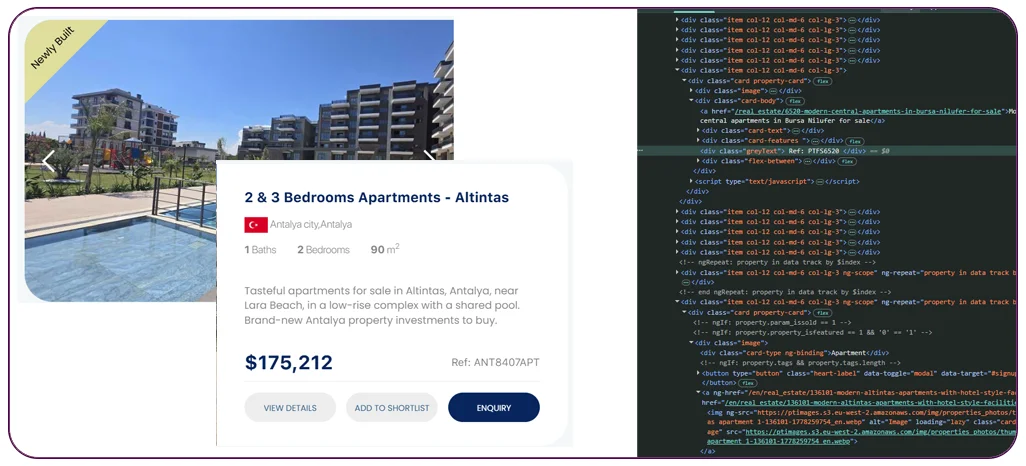
The same principle applies when the output is used for valuation, benchmarking or market research. A structured real estate datasets approach can preserve source identifiers, timestamps and normalized fields so analysts can distinguish a genuine market movement from a collection or parsing issue.
Listing identity: listing ID, source site, URL, listing title, listing date, last updated date and status such as active or removed.
Transaction type and property type: sale or rent, residential or commercial, and subtype such as apartment, villa, townhouse, office, shop, land or warehouse.
Price data: asking price, currency, price per square metre or foot, rent period (yearly, monthly), number of cheques for rentals where shown, service charges and price history where available.
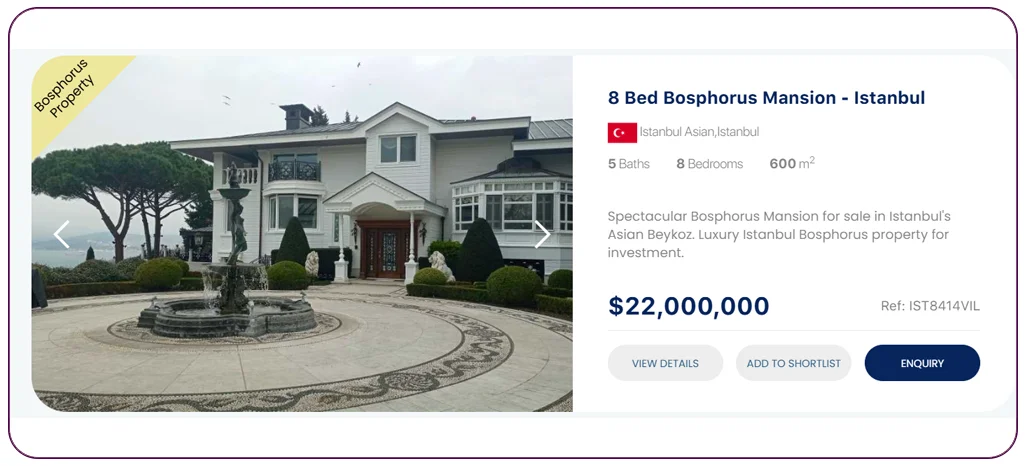
Property attributes: bedrooms, bathrooms, built-up area, plot area, floor, number of floors, furnished status, parking, view, amenities, age, completion status (ready or off-plan) and developer and project name.
Location data: country, city, district or community, building or project name, address text, latitude and longitude where shown.
Agent and agency data: agency name, agent name and agency listing counts as shown publicly for business purposes.
Content data: description text, images count and image URLs, floor plans and video flags.
Market data: where portals publish indices, market reports or transaction information, these can be collected as separate datasets.
Architecture Of A Managed Service At Scale
For larger deployments, an enterprise web scraping architecture can separate scheduling, collection, parsing, validation, storage and delivery. This makes individual components easier to monitor and scale as portal coverage grows.
- Source adapters: one adapter per site, designed to collect all listings of the target types and countries.
- Crawl orchestration: schedules daily, weekly and monthly jobs, allocating capacity across sites and managing rate limits.
- Raw data store: keeps raw pages or responses for audit, reprocessing and debugging.
- Parsing and normalisation: converts raw data into the common schema.
- Enrichment and geocoding: maps locations to standard administrative areas, assigns coordinates when missing and standardises property types.
- Deduplication and entity resolution: links the same property across portals, and the same listing across days.
- Quality control: validates fields, detects anomalies and monitors volumes per site.
- Delivery layer: produces daily, weekly and monthly files, API endpoints or warehouse tables.
- Monitoring and maintenance: tracks scraper health, detects layout changes and triggers fixes.
Schedules: Daily, Weekly And Monthly
Different data needs different frequencies:
- Daily: new listings, price changes and removals, which are important for market tracking and lead generation
- Weekly: full refresh of active listings, to catch changes the daily run missed and to refresh attributes
- Monthly: market snapshots, aggregated statistics and deeper attribute collection, such as full descriptions and images
A tiered approach reduces load. Daily runs focus on new and recently changed listings, while weekly and monthly runs revisit everything.
Languages And Scripts
This normalization layer is especially important when the same property-market concepts appear in Arabic, English and Turkish. Standardized location and property fields also make real estate scraping API outputs easier to integrate into dashboards, databases and valuation workflows.
The project must handle Arabic, English and Turkish, and sometimes other languages. Arabic text is right-to-left and has variants of letters and numerals, including Eastern Arabic digits. Turkish has special characters. Location names appear in several spellings, such as different transliterations of the same Arabic district name. A location dictionary that maps spelling variants to a standard name is essential for analysis by area.
Entity Resolution: The Same Property On Many Portals
A villa listed by two agencies on three portals appears as six listings. For market analysis, you often want to count it once. Entity resolution compares:
- Location, including coordinates and building or project
- Property type and size
- Bedrooms and bathrooms
- Price within a tolerance
- Image similarity
- Agent and agency
Matches are scored, and listings are grouped into property clusters. The raw listings remain, but the cluster ID lets analysts count unique properties and see price spreads between agents.
Currency And Units
Prices appear in AED, SAR, EGP, QAR, BHD and TRY, and sometimes in USD or EUR. Areas appear in square metres or square feet. A good dataset keeps the original values and adds standardised fields: price in a base currency with the exchange rate and date, and area in square metres. In Turkey and Egypt, where inflation and currency volatility are high, the exchange rate date matters a lot for comparisons.
Technical Challenges
A practical way to reduce operational overhead is to treat monitoring as part of the service rather than an afterthought. Large-scale data collection workflows need source-specific controls, validation and maintenance because a technically successful crawl can still produce incomplete or inconsistent records.
- Volume and cost: 22 million records a month requires efficient crawling and storage. Fetching only changed data and prioritising new listings controls cost.
- Anti-bot protection: property portals defend their data. Stable collection needs careful pacing, rotation, session handling and constant maintenance.
- Layout changes: 26 sites will change layouts often, so the monitoring and repair process is a core part of the service.
- Search result limits: many portals limit the number of results per search, so searches must be partitioned by location, price and type.
- Data quality variation: listing quality varies by site and country. Missing coordinates, vague locations and inconsistent areas are common.
- Stale listings: some listings remain online after the property is sold or rented. Tracking last seen dates and removal helps estimate true availability.
- Multilingual processing: text needs normalisation and, where required, translation.
- Legal and terms of use: portals typically restrict automated access, and data protection rules apply to agent information.
Quality Assurance For A Service At This Scale
Quality control is automated wherever possible:
- Volume checks: expected listing counts per site, city and type compared with historical ranges
- Field completeness: share of records with price, area, location and type
- Validation rules: price and area within plausible ranges per market
- Duplicate rate monitoring within and across sources
- Schema checks on every delivery
- Manual sampling against live listings
- Quality scorecard delivered with each batch, so clients see how complete and accurate the data is
Use Cases
For teams that need a ready-to-use starting point rather than a new extraction pipeline, real estate datasets can be useful for historical analysis, benchmarking and model development. For continuously changing listings, an API or scheduled feed can be a better fit.
- Investors and funds: track yields, price trends and supply across cities.
- Developers: benchmark prices per square metre, absorption signals and competing projects.
- Banks and valuers: use listing data in automated valuation models and portfolio monitoring.
- Brokerages and agencies: monitor competitors' inventory and pricing, and find leads.
- Proptech companies: power search, valuation and market-report products.
- Government and research bodies: study housing supply, affordability and rental markets.
Example: A Regional Valuation Model
A proptech company builds an automated valuation tool covering six countries. It consumes the daily listing feed, uses clustering to count unique properties and trains models on asking prices by community, size and type. Monthly snapshots calibrate the model for seasonal patterns. The managed service delivers files to the company's data warehouse each morning.
Example: A Developer's Market Watch
A developer planning a new residential project in Riyadh monitors competing projects. The weekly dataset shows the number of active listings, asking price per square metre and time on market in the target districts. The developer adjusts its price positioning and launch timing.
Delivery Formats
Choosing between a dataset and an API should depend on how the information will be consumed. Real estate scraping API delivery is suited to applications that need structured records on demand, while scheduled datasets can be more convenient for analysts and research teams.
Data can be delivered as Parquet or CSV files in cloud storage, partitioned by country and date, loaded into a data warehouse such as BigQuery, Snowflake or Redshift, or served through an API. Each delivery includes a schema description, a change log and a quality report. Small client teams often prefer curated monthly tables, while data science teams prefer full raw-to-clean pipelines.
Compliance And Governance
- Collect only information that is publicly visible and avoid bypassing access controls.
- Review each portal's terms and take legal advice by country, since rules on data, database rights and scraping differ.
- Handle agent and agency data as business information, and avoid collecting private individuals' personal data. Where personal data is unavoidable, apply local data-protection laws.
- Keep a record of sources, collection methods and dates for audit.
- Consider official partnerships or data licences with portals where available, especially for commercial use at this scale.
Why Choose Real Data API For Managed Property Data
A managed engagement can also be evaluated alongside broader web scraping services when the organization expects to add other data sources later. Starting with a focused property-data pilot keeps the initial scope measurable while leaving room to expand the workflow.
Real Data API operates managed extraction pipelines with source monitoring, normalisation and quality scorecards. We recommend starting with a pilot of three to five portals in one or two countries, measuring coverage, accuracy and cost, and then scaling to the full 26-portal programme in phases.
Conclusion
If the initial requirement is focused on UAE inventory, a dedicated Bayut data scraping workflow can be evaluated as one regional component before expanding coverage across additional portals and countries.
A managed real estate data service for the Middle East and Turkey turns dozens of separate portals into one consistent, high-quality dataset. With a tiered crawl schedule, multilingual normalisation, entity resolution and strong quality control, even tens of millions of monthly records become a reliable foundation for investment, valuation and market intelligence.
Need regional property data? Real Data API can scope a managed pilot for your countries and portals.
FAQs
What counts toward the 22 million records?
Each listing snapshot, meaning a listing on a site on a collection date, counts as a record. Unique listings are fewer.
Can you cover all 26 portals from day one?
We advise phasing. Start with the highest-value portals, prove quality and then add the rest.
Can you deliver both listings and market statistics?
Yes. Listings are the base, and aggregated market metrics can be built on top, and portal-published reports can be added where available.
How do you handle multiple languages?
Original text is stored, and standard fields, such as property type and location names, are normalised, with translation added where needed.
Can data be delivered into our warehouse?
Yes. Files or direct warehouse loads are available.
Latest posts

Amazon.ae Multi-SKU Price Tracking for the UAE Market

Mercado Livre Brazil Data Scraping: Daily Hair Dryer Data and How to Handle Rounded sold_quantity Values
Real Estate Data Scraping Across the Middle East and Turkey: A Managed Service for 26 Portals and 22 Million Records a Month

How Real-Time Product Data Scraping Helps Retailers Track Prom.ua Market Trends in 2026?




.png)


