
TL;DR
- Businesses can use Amazon video results scraper for data extraction to monitor competitor content, discover product-related videos, compare content themes, and identify emerging audience interests without relying on manual research.
- Amazon's scale makes systematic data collection increasingly valuable: Amazon's net sales grew from $386.1 billion in 2020 to $716.9 billion in 2025, while its advertising and streaming ecosystem expanded significantly through Amazon Data Scraping opportunities.
- The right extraction workflow combines collection, normalization, historical tracking, competitor benchmarking, and API delivery so marketing and research teams can turn raw results into actionable intelligence.
Introduction
Competitor video research becomes difficult when teams must manually review hundreds or thousands of results, record changing titles and creators, compare product associations, and identify recurring themes. Amazon Data Scraping can turn this fragmented information into structured datasets that are easier to filter, compare, monitor, and analyze.
For businesses, the core opportunity is not simply collecting video results. It is creating a repeatable intelligence layer around those results. A well-designed Amazon video results scraper for data extraction workflow can capture titles, creators, descriptions, categories, product relationships, ratings, publication information, and other publicly available attributes, then organize them into a historical dataset.
Amazon's overall scale demonstrates why structured monitoring matters. Its consolidated net sales increased from $386.1 billion in 2020 to $469.8 billion in 2021, $514.0 billion in 2022, $574.8 billion in 2023, $638.0 billion in 2024, and $716.9 billion in 2025.
The video and advertising environment has also become more measurable. Amazon introduced Prime Video advertising in 2024, and by 2025 it reported more than 130 million monthly ad-supported Prime Video viewers in the U.S.
For brands, agencies, publishers, sellers, and market researchers, this creates a practical question: how can video-result intelligence be converted into competitor insights quickly enough to support decisions?
What Does Video Intelligence Reveal About Competitors?
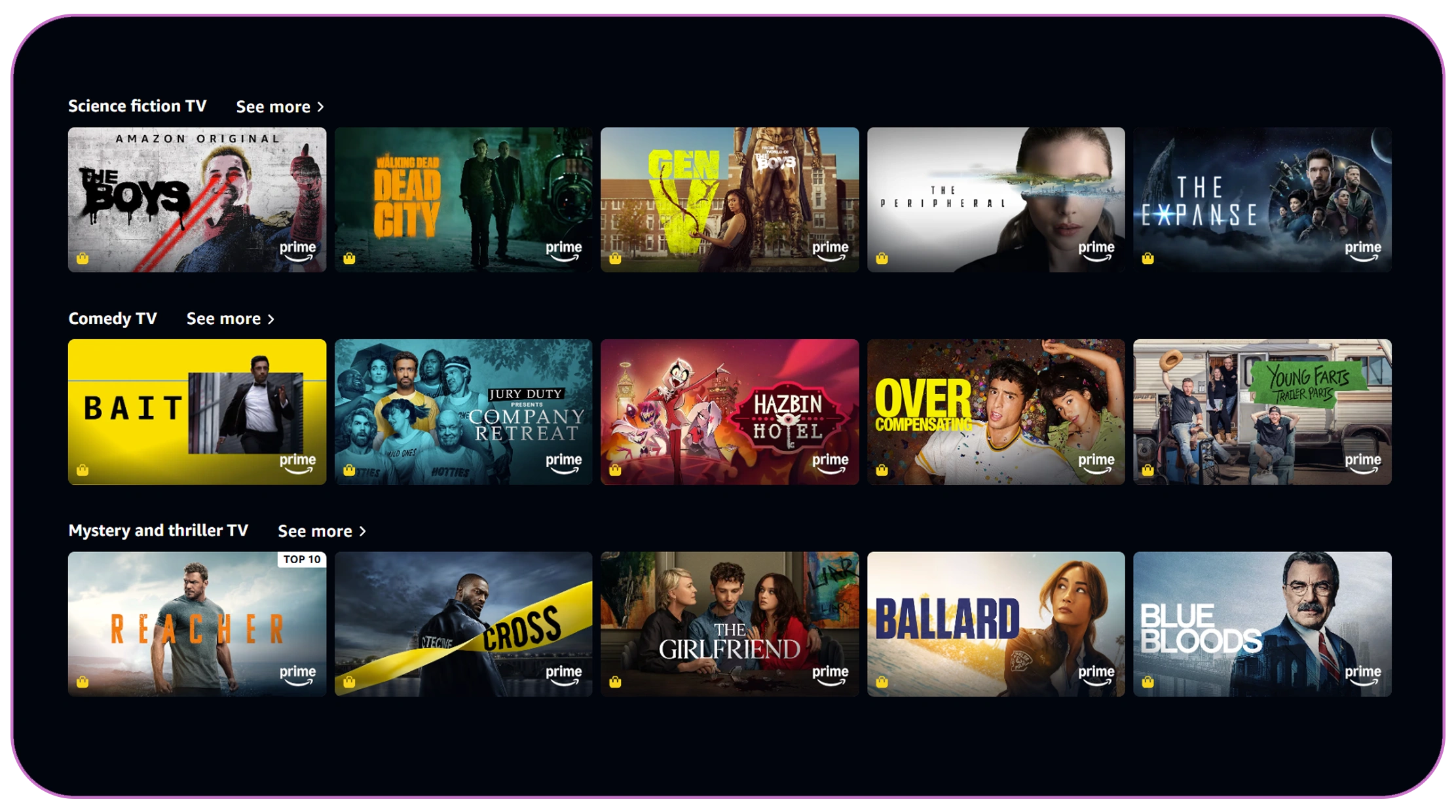
Competitor research becomes more useful when video results are treated as structured market signals rather than isolated pieces of content. Amazon video web scraping for content research can help research teams identify which subjects competitors repeatedly promote, how product-related videos are positioned, which creators appear frequently, and what content formats are gaining visibility.
A useful dataset should separate raw collection from interpretation. Raw fields can include video title, URL, creator, category, product reference, publication date, description, rating, review count, and collection timestamp. Analytical fields can then be calculated from those records, such as competitor frequency, topic clusters, product-video associations, content freshness, and trend movement.
Amazon's broader business growth provides useful context for why longitudinal research matters.
| Year | Amazon consolidated net sales | Research context |
|---|---|---|
| 2020 | $386.1B | Major acceleration in digital commerce |
| 2021 | $469.8B | Continued high digital demand |
| 2022 | $514.0B | Scale remained elevated |
| 2023 | $574.8B | Strong recovery and expansion |
| 2024 | $638.0B | Prime Video ads introduced |
| 2025 | $716.9B | Prime Video ad audience expanded |
| 2026 | Current year | Ongoing monitoring and reporting |
The 2020-2025 figures are Amazon-reported annual results; 2026 is intentionally not presented as a completed financial year.
For a competitor analyst, the key insight is that historical snapshots are more valuable than one-time exports. A monthly dataset can reveal whether a competitor is increasing video activity, shifting product categories, changing messaging, or focusing on particular seasonal opportunities.
This approach also reduces subjective research. Instead of asking analysts to manually decide what appears important, structured records can support measurable comparisons such as video frequency by competitor, percentage of videos associated with particular products, or changes in content themes over time.
How Can Automated Collection Improve Competitor Monitoring?
automated Amazon video data extraction helps businesses move from occasional research to continuous monitoring. Instead of assigning analysts to repeatedly search, copy, clean, and consolidate results, an automated workflow can perform collection at defined intervals and deliver normalized records to a database, spreadsheet, warehouse, or analytics platform.
Automation is particularly useful when competitors publish frequently. A single manual research exercise may provide a useful snapshot, but it cannot reliably answer whether content activity increased three weeks later. Scheduled extraction solves this problem by creating comparable historical observations.
The development of Amazon's advertising ecosystem further reinforces the need for structured monitoring. Amazon reported advertising-services revenue of $19.8 billion in 2020, $31.2 billion in 2021, and $37.7 billion in 2022.
| Year | Amazon advertising-services revenue | Implication for monitoring |
|---|---|---|
| 2020 | $19.8B | Growing digital advertising importance |
| 2021 | $31.2B | Larger commercial signal |
| 2022 | $37.7B | Increasing advertising scale |
| 2023 | --- | Continued expansion |
| 2024 | --- | Prime Video advertising introduced |
| 2025 | --- | Broader streaming audience |
| 2026 | Current year | Continuous intelligence opportunity |
Amazon announced the introduction of video advertising on Prime Video in 2024, followed by expansion into additional countries including India in 2025.
For a buyer, the value of automation lies in consistency. A useful pipeline should handle pagination, duplicate detection, field normalization, timestamps, failed requests, retries, and historical storage. It should also preserve the original record so analysts can validate insights later.
Businesses can then build alerts around meaningful changes. Examples include a sudden increase in competitor video volume, repeated promotion of a particular product, new creators appearing in a category, or significant changes in the language used around products.
Want to replace repetitive competitor research with structured, scalable video intelligence? Build an automated extraction workflow that delivers clean data directly into your analytics process.
Get Insights Now!How Can Extracted Video Data Support Content Analysis?

Extract Amazon video data for content analysis becomes valuable when raw records are transformed into comparable business metrics. Marketing teams can group videos by topic, creator, product, category, publication period, or competitor and then evaluate changes over time.
For example, a consumer electronics company could identify how frequently competing brands publish product demonstrations, tutorials, comparison videos, or promotional content. A beauty brand could track recurring product themes and creator associations. A research firm could compare category-level content activity across thousands of products.
The strongest approach combines descriptive and trend analysis.
| Year | Amazon business-scale indicator | Content-analysis opportunity |
|---|---|---|
| 2020 | $386.1B net sales | Establish baseline datasets |
| 2021 | $469.8B | Expand competitor coverage |
| 2022 | $514.0B | Build category comparisons |
| 2023 | $574.8B | Strengthen historical trends |
| 2024 | $638.0B | Include streaming-ad context |
| 2025 | $716.9B | Benchmark broader audience signals |
| 2026 | Current year | Monitor current movements |
Amazon's reported results show that the platform's overall commercial scale continued expanding throughout this period.
A practical content-analysis model can assign each record several dimensions: content type, product category, competitor, creator, topic, sentiment indicator, publishing period, and product association. Analysts can then calculate measures such as content share, publishing frequency, topic concentration, and content freshness.
The important distinction is between collection and analysis. Extraction provides evidence; analysis converts evidence into a decision. A data buyer should therefore avoid purchasing a dataset that contains only URLs and titles if the intended business outcome requires competitive benchmarking.
Historical comparison is especially useful. Suppose a competitor publishes 40 product-related videos in one quarter and 85 in the next. That increase can signal a campaign, product launch, category push, or change in marketing strategy. The dataset does not automatically explain the reason, but it gives analysts a measurable signal to investigate.
The same framework can support content gap analysis. If competitors repeatedly cover a topic while a brand has little or no corresponding content, marketers can identify potential opportunities for new videos, product education, comparison pages, or promotional campaigns.
Why Is an API Useful for Large-Scale Video Monitoring?
An Amazon video scraping API can make extracted information easier to integrate into existing business systems. Instead of downloading files manually, teams can request structured records programmatically and feed them into dashboards, databases, business-intelligence platforms, or internal applications.
This is particularly important for organizations that need frequent refreshes. A research company may need daily collection, while a smaller marketing team may require weekly or monthly updates. An API-based workflow can support both without forcing users to repeatedly manage files.
Amazon itself increasingly provides reporting through APIs in parts of its broader ecosystem. Prime Video documentation describes reporting APIs and downloadable reports for business and performance information, while Amazon's reporting documentation provides programmatic access to report files.
| Year | Data-integration environment | Recommended approach |
|---|---|---|
| 2020 | Rapid digital-commerce growth | Batch datasets |
| 2021 | Larger data volumes | Scheduled extraction |
| 2022 | More structured reporting | Database pipelines |
| 2023 | Greater analytics adoption | API-led delivery |
| 2024 | Streaming advertising growth | Near-real-time monitoring |
| 2025 | Larger audience measurement | Automated dashboards |
| 2026 | Unified reporting direction | Integrated data workflows |
Amazon updated its advertising reporting environment in 2026 with unified reporting intended to combine campaign information across multiple advertising products and accounts.
For buyers, API delivery reduces operational friction. Instead of asking analysts to repeatedly retrieve files, a system can automatically pull new records, compare them with historical data, and trigger downstream processing.
The API layer should ideally provide predictable schemas, authentication, pagination, error handling, timestamps, filtering, and documentation. These features matter because the quality of an extraction service is determined not only by how much data it collects, but also by how reliably that data can be consumed.
How Can a Dedicated Scraper Support Competitive Intelligence?
An Amazon Scraper becomes strategically useful when collection is designed around a defined research objective rather than simply maximizing record volume. For competitor monitoring, the system should prioritize fields that help answer business questions.
The core dataset can include competitor name, video title, creator, product reference, category, URL, publication date, description, rating, review information, and extraction timestamp. Additional calculated fields can identify first-seen dates, changes between crawls, content frequency, and category movement.
The phrase Amazon video results scraper for data extraction describes the collection layer that can turn search-result information into structured competitive intelligence. The important business outcome, however, is not the scrape itself. It is the ability to compare competitors consistently.
Amazon's scale offers a useful benchmark for the changing data environment.
| Year | Consolidated net sales | Strategic relevance |
|---|---|---|
| 2020 | $386.1B | Digital demand accelerated |
| 2021 | $469.8B | Scale increased substantially |
| 2022 | $514.0B | Large marketplace ecosystem |
| 2023 | $574.8B | Continued growth |
| 2024 | $638.0B | Video advertising expanded |
| 2025 | $716.9B | Further scale and audience growth |
| 2026 | Current year | Active monitoring period |
Historical figures are from Amazon financial disclosures; 2026 is shown as the current monitoring year rather than a completed annual result.
A competitive-intelligence workflow should therefore include four layers: discovery, extraction, normalization, and analysis. Discovery identifies relevant results. Extraction captures structured fields. Normalization creates consistent records. Analysis identifies trends and opportunities.
For example, a retailer can compare competitor video activity across product categories and identify categories where competitors are publishing aggressively. A manufacturer can monitor how its products and competing products are represented. An agency can create recurring competitor reports for multiple clients.
This also supports historical change detection. If the same result changes title, description, category, or product association, the system can preserve both versions. Such change history can reveal repositioning, campaign updates, or content refreshes that may otherwise go unnoticed.
What Role Does an API Play in a Scalable Data Strategy?
An Amazon API can serve as the delivery layer connecting collected information to the systems where decisions are made. For enterprise buyers, that may include a cloud warehouse, BI dashboard, CRM, data lake, competitive-intelligence platform, or internal analytics application.
The business case becomes stronger when the API supports recurring delivery instead of one-off exports. A company can define the sources and fields it needs, schedule collection, store historical records, and automatically refresh downstream dashboards.
Amazon's own technical documentation demonstrates the growing role of programmatic reporting. Prime Video Slate provides reporting capabilities covering areas such as TVOD, Prime Channels, subscriptions, live events, and ad-supported video, with report availability and frequency depending on the account and business line.
| Year | Data maturity trend | Business opportunity |
|---|---|---|
| 2020 | Larger digital datasets | Centralized storage |
| 2021 | Higher collection frequency | Automated refreshes |
| 2022 | More structured analytics | Competitive dashboards |
| 2023 | API adoption expands | System integration |
| 2024 | Video advertising grows | Video intelligence |
| 2025 | Audience scale increases | Cross-channel analysis |
| 2026 | Unified reporting evolves | Connected data pipelines |
A scalable architecture should also separate ingestion from consumption. This allows the extraction process to continue even if a dashboard or downstream application is temporarily unavailable.
For buyers, important evaluation criteria include data freshness, historical coverage, schema stability, geographic support, duplicate handling, extraction reliability, API limits, documentation, and customer support.
The strongest implementation is therefore not simply "scrape and export." It is a repeatable data pipeline that turns competitive observations into an operational intelligence product.
Why Choose Real Data API?
For companies that need reliable, structured, and scalable datasets, Real Data API can support a workflow designed around repeatable collection rather than manual research. The approach is especially useful for organizations tracking competitor activity across large numbers of search results and product-related content.
A robust solution should provide structured fields, consistent formatting, historical records, scalable delivery, and integration options suited to analytics teams. These capabilities help marketing managers, competitive-intelligence teams, agencies, researchers, and data professionals spend less time collecting records and more time interpreting them.
A useful Amazon E-commerce Dataset can also complement video-result information by connecting content signals with broader product attributes. This makes it possible to investigate relationships between products, categories, content themes, and competitor activity rather than analyzing videos in isolation.
The business value comes from creating a dependable intelligence loop: collect, normalize, store, compare, analyze, and act. Instead of relying on sporadic manual research, teams can establish recurring monitoring and use historical records to identify meaningful changes.
For organizations managing multiple categories or markets, scalability is equally important. A standardized data structure makes it easier to compare competitors across categories, locations, and time periods while reducing inconsistent analyst interpretation.
Conclusion
Businesses can track competitors more effectively by converting video-result information into structured, historical, and analyzable datasets. The opportunity is especially relevant as Amazon's commerce, advertising, and streaming ecosystems continue to expand.
From 2020 through 2025, Amazon's consolidated net sales increased from $386.1 billion to $716.9 billion, while Prime Video advertising and reporting capabilities developed significantly.
The practical strategy is straightforward: define the competitor questions first, collect the fields required to answer them, preserve historical snapshots, normalize the records, and connect the resulting dataset to analytics systems.
This allows businesses to identify content trends, benchmark competitors, discover gaps, monitor product-related video activity, and support faster strategic decisions.
Ready to turn competitor video results into actionable market intelligence? Real Data API helps you build scalable data pipelines and transform competitor data into structured insights for smarter research, analytics, and decision-making.
FAQs
What is the main benefit of collecting Amazon video results?
The primary benefit is structured competitor intelligence. Businesses can compare video topics, creators, products, categories, publishing activity, and content changes over time instead of relying on manual research.
How can businesses use Amazon Data Scraping for competitor research?
Businesses can collect publicly available video-result attributes, normalize them, store historical snapshots, and analyze competitor publishing patterns, product associations, topics, and emerging content opportunities.
Is an Amazon Scraper useful for ongoing monitoring?
Yes. An automated workflow can repeatedly collect comparable records, identify changes, remove duplicates, preserve timestamps, and support recurring competitor reports without requiring analysts to repeat manual searches.
When should a company use an Amazon API?
Companies should consider an API when data needs to flow repeatedly into dashboards, databases, warehouses, analytics platforms, or internal applications rather than being downloaded manually.
Can an Amazon E-commerce Dataset complement video research?
Yes. Combining product information with video-result records can help analysts connect content activity with product categories, competitor positioning, product attributes, and broader marketplace trends.
Latest posts
Netflix Scraper - How to Overcome Pricing, Content, and Competitor Monitoring Problems
How Amazon Video Data Helps Businesses Track Competitors Using Amazon video results scraper for data extraction?
How to Extract Grocery Data Using the Aldi API for Smarter Grocery Data Extraction in 2026?
How E-Commerce Datasets for Competitive Analysis Solve Pricing, Product, and Market Intelligence Challenges?






.png)



