.gif)
.png)

TL;DR
- Willhaben API enables businesses to structure marketplace information for pricing, product, listing, and competitive intelligence workflows.
- Willhaben Data Scraping can help teams monitor listings, prices, categories, availability, and market movements at scale.
- Willhaben has grown into Austria's largest digital marketplace, with around 13 million listings across its major categories as of August 2026.
Introduction
Businesses that rely on marketplace intelligence need current information on products, prices, listings, availability, and competitors. A Willhaben API approach can help convert marketplace information into structured datasets that pricing teams, retailers, analysts, and product intelligence platforms can process at scale. This is particularly relevant because Willhaben spans marketplace goods alongside real estate, automotive, and jobs, creating a broad source of commercial signals.
Willhaben Data Scraping can complement API-driven workflows by collecting publicly available listing information and transforming it into structured records for analysis. For a pricing manager, the value is not simply having more data; it is having consistent information that can be compared across products, categories, locations, conditions, and time periods.
Willhaben's scale illustrates why automation matters. The platform reported approximately 13 million advertisements in August 2026, including more than 112,000 real-estate listings, 206,000 vehicles, and 15.6 million marketplace goods and services according to its current press information.
The historical trajectory is also significant. Willhaben recorded more than 8.4 million unique clients and 74 million visits in July 2020, while its 2023 figures cited 88 million monthly visits and 1.36 billion page impressions.
For businesses, the practical objective is to transform this constantly changing marketplace environment into usable intelligence for pricing decisions, product discovery, competitor monitoring, assortment analysis, and market research.
How has marketplace scale changed from 2020 to 2026?
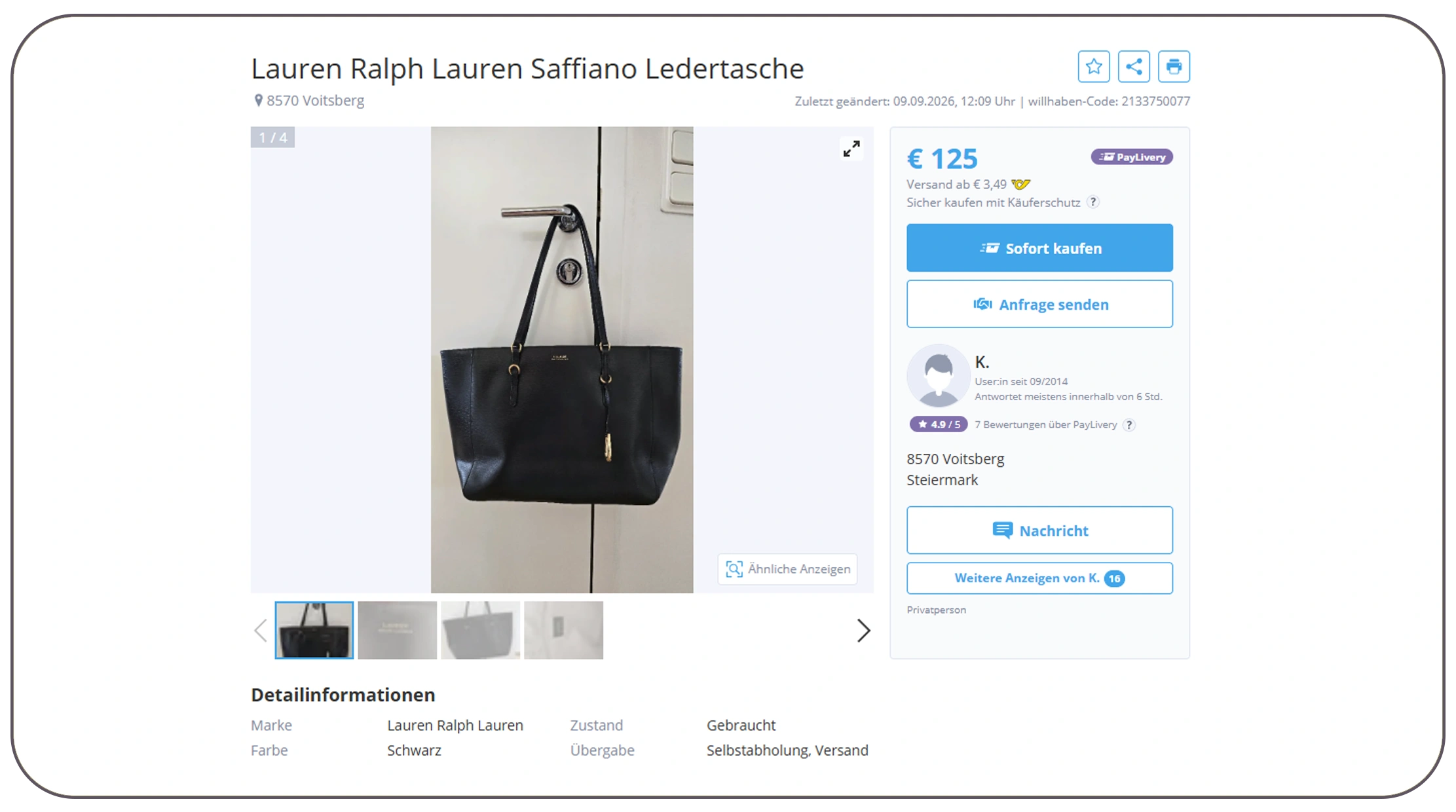
The expansion of marketplace activity has increased the value of automated data pipelines. In 2020, Willhaben was already among Austria's most visited digital services, with 74 million visits recorded in July. By 2023, the platform reported 88 million monthly visits and 1.36 billion page impressions. Its 2024 marketplace activity included more than 26 million new marketplace advertisements and 593.6 million marketplace visits. By August 2026, Willhaben reported approximately 13 million advertisements across the platform.
For data buyers, the implication is straightforward: marketplace monitoring becomes harder to manage manually as listing volume and refresh frequency increase. A pricing analyst may need to compare hundreds or thousands of comparable products, while a category manager may want to detect newly listed products or price changes.
Marketplace scale indicators
| Year | Publicly reported indicator | Data intelligence implication |
|---|---|---|
| 2020 | 74M visits in July | Strong marketplace reach |
| 2021 | 82.1M visits reported in Oct. | Large recurring traffic base |
| 2022 | No directly comparable figure identified | Continued digital marketplace development |
| 2023 | 88M monthly visits | High-frequency marketplace activity |
| 2024 | 593.6M marketplace visits | Large annual marketplace engagement |
| 2025 | 13M+ advertisements reported in factsheet | Extensive listing universe |
| 2026 | ~13M advertisements platform-wide | Scale favors automated monitoring |
Note: These are publicly reported indicators from different measurement periods and should not be treated as a single standardized annual growth series.
The commercial opportunity is to create a continuously refreshed dataset rather than repeatedly conducting manual searches. Such a dataset can support price benchmarking, product-level comparisons, seller analysis, assortment monitoring, and historical trend analysis.
What can businesses learn from pricing signals?
Price intelligence becomes more useful when it is collected consistently rather than as a one-time snapshot. real-time Willhaben marketplace data can help pricing teams observe asking prices, discounts, product conditions, listing age, locations, and comparable offers.
A key advantage is the ability to distinguish between individual listings and broader market patterns. For example, a single unusually low price may represent a used product in poorer condition, a seller seeking a quick transaction, or an incorrectly categorized listing. A larger dataset allows analysts to compare multiple observations before changing a pricing strategy.
Pricing intelligence framework, 2020-2026
| Period | Market-data focus | Example business use |
|---|---|---|
| 2020 | Marketplace expansion | Establish baseline categories |
| 2021 | Listing and traffic monitoring | Benchmark competitors |
| 2022 | Category-level comparison | Identify emerging demand |
| 2023 | High visit and page-view activity | Increase monitoring frequency |
| 2024 | 26M+ new marketplace ads | Detect assortment changes |
| 2025 | 13M+ advertisements | Build larger product benchmarks |
| 2026 | ~13M advertisements | Support continuous intelligence |
Willhaben's 2024 marketplace figures show 26,018,340 new marketplace advertisements and 47,443,372 inquiries, demonstrating how quickly listing and buyer-seller activity can accumulate.
For a retailer or marketplace operator, this information can answer practical questions: What is the prevailing asking price? Which products are becoming more expensive? Which sellers repeatedly offer similar products? How does condition affect price? Are certain categories seeing more new listings?
The answer should not be based on raw volume alone. Pricing intelligence becomes actionable when records are normalized by product attributes, location, condition, brand, seller type, and collection timestamp. This creates a more reliable foundation for competitive pricing and market research.
How can teams analyze prices for market research?
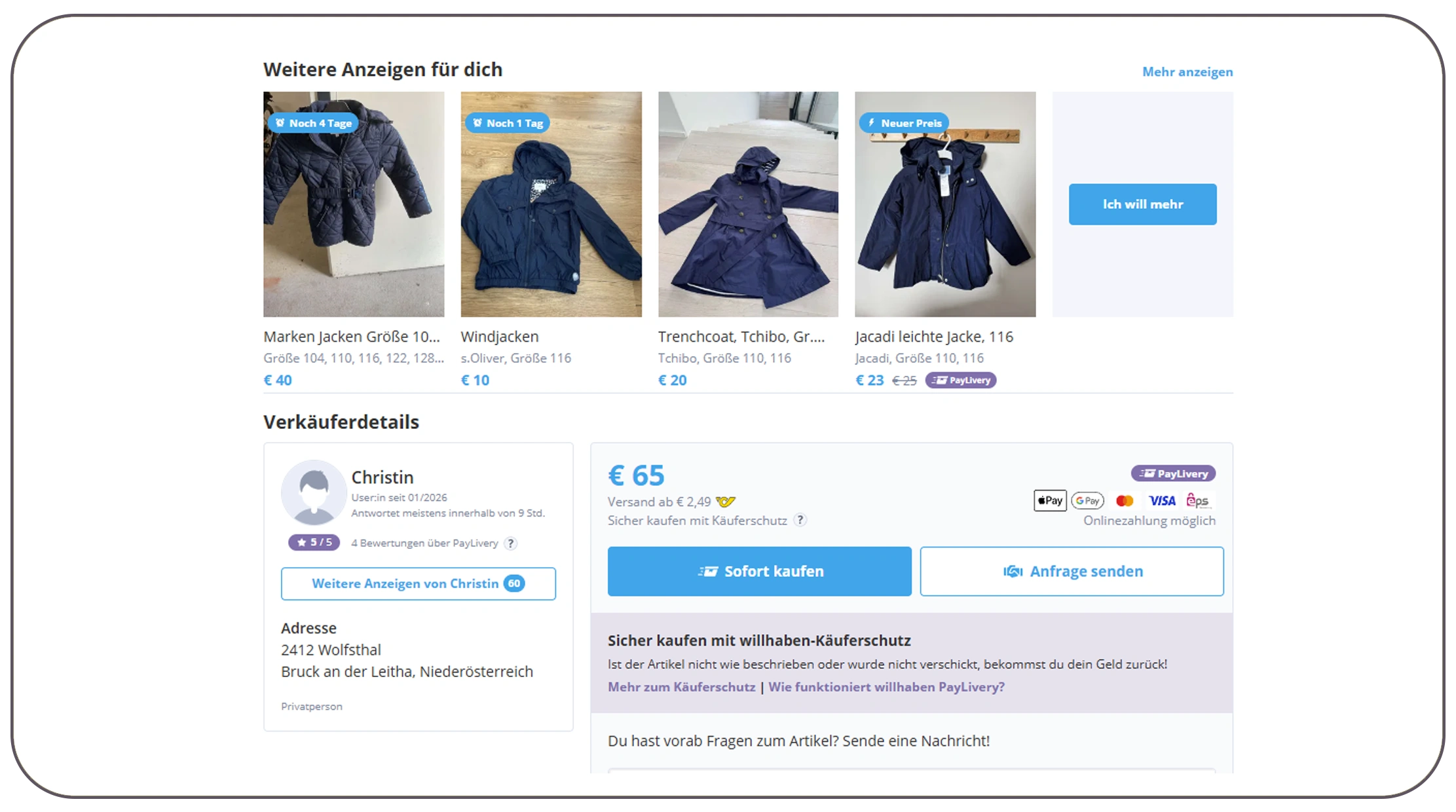
Scrape Willhaben Prices for Market Research workflows can organize listing-level price observations into comparable datasets. This allows businesses to examine median asking prices, price ranges, discount patterns, product-condition differences, and geographic variations.
A useful approach is to capture the price together with contextual fields. A €500 listing does not mean the same thing if one item is new and another is used, or if one includes accessories while another does not. Product title, brand, model, condition, location, listing date, and seller information can therefore be important analytical dimensions.
Example price intelligence dataset
| Data field | Why it matters |
|---|---|
| Product title | Identifies the offer |
| Brand/model | Enables comparable-product analysis |
| Asking price | Core pricing metric |
| Condition | Separates new and used inventory |
| Location | Supports regional comparisons |
| Listing date | Enables freshness analysis |
| Seller type | Helps segment supply |
| Category | Enables category benchmarking |
| Timestamp | Supports price-change monitoring |
From 2020 through 2026, marketplace intelligence has increasingly shifted from static research toward continuously refreshed datasets. Willhaben's reported scale reinforces the need for automated workflows: its 2023 data showed 88 million monthly visits, while its 2024 marketplace recorded more than 593 million visits and more than 26 million new advertisements.
For market researchers, the objective is not to collect every possible field. It is to collect the fields that explain price differences and market behavior. A well-designed pipeline can calculate median prices, identify outliers, compare regions, track listing frequency, and detect changes in competitive positioning.
Build a structured marketplace pricing dataset with Real Data API and turn changing listings into actionable market intelligence.
Get Insights Now!What product and listing information should businesses monitor?
Extract Willhaben Product and Listing Data workflows can capture structured information that supports product intelligence beyond simple price tracking. The most valuable fields depend on the business objective, but product name, category, brand, condition, price, location, listing date, availability indicators, and seller information commonly form the foundation.
Willhaben's marketplace is particularly suitable for comparative analysis because its ecosystem includes products and services alongside specialized areas such as real estate, cars and motors, and jobs.
Product intelligence indicators
| Indicator | 2020-2022 use | 2023-2026 use |
|---|---|---|
| Product price | Basic benchmarking | Continuous price tracking |
| Product condition | Used/new comparison | Condition-adjusted pricing |
| Category | Assortment research | Category trend detection |
| Listing volume | Market sizing | Supply monitoring |
| Location | Regional comparison | Geographic intelligence |
| Listing age | Availability proxy | Seller and inventory analysis |
| Seller attributes | Basic segmentation | Competitive monitoring |
The 2020-2021 period established a strong digital marketplace environment, while later years brought increasingly valuable signals from high-volume listings and interactions. Willhaben's 2024 figures show more than 47 million inquiries and 1.7 million PayLivery purchases, illustrating substantial interaction between listings and potential buyers.
By 2026, the platform reported approximately 13 million advertisements, making structured data particularly valuable for businesses that need category-level visibility.
For product intelligence teams, the next step is normalization. Duplicate products should be grouped, inconsistent names standardized, currencies and units normalized where relevant, and timestamps retained. This creates a historical dataset capable of answering questions that individual searches cannot answer.
Which collection model works best for continuous monitoring?
Willhaben product data collection services can help organizations build repeatable workflows for marketplace intelligence rather than relying on manual exports. The right architecture depends on collection frequency, target categories, required fields, geographic coverage, and downstream analytics.
From 2020 to 2026, the growing scale of digital marketplace activity has made refresh frequency increasingly important. In 2020, Willhaben was already generating tens of millions of visits, while by 2024 the marketplace alone recorded nearly 594 million visits.
Recommended monitoring architecture
| Layer | Function | Example output |
|---|---|---|
| Collection | Retrieve permitted public marketplace information | Raw listings |
| Parsing | Extract structured fields | Product, price, seller |
| Normalization | Standardize records | Comparable products |
| Storage | Preserve historical snapshots | Time-series dataset |
| Analytics | Calculate market metrics | Median price, volume |
| Delivery | Send data to applications | API/JSON/CSV |
| Monitoring | Detect changes | Price/listing alerts |
The major advantage is repeatability. A business can define a collection schedule and automatically receive refreshed records instead of rebuilding the same research process.
For example, a category manager could monitor selected product groups daily, while a market research organization could collect broader category snapshots weekly. A pricing team may require more frequent refreshes for fast-changing products.
The dataset can then feed dashboards, business intelligence systems, internal databases, recommendation engines, or pricing models. The objective is to create a reliable information layer between marketplace activity and business decision-making.
A scalable workflow should also include validation. Missing prices, duplicate listings, unexpected category changes, and parsing errors should be flagged before the data reaches analytical systems.
How does an API make marketplace data workflows scalable?
A Web Scraping API can simplify the process of connecting marketplace collection workflows with existing applications. Instead of requiring analysts to manually search pages, parse information, and maintain separate extraction scripts, API-based delivery can provide structured outputs for downstream systems.
The business value becomes clearer when viewed across the 2020-2026 period. Marketplace activity has remained substantial, while listing volumes and available digital signals have expanded. Willhaben reported 13 million advertisements in August 2026, making manual monitoring increasingly unsuitable for large-scale intelligence programs.
API workflow for marketplace intelligence
| Stage | Traditional workflow | API-driven workflow |
|---|---|---|
| Discovery | Manual searches | Automated requests |
| Extraction | Copy/export | Structured response |
| Refresh | Manual repetition | Scheduled collection |
| Storage | Spreadsheets | Database/data warehouse |
| Analysis | Manual formulas | Automated analytics |
| Distribution | Email/files | API endpoints |
| Monitoring | Periodic checks | Continuous pipeline |
An API-centered approach can also support multiple business teams. Pricing can use current price records, product teams can analyze assortment, researchers can examine market trends, and analysts can combine marketplace information with internal sales data.
The critical consideration is compliance and data governance. Collection should respect applicable laws, platform terms, access controls, privacy requirements, and reasonable request rates. Publicly accessible does not automatically mean unrestricted commercial use.
A mature implementation therefore combines technical scalability with responsible collection. Data should be minimized to the fields necessary for the business objective, stored securely, and retained according to an appropriate policy.
How can property intelligence benefit from marketplace data?
Real Estate Data Scraping can support a separate but highly valuable intelligence use case because Willhaben has a dedicated real-estate category. The platform reported more than 112,000 real-estate listings in August 2026, demonstrating the size of the available property marketplace.
Property analysts can examine listing prices, property types, locations, floor areas, rooms, features, listing dates, and other publicly available attributes to create structured market datasets.
Real-estate intelligence indicators
| Period | Intelligence opportunity |
|---|---|
| 2020 | Establish regional property baselines |
| 2021 | Compare property supply |
| 2022 | Track changing asking prices |
| 2023 | Increase geographic segmentation |
| 2024 | Monitor listing and demand signals |
| 2025 | Build larger property benchmarks |
| 2026 | Analyze 112K+ reported real-estate listings |
Willhaben itself has introduced increasingly sophisticated market tools. In 2026, it highlighted a transaction map giving brokers access to historical land-register data for apartment sales since June 2025, alongside filtering and comparison functions.
This illustrates a broader market trend: raw listings become more valuable when transformed into structured analytical intelligence.
A Willhaben API workflow for permitted property information can therefore support applications such as regional price monitoring, property-market research, competitive analysis, and inventory discovery. The exact dataset should be designed around the intended use case rather than collecting unnecessary personal information.
For businesses operating across both commerce and property intelligence, a common data infrastructure can reduce duplicated collection and analytics work while keeping datasets logically separated.
Why Choose Real Data API?
Real Data API is positioned as a data-access layer for businesses that need scalable marketplace intelligence. The value is particularly relevant when teams want structured outputs without building every component of a collection infrastructure internally.
A Scraping Browser API can help address browser-dependent collection scenarios where ordinary HTTP requests may not reproduce the behavior required to access publicly available pages. Combined with a Willhaben API workflow, businesses can design a pipeline around collection, parsing, normalization, storage, and delivery.
For pricing teams, this can mean faster access to comparable marketplace records. For product teams, it can provide structured assortment information. For market researchers, it can support repeatable snapshots and historical analysis.
The business case is strongest when data requirements are clearly defined. Instead of collecting everything, organizations can specify target categories, fields, refresh intervals, locations, and output formats.
This approach can reduce manual research effort while creating datasets suitable for dashboards, analytics platforms, pricing engines, and internal applications.
Conclusion
The core value of automated marketplace data is consistency. Businesses can use structured listing, product, price, category, location, and availability information to understand competitive conditions and make better pricing and assortment decisions.
Willhaben's evolution demonstrates why this matters. From tens of millions of visits in 2020 to hundreds of millions of marketplace visits in 2024 and approximately 13 million platform-wide advertisements in 2026, the volume of marketplace information creates both an opportunity and a data-management challenge.
A Willhaben API strategy can help businesses move from manual marketplace research toward structured, repeatable intelligence workflows. The strongest implementations combine automated collection, data normalization, historical storage, validation, analytics, and responsible data governance.
Start building a scalable marketplace intelligence workflow with Real Data API and turn continuously changing listings into actionable pricing and product insights!
FAQs
What is a Willhaben API used for?
A Willhaben API can support structured marketplace data workflows for monitoring listings, prices, categories, products, locations, and other permitted information for business intelligence.
Why use Willhaben Data Scraping?
Willhaben Data Scraping can help researchers collect structured marketplace observations repeatedly, enabling price benchmarking, assortment analysis, competitor monitoring, and historical trend identification.
What is real-time Willhaben marketplace data?
real-time Willhaben marketplace data refers to freshly collected listing information that helps businesses monitor current prices, availability, products, sellers, and changing marketplace conditions.
How does price scraping support research?
Scrape Willhaben Prices for Market Research workflows help analysts compare asking prices, product conditions, categories, locations, and listing timestamps to identify pricing patterns and market opportunities.
Can Real Data API support product intelligence?
Real Data API can support structured collection workflows for Extract Willhaben Product and Listing Data, helping businesses organize product attributes, prices, categories, and listing information for analysis.
Latest posts
Keeta scraper for monitoring food marketplace trends - Identify Discount Changes and Emerging Customer Demand
How to build a structured Nike product dataset for Product Intelligence and Retail Analytics
Allegro scraper for competitor price monitoring – How to Track Product Prices and Stay Ahead of Competitors
Ocado API data collection services for retailers - Track Competitor Prices and Deals







.png)