.gif)
.png)
TL;DR
- Netflix scraper technology can help businesses organize public streaming information for catalog, pricing, availability, and competitive research.
- Netflix Web Scraping Services can automate recurring collection and convert scattered content signals into structured datasets for analytics, dashboards, and market intelligence.
Introduction
A Netflix scraper can help businesses overcome fragmented streaming research by collecting publicly accessible information into structured, analysis-ready records. For organizations tracking content, pricing, regional availability, and competitor movements, automation is more scalable than manually checking thousands of titles and market changes.
The need for structured intelligence has grown alongside Netflix itself. Netflix reported approximately 204 million paid memberships and about $25 billion in revenue in 2020. By 2025, paid memberships had surpassed 325 million and revenue reached approximately $45.2 billion. In Q2 2026, Netflix reported $12.56 billion in quarterly revenue, up 13% year over year.
For media companies, research teams, aggregators, advertisers, investors, and entertainment analysts, the challenge is no longer simply collecting information. Netflix Web Scraping Services can help create a repeatable system that captures changes, standardizes attributes, preserves historical records, and makes the resulting information useful for informed business decisions.
Streaming Market Scale: 2020-2026
| Year | Netflix paid memberships / period indicator | Revenue indicator |
|---|---|---|
| 2020 | 203.7M year-end | $25.0B |
| 2021 | 221.8M year-end | $29.7B |
| 2022 | 230.7M year-end | $31.6B |
| 2023 | 260.3M year-end | $33.7B |
| 2024 | 301.6M year-end | $39.0B |
| 2025 | 325M+ year-end | $45.2B |
| 2026 | Current-year reporting | $24.81B H1 revenue |
*2020-2025 figures are annual; 2026 revenue shown is first-half 2026, not a full-year forecast.
How Does Movie-Level Data Improve Content Intelligence?
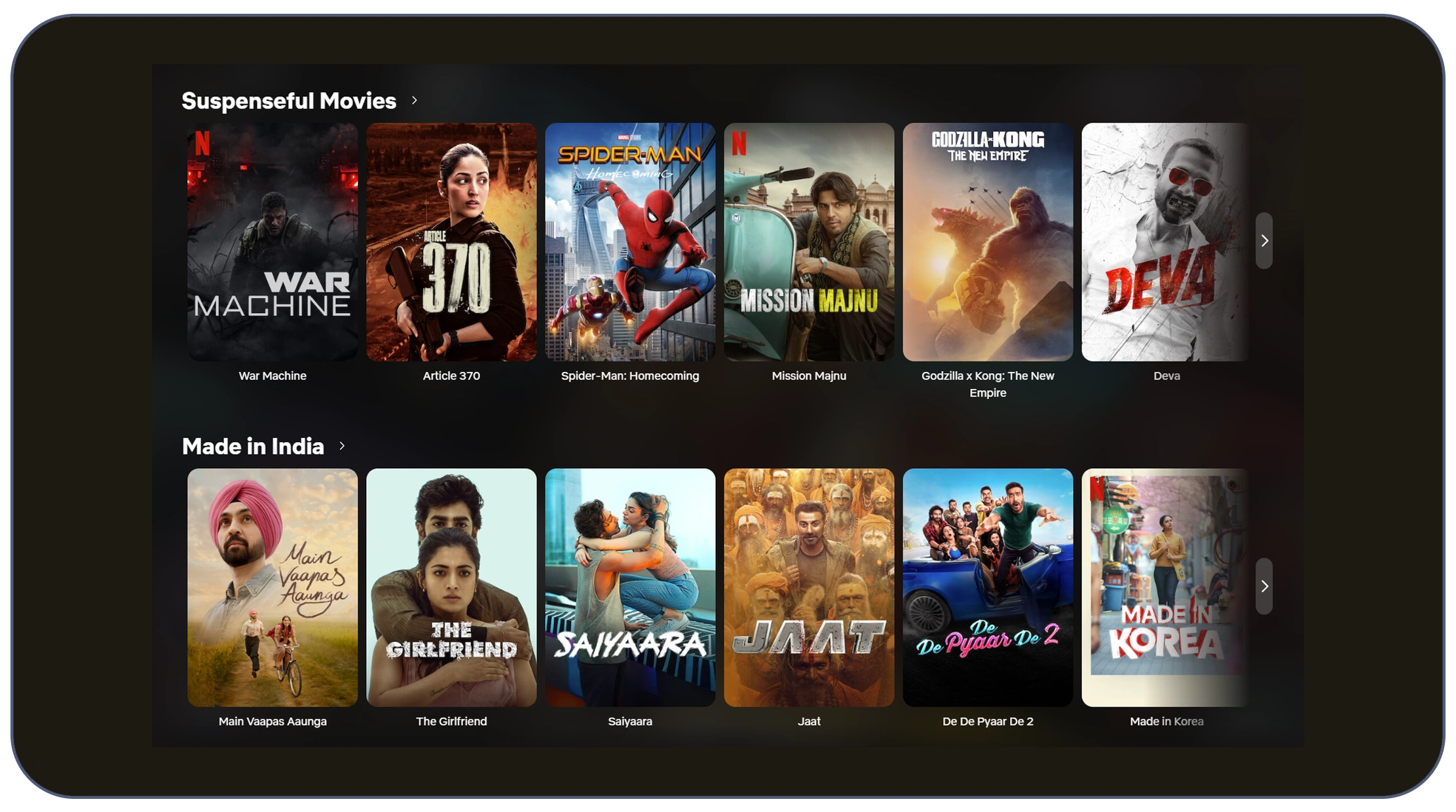
Businesses monitoring entertainment catalogs need more than a title list. They need structured information covering movie names, genres, release dates, languages, maturity ratings, runtime, regional availability, descriptions, and other attributes that can be compared over time. Netflix movie data scraping can create this structured layer for research and analytics.
From 2020 onward, streaming competition became increasingly data-driven. Netflix highlighted its global reach in 2020, when its content was available across more than 190 countries and in more than 30 languages. In 2021, the company highlighted major releases including Red Notice and Don't Look Up. By 2025, Netflix reported major engagement across films, series, and live programming.
For a research team, historical snapshots can answer questions such as: Which genres are expanding? Which countries receive a title first? How long does a movie remain available? Which languages are increasingly represented? Which content categories are repeatedly associated with high visibility?
| Year | Key market signal | Business intelligence opportunity |
|---|---|---|
| 2020 | 203.7M memberships | Establish baseline catalog intelligence |
| 2021 | 221.8M memberships | Track breakout movie categories |
| 2022 | 230.7M memberships | Compare content with pricing changes |
| 2023 | 260.3M memberships | Monitor catalog and regional expansion |
| 2024 | 301.6M memberships | Analyze broader content monetization |
| 2025 | 325M+ memberships | Connect content with engagement signals |
| 2026 | H1 revenue reached $24.81B | Maintain near-current monitoring |
Netflix's annual reporting shows how quickly the commercial environment expanded. Streaming revenue rose from approximately $24.76 billion in 2020 to $45.18 billion in 2025.
For buyers, the actionable insight is to build a historical movie-level database rather than collect isolated pages. Each record should have a stable title identifier, collection timestamp, country or market, observed attributes, and change history. This enables trend analysis, catalog comparisons, and alerting when important fields change.
Why Is Series-Level Monitoring Important for Competitive Research?
Series behave differently from movies because they generate recurring seasons, episodes, renewals, cancellations, and release patterns. Netflix TV show data scraping can help researchers create structured records around series, seasons, episodes, genres, languages, ratings, release dates, and regional availability.
The 2020-2026 period illustrates why longitudinal tracking matters. Netflix reported approximately 204 million paid memberships at the end of 2020 and approximately 222 million in 2021. In 2022, the company reported about 231 million memberships. By 2023, the figure had exceeded 260 million, followed by more than 300 million in 2024 and more than 325 million in 2025.
| Year | Membership scale | Useful series-monitoring focus |
|---|---|---|
| 2020 | 203.7M | Genre and language baselines |
| 2021 | 221.8M | Breakout-series monitoring |
| 2022 | 230.7M | Subscription-plan and catalog comparison |
| 2023 | 260.3M | Regional series intelligence |
| 2024 | 301.6M | Cross-market content analysis |
| 2025 | 325M+ | Engagement and franchise monitoring |
| 2026 | Current-year | Continuous change detection |
A strong monitoring workflow should separate series-level and episode-level attributes. A series record might contain title, genre, country, language, rating, and overall status. Episode records can include season, episode number, release date, runtime, and availability.
This structure gives businesses a much richer competitive view. They can compare the depth of catalogs, identify content gaps, detect new seasons, measure how frequently categories change, and build regional content matrices.
The most important principle is consistency. A dataset collected once may answer a single research question, but a regularly refreshed dataset can reveal changes and patterns. Timestamped collection therefore becomes as important as the content fields themselves.
How Can an API Make Streaming Intelligence Easier to Scale?
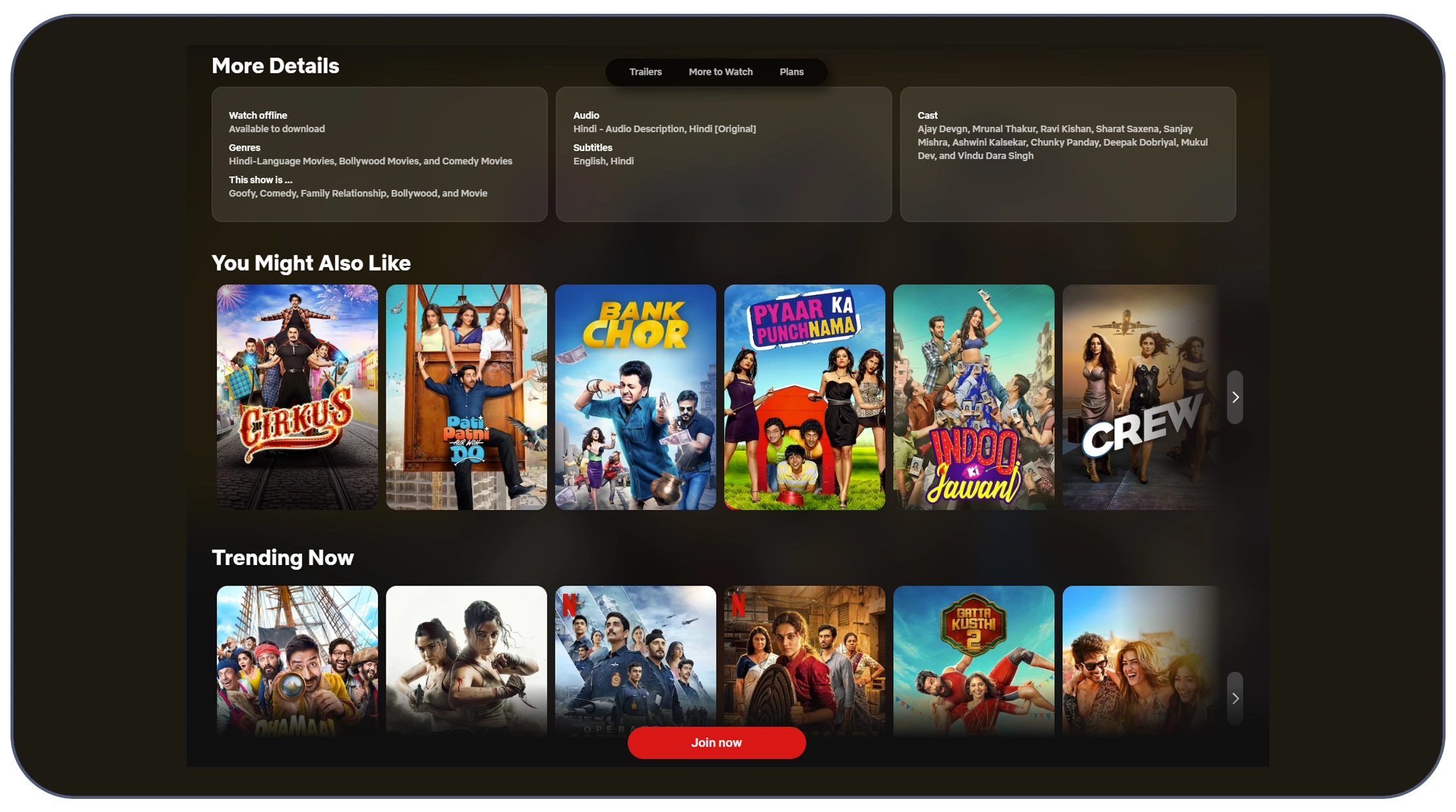
A Netflix streaming data API can provide a structured delivery layer between data collection and downstream business systems. Instead of repeatedly building custom extraction workflows for every dashboard or analysis, teams can consume standardized records through an API architecture.
This becomes particularly valuable as streaming businesses scale. Netflix's revenue increased from approximately $25.0 billion in 2020 to $45.2 billion in 2025, while paid memberships rose from 203.7 million to more than 325 million.
| Year | Revenue | Growth/indicator |
|---|---|---|
| 2020 | $25.0B | Pandemic-era acceleration |
| 2021 | $29.7B | +18.8% vs. 2020 |
| 2022 | $31.6B | +6.5% |
| 2023 | $33.7B | +6.7% |
| 2024 | $39.0B | +16% |
| 2025 | $45.2B | +16% |
| 2026 H1 | $24.81B | +15% vs. H1 2025 |
2026 H1 revenue increased 15% year over year, while Q2 revenue increased 13%. Netflix attributed revenue growth to factors including membership growth, price increases, advertising revenue, and foreign-exchange effects.
Build a structured streaming intelligence pipeline that turns changing public information into usable, timestamped business data.
Get Insights Now!For enterprise users, the API layer should support pagination, consistent schemas, metadata, timestamps, error handling, and incremental updates. These capabilities make the resulting dataset easier to connect with BI tools, data warehouses, internal applications, and analytical models.
The objective should not be collecting the maximum amount of information. It should be collecting the right fields at the right frequency and delivering them in a format that supports measurable business decisions.
What Is the Best Way to Monitor Changing Content Information?
When catalogs change frequently, one-time research quickly becomes outdated. Businesses need a process capable of detecting additions, removals, metadata changes, regional differences, and other catalog events. The goal when teams scrape Netflix content data should therefore be continuous intelligence rather than simple extraction.
The market scale demonstrates why refresh frequency matters. Netflix's streaming revenue increased from $24.76 billion in 2020 to $31.47 billion in 2022, $33.64 billion in 2023, $39.00 billion in 2024, and $45.18 billion in 2025.
| Year | Streaming revenue | Monitoring implication |
|---|---|---|
| 2020 | $24.76B | Establish historical baseline |
| 2021 | $29.52B | Increase monitoring frequency |
| 2022 | $31.47B | Track pricing and plan changes |
| 2023 | $33.64B | Expand regional intelligence |
| 2024 | $39.00B | Connect content with monetization |
| 2025 | $45.18B | Monitor wider entertainment strategy |
| 2026 H1 | $24.81B total revenue | Prioritize near-real-time refreshes |
A practical workflow begins with a defined schema. Useful fields can include title, content type, genre, country, language, rating, release information, availability, observed price or plan information where applicable, and collection timestamp.
The second layer is change detection. Instead of storing only today's value, businesses should compare today's record with the previous snapshot. A change log can then identify newly observed titles, removed titles, altered metadata, or regional differences.
The third layer is quality control. Duplicate detection, missing-field checks, anomaly detection, and timestamp validation prevent unreliable records from entering downstream analytics.
This approach gives content teams a historical timeline that can support market reports, competitor benchmarking, catalog intelligence, and strategic planning.
How Can Automated Monitoring Reduce Manual Competitive Research?
Manual monitoring creates a difficult trade-off: researchers either check a limited number of titles frequently or attempt broad collection less often. A Netflix Scraper can automate repetitive observation while allowing analysts to focus on interpreting the resulting information.
The scale of Netflix's business makes automation particularly relevant. Paid memberships increased from 203.7 million in 2020 to 221.8 million in 2021, 230.7 million in 2022, 260.3 million in 2023, 301.6 million in 2024, and more than 325 million in 2025.
| Year | Paid memberships | Why automation matters |
|---|---|---|
| 2020 | 203.7M | Large catalog baseline |
| 2021 | 221.8M | Faster content discovery |
| 2022 | 230.7M | More complex market signals |
| 2023 | 260.3M | Larger regional comparisons |
| 2024 | 301.6M | More extensive monitoring |
| 2025 | 325M+ | Enterprise-scale intelligence |
| 2026 | Current reporting | Continuous market observation |
Automation can support several operational use cases. A research team can schedule collection jobs, normalize records, compare snapshots, flag changes, and deliver standardized data to internal systems.
However, responsible implementation matters. Organizations should review applicable laws, website terms, intellectual-property requirements, robots directives, access restrictions, and data-use policies before collecting information. Public availability does not automatically mean unrestricted commercial use.
For a buyer, the strongest architecture combines automated collection with governance. Data should be traceable to collection times, processing rules should be documented, and sensitive or restricted information should not be targeted.
The result is a repeatable competitive-monitoring process rather than a collection of disconnected scraping scripts.
How Can a Historical Dataset Support Better Streaming Decisions?
A Netflix Dataset becomes significantly more valuable when it is historical, normalized, and designed around business questions. Instead of treating data as a static list of titles, organizations can use snapshots to understand how content, availability, and other observable attributes change over time.
The financial trajectory reinforces the value of historical analysis. Netflix revenue increased from approximately $25 billion in 2020 to $29.7 billion in 2021, $31.6 billion in 2022, $33.7 billion in 2023, $39 billion in 2024, and $45.2 billion in 2025.
| Year | Revenue | Example dataset use |
|---|---|---|
| 2020 | $25.0B | Historical baseline |
| 2021 | $29.7B | Trend comparison |
| 2022 | $31.6B | Pricing/content analysis |
| 2023 | $33.7B | Regional benchmarking |
| 2024 | $39.0B | Catalog intelligence |
| 2025 | $45.2B | Cross-market analysis |
| 2026 H1 | $24.81B | Current-year benchmarking |
A mature dataset should include both current records and historical snapshots. Recommended fields include content identifier, title, type, genre, language, country, rating, release date, availability status, source URL or reference, collection timestamp, and change status.
This makes the information useful for machine learning, business intelligence, competitive research, media reports, recommendation analysis, and market forecasting.
For AI and LLM workflows, structured records are especially useful because they provide consistent entities and attributes. Instead of asking an AI system to interpret inconsistent pages repeatedly, teams can provide normalized records with clear timestamps and definitions.
The strongest outcome is therefore not simply a large dataset. It is a governed information layer that allows analysts and AI systems to distinguish current observations from historical ones and factual fields from derived metrics.
Why Choose Real Data API for Streaming Intelligence?
For organizations that need scalable collection and structured delivery, Netflix Data Scraping can be integrated into a broader data pipeline instead of operating as an isolated manual activity. A reliable provider should prioritize consistent schemas, scheduled updates, historical storage, quality controls, and delivery formats that fit the buyer's existing technology stack.
The key advantage is operational efficiency. Analysts should not spend their working hours repeatedly checking catalog pages, recording changes, cleaning duplicates, and manually building spreadsheets. A structured data pipeline can automate those repetitive tasks and make refreshed information available for downstream analysis.
A buyer should evaluate data providers against practical criteria: refresh frequency, geographic coverage, schema consistency, historical retention, API reliability, scalability, documentation, monitoring, and support. Legal and compliance review should also form part of vendor evaluation.
The ideal solution connects collection, validation, storage, API delivery, and analytics into one repeatable workflow. This creates a foundation for competitive intelligence, content research, market monitoring, and data-driven strategic decisions.
Conclusion
Businesses can solve streaming-market monitoring challenges by moving from manual observation to structured, timestamped, repeatable data collection. A Netflix scraper is most valuable when it forms part of a broader intelligence workflow that captures relevant attributes, detects changes, maintains historical records, and delivers clean information to analysts and applications.
The opportunity has expanded considerably. Netflix grew from 203.7 million paid memberships in 2020 to more than 325 million in 2025, while 2026 revenue continued to grow, reaching $24.81 billion during the first half of the year.
For companies competing in entertainment, media analytics, advertising, research, or digital intelligence, timely structured information can reduce manual work and improve decision speed.
Talk to Real Data API to build a scalable, structured, and business-ready streaming data pipeline tailored to your monitoring and analytics requirements!
FAQs
What is a Netflix scraper used for?
A Netflix scraper collects publicly accessible information such as titles, genres, ratings, languages, release details, and availability to support structured research and competitive analysis.
Why use Netflix Web Scraping Services?
Netflix Web Scraping Services automate recurring collection, normalization, validation, and delivery, helping businesses reduce manual monitoring while creating consistent datasets for analytics and reporting.
How does a Netflix Scraper help businesses?
A Netflix Scraper can support catalog monitoring, regional comparisons, content research, change detection, and competitive intelligence while reducing repetitive manual data-collection tasks.
What makes a useful Netflix Dataset?
A Netflix Dataset should contain standardized fields, timestamps, geographic context, historical snapshots, identifiers, and quality controls so analysts can compare content changes accurately.
Is Netflix Data Scraping suitable for enterprise research?
Yes, when implemented responsibly. Real Data API can support structured research workflows, while organizations should review applicable laws, website terms, access policies, and data-use requirements.
Latest posts
Keeta scraper for monitoring food marketplace trends - Identify Discount Changes and Emerging Customer Demand
How to build a structured Nike product dataset for Product Intelligence and Retail Analytics
Allegro scraper for competitor price monitoring – How to Track Product Prices and Stay Ahead of Competitors
Ocado API data collection services for retailers - Track Competitor Prices and Deals






.png)