TL;DR
- BigBasket API can help brands structure grocery product, pricing, promotion, and availability information for competitive intelligence.
- BigBasket Product Data Scraping can support recurring monitoring of product assortments, discounts, price movements, and stock signals.
- India's online grocery and quick-commerce ecosystem has expanded rapidly since 2020, increasing the need for timely, structured marketplace data. BigBasket states that its platform carries 40,000+ products from 1,000+ brands and serves 300+ cities and towns.
Introduction
Businesses selling groceries and FMCG products need more than occasional snapshots of online prices. They need structured visibility into products, pack sizes, selling prices, discounts, offers, ratings, and availability so that commercial teams can respond to marketplace changes.
BigBasket API can support this requirement by enabling a structured approach to collecting and organizing grocery marketplace information. Depending on the technical implementation and accessible data, the resulting dataset can feed pricing intelligence, assortment analysis, promotional monitoring, and competitive benchmarking workflows.
This requirement has become more important as India's digital grocery market has accelerated. IBEF reports that quick commerce accounted for 70–75% of India's total e-grocery orders in 2025, compared with about 35% in 2022.
For FMCG brands, retailers, distributors, market researchers, and pricing teams, the objective is therefore not simply to collect data. The objective is to convert frequently changing marketplace information into reliable, comparable, analytics-ready records.
How Can Grocery Data Collection Improve Product Visibility?
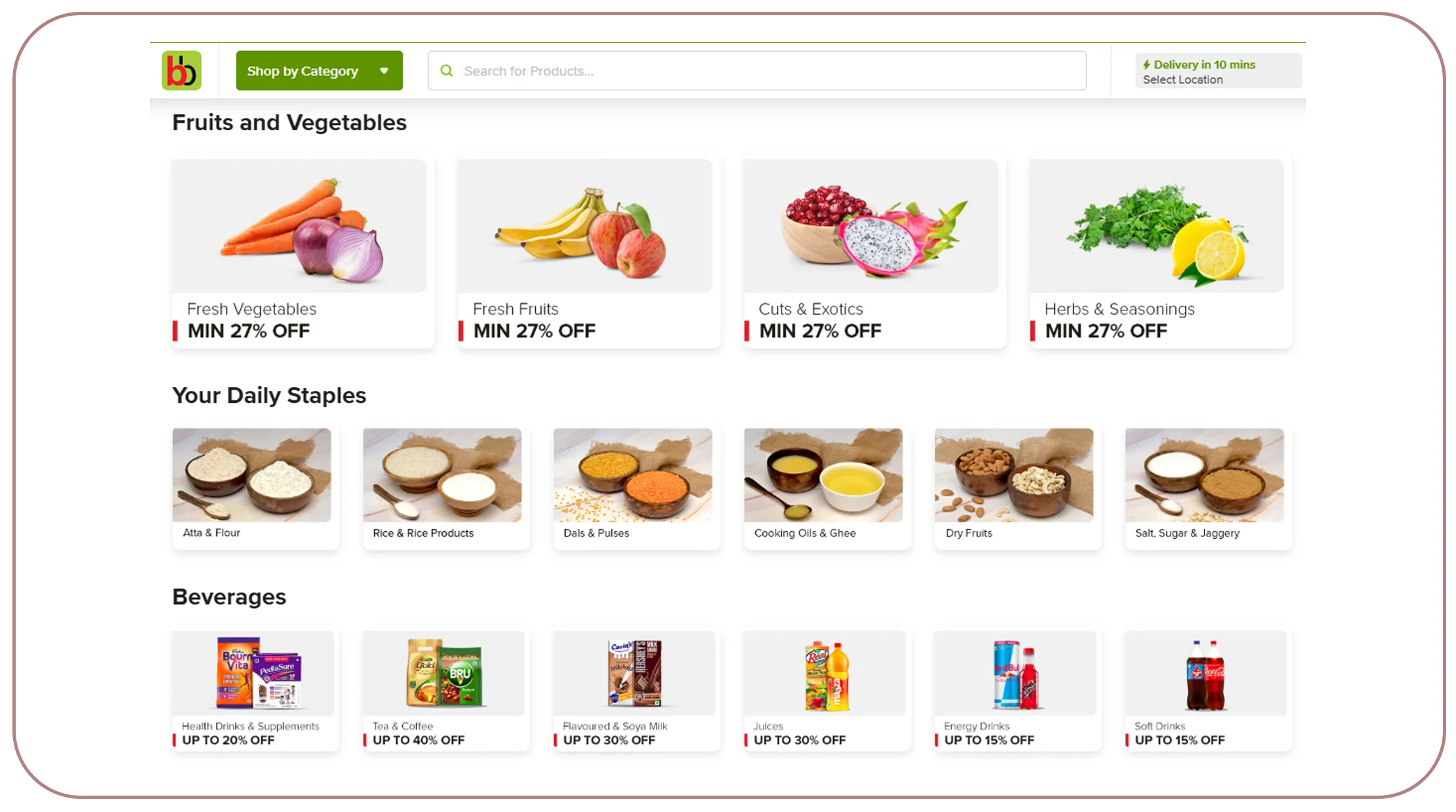
BigBasket grocery product data web scraping provides a structured way to monitor the attributes that matter to grocery and FMCG businesses. A useful dataset can contain product name, brand, category, pack size, MRP, selling price, discount, availability, product URL, ratings, and other accessible attributes.
BigBasket's current website describes an assortment of more than 40,000 products from over 1,000 brands and says the service reaches 300+ cities and towns. Its bbnow service lists 5,000+ grocery essentials in selected cities.
What changed from 2020 to 2026?
The market context changed considerably after the pandemic. IBEF reports that online grocery purchases increased 80% in 2020, reaching approximately ₹23,951 crore, as consumers shifted toward online purchasing during lockdowns.
By 2024, NIQ data cited by IBEF found that 31% of urban Indian consumers used quick commerce as their primary grocery-shopping channel, while 39% used it for top-up purchases.
By 2025, quick commerce represented 70–75% of e-grocery orders, demonstrating how quickly digital grocery behavior evolved.
| Year | Market development | Data implication |
|---|---|---|
| 2020 | Online grocery purchases surged during lockdowns | Brands needed digital product visibility |
| 2021 | Online grocery adoption remained elevated | Recurring price monitoring became more relevant |
| 2022 | Quick commerce accounted for about 35% of e-grocery orders | Availability and speed became important |
| 2023 | Quick-commerce infrastructure expanded | Location-based monitoring gained importance |
| 2024 | 31% of surveyed urban shoppers used quick commerce for primary grocery shopping | Promotion and assortment visibility became more important |
| 2025 | Quick commerce reached 70–75% of e-grocery orders | High-frequency data became increasingly valuable |
| 2026 | Digital and quick-commerce channels continue expanding | Automated monitoring supports ongoing intelligence |
The practical insight is straightforward: product monitoring should capture the complete commercial context rather than only a product name and price.
What Can Brands Learn by Monitoring Grocery Prices?
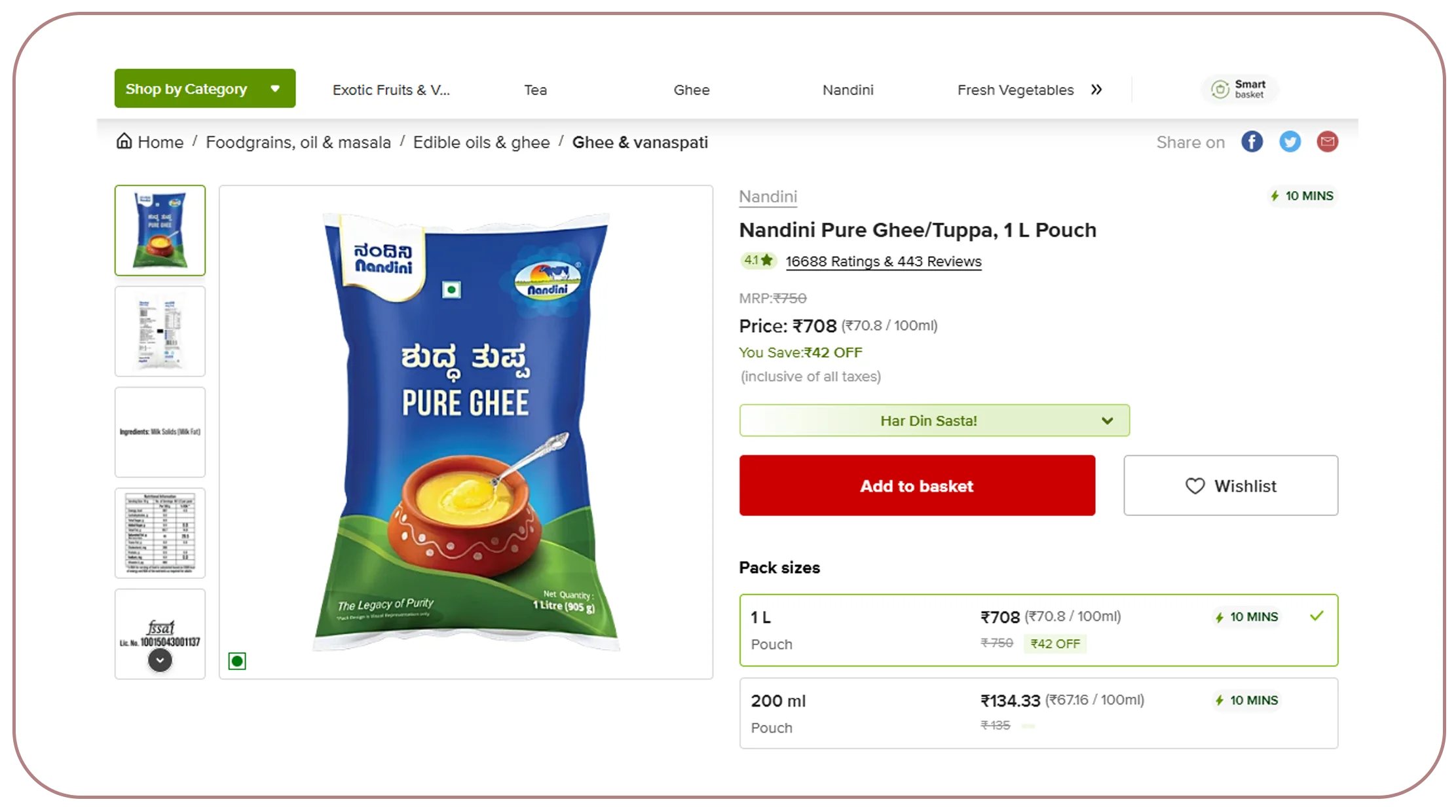
Brands can extract BigBasket product price data to create historical price records and compare changes across products, categories, pack sizes, and time periods.
Price monitoring is particularly useful for FMCG teams because a simple price comparison can become misleading when products have different pack sizes or promotional mechanics. A 500-gram pack and a 1-kilogram pack should not be compared using headline prices alone.
A better workflow captures:
- Product name and brand
- Pack size and unit
- Selling price
- MRP
- Discount percentage
- Offer price
- Product availability
- Category
- Timestamp
- Product URL
- Location or service-area information where accessible
How did the market evolve from 2020 to 2026?
In 2020, the pandemic accelerated online grocery adoption. By 2022, quick commerce was already accounting for approximately 35% of e-grocery orders, according to Bain data cited by IBEF.
In 2024, India's e-commerce and grocery landscape had become substantially more digital. Statista reports that India's online grocery market value exceeded ₹1 trillion in 2024.
By FY25, quick-commerce gross order value reached approximately ₹64,000 crore, more than double the ₹30,000 crore recorded in FY24, according to CareEdge data reported by IBEF.
| Metric | Earlier period | Recent period |
|---|---|---|
| Quick-commerce e-grocery share | ~35% in 2022 | 70–75% in 2025 |
| Quick-commerce GOV | ₹30,000 crore in FY24 | ₹64,000 crore in FY25 |
| Urban primary grocery via quick commerce | — | 31% in 2024 survey |
| Online grocery market | — | >₹1 trillion in 2024 |
For pricing teams, this progression means historical datasets can reveal whether changes are isolated events or part of broader pricing and promotional patterns.
How Can Businesses Track Discounts and Promotions More Systematically?
A BigBasket offers data API workflow can help organizations structure promotional information instead of relying on screenshots or manually maintained spreadsheets.
Offers may include percentage discounts, price reductions, promotional labels, bundled offers, or other visible deal mechanisms. BigBasket's current offers page displays more than 40,000 products under discount categories, including more than 20,000 products listed in the "more than 25%" discount group at the time of collection.
Why does promotional monitoring matter?
A product may appear competitively priced because of a temporary promotion rather than a permanent price change. Separating base price, MRP, promotional price, and discount information allows analysts to understand the reason behind observed price movements.
From 2020 to 2026, the relevance of promotions increased alongside digital grocery adoption. During the 2020 disruption, online channels became essential for household shopping. By 2024, 87% of respondents in an NIQ survey were reportedly impacted by rising food prices, while 60% purchased staples online.
By 2025, FMCG companies were increasingly using quick-commerce channels as part of their sales strategy. IBEF reported that several major FMCG companies collectively generated more than ₹4,400 crore in quick-commerce sales during FY25.
| Promotional insight | Business application |
|---|---|
| Discount percentage | Compare promotional intensity |
| MRP vs. selling price | Measure effective discount |
| Offer label | Classify promotion type |
| Product availability | Identify whether promotion is actionable |
| Timestamp | Establish promotion duration |
| Category | Compare promotional activity across segments |
How Does Continuous Price Collection Support Competitive Intelligence?
BigBasket Product Data Scraping services can help businesses move from one-time price checks toward recurring marketplace intelligence.
A continuous workflow captures snapshots at defined intervals and creates a historical record. Analysts can then identify price increases, reductions, discount changes, assortment shifts, and availability changes over time.
This is particularly useful for brands operating in categories such as:
- Staples
- Packaged foods
- Beverages
- Personal care
- Household products
- Dairy
- Snacks
- Fresh produce
- Baby care
BigBasket's current product pages show that product records can contain several commercially relevant fields, including pack size, selling price, MRP, discounts, ratings, and product availability indicators.
2020–2026 progression
The shift from physical retail to digital grocery accelerated in 2020. In subsequent years, digital channels became more important for FMCG brands, while quick commerce increased the frequency at which consumers could purchase everyday products.
IBEF reports that e-commerce accounted for nearly 18% of FMCG sales across India's top eight metro cities during October–December 2025, highlighting the growing role of digital channels.
This creates a clear data requirement: brands need historical, comparable observations instead of isolated checks.
| Monitoring layer | What it answers |
|---|---|
| Product | What is being sold? |
| Price | What does it cost now? |
| MRP | What is the reference price? |
| Discount | How aggressive is the offer? |
| Availability | Can consumers purchase it? |
| Timestamp | When was the observation captured? |
| Category | Where is the competitive movement occurring? |
For commercial teams, this structure supports price benchmarking, promotion analysis, assortment planning, and category-level competitive intelligence.
How Can an API-Based Workflow Scale Grocery Intelligence?
An BigBasket API workflow can provide an automation layer for businesses that need structured marketplace information repeatedly rather than manually.
The important distinction is between raw collection and an analytics-ready pipeline. A scalable workflow should include discovery, extraction, normalization, validation, deduplication, timestamping, storage, and delivery.
A practical workflow
1. Define the product universe
Identify categories, brands, SKUs, pack sizes, and monitored products.
2. Collect product information
Capture accessible product-level fields according to the project requirements.
3. Normalize the records
Standardize names, units, prices, discounts, and availability values.
4. Validate the dataset
Identify missing fields, duplicates, unexpected price values, and inconsistent records.
5. Timestamp observations
Maintain collection time so that historical changes can be identified.
6. Store structured data
Deliver the information through databases, files, dashboards, or other agreed formats.
7. Schedule recurring collection
Set refresh frequencies according to the business use case.
What does 2020–2026 tell businesses?
The rapid development of digital grocery makes recurring data more useful than static datasets. India's online shopper base reached nearly 290–300 million in 2025, according to IBEF, with Tier-2 and smaller cities accounting for around 65% of new shoppers.
In September 2026, IBEF reported that India's e-commerce market was projected to reach US$345 billion by 2030 from about US$125 billion in 2024, while the quick-commerce segment was projected to reach US$65–70 billion.
The implication for data teams is that monitoring architecture needs to be scalable enough to accommodate larger product universes, more locations, and more frequent refresh cycles.
How Does Automated Monitoring Improve Marketplace Analysis?
A BigBasket Scraper can be used as part of a broader data pipeline for collecting publicly accessible marketplace information at scale. The value comes from combining automated extraction with data quality controls and analytical structure.
A basic implementation may collect product names and prices. A mature implementation can create a historical product intelligence layer containing price, MRP, discount, availability, category, brand, pack size, URL, and timestamp information.
This distinction matters because business teams rarely need raw pages. They need consistent records that can be compared over time.
2020–2026 market context
India's digital grocery market has evolved from pandemic-driven adoption toward a high-frequency, convenience-led ecosystem. IBEF reports that Q-commerce orders represented 70–75% of total e-grocery orders in 2025, compared with about 35% in 2022.
At the same time, BigBasket states that its core platform serves 300+ cities and towns, while bbnow offers 15–30-minute delivery in selected cities.
| Data capability | Business use |
|---|---|
| Product extraction | Assortment intelligence |
| Price extraction | Competitive benchmarking |
| Offer extraction | Promotion analysis |
| Availability tracking | Stock visibility |
| Historical snapshots | Trend analysis |
| Location-level data | Geographic comparison |
| Automated refresh | Recurring intelligence |
For brands, retailers, and analysts, automation can reduce repetitive data collection and provide a consistent foundation for pricing and assortment decisions.
Why Choose Real Data API?
A reliable grocery data partner should focus on more than extraction. The priority should be data usability, consistency, scalability, and delivery.
Real Data API can structure a Bigbasket Grocery Dataset around the attributes required by the buyer's specific use case. Depending on project requirements and data accessibility, the dataset can include:
- Product and brand information
- Category and subcategory
- SKU or product identifiers
- Pack size
- MRP and selling price
- Discount information
- Offers and promotions
- Availability
- Product URLs
- Ratings and review counts
- Location context
- Collection timestamps
Why does this matter?
A pricing analyst may need historical price comparisons. A category manager may need assortment visibility. An FMCG brand may need promotion monitoring. A market researcher may require category-level datasets.
The underlying collection process can therefore be customized around the business question rather than producing a generic dataset.
Real Data API can also support recurring collection workflows, normalization, validation, structured delivery, and integration with analytical environments.
The result is a dataset designed for business use rather than simply a collection of extracted web pages.
Conclusion
BigBasket API can help businesses create structured access to product, pricing, promotion, and availability information for marketplace intelligence. The real value comes from turning individual observations into standardized, timestamped datasets that can be compared across products and collection periods.
From the rapid digital adoption of 2020 to the high-frequency grocery environment of 2026, India's online retail landscape has changed significantly. Quick commerce now represents a substantial share of e-grocery activity, while digital channels continue expanding across consumer segments.
For FMCG brands, retailers, pricing teams, and market researchers, structured grocery data can support price benchmarking, promotion analysis, assortment intelligence, and availability monitoring.
Talk to Real Data API to build a scalable grocery data solution tailored to your product, pricing, and competitive intelligence requirements!
FAQs
1. What can businesses collect using a BigBasket API?
Businesses can structure accessible product information such as names, brands, categories, pack sizes, prices, MRP, discounts, availability, URLs, and timestamps for analysis.
2. How does BigBasket Product Data Scraping help FMCG brands?
It can provide recurring product-level records that help FMCG teams monitor assortment, pricing, promotional changes, availability, and marketplace activity over time.
3. What is the benefit of BigBasket grocery product data web scraping?
It helps businesses create structured product datasets instead of relying on fragmented manual observations, supporting assortment analysis and competitive marketplace monitoring.
4. Can businesses extract BigBasket product price data for historical analysis?
Yes. With scheduled collection and timestamped records, businesses can create historical observations that support price comparisons, trend analysis, and promotional monitoring.
5. How can BigBasket offers data API support promotion tracking?
It can help structure promotional information such as discounts and offer prices, allowing businesses to compare promotional activity across products, categories, and monitoring periods. Real Data API can customize the workflow around these requirements.
Latest posts
How Restaurant, Menu, Price, Rating, and Delivery Data Helps Businesses Track Food Delivery Markets
How Businesses Solve Restaurant Market Intelligence Challenges with Rating, Review, and Location Data
How Businesses Use Grocery, Product, Pricing, and Retail Food Data for Competitive Analysis

How Etsy API Solves Marketplace Intelligence Challenges with Product, Price, and Seller Data






.png)