TL;DR
- Deliveroo API helps businesses structure restaurant, menu, pricing, rating, and delivery information for food-market intelligence and competitive research.
- Deliveroo Food Data Scraping can support recurring collection of marketplace information across restaurants, locations, categories, menus, prices, customer ratings, and delivery availability.
- From 2020–2026, the expansion of online food ordering has increased the need for timely marketplace datasets that help restaurants, aggregators, investors, and consumer brands understand pricing, assortment, and local competition.
Introduction
The core challenge in food-delivery intelligence is not simply finding restaurant information; it is continuously understanding how restaurant availability, menus, prices, ratings, and delivery conditions change across locations. Deliveroo API solutions can help businesses convert marketplace information into structured datasets that support competitive analysis, pricing intelligence, restaurant discovery, and operational research.
The global online food-delivery market has expanded significantly since 2020, accelerated by changing consumer ordering habits and wider digital adoption. For businesses operating in this ecosystem, a static dataset can quickly become outdated because menus change, restaurants open or close, prices fluctuate, promotions appear, and delivery conditions vary by location and time.
A structured data strategy allows businesses to monitor these changes systematically. Restaurant groups can benchmark competitors, food-tech companies can analyze marketplace coverage, investors can study category trends, and data teams can build dashboards around menu assortment, pricing, ratings, and delivery availability.
The following sections explain how businesses can organize these data points into practical intelligence and why recurring marketplace monitoring matters from 2020 through 2026.
How Can Restaurant-Level Data Reveal Competitive Gaps?
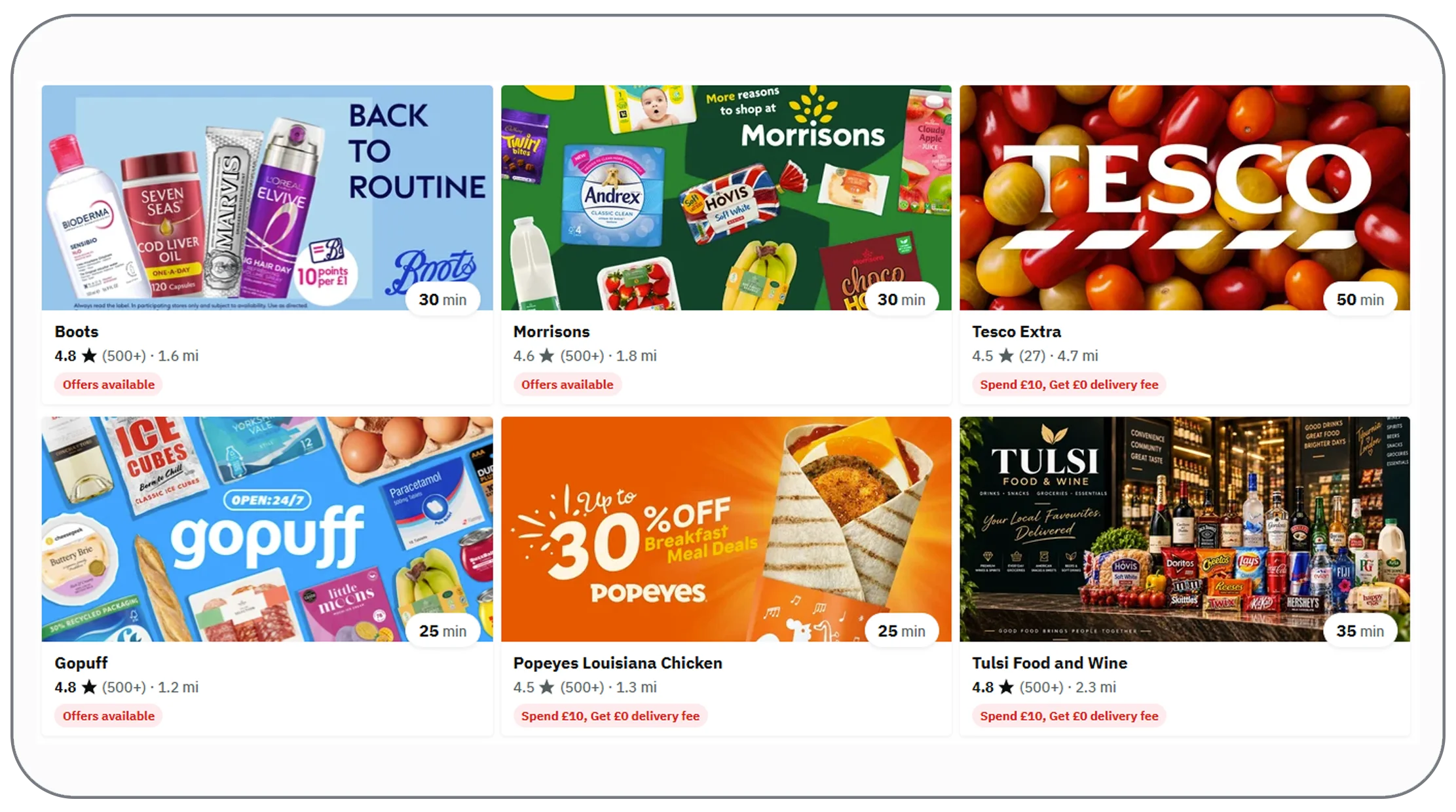
Deliveroo restaurant data web scraping can help businesses build a structured view of restaurants operating within specific markets, cities, neighborhoods, or delivery zones. Useful fields can include restaurant name, cuisine type, location, operating status, rating, review count, delivery information, promotional indicators, and marketplace URL.
For restaurant groups, the value comes from comparing their presence with competing establishments. A business can identify which cuisine categories have expanded, where competitors are concentrated, and which areas show changes in restaurant availability.
For marketplaces and research teams, restaurant-level information can become the foundation for broader food-delivery analysis. Restaurant records can subsequently be connected with menu, pricing, rating, and delivery datasets.
Real-world market context
Statista has reported substantial growth in online food delivery during the 2020s, while consumer adoption accelerated during the pandemic and remained an important part of digital commerce afterward. Exact market estimates vary by geography and methodology, so businesses should treat third-party market figures as directional rather than interchangeable.
| Period | Market development | Business implication |
|---|---|---|
| 2020 | Food-delivery adoption accelerated globally | Greater dependence on digital ordering channels |
| 2021 | Online ordering remained deeply embedded in consumer behavior | More competitive marketplace monitoring |
| 2022 | Restaurants increasingly balanced dine-in and delivery channels | Need to compare digital and physical competition |
| 2023 | Delivery platforms continued developing broader merchant ecosystems | Larger restaurant datasets |
| 2024 | Consumers increasingly compared restaurants digitally | Greater importance of ratings and menus |
| 2025 | Marketplace competition remained data-intensive | More frequent price and assortment monitoring |
| 2026 | Businesses increasingly focus on structured, recurring intelligence | Greater demand for scalable data pipelines |
For example, a restaurant chain entering a new city can compare restaurant density by cuisine, average visible ratings, menu breadth, price ranges, and delivery conditions. Instead of relying on occasional manual research, recurring datasets can reveal changes over time.
How Does Menu Intelligence Improve Food-Market Analysis?
Deliveroo menu data scraping enables businesses to examine what restaurants actually offer to customers. Menu datasets can contain item names, categories, descriptions, prices, dietary indicators, package sizes, modifiers, promotional information, and availability where publicly visible.
Menu intelligence is particularly valuable because restaurant competition is increasingly shaped by assortment rather than simply location. Two restaurants may operate in the same area but target customers differently through vegetarian choices, premium dishes, meal bundles, desserts, beverages, or value-oriented combinations.
A structured menu dataset can answer questions such as:
- Which cuisines have the widest menu assortment?
- What dishes are most commonly offered within a category?
- How do competitors structure meal bundles?
- Which menu categories have the highest price ranges?
- How frequently do restaurants introduce or remove items?
- How does menu breadth differ across locations?
2020–2026 development
Between 2020 and 2026, digital menus became an increasingly important customer touchpoint. Restaurants expanded online ordering options, experimented with delivery-specific products, and adjusted menus around changing consumer demand.
| Analysis area | Example dataset | Potential business use |
|---|---|---|
| Menu breadth | Number of listed items | Assortment benchmarking |
| Cuisine | Italian, Indian, Thai, burgers | Category analysis |
| Item pricing | Dish-level price | Competitive benchmarking |
| Meal bundles | Combo or family meals | Promotion analysis |
| Dietary options | Vegetarian/vegan indicators | Consumer segmentation |
| Availability | Listed/unlisted items | Assortment monitoring |
For consumer brands, menu data can also identify product opportunities. A beverage manufacturer, for example, could study which restaurant categories commonly sell specific beverage types. A restaurant operator could examine competitor menu structures before launching a new concept.
The key is normalization. Menu names, categories, prices, and attributes should be standardized so analysts can compare equivalent items across restaurants and locations.
How Can Real-Time Pricing Data Support Competitive Decisions?
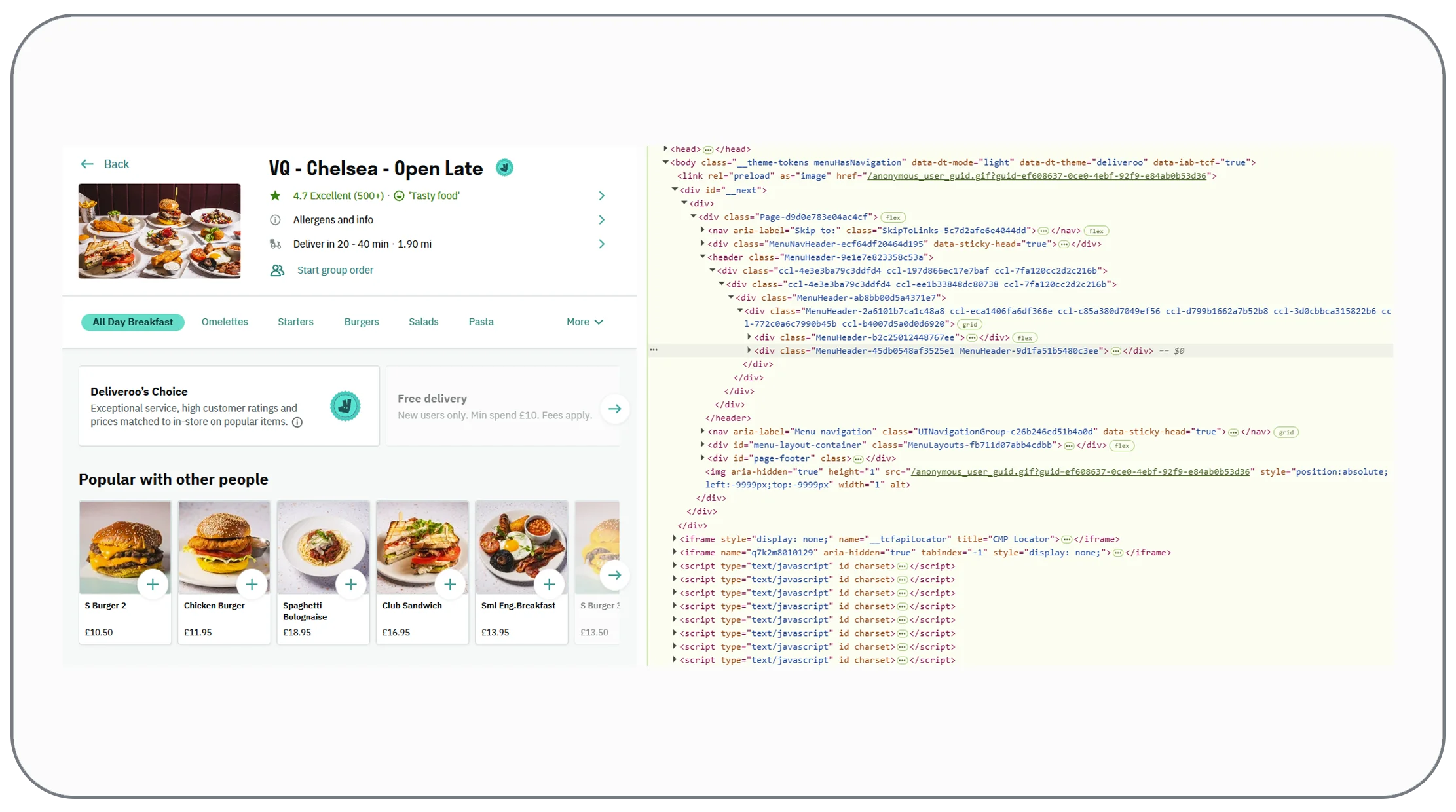
A real-time Deliveroo price data API can help businesses monitor marketplace pricing at recurring intervals instead of depending on occasional manual checks. This is useful because displayed prices can change according to restaurant decisions, promotions, location, product availability, and marketplace conditions.
Price intelligence can support several business functions. Restaurant operators can benchmark comparable dishes. Consumer brands can study pricing within restaurant categories. Investors and analysts can examine price movements across cities or cuisine segments.
The important distinction is between collecting a single price and maintaining a historical price series.
Example pricing dataset
| Restaurant | Product | Previous Price | Current Price | Change | Analysis Example |
|---|---|---|---|---|---|
| Restaurant A | Chicken Burger | £8.50 | £9.00 | +5.9% | Menu price increase |
| Restaurant B | Margherita Pizza | £10.00 | £10.50 | +5.0% | Category movement |
| Restaurant C | Pad Thai | £11.50 | £11.50 | 0% | Stable pricing |
| Restaurant D | Meal Combo | £14.00 | £12.50 | -10.7% | Promotional pricing |
Illustrative examples; figures are not claimed as live marketplace prices.
2020–2026 perspective
Food inflation became a major consideration for restaurants during the 2020s. The UK Consumer Prices Index and related food-price indicators recorded significant food-price movements during this period. Restaurant businesses therefore had to balance ingredient costs, labor expenses, delivery economics, promotions, and consumer price sensitivity.
For data teams, historical price tracking provides more value than isolated snapshots. A six-month dataset can reveal whether an item experienced gradual increases, temporary promotional reductions, or repeated price changes.
Why Do Ratings and Reviews Matter for Restaurant Intelligence?
Deliveroo rating data collection services can help businesses monitor customer-facing reputation indicators alongside restaurant and pricing information. Ratings can be collected with other publicly visible attributes, such as review counts, restaurant categories, locations, and menu information, subject to applicable platform terms and legal requirements.
Ratings become more useful when analyzed comparatively. A restaurant with a high rating may have a different competitive position from one with a similar rating but substantially fewer reviews. Likewise, rating movements can become meaningful when tracked across time rather than viewed as a single number.
Rating intelligence framework
| Metric | What it indicates | Example application |
|---|---|---|
| Average rating | Overall customer sentiment signal | Restaurant benchmarking |
| Review volume | Relative customer-feedback activity | Popularity analysis |
| Rating change | Reputation movement | Monitoring customer response |
| Restaurant category | Competitive context | Cuisine-level comparison |
| Location | Geographic context | Local market analysis |
| Menu correlation | Product-level context | Linking offerings with feedback |
2020–2026 trend
As online ordering became a routine part of restaurant discovery, digital reputation increasingly became part of the customer decision process. A rating dataset therefore works best when combined with restaurant availability, menu assortment, price, and delivery information.
For example, an analyst could investigate whether restaurants introducing larger meal bundles experience changes in rating or review activity. A restaurant group could monitor competitors whose ratings are changing rapidly. A marketplace analyst could compare rating distributions across cuisine categories.
However, ratings should not be treated as a complete measure of restaurant quality. They represent customer feedback captured through a particular platform and can be affected by review volume, timing, customer expectations, and platform-specific behavior.
How Can Businesses Turn Marketplace Data Into Actionable Intelligence?
A structured Deliveroo API data workflow can connect multiple marketplace attributes into one analytical environment. Instead of examining restaurant, menu, pricing, ratings, and delivery information separately, businesses can create relationships between these data points.
For example:
Restaurant → Menu → Item → Price → Rating → Delivery Availability → Location → Timestamp
This structure enables more sophisticated analysis.
Business intelligence use cases
| Use case | Data required | Possible output |
|---|---|---|
| Competitor monitoring | Restaurant + menu + price | Competitive dashboard |
| Price benchmarking | Item + restaurant + timestamp | Price-change report |
| Menu intelligence | Menu + category + item | Assortment analysis |
| Restaurant discovery | Location + cuisine + availability | Market map |
| Reputation monitoring | Rating + review count | Rating dashboard |
| Delivery analysis | Delivery status + location | Availability report |
2020–2026 evolution
In 2020, many organizations were primarily concerned with establishing online ordering visibility. By 2026, the analytical requirement is broader: businesses increasingly want historical, normalized, recurring datasets that can feed BI platforms, data warehouses, machine-learning workflows, and reporting systems.
The technical architecture matters. A scalable workflow generally requires extraction, validation, normalization, deduplication, timestamping, storage, monitoring, and delivery. APIs or API-style data interfaces can then make the resulting information accessible to downstream applications.
For enterprise teams, the objective is not merely collecting more records. It is producing consistent records that analysts can compare over time.
What Can a Food-Delivery Dataset Reveal About Market Trends?
A Deliveroo Food Dataset can combine restaurant, menu, price, rating, location, and delivery attributes into an analytics-ready resource. When collected periodically, the dataset becomes a historical record of marketplace changes.
This enables businesses to move from descriptive questions—such as "What restaurants are available?"—toward analytical questions such as "Which categories are expanding?", "Where are prices changing?", and "How is restaurant assortment evolving?"
Example analytical model
| Dataset layer | Example fields | Business question |
|---|---|---|
| Restaurant | Name, cuisine, location | Who competes in this market? |
| Menu | Item, category, description | What products are offered? |
| Price | Current price, previous price | How is pricing changing? |
| Rating | Rating, review count | What reputation signals exist? |
| Delivery | Availability, delivery information | Where can customers order? |
| Time | Collection timestamp | When did the change occur? |
2020–2026 perspective
The growth of digital commerce has made historical data increasingly valuable. A dataset collected only once provides a snapshot. A recurring dataset can provide a timeline.
For example, an analytics team could collect the same restaurant set every week for 12 months. The resulting records could reveal menu additions, discontinued items, price movements, changes in ratings, and shifts in availability.
This can support category managers, restaurant groups, consultants, market researchers, and food-tech companies. It can also help data scientists develop models around pricing, assortment, restaurant segmentation, and market changes.
Data quality remains critical. Duplicate restaurants, inconsistent category names, currency differences, missing attributes, and changing URLs can distort analysis. Therefore, normalization and validation should be part of the pipeline rather than an afterthought.
Why Choose Real Data API?
Businesses need more than raw marketplace records. They need data that can be organized around specific analytical objectives.
Real Data API can support a structured approach to marketplace intelligence by focusing on:
- Scalable data collection: Designed for recurring collection across large restaurant and product sets.
- Structured outputs: Restaurant, menu, pricing, rating, and delivery attributes can be organized into consistent schemas.
- Data normalization: Standardized fields make cross-restaurant and cross-location comparisons easier.
- Historical monitoring: Timestamped records can support trend and change analysis.
- Business-ready delivery: Data can be prepared for dashboards, analytics systems, databases, or downstream workflows.
- Custom requirements: Fields, locations, categories, and collection frequencies can be aligned with a specific research objective.
A useful Deliveroo Scraper workflow should also incorporate validation, duplicate handling, monitoring, and error management. Businesses should ensure that collection methods comply with applicable laws, contractual restrictions, and the platform's terms.
Conclusion
Food-delivery marketplaces contain multiple layers of commercial intelligence: restaurants reveal competitive coverage, menus reveal assortment, prices reveal market positioning, ratings reveal customer-feedback signals, and delivery information provides geographic and operational context.
Deliveroo API data workflows can bring these signals together into structured datasets that businesses can monitor over time. The greatest value comes from combining recurring collection with normalization, historical storage, validation, and analytics rather than treating marketplace information as a one-time snapshot.
For restaurant groups, food-tech companies, market researchers, consultants, and consumer brands, this approach can turn fragmented marketplace information into a repeatable intelligence resource.
Want to build a scalable restaurant and food-delivery intelligence pipeline? Connect with Real Data API to discuss your data requirements and create a structured solution for your market!
FAQs
1. What is a Deliveroo API used for?
A Deliveroo API can support structured access to restaurant, menu, pricing, rating, and delivery information for analytics, competitive research, market monitoring, and business intelligence workflows.
2. How does Deliveroo Food Data Scraping help businesses?
Deliveroo Food Data Scraping can collect recurring marketplace information, allowing businesses to compare restaurant coverage, menus, prices, ratings, availability, and market changes across selected locations.
3. What is Deliveroo restaurant data web scraping?
Deliveroo restaurant data web scraping focuses on collecting publicly available restaurant-level information such as names, cuisines, locations, ratings, availability, and other relevant marketplace attributes.
4. Why use Deliveroo menu data scraping?
Deliveroo menu data scraping helps businesses analyze restaurant assortment, item categories, descriptions, pricing, dietary options, promotions, and changes in menu composition over time.
5. How does real-time Deliveroo price data API support analysis?
A real-time Deliveroo price data API can provide recurring pricing information that businesses use to identify price changes, benchmark comparable offerings, monitor promotions, and maintain historical pricing datasets.
Latest posts
How Restaurant, Menu, Price, Rating, and Delivery Data Helps Businesses Track Food Delivery Markets
How Businesses Solve Restaurant Market Intelligence Challenges with Rating, Review, and Location Data
How Businesses Use Grocery, Product, Pricing, and Retail Food Data for Competitive Analysis

How Etsy API Solves Marketplace Intelligence Challenges with Product, Price, and Seller Data






.png)