.gif)
.gif)
Quick Summary
- Learn how event organizers and ticketing businesses can use BookMyShow Live Events Intelligence to identify audience demand, monitor ticket availability, and spot emerging entertainment trends.
- Explore how BookMyShow Movie Ticket Price Data Scraping and structured event-pricing data can support better scheduling, competitive analysis, and ticket-sales decisions.
- Understand practical data collection methods, platform limitations, and research-backed ways to turn event information into actionable market insights.
Introduction
Identifying high-demand events early helps organizers make better decisions about venue selection, ticket inventory, promotional timing, and pricing. BookMyShow Live Events Intelligence can support this process by organizing publicly available information about event listings, dates, venues, categories, ticket availability, and published prices. Instead of relying only on isolated observations, businesses can compare event information over time to understand where audience interest may be building.
BookMyShow Movie Ticket Price Data Scraping is a related data use case, but movie-ticket listings and live-event listings should be analyzed separately. Film showtimes, cinema locations, and seat-level prices represent a different market from concerts, comedy shows, festivals, and other live experiences. Keeping these datasets distinct helps analysts avoid misleading comparisons.
The key business question is not simply which event has the most listings. It is which observable signals—such as ticket-category availability, price changes, event frequency, and venue capacity information—can help a business make a more informed decision. The sections below explain how to collect, interpret, and validate those signals without treating listing activity as proof of actual ticket sales.
Why Is the Indian Live-Event Market Becoming More Competitive?
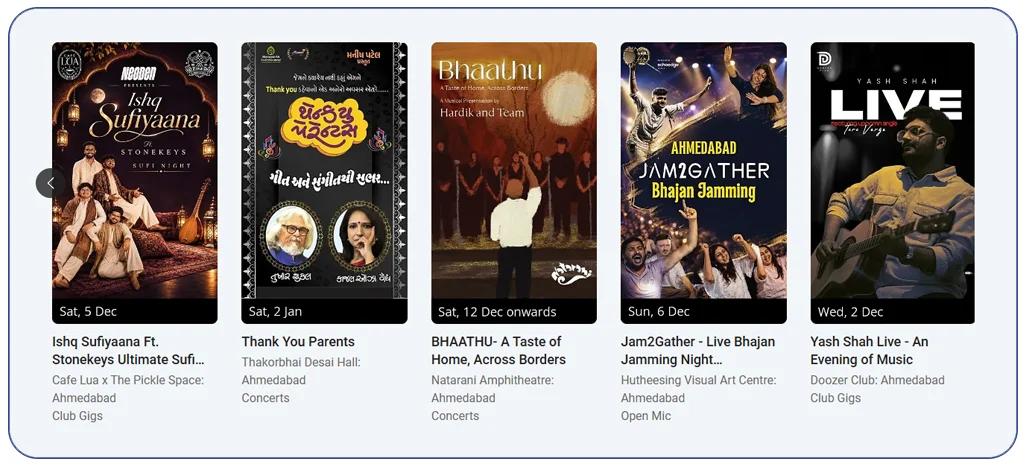
Businesses need to identify demand signals before committing to event promotions, venue partnerships, or ticket inventory. Live events web scraping can collect publicly displayed event information, including event names, categories, dates, cities, venues, ticket bands, and availability labels. When this information is gathered consistently, analysts can compare competing events and identify changes that may indicate growing audience interest.
India’s organized live-events market has expanded significantly since the pandemic disruption. The Ministry of Information and Broadcasting’s published industry data records the sector’s revenue at ₹27 billion in 2020, ₹32 billion in 2021, ₹73 billion in 2022, ₹88 billion in 2023, and ₹101 billion in 2024. The 2025 figure is ₹145 billion, as reported in the 2026 FICCI-EY report. These figures are industry estimates, not BookMyShow sales.
| Year | Organized live-events revenue in India |
|---|---|
| 2020 | ₹27 billion |
| 2021 | ₹32 billion |
| 2022 | ₹73 billion |
| 2023 | ₹88 billion |
| 2024 | ₹101 billion |
| 2025 | ₹145 billion |
| 2026 | Full-year result not yet available |
Sources: Ministry of Information and Broadcasting, FICCI-EY 2026 report announcement.
BookMyShow Live Events Intelligence can help businesses organize platform-visible information into comparable indicators. However, a listing, a sold-out label, or a price change is not equivalent to verified ticket sales. Analysts should treat these as demand signals and validate them against authorized sales, attendance, or organizer data wherever available.
How Can Concert Listings Reveal Audience Demand?
Concert demand is influenced by several factors: artist popularity, city selection, tour schedules, venue size, ticket categories, and competing entertainment options. BookMyShow concert data scraping can help analysts organize public event listings around these dimensions and compare how concert offerings change across locations and dates.
For example, a research team can track whether an artist has announced multiple city dates, whether additional shows appear, and whether different ticket categories are listed at different prices. These observations may help identify markets where organizers are expanding availability. They do not, by themselves, establish how many tickets have sold or how quickly an event is selling.
The wider market context supports the importance of this analysis. EY reported that India’s live-event segment exceeded ₹12,000 crore in 2024 and projected a 19% compound annual growth rate over the following three years. Its analysis also discussed the growing role of large concerts and international acts in India’s live-entertainment economy. EY: India’s rising concert economy.
Businesses can use a structured concert dataset to compare:
- Artist and event category
- City, venue, and event date
- Number of announced dates for a tour
- Publicly displayed ticket categories and prices
- Changes in listing status over time
- Competing events scheduled in the same city or period
The most useful output is a consistent event calendar, not an unsupported ranking of “best-selling” concerts.
Which Ticket-Price Signals Can Help Improve Sales Decisions?
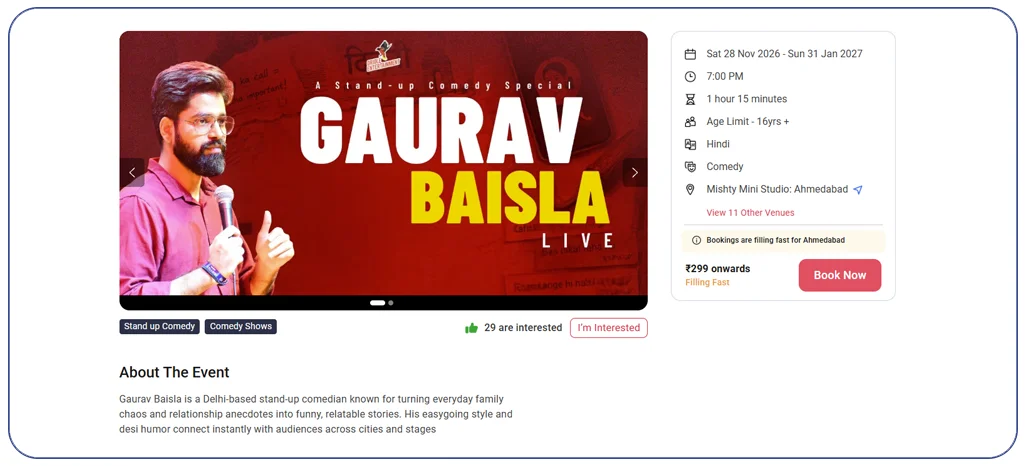
Ticket prices influence purchase decisions, but a single displayed price rarely represents the full cost of attending an event. Extract BookMyShow live show ticket pricing workflows can capture publicly displayed price bands, ticket categories, booking fees when shown, taxes when itemized, and availability labels. Recording the collection time is essential because prices and availability can change.
A practical pricing dataset should distinguish between the base ticket price and the final payable amount. It should also preserve category labels such as general admission, balcony, premium, or VIP when those labels are available. Comparing unlike categories can produce misleading conclusions, so the dataset should retain the original category and event context.
| Data point | Business use | Important limitation |
|---|---|---|
| Listed ticket price | Compare published price bands | May exclude fees or taxes |
| Ticket category | Compare like-for-like access levels | Category names differ by event |
| Availability label | Track visible changes over time | Does not prove sales volume |
| Booking or convenience fee | Understand disclosed additional charges | May vary by transaction |
| Event date and time | Compare demand across time slots | Does not establish attendance |
BookMyShow Live Events Intelligence can support price benchmarking when records are captured consistently and compared within equivalent event types, cities, and ticket categories. Businesses should avoid automatically interpreting a higher price as stronger demand: pricing can also reflect venue configuration, artist agreements, event format, or premium inclusions.
Make your next pricing decision with structured event and ticket information—not isolated listing snapshots!
Get Insights Now!How Can an API Make Event Monitoring More Reliable?
An Live event data API workflow can make recurring research more consistent by delivering structured records to a company’s analytics environment. Instead of manually checking event pages, a business can integrate permitted data sources into its reporting process and schedule updates according to its research requirements.
A useful event record may include an event identifier, title, category, city, venue, date, ticket category, listed price, availability label, source URL, and collection timestamp. Stable identifiers help analysts recognize the same event across multiple updates. Timestamps make it possible to distinguish a new listing from a change to an existing listing.
A reliable pipeline should include these stages:
- Source validation: Confirm that the source is accessible and that collection is permitted under its terms and applicable law.
- Field extraction: Capture only the fields needed for the business question.
- Normalization: Standardize date formats, currencies, city names, and event categories.
- Change detection: Compare new records with earlier snapshots to identify changes in price, date, or listing status.
- Quality checks: Flag missing fields, duplicate records, unusual values, and parsing errors.
- Delivery: Send validated records to a dashboard, warehouse, or internal analytics tool.
An API does not automatically guarantee real-time accuracy. Update frequency depends on source availability, access permissions, rate limits, and the collection schedule. Businesses should also avoid bypassing access controls or collecting personal information that is not necessary for the stated purpose.
How Can Social Buzz Help Predict Event Interest?
Ticket listings show what is available, but they do not fully explain why audiences may be interested in an event. Social Media Data Scraping can help researchers study public conversations, event announcements, artist mentions, hashtags, and audience reactions across accessible social platforms. When collected lawfully and analyzed in context, these signals can add useful information to event-demand research.
A business could compare public discussion around an artist or event with its listing timeline. For example, an increase in public posts after an announcement may indicate growing awareness. Researchers can also monitor recurring questions about venue access, event dates, ticket categories, and additional show announcements. These observations help marketing teams understand what audiences are discussing and what information may need clarification.
Social data should not be treated as a direct measure of ticket purchases. A post, comment, like, or share does not confirm that someone intends to attend. Public conversation can also be affected by viral content, criticism, promotional campaigns, or activity from users outside the event’s target market.
BookMyShow Live Events Intelligence becomes more useful when event-listing signals are compared with public audience conversations rather than analyzed in isolation.
| Social signal | Potential business insight | What it cannot prove |
|---|---|---|
| Event-related mentions | Awareness and discussion | Purchase intent |
| Hashtag activity | Conversation around an event | Unique audience size |
| Public comments | Common questions and concerns | Actual attendance |
| Artist-related discussion | Interest in performers | Confirmed ticket demand |
| Announcement reactions | Response to promotional activity | Conversion rate |
The practical approach is to combine social listening with verified ticketing and campaign data wherever access is authorized.
How Can Market Research Turn Event Data Into Better Decisions?
Market Research helps businesses move beyond collecting event records and toward answering specific commercial questions. Event organizers, venue operators, ticketing businesses, entertainment agencies, and sponsors can use structured datasets to study competing events, location opportunities, pricing patterns, and changes in the entertainment calendar.
A useful research process begins by defining the decision. An organizer planning a concert tour may need to compare cities and competing event dates. A venue operator may want to understand the mix of events listed in its region. A sponsor may need to identify event categories that align with its audience. Each question requires different fields and comparison methods.
India’s 2025 live-events growth provides important context. The FICCI-EY report estimated organized live-events revenue at ₹145 billion, up 44% from 2024. The report attributed growth to several types of activity, including ticketed concerts, large public events, weddings, government events, and religious gatherings. This means businesses should not interpret the growth figure as a measure of concert-ticket sales alone. FICCI-EY 2026 findings.
| Research question | Useful dataset fields | Decision supported |
|---|---|---|
| Which cities have more listed events? | City, event type, date | Geographic planning |
| Which event categories are appearing more often? | Category, listing date, event date | Portfolio planning |
| How do published prices differ? | Ticket category, price, fees | Pricing comparisons |
| When do competing events overlap? | City, venue, event date | Scheduling |
| How do listings change over time? | Status, timestamp, source | Monitoring and reporting |
For credible conclusions, analysts should maintain consistent collection intervals, document missing records, and distinguish observed listing changes from confirmed sales or attendance. This prevents market reports from overstating what publicly accessible data can establish.
Why Choose Real Data API?
Businesses need event intelligence that is structured, consistent, and relevant to their decisions. Real Data API can be positioned as a data partner for organizations that need support with collecting and organizing publicly accessible information from permitted sources.
Web Scraping Services can support research workflows that involve multiple event categories, locations, and listing fields. A well-designed dataset can reduce repetitive manual research and help teams compare event information using consistent formats.
BookMyShow Live Events Intelligence is most valuable when the collected information is aligned with a clear business objective. A practical data solution should focus on:
- Relevant data fields: Event names, categories, locations, dates, venues, ticket categories, and displayed prices where accessible.
- Consistent formatting: Standardized dates, currencies, categories, and location names.
- Historical comparisons: Timestamped records that help identify changes across collection periods.
- Data quality checks: Duplicate detection, missing-field checks, and validation rules.
- Business-ready delivery: Structured outputs that can be used in dashboards, reporting systems, and internal analytics workflows.
The appropriate collection method depends on source permissions, technical availability, and the platform’s applicable terms. Businesses should confirm those requirements before beginning any automated collection.
Conclusion
The live-entertainment market is growing, but identifying high-demand opportunities requires more than looking at popular event announcements. Businesses need reliable ways to compare event listings, published ticket prices, availability signals, competing schedules, and audience conversations.
BookMyShow Live Events Intelligence can help organize these signals into a structured research process. When businesses combine timestamped event records with authorized sales information and campaign performance data, they can make better-informed decisions about event planning, pricing, promotion, and market selection.
Ready to strengthen your event research? Contact Real Data API to discuss a structured data solution for your event intelligence and ticket-market analysis requirements!
FAQs
1. What is BookMyShow Live Events Intelligence?
It is the analysis of event listings, venues, dates, ticket categories, and published prices to understand market activity and support better event planning and competitive decisions.
2. How can movie-ticket information support market analysis?
BookMyShow Movie Ticket Price Data Scraping can help researchers compare publicly displayed cinema ticket prices, showtimes, locations, and formats across accessible listings.
3. What is the purpose of collecting event listings?
Live events web scraping can organize public event details into structured records, helping businesses compare schedules, locations, categories, and changes over time.
4. Can concert listings reveal audience demand?
BookMyShow concert data scraping can track public listing changes, ticket categories, and published prices, but these signals alone cannot confirm actual ticket sales or attendance.
5. How can businesses monitor published ticket prices?
Extract BookMyShow live show ticket pricing workflows can record displayed price categories and availability labels. Real Data API can help businesses explore structured data collection options.
Latest posts
BookMyShow Live Events Intelligence - How to Identify High-Demand Events and Optimize Ticket Sales Before Competitors

Car Rental Price Scraping for Australia: Booking.com Cars, DiscoverCars and CarJet at Eight Airports
Amazon.ae Multi-SKU Price Tracking for the UAE Market
Mercado Livre Brazil Data Scraping: Daily Hair Dryer Data and How to Handle Rounded sold_quantity Values



.png)


