.gif)
.png)

Introduction
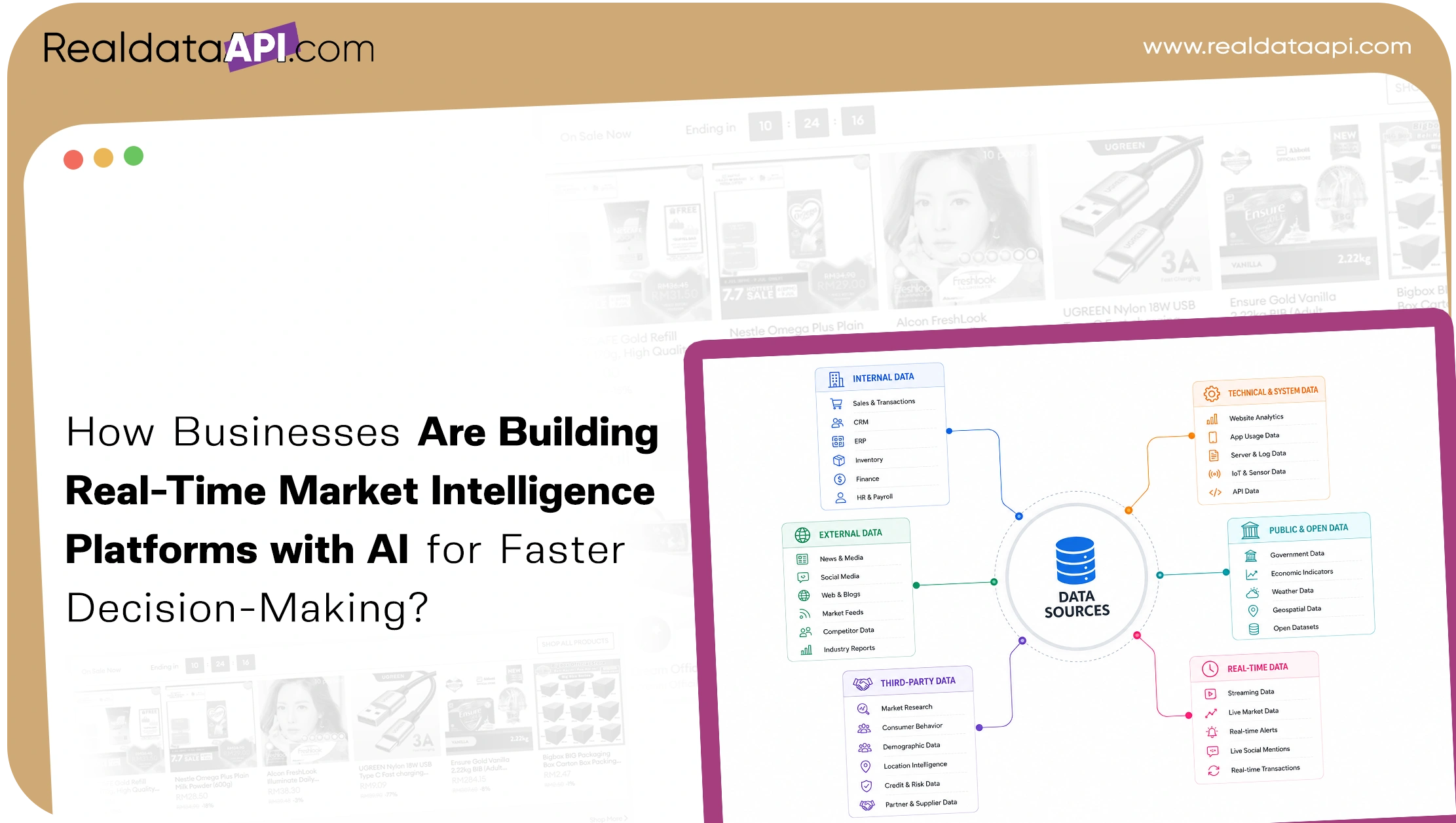
Businesses gain a competitive advantage by Building real-time market intelligence platforms with AI that collect, analyze, and deliver live market insights. AI-powered platforms help organizations monitor competitors, predict trends, automate decisions, and respond faster to changing customer behavior, resulting in smarter business strategies and sustainable growth.
Industry Insight: According to industry estimates, over 75% of enterprises are expected to incorporate AI-driven analytics into their decision-making workflows by 2026, highlighting the growing demand for intelligent market intelligence platforms.
Markets change every minute. Product prices fluctuate, competitors launch new offerings, customer preferences evolve, and industry trends emerge faster than ever. Traditional reporting systems often fail to capture these rapid changes, leaving businesses with outdated information that slows decision-making.
Modern organizations are overcoming this challenge by Building real-time market intelligence platforms with AI that continuously collect, process, and analyze data from multiple public and commercial sources. Combined with Generative AI, these platforms convert massive datasets into meaningful insights, automated reports, predictive forecasts, and strategic recommendations.
For business leaders, pricing teams, market researchers, retailers, manufacturers, eCommerce companies, and investment firms, AI-powered intelligence platforms provide continuous visibility into changing markets. Instead of waiting days or weeks for reports, organizations receive actionable intelligence almost instantly.
Real Data API enables businesses to build scalable market intelligence ecosystems through automated web data collection, AI-powered analytics, enterprise APIs, and real-time monitoring that supports faster and more confident business decisions.
How Can Businesses Turn Live Market Data into Competitive Intelligence?
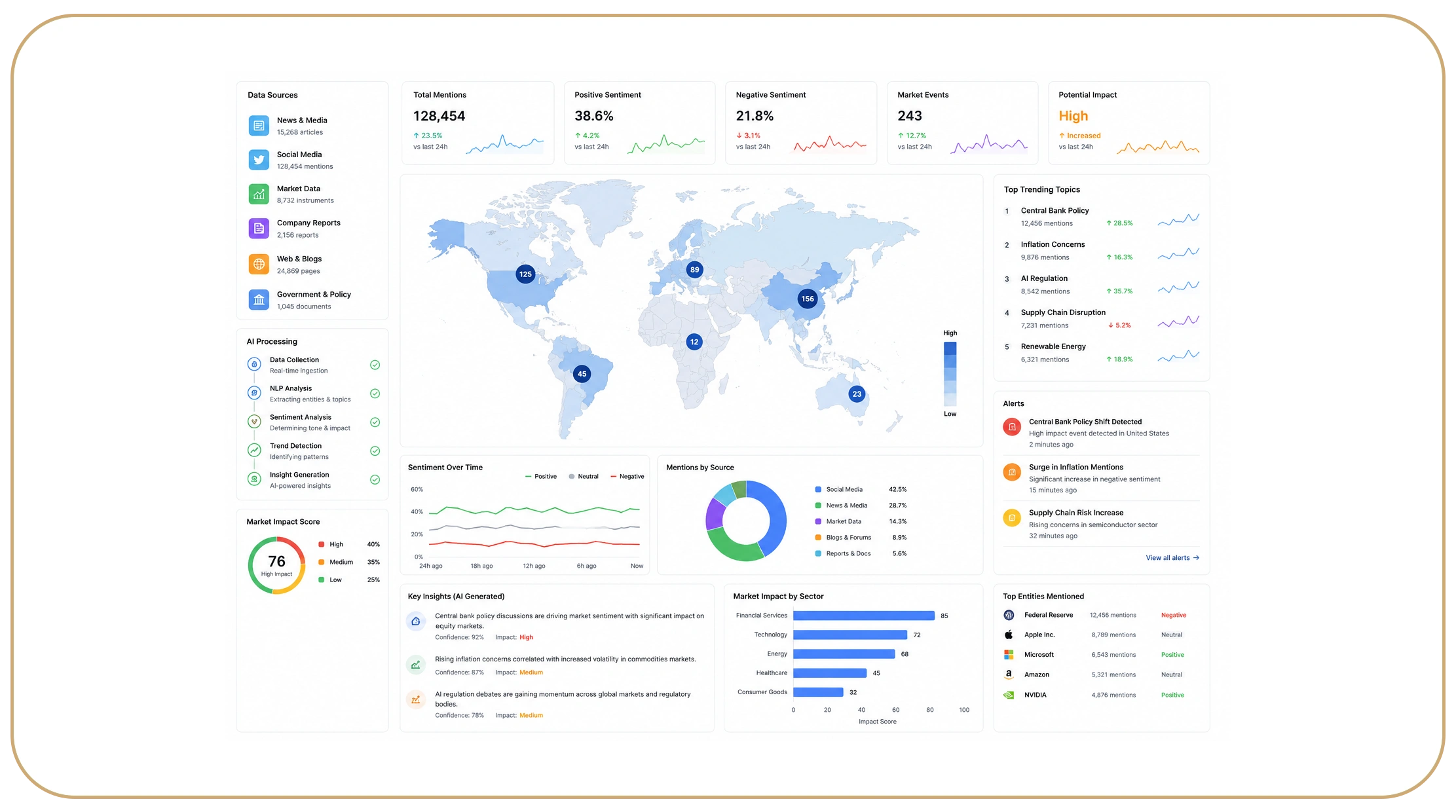
Organizations today generate and consume enormous volumes of market information every day. Product catalogs, pricing updates, customer reviews, promotional campaigns, stock availability, and competitor launches all influence strategic decisions. Without automation, collecting and analyzing this information becomes expensive and time-consuming.
Businesses are increasingly adopting Real-time market intelligence using artificial intelligence to transform constantly changing market data into actionable business insights. AI algorithms automatically identify trends, detect anomalies, compare competitors, and generate predictive recommendations that help organizations respond faster than traditional analytics methods.
Instead of relying on historical reports, decision-makers gain access to continuously updated dashboards that highlight significant pricing movements, product launches, customer demand patterns, and competitor activities.
Market Intelligence Adoption (2020–2026)
| Year | Organizations Using AI | Market Data Sources | Average Data Refresh |
|---|---|---|---|
| 2020 | 18% | 120 | Daily |
| 2021 | 24% | 180 | Every 12 Hours |
| 2022 | 33% | 260 | Every 6 Hours |
| 2023 | 46% | 420 | Hourly |
| 2024 | 58% | 650 | Every 30 Minutes |
| 2025 | 69% | 900 | Every 15 Minutes |
| 2026* | 78% | 1,200+ | Near Real Time |
Projected industry estimates.
Why Businesses Are Investing
- Monitor competitors continuously.
- Detect pricing changes instantly.
- Analyze consumer behavior.
- Identify market opportunities early.
- Reduce manual research.
- Improve forecasting accuracy.
- Support executive decision-making.
- Deliver faster business insights.
AI-powered market intelligence enables organizations to move beyond reactive reporting. Companies can proactively identify business opportunities, anticipate market disruptions, and optimize strategies using continuously updated intelligence rather than static historical data.
What Makes Enterprise Intelligence Platforms More Scalable?
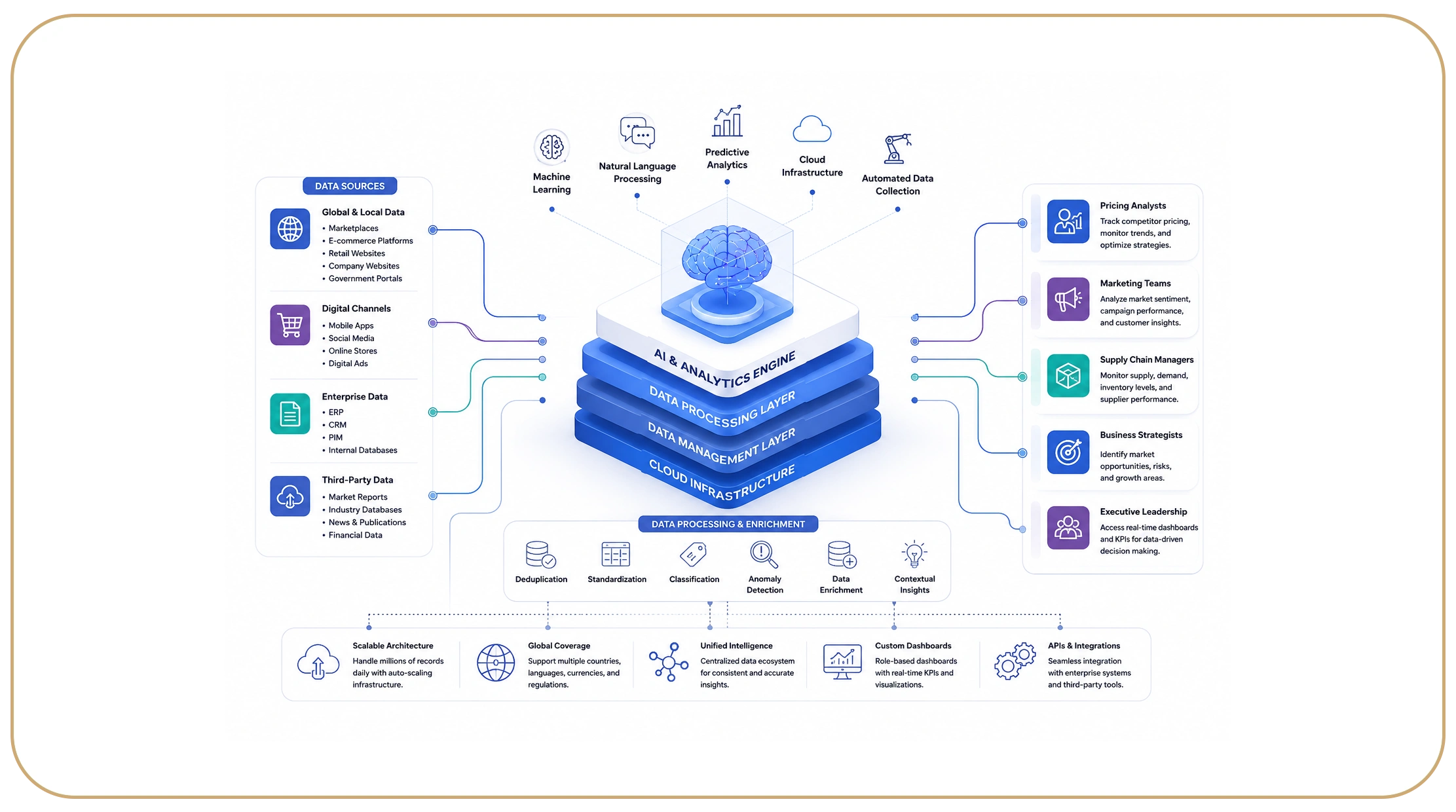
Modern enterprises require intelligence systems capable of processing millions of records daily while integrating data from multiple industries, countries, and digital channels. Scalability has become a defining feature of successful market intelligence platforms.
An Enterprise market intelligence platform using AI combines automated data collection, machine learning, natural language processing, predictive analytics, and cloud infrastructure into one centralized ecosystem. This allows organizations to manage structured and unstructured datasets without increasing operational complexity.
AI also improves data quality by removing duplicate records, standardizing formats, classifying products, identifying anomalies, and enriching datasets with contextual insights. As businesses expand globally, enterprise AI platforms ensure consistent reporting across different markets, languages, currencies, and product categories.
These platforms support cross-functional teams including pricing analysts, marketing departments, supply chain managers, business strategists, and executive leadership by delivering unified intelligence through customizable dashboards and APIs.
Enterprise AI Platform Growth (2020–2026)
| Year | Enterprise Deployments | Daily Records Processed | Automated Reports |
|---|---|---|---|
| 2020 | 850 | 15 Million | 2,000 |
| 2021 | 1,250 | 28 Million | 3,800 |
| 2022 | 1,900 | 46 Million | 6,200 |
| 2023 | 2,850 | 70 Million | 9,500 |
| 2024 | 4,200 | 105 Million | 14,000 |
| 2025 | 5,900 | 148 Million | 20,500 |
| 2026* | 7,400 | 205 Million | 28,000 |
Projected industry estimates.
Benefits of Enterprise AI Platforms
- Centralize multiple data sources.
- Automate market monitoring.
- Improve reporting speed.
- Scale globally.
- Enhance forecasting.
- Deliver real-time dashboards.
- Reduce operational costs.
- Support strategic planning.
Organizations investing in enterprise AI platforms are better equipped to adapt to rapidly changing markets. Instead of managing disconnected datasets, they gain a unified view of competitors, pricing, consumer behavior, and emerging trends. This enables faster collaboration, stronger governance, and more accurate decision-making across every level of the business.
How Does AI Turn Raw Market Data into Business Growth?

Organizations collect massive amounts of market data every day, but raw information alone does not create value. Businesses need intelligent systems that can identify patterns, predict future trends, and generate recommendations in real time. AI transforms scattered datasets into strategic intelligence that supports faster and more accurate decisions.
Modern enterprises increasingly rely on AI-driven market data analytics for business growth to analyze competitor pricing, customer behavior, product demand, supply chain movements, and industry trends. Machine learning models continuously evaluate structured and unstructured data, enabling businesses to uncover hidden opportunities while minimizing business risks.
For retailers, manufacturers, financial institutions, eCommerce companies, and consulting firms, AI-powered analytics improve forecasting accuracy, optimize pricing strategies, and strengthen competitive positioning. Real-time dashboards help executives monitor KPIs while predictive models identify future market shifts before they occur.
AI Analytics Adoption (2020–2026)
| Year | AI Analytics Users | Daily Data Processed | Forecast Accuracy |
|---|---|---|---|
| 2020 | 20% | 12 Million | 68% |
| 2021 | 28% | 20 Million | 72% |
| 2022 | 39% | 35 Million | 77% |
| 2023 | 52% | 58 Million | 82% |
| 2024 | 63% | 86 Million | 86% |
| 2025 | 72% | 120 Million | 90% |
| 2026* | 81% | 165 Million | 93% |
Projected industry estimates.
Key Business Benefits
- Predict demand more accurately.
- Improve pricing decisions.
- Detect competitor trends.
- Reduce manual analysis.
- Support executive planning.
- Identify growth opportunities.
- Improve operational efficiency.
- Enable data-driven strategies.
Organizations that adopt AI-powered analytics gain faster insights, better forecasting capabilities, and stronger competitive intelligence. Instead of reacting to market changes after they happen, businesses can proactively plan future strategies using continuously updated market data.
How Can Conversational AI Improve Market Intelligence?

Business teams often spend valuable time searching through reports, dashboards, and spreadsheets to find answers. Conversational AI simplifies this process by allowing users to ask questions in natural language and receive instant insights from enterprise data.
An AI Chatbot integrated into a market intelligence platform enables executives, analysts, marketing teams, and sales professionals to retrieve business insights without writing queries or navigating complex dashboards. Users can ask questions such as:
- Which competitor reduced prices this week?
- Which products gained the highest demand?
- What categories are growing fastest?
- Which markets experienced the largest pricing changes?
The chatbot interprets user intent, searches connected datasets, generates summaries, and presents recommendations within seconds. This significantly improves productivity while making business intelligence accessible across departments.
Conversational AI Growth (2020–2026)
| Year | Enterprise AI Chatbots | User Queries per Day | Response Accuracy |
|---|---|---|---|
| 2020 | 1,200 | 80,000 | 75% |
| 2021 | 2,000 | 130,000 | 80% |
| 2022 | 3,100 | 220,000 | 85% |
| 2023 | 4,800 | 360,000 | 89% |
| 2024 | 6,900 | 580,000 | 92% |
| 2025 | 9,500 | 860,000 | 95% |
| 2026* | 12,400 | 1.2 Million | 97% |
Projected industry estimates.
Advantages
- Simplifies access to data.
- Answers business questions instantly.
- Reduces reporting time.
- Improves executive productivity.
- Supports self-service analytics.
- Delivers natural language insights.
- Accelerates business decisions.
- Enhances collaboration.
Conversational AI is becoming an essential interface for enterprise intelligence platforms because it reduces complexity while making sophisticated analytics available to every business user.
Why Is Intelligent Product Matching Essential?

Modern businesses monitor millions of products across multiple marketplaces. Differences in product names, descriptions, specifications, packaging sizes, and regional naming conventions make manual comparison almost impossible.
AI-Powered Product Matching uses machine learning and natural language processing to automatically identify equivalent or similar products across multiple retailers, marketplaces, suppliers, and competitors. Instead of relying only on product titles, AI evaluates specifications, brand attributes, images, categories, pricing, and contextual information to improve matching accuracy.
This capability is particularly valuable for retailers, manufacturers, FMCG brands, pricing teams, and eCommerce businesses. Accurate product matching enables meaningful competitor benchmarking, dynamic pricing, assortment analysis, inventory planning, and promotional comparisons.
Product Matching Trends (2020–2026)
| Year | Products Matched | Matching Accuracy | Retailers Connected |
|---|---|---|---|
| 2020 | 8 Million | 78% | 220 |
| 2021 | 14 Million | 83% | 360 |
| 2022 | 22 Million | 88% | 520 |
| 2023 | 36 Million | 91% | 760 |
| 2024 | 55 Million | 94% | 1,050 |
| 2025 | 82 Million | 96% | 1,450 |
| 2026* | 118 Million | 98% | 1,900 |
Projected industry estimates.
Business Advantages
- Improve competitive benchmarking.
- Eliminate duplicate products.
- Compare similar SKUs.
- Enhance pricing accuracy.
- Optimize assortments.
- Strengthen catalog quality.
- Support dynamic pricing.
- Improve inventory planning.
AI-driven product matching significantly improves the quality of market intelligence by ensuring businesses compare equivalent products rather than unrelated listings, leading to more reliable analytics and smarter commercial decisions.
How Can Continuous Data Monitoring Drive Better Decisions?

Market conditions change every minute. Product launches, competitor pricing, inventory availability, promotional campaigns, and customer sentiment evolve constantly. Organizations that rely on periodic reports often miss critical business opportunities.
AI Web Data Monitoring enables enterprises to collect, analyze, and monitor information from websites, marketplaces, news sources, and public data in near real time. AI automatically detects meaningful changes, prioritizes important events, and alerts decision-makers when significant market shifts occur.
Continuous monitoring supports industries such as retail, healthcare, manufacturing, financial services, travel, logistics, and eCommerce by providing timely intelligence that improves strategic planning and operational responsiveness.
Instead of reviewing thousands of web pages manually, businesses receive automated alerts whenever competitors adjust prices, launch products, modify assortments, or introduce promotional campaigns.
Web Monitoring Growth (2020–2026)
| Year | Websites Monitored | Daily Changes Captured | Automated Alerts |
|---|---|---|---|
| 2020 | 12,000 | 1.6 Million | 45,000 |
| 2021 | 19,000 | 2.8 Million | 78,000 |
| 2022 | 28,000 | 4.3 Million | 122,000 |
| 2023 | 41,000 | 6.7 Million | 185,000 |
| 2024 | 58,000 | 9.8 Million | 270,000 |
| 2025 | 77,000 | 13.4 Million | 365,000 |
| 2026* | 101,000 | 18.2 Million | 495,000 |
Projected industry estimates.
Why Continuous Monitoring Matters
- Detect market changes instantly.
- Monitor competitor activities.
- Track product launches.
- Capture pricing updates.
- Improve forecasting.
- Reduce manual monitoring.
- Enable proactive decisions.
- Strengthen competitive intelligence.
Organizations that implement continuous AI-powered monitoring build a stronger foundation for real-time decision-making. By identifying market changes as they happen, businesses can respond faster, reduce uncertainty, and maintain a lasting competitive advantage.
Why Choose Real Data API?
Modern businesses need more than raw data—they need intelligent, scalable, and real-time insights that drive confident decisions. Real Data API helps organizations simplify Building real-time market intelligence platforms with AI by combining automated web data collection, AI-powered analytics, enterprise APIs, and customizable dashboards into one unified solution. Our platform collects structured market data from multiple public sources, transforms it into actionable intelligence, and delivers near real-time updates for faster decision-making. Whether you operate in retail, eCommerce, FMCG, finance, travel, healthcare, or manufacturing, Real Data API provides the scalability, accuracy, and flexibility required to build enterprise-grade market intelligence platforms that support sustainable business growth.
Conclusion
AI is transforming how organizations collect, analyze, and act on market information. By Building real-time market intelligence platforms with AI, businesses can monitor competitors, identify market trends, optimize pricing, and improve forecasting with greater speed and accuracy. Combining Real-time market intelligence using artificial intelligence with automated data collection empowers decision-makers to replace reactive reporting with proactive strategies based on continuously updated insights.
Businesses that invest in AI-driven market intelligence today will be better prepared to respond to tomorrow's opportunities and market disruptions.
Ready to accelerate your market intelligence strategy? Contact Real Data API today to start Building real-time market intelligence platforms with AI and unlock faster, smarter, and data-driven business decisions!
Latest posts
Keeta scraper for monitoring food marketplace trends - Identify Discount Changes and Emerging Customer Demand
How to build a structured Nike product dataset for Product Intelligence and Retail Analytics

Allegro scraper for competitor price monitoring – How to Track Product Prices and Stay Ahead of Competitors

Ocado API data collection services for retailers - Track Competitor Prices and Deals







.png)