.gif)
.gif)
Quick Summary
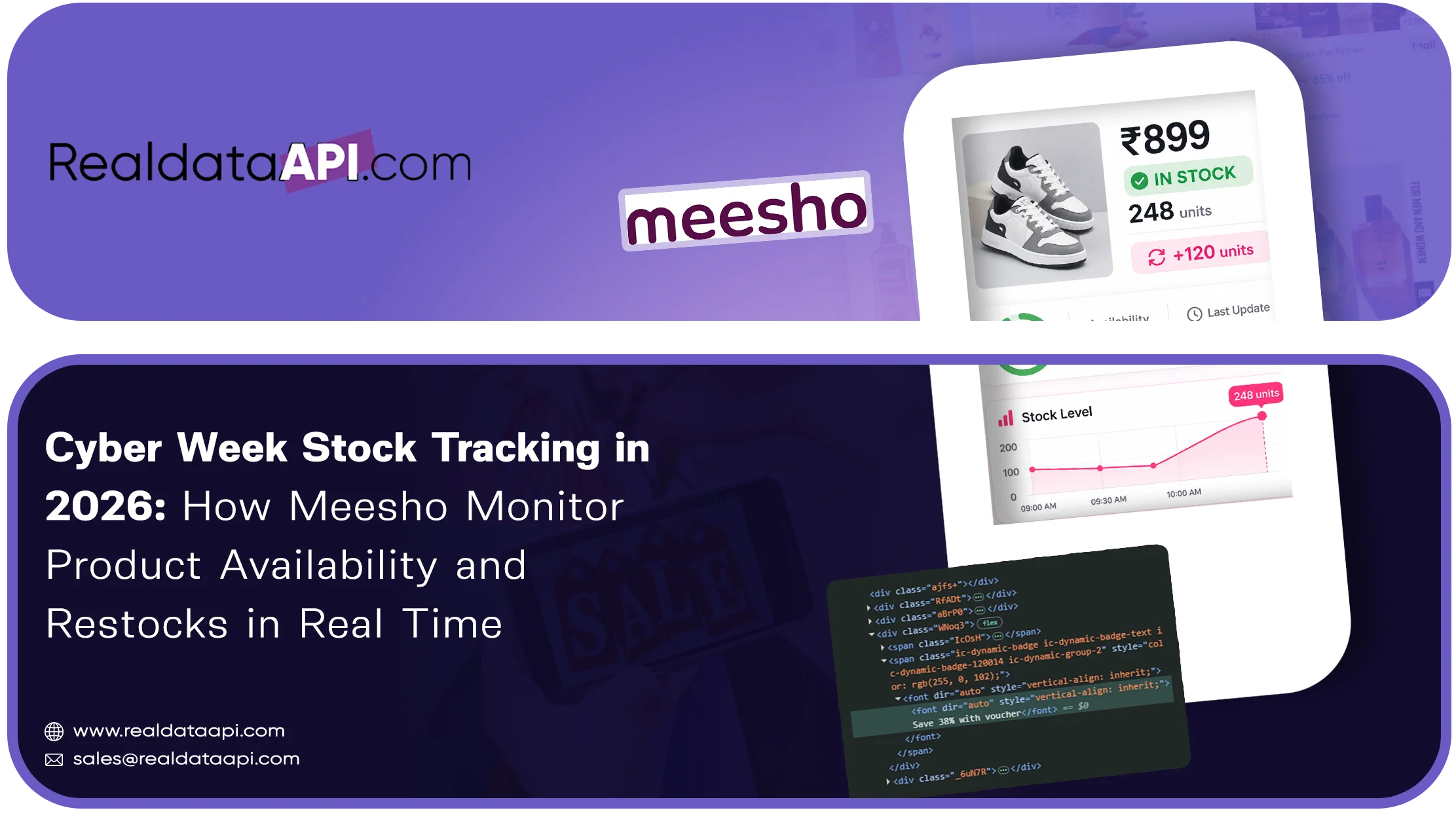
- Cyber Week Stock Tracking in 2026: How Meesho Monitor Product Availability and Restocks in Real Time explains how sellers and market intelligence teams can detect stockouts, low-stock listings, and restocks through structured product monitoring.
- A properly authorized Meesho API integration or permitted data collection workflow can help organize product availability observations, compare listing changes, and generate timely alerts.
- Historical shopping data and Meesho’s published marketplace figures show why reliable inventory visibility matters during high-demand retail periods.
Introduction
Cyber Week Stock Tracking in 2026: How Meesho Monitor Product Availability and Restocks in Real Time is an important consideration for sellers, retailers, and e-commerce intelligence teams preparing for seasonal demand. When popular products become unavailable, businesses can lose sales opportunities, overlook competitor restocks, or make purchasing decisions using outdated information. A structured monitoring process helps teams identify product availability changes and respond with better inventory planning.
Meesho provides sellers with inventory management features through its Supplier Panel. Its official guidance describes separate views for all stock, low stock, and out-of-stock products, along with individual and bulk stock-update options. These features give sellers a direct way to manage their own catalog inventory. For external analytics, teams should first confirm whether an authorized Meesho API or another approved data-access method is available for their use case. Meesho’s public inventory guidance should not be interpreted as confirmation of a public inventory API.
The objective is not simply to collect product pages. It is to create a reliable record of what was available, when a listing changed, which product variant was affected, and whether availability returned later. This information can support replenishment planning, competitor analysis, category research, and campaign performance reviews.
How can structured product monitoring improve inventory visibility?
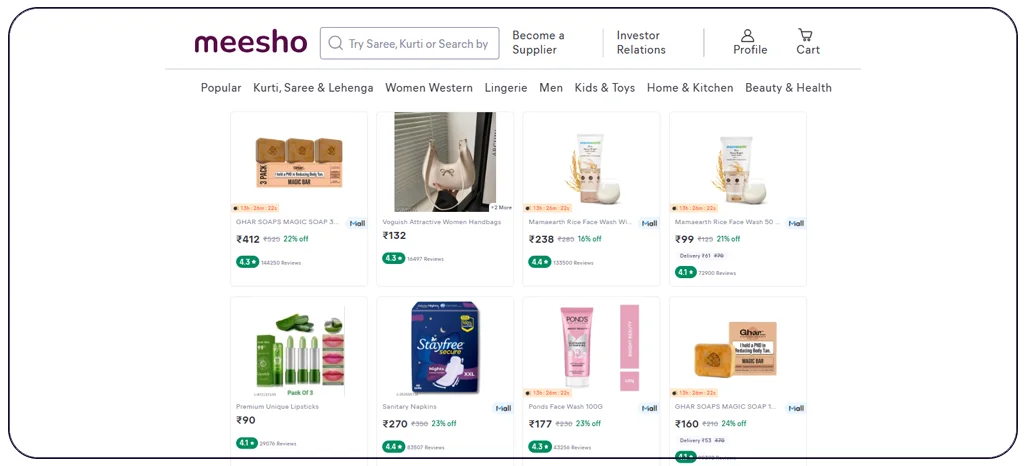
E-commerce data scraping can help businesses collect publicly accessible product information at scheduled intervals, subject to website terms, applicable law, and permitted access methods. For inventory analysis, the collected fields may include product title, product identifier, seller or catalog reference, category, variant, displayed price, availability label, product URL, and observation timestamp.
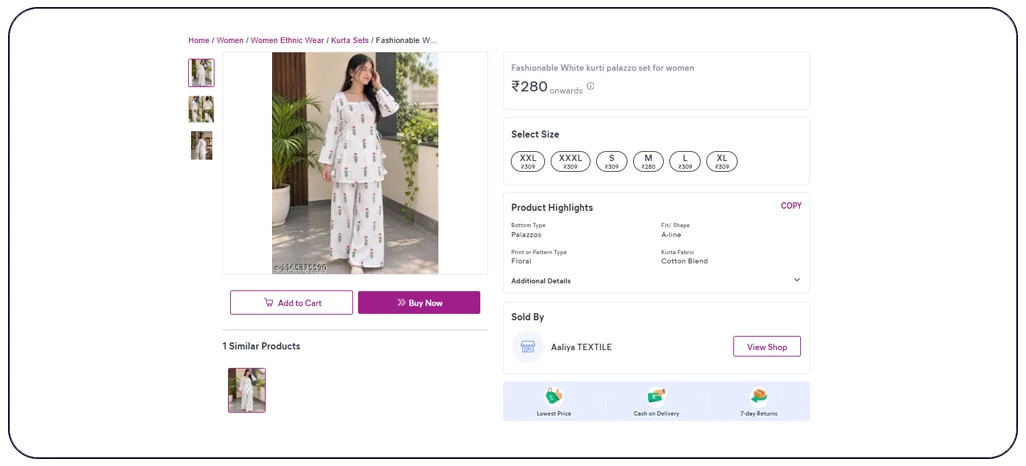
The most important requirement is consistency. A product may appear under different titles, images, or catalog descriptions across observations. A monitoring system should therefore use stable identifiers wherever available and retain the original listing URL. For products with size, color, or pack variations, availability should be recorded at the variant level instead of treating the entire catalog as one stock unit.
A useful workflow has four stages. First, collect permitted listing information. Second, normalize product names, identifiers, categories, and variant attributes. Third, compare the latest observation with the previous record. Finally, create an alert when a meaningful availability change occurs. This approach helps analysts distinguish a genuine stockout from a listing that has been paused, blocked, removed, or temporarily unavailable.
Meesho’s official Supplier Panel guidance describes active, activation-pending, blocked, and paused catalog states. Within active inventory, sellers can view all stock, out-of-stock, and low-stock products. These distinctions matter because a listing that is not currently purchasable does not always indicate that physical inventory has reached zero. Teams should preserve the observed status rather than converting every unavailable page into a confirmed stockout.
What should an inventory monitoring record contain?
| Data field | Why it matters |
|---|---|
| Product or catalog identifier | Helps match repeated observations |
| Product title and category | Supports classification and reporting |
| Variant details | Separates size, color, and other options |
| Availability status | Records the displayed stock condition |
| Price | Helps connect stock changes with pricing activity |
| Product URL | Provides a traceable source reference |
| Observation timestamp | Shows when the status was detected |
| Collection status | Identifies missing, blocked, or inaccessible records |
The value of this structure is that every availability change can be traced to an observation. Analysts can then review changes over time instead of relying on a single product-page snapshot.
Source: Meesho – How to Manage Inventory.
How can historical retail data help identify inventory pressure?
Extract Black Friday inventory data to understand how product availability changes around major promotional periods. Historical records can help analysts identify products that repeatedly become unavailable, categories with frequent listing changes, and periods when restocks appear after a demand spike. However, sales data and inventory data are different measurements: high online spending does not, by itself, prove that a particular product experienced a stockout.
Adobe Analytics publishes annual U.S. holiday shopping results that provide useful context for the scale of Cyber Week. The figures below are actual reported online spending for the five-day period from Thanksgiving through Cyber Monday, rather than estimates of Meesho sales.
How has Cyber Week online spending changed?
| Year | U.S. Cyber Week online spending | Data status |
|---|---|---|
| 2020 | $34.4 billion | Reported actual |
| 2021 | $33.9 billion | Reported actual |
| 2022 | $35.3 billion | Reported actual |
| 2023 | $38.0 billion | Reported actual |
| 2024 | $41.1 billion | Reported actual |
| 2025 | $44.2 billion | Reported actual |
| 2026 | Not yet available | Event not completed as of November 24, 2026 |
Sources: Adobe’s 2020 Cyber Week review, Adobe’s 2021 results, Adobe’s 2022 results, Adobe’s 2023 results, Adobe’s 2024 results, and Reuters’ report on 2025 Cyber Week.
These figures describe the U.S. online retail market. They are not Meesho-specific revenue, order, or inventory statistics, and should not be used as a direct forecast for Indian marketplace demand. Their relevance is that they demonstrate the scale of promotional shopping activity and the importance of preparing inventory systems for periods of concentrated demand.
For practical analysis, businesses should combine historical availability observations with their own order, cancellation, and replenishment records. A product that repeatedly becomes unavailable during a campaign may deserve closer monitoring before the next event. A product that returns to availability shortly after a stockout may indicate replenishment, but the observation should be checked against the listing and seller records before being classified as a confirmed restock.
Why should businesses compare competitor availability during major sales?
A Competitor stock tracking API or authorized monitoring integration can help retailers organize availability observations across competing product listings. The purpose is to understand whether comparable products remain available, become unavailable, or return to sale during a promotional period. This can provide useful context for pricing decisions, assortment planning, and campaign evaluation.
Competitor monitoring should begin with product matching. Two listings may have similar titles but different specifications, pack sizes, brands, or variants. Comparing them without matching the underlying product attributes can produce misleading conclusions. A practical matching process should consider product identifiers when available, brand, model, size, color, quantity, and other category-specific characteristics.
Once comparable listings are identified, teams can record their displayed availability at consistent intervals. A change from “in stock” to “out of stock” can trigger a review. A later return to an available state can be recorded as a possible restock. The system should retain both observations, including timestamps, so analysts can distinguish a temporary page error from a sustained status change.
What should teams compare?
- Availability: Which comparable products are currently displayed as available?
- Variant coverage: Are all sizes, colors, or pack options available?
- Price movement: Did the displayed price change around the same time as availability?
- Listing continuity: Did the product remain active, become paused, or disappear?
- Restock timing: How long passed between the first unavailable observation and the next available observation?
A competitor listing becoming unavailable does not prove that a competitor has exhausted its physical inventory. It may reflect a seller decision, catalog change, technical issue, or platform restriction. Reports should label the finding as an observed listing-status change unless stronger evidence confirms the underlying cause.
Build a clearer view of product availability across your target marketplace and competitor set with a structured, timestamped monitoring workflow!
Get Insights Now!What should a reliable campaign monitoring workflow capture?
Cyber Week product stock data extraction should be designed around the questions a business needs to answer. A retailer may want to know whether a high-priority product is still available, whether a specific variant has disappeared, or whether a listing has returned after being unavailable. Each question requires a clear data definition and a repeatable collection schedule.
The first step is to create a product watchlist. Include the product identifiers, URLs, category, variants, and priority level. Avoid collecting every listing without a defined purpose; a focused watchlist makes it easier to validate records and investigate meaningful changes.
The second step is to set observation intervals according to business need and permitted access limits. A high-priority campaign product may require more frequent checks than a slow-moving item. The schedule should also respect website rules and avoid excessive requests. Monitoring frequency should be described accurately: a system that checks every hour is not a real-time feed, even if it sends an alert immediately after a check detects a change.
The third step is to apply status rules. For example, a product can be marked as “observed available,” “observed unavailable,” “status unclear,” or “listing inaccessible.” These categories prevent a broken page or missing response from being incorrectly treated as a stockout.
Finally, alerts should include the product reference, previous status, latest status, observation time, and source URL. Analysts should be able to open the source record and verify the change. A historical log is equally important because it allows teams to calculate how often a product became unavailable and how long it remained in that state.
What makes an alert useful?
| Alert element | Recommended information |
|---|---|
| Product reference | Catalog ID or matched product key |
| Change detected | Previous and current observed status |
| Timestamp | Date and time of both observations |
| Variant | Exact size, color, or pack option |
| Source | Original listing URL |
| Confidence | Confirmed observation or needs review |
| Priority | Business-defined urgency |
A reliable process should also record collection failures separately. If a page cannot be accessed, the system should not automatically label the product out of stock. This simple distinction protects reporting quality during high-traffic periods.
How can Meesho catalog monitoring support seller decisions?
Meesho Product Data Scraping can be useful when businesses need a structured view of product listings and availability observations for analysis. Any collection should follow applicable laws, platform terms, and authorized access requirements. The goal is to organize information for decision-making, not to bypass platform restrictions or access private seller data.
Meesho’s published seller guidance describes inventory controls that let sellers view all stock, low-stock products, and out-of-stock products. It also explains how sellers can update individual listings or use a bulk stock-update sheet. These functions are particularly relevant to sellers managing large catalogs because they provide a platform-supported way to review and update inventory.
Meesho’s scale also makes accurate catalog operations important. In its FY2025–26 shareholder update, the company reported 264 million annual transacting users and 2,668 million placed orders for the financial year. It also reported net merchandise value of ₹41,560 crore. These are company-wide marketplace metrics, not measurements of Cyber Week activity or stockout frequency. They provide context for the size of the marketplace ecosystem in which sellers operate.
Selected Meesho marketplace metrics
| Financial year | Annual transacting users | Placed orders | Net merchandise value |
|---|---|---|---|
| FY2023 | — | — | — |
| FY2024 | 156 million | 1,342 million | ₹23,241 crore |
| FY2025 | 199 million | 1,834 million | ₹29,988 crore |
| FY2026 | 264 million | 2,668 million | ₹41,560 crore |
Source: Meesho – Progress towards our Mission, Q4 and Full Year FY2026. FY2023 values are omitted here because the cited FY2026 summary does not provide them in this table.
For sellers, the practical opportunity is to connect inventory discipline with listing performance. Review high-demand catalogs before a campaign, verify physical stock before updating the platform, and pay attention to low-stock warnings. After the event, compare orders, cancellations, and stock updates to identify products that need improved replenishment planning.
For market intelligence teams, historical listing observations can add another layer of context. They can show when a product was publicly displayed as available or unavailable, while seller-side inventory records can help validate what happened internally. The two sources should remain clearly distinguished in reports.
What should businesses look for in a scalable monitoring solution?
A Meesho Scraper project should be evaluated on data quality, access authorization, product matching, update consistency, and the ability to explain how each observation was collected. A large volume of unverified product records is less useful than a smaller dataset with clear identifiers, timestamps, and source references.
Start with coverage. The solution should identify the product fields required for the business question and document which fields are available through approved sources. If variant-level availability is essential, confirm that the collection process can distinguish individual variants instead of reporting only a catalog-level status.
Next, assess data validation. Product identifiers should be checked for duplication, missing values, and inconsistent formats. Titles and categories should be normalized without discarding the original source text. Price and availability fields should retain the original observation so that analysts can audit unexpected changes.
The monitoring system should also support historical records. Overwriting yesterday’s availability with today’s status destroys the timeline needed to identify stockout duration and restock patterns. A timestamped history allows teams to calculate the time between observed status changes and compare campaign periods.
Finally, assess alerting and reporting. Useful reports include products with repeated unavailable observations, variants with changing status, listings that have not been observed recently, and records requiring manual review. Teams should be able to filter these findings by category, seller reference where legitimately available, product priority, and date.
A scalable workflow should be transparent about limitations. It should not claim exact physical inventory counts when only a public availability label is visible. It should not describe periodic checks as instantaneous monitoring. It should also distinguish a listing removal from a confirmed stockout. These distinctions make the resulting analysis more reliable for merchandising, operations, and management teams.
Why Choose Real Data API?
Businesses need dependable product intelligence to make informed decisions during high-pressure retail campaigns. Real Data API can support organizations that need structured data collection, product information processing, and marketplace intelligence workflows designed around their business requirements.
A useful delivery process begins with defining the target marketplace, product categories, required fields, and permitted data sources. The next stage is to establish product-matching rules and validation checks so that repeated observations can be compared accurately. Historical records can then be organized into reports that help teams review availability changes, pricing observations, and catalog activity.
What can a well-structured data solution help with?
- E-Commerce Datasets: Organize product information into consistent fields for analysis and reporting.
- Availability history: Preserve timestamped observations to review listing-status changes.
- Product matching: Connect comparable products using identifiers and relevant attributes.
- Data validation: Flag missing, duplicated, or inconsistent records for review.
- Custom reporting: Present relevant product and category information in a format that supports business decisions.
The right solution should be aligned with the user's access permissions, platform requirements, and operational goals. Clear documentation of collection frequency, source coverage, and data limitations is essential for trustworthy results.
Conclusion
Cyber Week Stock Tracking in 2026: How Meesho Monitor Product Availability and Restocks in Real Time highlights why product availability should be monitored as a sequence of verified observations rather than a one-time page check. Meesho’s Supplier Panel provides sellers with stock, low-stock, out-of-stock, and bulk-update features. Businesses that need broader marketplace intelligence can complement their internal processes with authorized data collection, consistent product matching, timestamped records, and carefully defined alerts.
The strongest approach combines accurate catalog information, reliable historical tracking, and clear reporting. It also avoids treating inaccessible listings as confirmed stockouts or assuming that public availability labels reveal exact physical inventory.
Ready to improve product visibility and make better-informed inventory decisions? Contact Real Data API to discuss a structured e-commerce data solution aligned with your marketplace coverage, data requirements, and business goals!
FAQs
1. What is a Meesho API used for?
A Meesho API would enable approved software communication for supported functions. Confirm current access, documentation, and permissions with Meesho before planning an integration or relying on inventory endpoints.
2. How does e-commerce data scraping help monitor stock?
E-commerce data scraping collects permitted product observations at scheduled intervals, helping teams compare availability, identify listing changes, retain timestamps, and review possible restocks.
3. Can businesses extract Black Friday inventory data?
Yes, where access is permitted. Extract Black Friday inventory data by recording product identifiers, variants, availability labels, source URLs, and timestamps throughout the campaign period.
4. Why use a competitor stock tracking API?
A Competitor stock tracking API can organize comparable listing observations, helping analysts review availability changes and possible restocks while keeping source limitations and matching accuracy clear.
5. What is the value of Cyber Week product stock data extraction?
Cyber Week product stock data extraction helps businesses preserve campaign-period availability observations, investigate listing changes, and improve post-event inventory analysis. Real Data API can help plan structured data workflows.
Latest posts
Stock Availability Monitoring with WhatsApp Alerts: Tracking High-Demand Electronics Across Blinkit, Zepto, Flipkart and Instamart
Cyber Week Stock Tracking in 2026: How Meesho Monitor Product Availability and Restocks in Real Time
How to Scrape Amazon Fresh Grocery Delivery Data in 2026 - How to Monitor Competitor Prices and Protect Grocery Retail Profit Margins
Quick Commerce Data Scraping - Tracking Blinkit, Zepto and Instamart During New Year 2026




.png)


