.gif)
.png)
Quick Summary
- Learn how authorized product data collection helps retailers analyze beverage catalogs, displayed prices, product availability, and promotions using structured information.
- Discover how catalog standardization, API integration research, and historical price tracking support competitive intelligence and informed retail decisions.
- Explore practical data governance, validation, and monitoring methods that help e-commerce teams turn product information into actionable insights while respecting website terms, access permissions, and applicable laws.
Introduction
Retail businesses need accurate product information to understand market positioning, compare prices, and identify changes in product availability. An Extract authorized Total Wine Scraper workflow can help e-commerce managers, beverage brands, manufacturers, and marketplace sellers collect permitted product information and organize it for analysis. The objective is to transform accessible retail information into consistent records that support everyday commercial decisions.
Total Wine & More is a U.S. beverage retailer whose online catalog provides information about wine, beer, spirits, and other products, subject to location, availability, and applicable access restrictions. An organized Total Wine Price Dataset can help analysts examine displayed prices, product descriptions, categories, package sizes, and available promotional details over time. However, data collected from a product page should not automatically be treated as a complete record of in-store pricing or nationwide availability.
For decision-makers, the important questions are practical: Are comparable products priced differently? Have displayed prices changed? Are promotional offers still available? Can product records be matched accurately across different retailers? Answering these questions requires reliable collection methods, consistent data structures, and transparent validation procedures.
This guide explains how businesses can approach authorized retail data collection, beverage catalog analysis, API integration research, and competitive intelligence. It also distinguishes verifiable facts from analytical recommendations so that businesses can build dependable workflows without relying on invented statistics or unsupported market claims.
How can businesses collect product catalog information responsibly?
Total Wine product catalog data collection should begin with a clear authorization process, not an automated request to every available product page. Total Wine & More's published Terms and Conditions prohibit automated scraping and crawling of its site content, subject to stated exceptions. Businesses should therefore obtain explicit permission or use an approved data-access arrangement before implementing automated collection. Public visibility alone does not establish permission to scrape.
Once access is authorized, analysts can define the fields needed for a specific business objective. Common candidate fields include product name, brand, category, package size, displayed price, product URL, selected store or market, promotion details, and the time the information was observed. These are proposed data fields, not a claim that every field is available for every product.
A practical workflow separates collection, validation, and storage. First, document the permitted sources and access frequency. Next, capture the approved fields with their original context. Then validate price formats, product identifiers, and missing values before making records available to analysts.
| Data element | Validation requirement | Business use |
|---|---|---|
| Product name and brand | Normalize spelling without losing the original text | Product matching |
| Displayed price | Preserve currency and unit context | Price comparisons |
| Package size | Standardize volume or count units | Comparable-unit analysis |
| Product URL or identifier | Retain a stable reference where available | Record matching |
| Observation timestamp | Record date and time | Change detection |
| Store or market context | Record the selected location where authorized | Local availability analysis |
The table describes a recommended schema, not verified fields from a live feed. A dependable dataset should also preserve the source and collection method for each record. If a value cannot be verified, it should remain missing or be flagged rather than filled with an assumption.
What makes beverage catalog records consistent and useful?
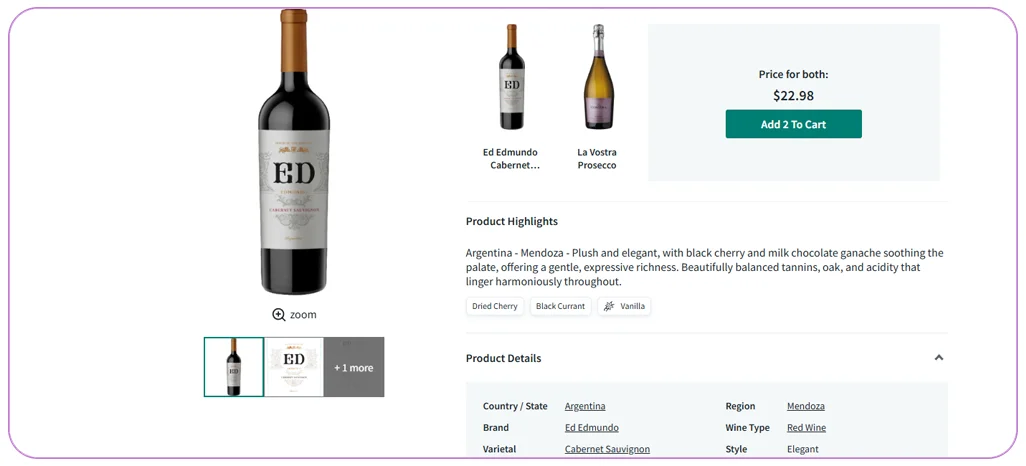
Total Wine beverage catalog data structuring turns separate product records into a dataset that analysts can compare and maintain. Beverage catalogs present particular challenges because product names can contain vintages, regions, grape varieties, bottle sizes, pack counts, alcohol percentages, and producer names. Similar names do not necessarily identify the same product.
A robust schema should distinguish a product from its individual offers. A product record describes the item itself; an offer record describes a displayed price or availability state in a particular market at a particular time. This distinction prevents a price change from accidentally creating a duplicate product.
For example, a 750 mL bottle and a multipack containing several bottles should not be treated as equivalent offers simply because their names are similar. Analysts should preserve the original package description and calculate normalized unit prices only when the quantity and price basis are clear.
| Structuring task | Recommended practice | Error to avoid |
|---|---|---|
| Category assignment | Maintain a consistent category hierarchy | Mixing product types |
| Brand normalization | Keep raw and standardized brand values | Merging different producers |
| Package normalization | Record volume, count, and unit | Comparing unlike package sizes |
| Product matching | Use identifiers where available and verify attributes | Matching by name alone |
| Price history | Store dated observations | Overwriting historical values |
| Promotion handling | Separate regular price and promotional price when verified | Treating every displayed price as a discount |
These practices are especially useful when comparing products across different retailers. They also improve reporting because analysts can explain why two products were matched and which attributes support the comparison.
Data quality should be measured with defined checks, such as missing-field rates, duplicate records, invalid price formats, and unresolved product matches. The resulting quality report should show actual measured results from the authorized dataset; targets and estimates must be labeled separately.
How should API integration research support reliable data workflows?
Total Wine API integration research should establish whether an approved API, licensed feed, partner interface, or other explicitly authorized access method exists for the intended use. The available public information cited here does not establish that Total Wine & More offers a general-purpose public product API. Businesses should confirm access options directly with the retailer rather than assume that an endpoint exists.
An integration assessment should document authentication, permitted endpoints, available fields, rate limits, refresh frequency, pagination, error responses, and usage restrictions. If an approved interface is provided, these specifications become the basis for a stable ingestion workflow.
A typical architecture separates the source connection from downstream analysis:
- Authorized access: Use credentials and methods explicitly approved for the project.
- Data ingestion: Retrieve only the fields and records covered by the permission.
- Validation: Check schemas, data types, duplicates, and incomplete responses.
- Storage: Preserve raw observations and validated records separately.
- Analytics: Calculate price changes, product matches, and availability indicators.
- Monitoring: Record failures, unusual response changes, and data freshness.
Integration testing should cover expired credentials, unavailable products, missing fields, rate-limit responses, and changes to the approved schema. Failed requests should be logged and retried only within the permitted limits. The system should not attempt to evade access restrictions or bypass technical controls.
For e-commerce teams, the most valuable integration is not necessarily the one that collects the greatest volume. It is the one that consistently delivers the permitted fields needed for a specific decision. Before implementation, the team should document the business purpose, source authorization, retention period, and expected data quality.
Explore how authorized retail data workflows can support your competitive research. Get Insights Now!
Get Insights Now!How can retail intelligence turn observations into decisions?
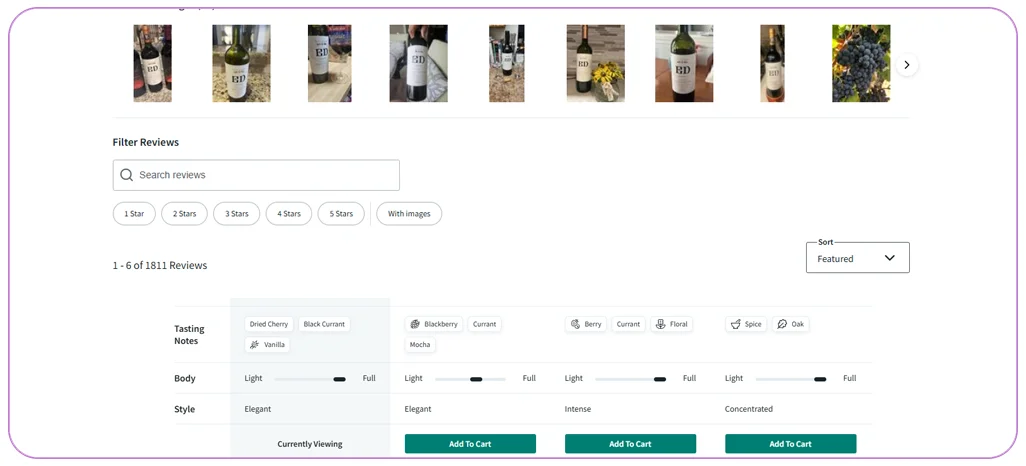
A Total Wine retail intelligence data solution should connect product-level observations with clearly defined business questions. A price record is useful on its own, but its commercial value increases when analysts can compare it with a matched product, a previous observation, or an authorized competitor dataset.
For example, a beverage manufacturer may want to understand how its products are positioned across retail channels. An e-commerce manager may need to distinguish a genuine price change from a difference in package size. A marketplace seller may want to identify products whose availability has changed in a particular market. Each question requires different matching rules and validation checks.
The wider U.S. retail environment demonstrates why reliable digital commerce information matters. The U.S. Census Bureau reported that retail e-commerce sales reached an estimated $1,233.7 billion in 2025, up 5.4% from 2024. E-commerce represented 16.4% of total U.S. retail sales that year. These are economy-wide figures, not Total Wine sales or beverage-category estimates.
| Year | Verified U.S. retail e-commerce measure | Source |
|---|---|---|
| 2020 | Annual sales: $791.7 billion; 14.0% of retail sales | Census Bureau |
| 2021 | Annual sales: $870.8 billion; 13.2% of retail sales | Census Bureau |
| 2022 | Annual sales: $1,034.1 billion; 14.6% of retail sales | Census Bureau |
| 2023 | Annual sales: $1,118.7 billion; 15.4% of retail sales | Census Bureau |
| 2024 | 16.1% of annual retail sales were e-commerce | Census Bureau |
| 2025 | Annual sales: $1,233.7 billion; 16.4% of retail sales | Census Bureau |
| 2026 | Full-year data not yet available as of October 21, 2026 | Census Bureau releases |
Note: These figures describe the U.S. retail sector overall. They should not be presented as evidence of Total Wine's revenue, prices, or market share.
To turn product observations into actionable analysis, businesses should monitor several measures:
- Price movement: Compare verified observations for the same product and package size.
- Promotion status: Identify changes only when the displayed regular and promotional prices are clearly distinguishable.
- Availability changes: Record whether a product is shown as available, unavailable, or unconfirmed in a particular market.
- Assortment differences: Compare the range of matched products across authorized sources.
- Data freshness: Show when each record was last successfully observed.
These measures support investigation rather than automatic conclusions. A lower displayed price does not necessarily indicate a competitor's overall pricing strategy, and a missing listing does not prove that a product has been discontinued.
What should an authorized monitoring workflow track over time?
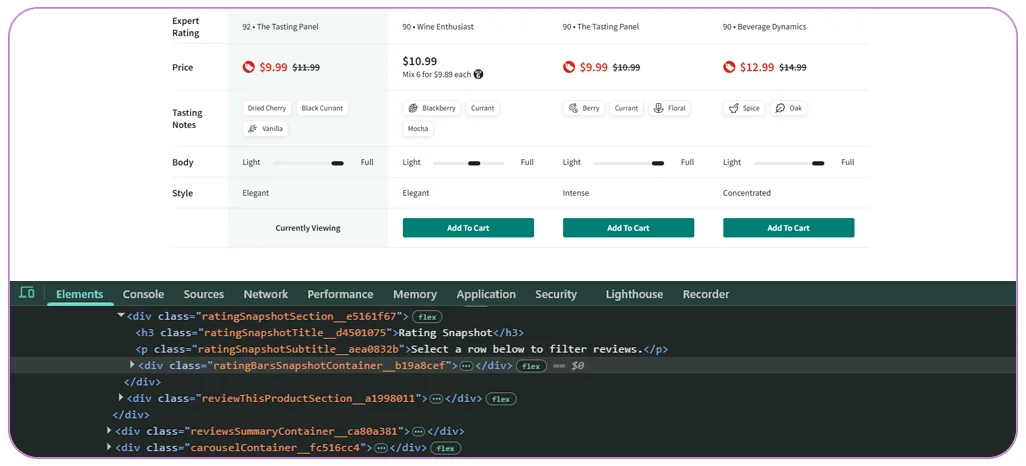
A Total Wine Scraper project should be designed around permission, data quality, and repeatable measurement. The goal is not simply to collect a large number of product pages; it is to maintain a defensible record of what was observed, when it was observed, and which conclusions the information can support.
Total Wine & More's official company page describes a broad beverage assortment, including wine, spirits, and beer. Its store finder also directs customers to select a location for accurate store information and product availability. These official pages demonstrate that product assortment and location context are relevant to understanding the retailer's offering. They do not establish permission to automate collection.
A monitoring plan should specify its observation frequency according to the authorized access arrangement. Some analyses may need periodic snapshots; others may need more frequent observations if that frequency is expressly permitted. The system should never assume that frequent requests are acceptable simply because the information is publicly visible.
| Monitoring component | What to retain | Recommended control |
|---|---|---|
| Price observations | Price, currency, package size, timestamp | Flag unexplained changes |
| Product status | Observed status and location context | Distinguish unavailable from unknown |
| Promotions | Offer text and verified price fields | Keep original evidence |
| Catalog changes | Added, modified, or missing records | Confirm before declaring removal |
| Collection history | Source, permission scope, run status | Maintain an audit trail |
| Quality metrics | Missing fields, duplicates, failed checks | Report measured results |
Historical records are especially important. If a system overwrites yesterday's price with today's value, it loses the ability to reconstruct the observed change. Keeping dated snapshots makes it possible to calculate price differences, identify unusual movements, and investigate anomalies.
Analysts should also distinguish between a missing observation and a verified change. A failed connection, an incomplete response, or an access restriction can all produce gaps that resemble product unavailability. A robust workflow marks these cases as unknown until additional evidence supports a conclusion.
Finally, monitoring results should be reviewed against the intended business use. A brand studying its product positioning needs reliable product matches and relevant comparison sets. A seller investigating promotions needs accurate offer dates and price context. Collecting fields that do not support a defined decision adds complexity without necessarily improving the analysis.
How can product-level datasets improve competitive analysis?
A Total Wine Product Data Scraper initiative can support competitive analysis when product records are collected through approved access and matched against reliable comparison data. The essential requirement is comparability: analysts must compare the same product, equivalent package sizes, relevant markets, and consistent price definitions.
Product matching should use stable identifiers where available. If identifiers are missing, matching can incorporate brand, product name, producer, vintage, package size, and other relevant attributes. Uncertain matches should be flagged for review rather than silently merged.
Once matching is complete, analysts can calculate several useful measures:
| Metric | Calculation or definition | Interpretation |
|---|---|---|
| Absolute price difference | Reference price minus comparison price | Difference in currency units |
| Relative price difference | Price difference divided by comparison price, multiplied by 100 | Percentage difference when the comparison price is valid |
| Price-change rate | Current observed price compared with a previous verified price | Direction and size of an observed movement |
| Assortment overlap | Matched products divided by the defined comparison assortment | Similarity within the chosen scope |
| Availability observation rate | Confirmed available observations divided by valid observations | Availability within the observed sample |
| Data completeness | Populated required fields divided by required field opportunities | Coverage of the chosen schema |
These calculations require appropriate handling of missing values, taxes, shipping charges, discounts, and package differences. If those elements are not comparable, the report should disclose the limitation rather than imply that the displayed prices are equivalent.
Consider a beverage brand evaluating the positioning of a particular bottle across retailers. A useful report would identify the matched product, state the market and observation date, show the verified displayed prices, and explain whether promotions or package differences affect the comparison. The report should not claim a national price trend from one store or one observation.
Competitive intelligence also benefits from confidence labels. High-confidence matches can be included in headline comparisons, while uncertain matches can be held for review. This reduces the risk that a similar product name or different bottle size will distort the analysis.
The result is a decision-support dataset rather than an unqualified list of prices. It helps analysts identify questions worth investigating, but commercial decisions should also account for supplier agreements, local market conditions, applicable alcohol regulations, and the limits of the observed data.
Why Choose Real Data API?
Real Data API can be positioned as a data intelligence partner for businesses that need structured retail information, dependable data pipelines, and analysis-ready datasets. Any proposed project involving Total Wine & More should begin by confirming the retailer's permission requirements and the availability of an approved data source.
For businesses seeking to Scrape Total Wine store locations data in the USA, the retailer's official store finder provides a useful reference for understanding its location-based information. The page allows customers to browse stores by state and search for nearby locations. Availability, opening hours, and product selection may vary by location.
A structured retail data project can provide the following benefits:
- Organized datasets: Consistent fields and standardized formats simplify reporting and analysis.
- Data quality controls: Validation rules help identify duplicates, missing information, and questionable records.
- Historical tracking: Dated observations support the investigation of verified changes.
- Integration support: Approved data feeds can be incorporated into analytics platforms and internal reporting workflows.
- Transparent reporting: Source references, timestamps, and confidence indicators help teams understand the limits of their findings.
The appropriate solution depends on the client's objectives, the permitted data source, and the fields actually available. A responsible implementation does not promise access to restricted information or assume that every product and store detail can be collected.
Conclusion
Retail data analysis is most valuable when it produces reliable evidence for practical decisions. Beverage brands, manufacturers, e-commerce managers, and marketplace sellers need more than raw product listings: they need consistent product identifiers, comparable prices, documented observation dates, and clear information about the markets represented in their datasets.
An Extract authorized Total Wine Scraper workflow should therefore be built around verified access permissions, structured records, data validation, and transparent reporting. Historical snapshots can help teams investigate price changes, assortment differences, and promotional activity, provided that the underlying observations are comparable and sufficiently complete.
For projects involving Total Wine & More, begin by reviewing the retailer's terms and conditions and confirming the availability of an approved access method. Then define the business questions, select the required data fields, and establish measurable quality checks before starting collection.
Ready to turn authorized retail data into actionable business intelligence? Contact Real Data API to discuss your data requirements, integration objectives, and a compliant approach to competitive analysis.
FAQs
1. What is an authorized Total Wine data collection workflow?
An authorized workflow collects permitted product information through approved access methods. An Extract authorized Total Wine Scraper project should follow the retailer's published terms and any additional written permissions.
2. What information can a Total Wine Price Dataset contain?
A Total Wine Price Dataset may contain permitted product names, displayed prices, package sizes, categories, observation dates, and location context, depending on source availability and authorization.
3. How does Total Wine product catalog data collection help retailers?
Total Wine product catalog data collection can support assortment comparisons, product matching, price monitoring, and historical analysis when records are accurate, comparable, and collected with appropriate permission.
4. Why is Total Wine beverage catalog data structuring important?
Total Wine beverage catalog data structuring standardizes product attributes, package sizes, and price fields, helping analysts reduce duplicate records and avoid misleading comparisons between different products.
5. How can Real Data API support retail intelligence?
Real Data API can help businesses plan structured data workflows, validation rules, and analytics requirements. A Total Wine API integration research project should first verify approved access options and available interfaces.
Latest posts
A Complete Guide to Extract authorized Total Wine Scraper for Retail Data Analysis and Competitive Intelligence
How Noon API for e-commerce business analytics Enables Smarter Product Price Analysis and Price Tracking

MakeMyTrip API Integration for Travel Data Analytics - Solutions for Smarter Travel Insights
Keeta scraper for monitoring food marketplace trends - Identify Discount Changes and Emerging Customer Demand



.png)


