TL;DR
- A Flipkart scraper for product data extraction can turn changing marketplace information into structured datasets covering product details, prices, reviews, ratings, sellers, and stock.
- This data supports competitive pricing, assortment research, customer sentiment, and availability monitoring.
- With API-based delivery, businesses can integrate marketplace intelligence into dashboards, databases, and analytics workflows for faster decision-making.
Introduction
India's e-commerce market has moved from rapid adoption to increasingly data-driven competition. Product discovery, pricing, promotions, seller positioning, ratings, reviews, and availability now influence how brands compete on major marketplaces. India's e-commerce market was estimated at about $125 billion in 2024 and is projected by IBEF to reach $163 billion in 2026.
Flipkart is particularly important for brands selling electronics, smartphones, appliances, fashion, beauty, home products, and other categories. During the 2024 Big Billion Days Early Access and Day 1 period alone, Flipkart reported more than 33 crore user visits, demonstrating the scale of marketplace activity that pricing and product teams may need to understand.
For businesses, manually checking thousands of product pages is difficult to scale. Product information can change frequently, while ratings and reviews continuously evolve. Flipkart web scraping for competitive analysis, Flipkart scraper for product data extraction can help transform these marketplace signals into structured information for pricing teams, retailers, brands, marketplaces, and research organizations.
A structured data workflow can capture product titles, brands, categories, selling prices, MRP, discounts, sellers, ratings, review counts, availability, specifications, images, and other marketplace attributes. Real Data API states that its Flipkart API can return these fields in structured JSON or CSV and supports real-time, bulk, and scheduled requests.
The result is not simply a larger dataset. It is a continuously usable source of marketplace intelligence that can help teams understand what is changing, where it is changing, and how competitors and customers are responding.
Turning Marketplace Data Into Competitive Intelligence
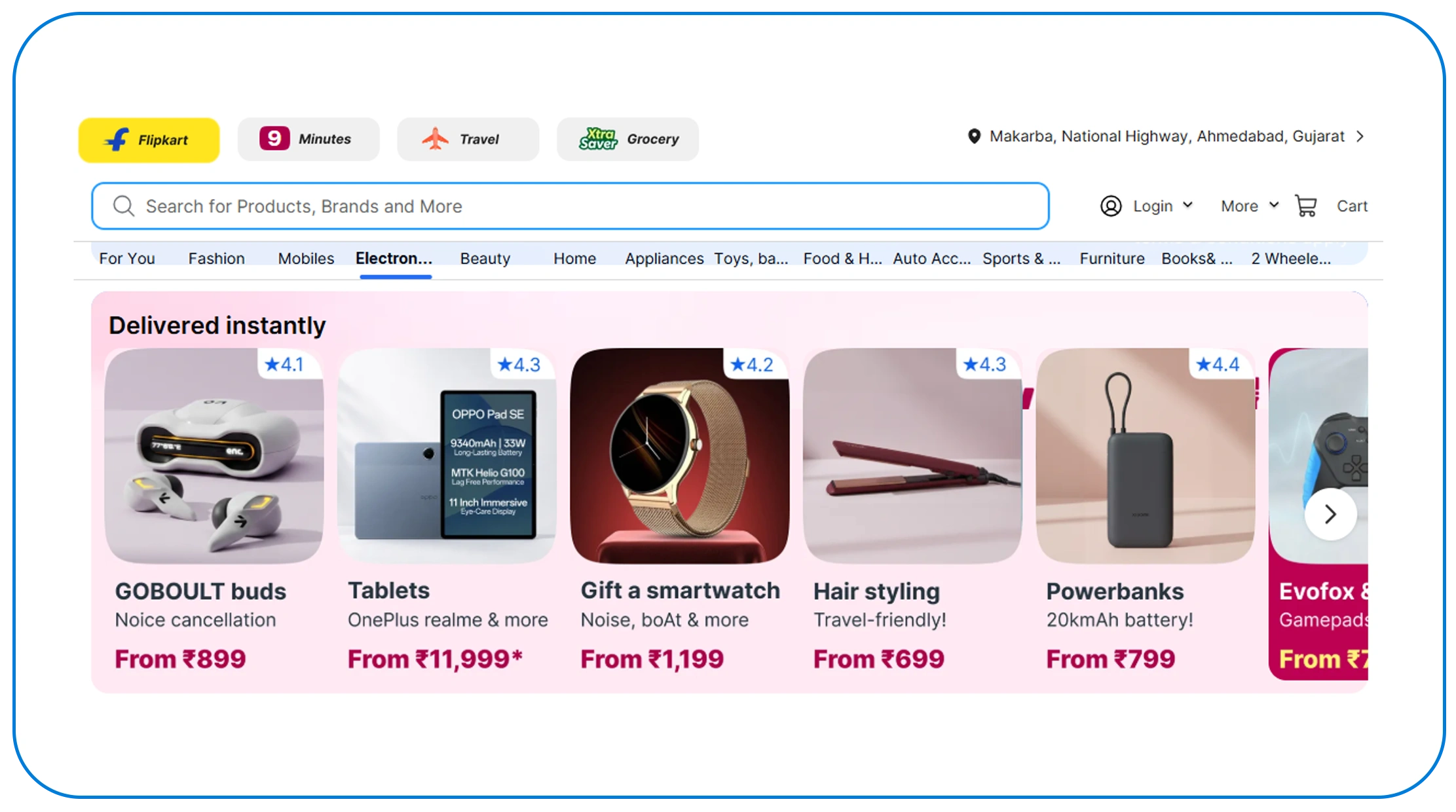
The evolution of Indian e-commerce between 2020 and 2026 shows why structured marketplace data has become increasingly important. The pandemic accelerated online shopping in 2020, while subsequent years brought broader adoption across smartphones, electronics, fashion, appliances, and everyday categories. One industry estimate places India's e-commerce market at $46.3 billion in 2020, rising to $61.0 billion in 2021, $74.8 billion in 2022, $91.6 billion in 2023, $112.1 billion in 2024, $136.9 billion in 2025, and $167.0 billion in 2026. These figures are an industry estimate rather than a single universally accepted market series, but they illustrate the scale trajectory.
| Year | India E-commerce Market Estimate | Data Implication |
|---|---|---|
| 2020 | $46.3B | Rapid shift toward online purchasing |
| 2021 | $61.0B | Growing digital product discovery |
| 2022 | $74.8B | Greater marketplace competition |
| 2023 | $91.6B | More complex assortment and pricing |
| 2024 | $112.1B | Stronger demand for real-time intelligence |
| 2025 | $136.9B | More sophisticated competitive monitoring |
| 2026 | $167.0B | Increasing importance of automated data |
The shift means brands can no longer rely on occasional snapshots of marketplace information. Consider a Samsung smartphone, Apple iPhone, boAt earbud, Lenovo laptop, or Philips appliance. Its price can change because of promotions, seller competition, bank offers, inventory conditions, or seasonal campaigns. A rating can also change as new customers submit feedback.
A structured extraction workflow creates historical observations that can be compared over time. Teams can identify whether a competitor consistently sells below a target price, whether discounting intensifies around major events, or whether certain products repeatedly move out of stock.
This is where Flipkart product data scraping for ecommerce analysis becomes valuable. Product records can be standardized and analyzed across categories, brands, sellers, and price bands. Analysts can use the information to benchmark assortments, compare competing SKUs, identify pricing gaps, and understand marketplace positioning.
The approach is particularly useful during high-volume events. Flipkart's 2024 Big Billion Days generated more than 33 crore visits during Early Access and Day 1, while Flipkart reported faster delivery coverage across more than 19,000 pin codes.
Build a structured marketplace intelligence pipeline to monitor product movements, pricing changes, and competitive positioning at scale.
Monitoring Stock and Delivery Signals More Effectively
Availability has become nearly as important as price. A product listed at an attractive price has limited competitive value if it is unavailable for purchase. This makes inventory and delivery information important inputs for marketplace analysis.
Between 2020 and 2026, online shoppers became increasingly accustomed to convenient fulfillment, faster delivery, and transparent availability information. As India's online retail ecosystem expanded, retailers also began competing on convenience alongside price and assortment. Euromonitor reports that Indian retail e-commerce remained highly concentrated in 2025, with Flipkart Internet and Amazon.in together accounting for 56% of value share.
| Period | Marketplace Development | Monitoring Opportunity |
|---|---|---|
| 2020 | COVID-driven online adoption | Track digital assortment |
| 2021 | Strong e-commerce expansion | Monitor SKU availability |
| 2022 | Increasing marketplace competition | Compare seller and stock signals |
| 2023 | Broader online category adoption | Track delivery and inventory |
| 2024 | Large-scale festive shopping | Monitor promotional availability |
| 2025 | More competitive marketplace landscape | Automate recurring checks |
| 2026 | Greater data-driven retail maturity | Integrate live intelligence |
A Flipkart API for product availability data can help teams collect availability signals systematically instead of relying on analysts to inspect individual pages. Depending on the available source fields, businesses can monitor in-stock or out-of-stock status, delivery estimates, seller information, and location-related fulfillment signals.
For example, an electronics manufacturer may track a Samsung television across multiple sellers. If one seller becomes unavailable while another remains active at a higher price, that movement can provide useful competitive context. A laptop brand could similarly monitor Lenovo or HP products to identify recurring availability differences.
Availability data can also be combined with price information. A sudden price increase accompanied by reduced availability may represent a different market condition from a price increase caused by a promotional strategy. Historical observations allow analysts to distinguish these patterns more effectively.
Real Data API's current Flipkart offering describes product, inventory, and delivery information, including stock status and pincode-level delivery estimates. Its API also supports recurring and bulk requests, making it suitable for larger monitoring programs.
This type of structured data can feed retail dashboards, competitive intelligence systems, pricing engines, or internal databases.
Turning Customer Feedback Into Product Intelligence
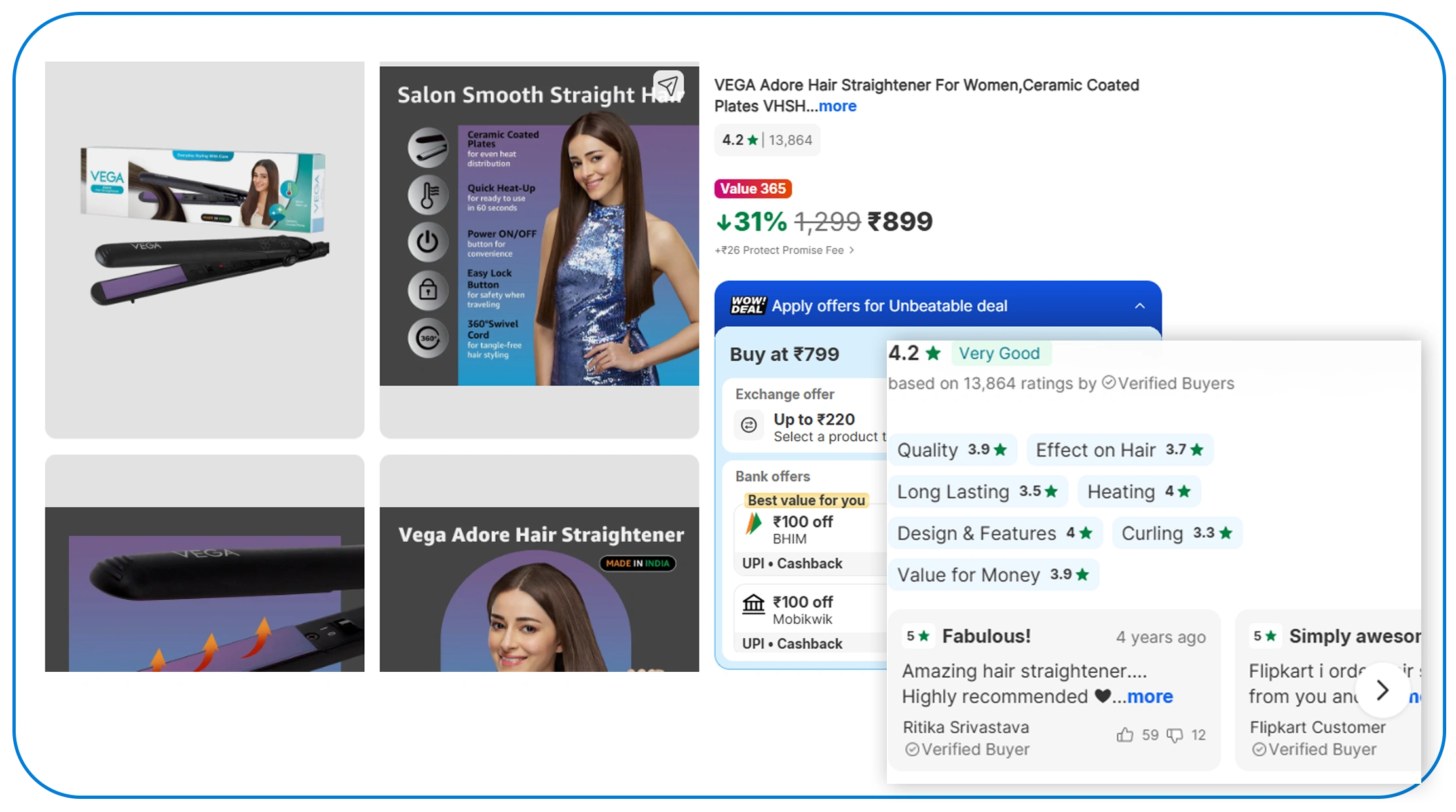
Customer reviews are one of the richest sources of qualitative marketplace information. A product's average rating provides a high-level signal, but individual review text can reveal why customers are satisfied or dissatisfied.
From 2020 onward, the growing importance of online purchasing made reviews increasingly influential in product evaluation. By 2026, businesses can use review data alongside product specifications, prices, seller information, and availability to create a more comprehensive view of marketplace performance.
| Review Signal | Example Insight |
|---|---|
| Average rating | Overall customer perception |
| Rating count | Depth of customer feedback |
| 5-star reviews | Product strengths |
| 1-2 star reviews | Recurring pain points |
| Review text | Specific customer experiences |
| Review date | Changes in perception |
| Verified-purchase indicator | Additional review context |
Businesses can extract Flipkart product reviews and ratings to examine customer responses across products and competitors. For example, reviews of Apple iPhones may reveal recurring comments about battery life, camera performance, or software experience. Reviews for Philips air fryers could highlight cooking performance, capacity, cleaning, or durability.
When collected consistently, review data can be classified into themes such as quality, packaging, delivery, performance, value for money, durability, design, or usability.
This also makes it possible to compare products with similar specifications. A retailer could examine whether a higher-priced Sony headphone receives stronger feedback than a lower-priced competing boAt model. A brand could identify whether complaints about a particular product feature are increasing over time.
Real Data API's Flipkart offering includes average ratings, review counts, star breakdowns, and individual review text with attributes such as rating, date, and verified-purchase information where available.
The analytical opportunity extends beyond sentiment. Review volumes can be tracked against pricing events, promotions, and availability changes. If a product receives a sudden increase in negative reviews after a model revision, for example, a brand may identify the change earlier than it would through traditional market research.
Turn marketplace reviews into structured customer intelligence that supports product improvement, benchmarking, and competitive strategy!
Get Insights Now!Building an API-First Data Pipeline
An API-first approach changes how marketplace information is consumed. Instead of building an internal scraping infrastructure and continuously maintaining page parsers, teams can request structured information through defined endpoints.
From 2020 to 2023, many organizations expanded their data-collection capabilities as e-commerce analytics became more important. Between 2024 and 2026, the emphasis has increasingly shifted toward automation, integration, and near-real-time decision-making.
| Year | Data Strategy Trend | Business Requirement |
|---|---|---|
| 2020 | Manual and semi-automated research | Basic marketplace visibility |
| 2021 | Growing data volumes | Scalable extraction |
| 2022 | Competitive monitoring | Recurring data collection |
| 2023 | Analytics integration | Standardized datasets |
| 2024 | Real-time retail decisions | Faster refresh cycles |
| 2025 | Automated intelligence | API and workflow integration |
| 2026 | AI/data-driven commerce | Machine-ready marketplace data |
A Flipkart API can provide structured product information to applications without requiring analysts to repeatedly collect information from web pages. Real Data API currently describes endpoints for products, searches, reviews, offers, sellers, bulk requests, and categories.
For example, a pricing platform could request current product data for a defined set of Samsung, Apple, Xiaomi, or Lenovo products. The returned data could then flow into a database where historical observations are stored.
The same architecture can support:
- Pricing dashboards
- Competitor monitoring systems
- Product comparison engines
- Recommendation systems
- Review analytics
- Inventory monitoring
- Market research platforms
- Retail intelligence applications
The API approach also provides flexibility. A business may begin with a few hundred products, validate the workflow, and then expand monitoring to thousands or millions of SKUs.
Real Data API reports 99.9% uptime SLA, an average response time below three seconds, and a 99.4% successful extraction rate on its current Flipkart API page. These are provider-reported performance figures, so they should be evaluated against a company's own workload and service requirements.
The key advantage is operational simplicity: applications consume structured data rather than having to manage the entire extraction, rendering, parsing, and maintenance layer themselves.
Creating Historical Marketplace Datasets
A single marketplace snapshot can answer what is happening now. A historical dataset can help explain what has changed.
From 2020 through 2026, e-commerce has become more dynamic, with pricing events, new product launches, changing sellers, evolving customer reviews, and seasonal campaigns producing frequent marketplace changes. A structured dataset preserves those observations for later analysis.
| Dataset Field | Potential Business Use |
|---|---|
| Product name | Product identification |
| Brand | Brand benchmarking |
| Category | Category analysis |
| Product ID/FSN | SKU-level tracking |
| Selling price | Price monitoring |
| MRP | Discount calculation |
| Discount | Promotion analysis |
| Rating | Customer perception |
| Review count | Engagement analysis |
| Seller | Seller competition |
| Availability | Stock monitoring |
| Specifications | Product comparison |
| Scraped date | Historical analysis |
A Flipkart Dataset can bring these fields together in a standardized structure. Real Data API's published dataset example includes product IDs, names, brands, category hierarchy, prices, MRP, discount, availability, seller information, ratings, colors, sizes, and other product attributes.
Historical data makes several analytical use cases possible. A retailer can calculate price movement across a six-month period. A brand can compare its average marketplace price with competitors. A product manager can investigate whether review ratings changed after a product update.
Consider a smartphone category containing Apple iPhone, Samsung Galaxy, OnePlus, Xiaomi, and Google Pixel products. A historical dataset could show how prices changed before and after festive sales, how availability fluctuated, and whether customer ratings moved alongside those changes.
The same principle applies to laptops, televisions, appliances, headphones, fashion, and home products.
A dataset also supports machine learning and business intelligence because information can be standardized into consistent fields. Analysts can calculate averages, identify outliers, create price bands, measure discount depth, compare ratings, and build time-series views.
The important point is that historical marketplace intelligence should preserve the observation date. Without timestamps, a business may know a product's current price but cannot determine whether it represents a normal market level, a temporary promotion, or an unusual event.
Scaling Product Intelligence Across Categories
Large marketplaces contain an enormous range of products, making scalability a central requirement. A monitoring workflow that works for 100 products may not work efficiently for 100,000.
Between 2020 and 2026, the increasing size and complexity of Indian e-commerce have made automated data workflows more valuable. IBEF estimates India's e-commerce industry at $125 billion in 2024 and projects $345 billion by 2030.
| Scale | Typical Requirement |
|---|---|
| 100 SKUs | Pilot monitoring |
| 1,000 SKUs | Automated recurring extraction |
| 10,000 SKUs | Bulk processing and validation |
| 100,000 SKUs | Scheduling and scalable infrastructure |
| 1M+ SKUs | High-volume API architecture |
A Flipkart Scraper, Flipkart Scraping API for product data extraction can support product-level collection across categories such as smartphones, laptops, televisions, appliances, fashion, beauty, and home products.
Scalability becomes particularly important during events such as Big Billion Days. Flipkart reported more than 33 crore visits during Early Access and Day 1 of the 2024 event, showing how quickly marketplace activity can scale during major shopping periods.
A scalable workflow can prioritize high-value products, schedule recurring requests, process bulk product IDs, and store historical results. Real Data API says its Flipkart infrastructure supports bulk requests of up to 10,000 FSNs per batch job and scheduled requests, while also providing search, product, review, offers, seller, and category endpoints.
This creates opportunities for different teams:
- Pricing teams: Compare competitor prices and discounts.
- Brand teams: Monitor product positioning and seller activity.
- Retailers: Track availability and assortment changes.
- Product teams: Analyze ratings and customer complaints.
- Market researchers: Build category-level datasets.
- Data teams: Feed structured marketplace records into analytical systems.
The value comes from connecting these signals rather than analyzing each independently. Price, availability, ratings, reviews, seller information, and specifications together create a much richer picture of marketplace performance.
Scale your marketplace monitoring from a small product list to a structured, automated intelligence pipeline.
Why Choose Real Data API?
For businesses that need recurring marketplace information, the advantage of an API-based approach is reduced infrastructure complexity. Real Data API's Flipkart solution provides structured JSON or CSV output and supports product, search, review, offers, seller, category, and bulk workflows.
The platform also describes real-time extraction, multi-seller resolution, scheduled requests, historical price tracking, and custom field selection. This allows businesses to request only the information relevant to their applications rather than processing complete pages themselves.
For example, a pricing team may focus on selling price, MRP, discount, seller, and availability, while a customer-insights team may prioritize ratings, review counts, and individual review text.
The API approach can also support integration with Python, Node.js, cURL, databases, dashboards, and other REST-compatible applications. According to the provider, the service offers a consistent JSON schema and JSON, CSV, or webhook delivery options.
For organizations moving from manual research to automated marketplace intelligence, Flipkart scraper for product data extraction capabilities can therefore become part of a broader data architecture rather than functioning as a standalone scraper.
Conclusion
The rapid development of India's e-commerce market between 2020 and 2026 has made marketplace intelligence increasingly important. Product prices, reviews, ratings, seller activity, specifications, and availability can change frequently, creating both challenges and opportunities for brands and retailers.
A structured data workflow enables businesses to move beyond occasional marketplace checks and build continuous intelligence. Flipkart scraper for product data extraction can support pricing analysis, customer sentiment research, product benchmarking, assortment intelligence, seller monitoring, and stock analysis.
With an API-first architecture, these datasets can flow directly into databases, dashboards, analytics platforms, and internal applications. Real Data API provides structured Flipkart endpoints designed for these types of workflows.
Start building a scalable Flipkart data pipeline to turn product, pricing, review, rating, and availability signals into actionable e-commerce intelligence!
FAQs
What data can a Flipkart product scraper collect?
A structured workflow can collect product names, brands, categories, prices, MRP, discounts, sellers, ratings, reviews, specifications, availability, images, variants, and other publicly available product attributes.
How can Flipkart data support competitive pricing?
Historical price and discount observations help brands compare competitors, identify pricing gaps, monitor promotional changes, analyze price positioning, and understand marketplace movements across products and categories.
Can review data be used for sentiment analysis?
Yes. Ratings, review counts, review text, dates, and other available review attributes can be organized for sentiment classification, topic analysis, complaint detection, product benchmarking, and customer-feedback research.
Can businesses monitor product availability?
Yes. Structured availability information can help businesses identify in-stock and out-of-stock products, compare seller availability, monitor delivery signals where available, and analyze inventory-related competitive movements.
How can Real Data API simplify Flipkart data collection?
Real Data API provides structured marketplace endpoints that can deliver product, pricing, reviews, sellers, offers, categories, and availability-related information through an API, reducing the need to maintain extraction infrastructure internally.
Latest posts
How A Flipkart Scraper For Product Data Extraction Tracks Product Reviews, Ratings, Prices, And Availability
How Amazon API for real-time ecommerce data Solves Pricing, Availability, and Competitor Monitoring Challenges?
How to Track Prices, Products, and Competitors with Meesho Data Scraping for Ecommerce Market Intelligence?

Indiamart Data Extraction For B2B Market Intelligence - Track Products, Competitors, And B2B Pricing Trends






.png)