.gif)
.png)

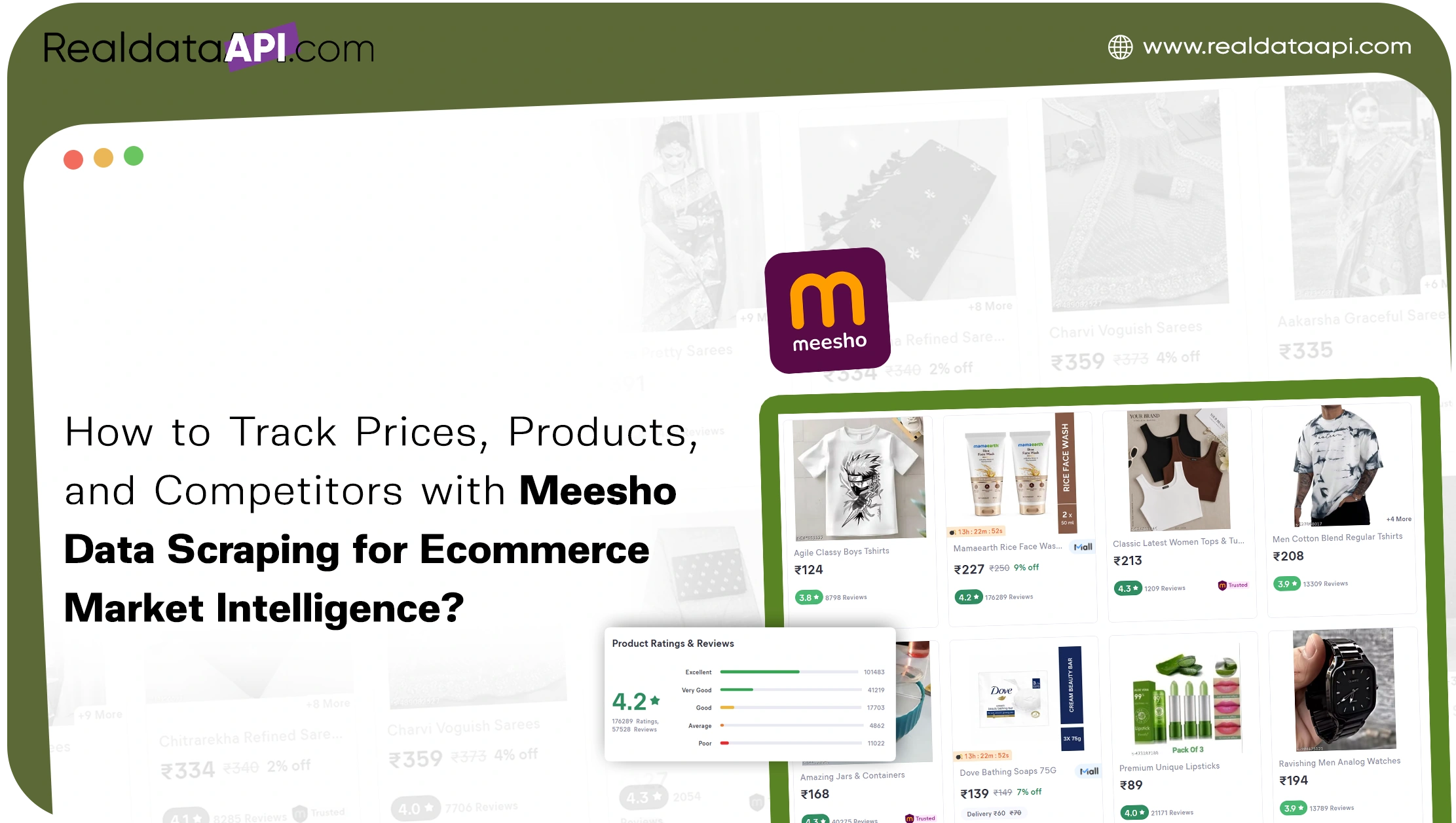
TL;DR
- Meesho data scraping for ecommerce market intelligence helps ecommerce teams systematically monitor product listings, prices, sellers, discounts, ratings, and competitive changes across a fast-growing marketplace environment.
- A structured Meesho API workflow can turn marketplace information into usable datasets for price benchmarking, assortment analysis, competitor monitoring, product discovery, and market research.
- From 2020 to 2026, India's ecommerce ecosystem expanded substantially, increasing the importance of timely marketplace intelligence. IBEF projects India's ecommerce market to reach about US$163 billion in 2026.
Introduction
Businesses cannot make reliable ecommerce decisions by looking at a handful of marketplace pages manually. They need structured information that shows how product prices, sellers, availability, discounts, ratings, and assortments change over time. Meesho data scraping for ecommerce market intelligence provides a practical way to collect and organize these marketplace signals for competitive analysis.
A data collection workflow can capture fields such as product name, category, seller, selling price, original price, discount, rating, review count, availability, product URL, and collection timestamp. Teams can then compare historical snapshots to identify price movements, new product launches, seller activity, and assortment changes.
A Meesho API can further support automated access to structured ecommerce datasets where an appropriate data-access method is available. For companies building dashboards, pricing systems, research databases, or competitor-monitoring workflows, API-based delivery can reduce repetitive data handling and make information easier to integrate into existing analytics systems.
The opportunity is significant because India's ecommerce market has expanded rapidly. IBEF reports an Indian ecommerce market size of US$67 billion in 2021, US$84 billion in 2022, US$102 billion in 2023, US$125 billion in 2024, US$145 billion forecast for 2025, and US$163 billion forecast for 2026.
The core question is simple: How can ecommerce businesses track Meesho prices, products, and competitors efficiently? The answer is to build a repeatable data pipeline that captures marketplace information, normalizes it, stores historical snapshots, and converts those records into actionable intelligence.
How can businesses build a reliable marketplace data pipeline?

The first step is deciding what information actually supports a business decision. A retailer interested in price intelligence may prioritize SKU, selling price, list price, discount, seller, rating, review count, and timestamp. A market researcher may additionally need category, brand, product attributes, ranking signals, and availability.
The collection layer should then capture the required fields at a consistent frequency. Daily monitoring may be sufficient for broad assortment research, while high-volatility categories can benefit from more frequent snapshots.
The 2020-2026 period illustrates why historical comparison matters. In 2020, pandemic-related behavioral changes accelerated online shopping. By 2021 and 2022, ecommerce adoption continued expanding. In 2023 and 2024, businesses increasingly focused on digital marketplaces, seller ecosystems, and price competition. By 2025 and 2026, broader ecommerce growth and expanding online retail adoption made automated competitive monitoring increasingly valuable. IBEF estimates India's ecommerce market at US$125 billion in 2024 and forecasts US$163 billion for 2026.
| Year | India ecommerce market | Business implication |
|---|---|---|
| 2020 | Market transition year | Online buying accelerated |
| 2021 | US$67B* | Digital marketplace adoption expanded |
| 2022 | US$84B* | Product and seller competition increased |
| 2023 | US$102B* | Larger datasets became useful for benchmarking |
| 2024 | US$125B* | Structured marketplace intelligence gained importance |
| 2025 | US$145B forecast* | More opportunities for automated monitoring |
| 2026 | US$163B forecast* | Scalable ecommerce intelligence becomes increasingly relevant |
*2021-2026 figures are IBEF market estimates/forecasts; 2020 is included as a contextual milestone rather than a directly comparable market-size figure.
For decision-makers, the practical objective is not simply collecting more records. It is collecting the right fields at the right frequency, preserving historical versions, and making the information accessible to pricing, product, merchandising, and strategy teams.
What can an ecommerce-focused scraper capture from Meesho?
A marketplace data pipeline should be designed around specific analytical questions rather than generic page extraction. For example, a pricing team may ask which products experienced the largest price changes during a promotional period. A merchandising team may ask which categories are gaining new listings. A competitor team may want to compare sellers offering similar products.
Meesho scraper API for ecommerce data workflows can be structured around these requirements. Typical fields include product title, SKU or product identifier where available, category, seller information, pricing, discounts, ratings, reviews, availability, product URL, and collection timestamp.
From 2020 through 2026, the broader Indian ecommerce environment moved toward increasingly data-driven decision-making. IBEF's market series shows growth from US$67 billion in 2021 to a forecast US$163 billion in 2026. That expansion means retailers and brands can face more products, sellers, categories, and pricing events to monitor.
| Data field | Example business use |
|---|---|
| Product title | Catalog and assortment analysis |
| Category | Category-level benchmarking |
| Selling price | Price comparison |
| Original price | Discount analysis |
| Discount | Promotion monitoring |
| Seller | Seller benchmarking |
| Rating | Product-quality signal |
| Review count | Customer-interest proxy |
| Availability | Assortment monitoring |
| Product URL | Record traceability |
| Timestamp | Historical price tracking |
A useful workflow stores every observation with a timestamp instead of replacing older records. This creates a historical dataset that can reveal whether a price change was temporary, promotional, seasonal, or part of a longer-term trend.
For example, suppose a product is observed at ₹499 in January, ₹449 in February, ₹399 during a promotional period, and ₹479 afterward. A single current snapshot only shows ₹479. Historical data reveals the full pricing pattern.
This is especially valuable for category managers and marketplace sellers who need to distinguish genuine competitive changes from short-lived promotional activity.
How can teams monitor changing product prices?
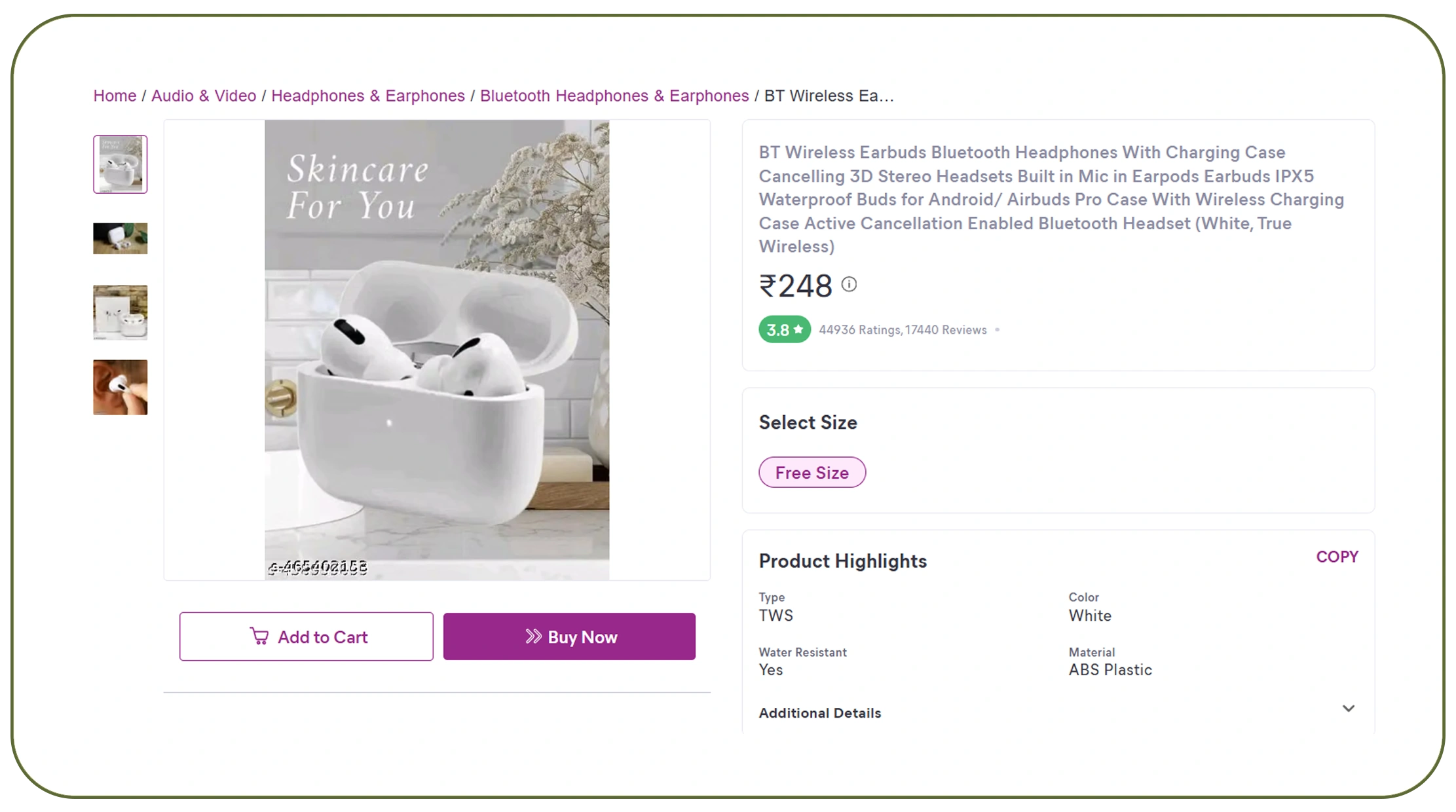
Price intelligence becomes more useful when data is collected repeatedly rather than once. A one-time dataset answers "What is the price now?" A historical dataset answers "How has the price changed, when did it change, and what happened afterward?"
Real-time Meesho product price data scraping can support monitoring systems that capture repeated observations and flag meaningful changes. Depending on business requirements, monitoring frequency can range from periodic daily collection to more frequent checks for highly dynamic categories.
The 2020-2026 ecommerce trajectory makes this increasingly important. India's ecommerce market was estimated at US$102 billion in 2023 and US$125 billion in 2024, with IBEF forecasting US$145 billion in 2025 and US$163 billion in 2026.
| Year | Market context | Pricing intelligence priority |
|---|---|---|
| 2020 | Ecommerce behavior shifted rapidly | Establish baseline prices |
| 2021 | US$67B ecommerce market* | Track competitive entry |
| 2022 | US$84B* | Monitor category pricing |
| 2023 | US$102B* | Build historical benchmarks |
| 2024 | US$125B* | Track promotions and sellers |
| 2025 | US$145B forecast* | Increase monitoring scale |
| 2026 | US$163B forecast* | Automate competitive alerts |
*Market figures from IBEF; pricing priorities are analytical recommendations rather than reported market statistics.
A useful price-monitoring model can calculate:
- Absolute price change.
- Percentage price change.
- Discount percentage.
- Minimum and maximum observed price.
- Average observed price.
- Seller-level price differences.
- Category-level price distribution.
- Frequency of price changes.
For example:
Price Change % = ((New Price − Previous Price) / Previous Price) × 100
This makes raw marketplace records easier for business users to understand.
A monitoring dashboard can then classify products into categories such as "price increased," "price decreased," "new listing," "out of stock," "discount changed," or "seller changed."
Turn recurring marketplace observations into structured pricing intelligence with an automated ecommerce data pipeline from Real Data API.
Get Insights Now!How can product listings support market research?
Product-listing intelligence is broader than price tracking. It helps businesses understand what sellers are offering, which categories are expanding, what product attributes are common, and how assortment differs across competitive groups.
Scrape Meesho product listings for ecommerce market research workflows can capture structured listing information for category discovery, competitor benchmarking, product-gap analysis, and assortment research.
Between 2020 and 2026, India's ecommerce ecosystem moved from accelerated digital adoption toward a more mature and competitive marketplace environment. IBEF reports that India's online retail market reached approximately US$80 billion in FY26 and grew 21% year over year, driven partly by quick commerce, value commerce, and digital adoption in Tier II and Tier III cities.
| Research metric | What it can reveal |
|---|---|
| Listing count | Category breadth |
| New listings | Product expansion |
| Price range | Market positioning |
| Discount range | Promotional intensity |
| Seller count | Competitive density |
| Rating distribution | Customer response |
| Review volume | Product traction |
| Product attributes | Consumer preferences |
| Availability | Assortment stability |
A research team can use these fields to construct a category-level market map. For instance, if hundreds of listings are grouped into a product category, analysts can segment them by price bands, seller type, rating, discount level, or product attributes.
This enables questions such as:
- Which price band contains the highest number of listings?
- Which products receive the strongest review activity?
- Which sellers appear across multiple categories?
- Which product attributes are increasingly common?
- Where are assortment gaps emerging?
- Which categories show unusually high promotional activity?
The advantage is scale. Instead of manually reviewing dozens of pages, analysts can work with a structured dataset and apply repeatable rules.
For brands entering the marketplace, this can support product positioning. For existing sellers, it can support assortment optimization. For investors and consultants, it can provide an additional dataset for market landscape analysis.
What does a marketplace scraper need to deliver?
A Meesho Scraper should not be evaluated only by how many pages it can process. The more important question is whether the resulting dataset is consistent, traceable, refreshable, and usable for business analysis.
A robust workflow generally includes discovery, extraction, normalization, validation, storage, and delivery. Product records should be standardized so that changes can be compared across collection dates.
The 2020-2026 period also demonstrates why scalability matters. India's ecommerce market rose from US$67 billion in 2021 to US$125 billion in 2024, with a forecast of US$163 billion in 2026.
| Year | Market size | Data requirement |
|---|---|---|
| 2020 | Contextual transition | Establish collection requirements |
| 2021 | US$67B* | Basic product datasets |
| 2022 | US$84B* | Seller and pricing fields |
| 2023 | US$102B* | Historical snapshots |
| 2024 | US$125B* | Larger category coverage |
| 2025 | US$145B forecast* | Automated monitoring |
| 2026 | US$163B forecast* | Scalable data delivery |
*IBEF figures/forecasts.
For business users, five capabilities are particularly important:
- Coverage: Collect the categories and products relevant to the business.
- Consistency: Keep field definitions stable across collection cycles.
- Historical storage: Preserve previous observations for trend analysis.
- Validation: Detect missing, malformed, or duplicate records.
- Delivery: Make structured data available through the required workflow.
The resulting dataset can feed BI dashboards, spreadsheets, databases, analytics platforms, pricing engines, or internal research tools.
A strong implementation should also distinguish between raw data and derived metrics. Raw fields preserve the marketplace observation, while derived metrics such as price change percentage, discount depth, seller count, and category growth support analysis.
This separation makes the dataset more auditable and easier to reuse.
How can an API make recurring marketplace intelligence easier?
Businesses that monitor marketplaces continuously need more than a static export. They need repeatable data delivery that can integrate with internal systems.
A Meesho Scraping API can serve as the delivery layer for structured marketplace information, depending on the permitted access and implementation model. Instead of manually moving files between teams, an API-oriented architecture can make collected data available to applications, dashboards, databases, and analytics workflows.
The business case has strengthened as India's digital commerce ecosystem has expanded. IBEF's 2026 data indicates that India's e-commerce market is valued at approximately US$159.25 billion in 2026 in one market estimate, while another IBEF series forecasts US$163 billion for 2026. Differences reflect methodology and market definitions, so businesses should treat these figures as directional rather than interchangeable.
| Year | Directional ecommerce context | Recommended data capability |
|---|---|---|
| 2020 | Rapid behavioral change | Initial collection |
| 2021 | US$67B estimate* | Product monitoring |
| 2022 | US$84B estimate* | Price and seller tracking |
| 2023 | US$102B estimate* | Historical analytics |
| 2024 | US$125B estimate* | Competitive benchmarking |
| 2025 | US$145B forecast* | Automated refresh |
| 2026 | US$163B forecast* | API-led data delivery |
*IBEF market series; 2020 is contextual.
An API-led workflow can support several operational patterns:
- Scheduled collection: Data is refreshed at defined intervals.
- Change detection: New or changed records are identified.
- Structured delivery: Data is returned in a predictable schema.
- Historical analysis: Current observations are compared against stored snapshots.
- Business integration: Data can be connected to dashboards and internal analytics systems.
For example, a pricing team can receive a dataset containing product ID, seller, current price, previous price, discount, rating, and timestamp. A dashboard can then automatically calculate price movements and identify products requiring review.
For market research teams, the same infrastructure can provide category-level listing datasets. For brands, it can support competitor benchmarking. For marketplace sellers, it can help identify pricing and assortment opportunities.
The key is to treat scraping as a data-engineering workflow rather than a simple page-copying exercise.
Why should businesses use Real Data API for marketplace intelligence?
Extract Product, Pricing, and Seller Data from Meesho through a structured workflow designed around recurring ecommerce intelligence requirements. Real Data API can help businesses organize marketplace information into datasets that are easier to analyze, compare, and integrate into existing research and analytics processes.
For a pricing team, the objective is straightforward: identify meaningful price movements without manually checking hundreds of listings. For a product team, it is understanding assortment changes and emerging product patterns. For a competitive intelligence team, it is building a historical view of sellers, prices, discounts, ratings, and product availability.
The broader ecommerce market supports the need for scalable data infrastructure. IBEF reports that India's online retail market reached approximately US$80 billion in FY26 and that Tier II and Tier III cities are contributing strongly to digital consumption growth.
Real Data API can be positioned around four practical requirements:
| Requirement | Business value |
|---|---|
| Product data | Catalog and assortment analysis |
| Pricing data | Competitive price benchmarking |
| Seller data | Marketplace competition analysis |
| Historical records | Trend and change detection |
The most valuable output is not simply a large dataset. It is a clean, structured, consistently refreshed dataset that answers specific business questions.
Teams can use marketplace intelligence for price benchmarking, competitor research, category analysis, product discovery, promotion monitoring, and assortment planning.
Meesho data scraping for ecommerce market intelligence can therefore become part of a broader data strategy where marketplace observations are transformed into recurring business signals.
Talk to Real Data API to build a structured ecommerce data workflow for product, pricing, seller, and competitive intelligence use cases!
Conclusion
Meesho data scraping for ecommerce market intelligence gives ecommerce businesses a systematic way to monitor products, prices, sellers, discounts, ratings, availability, and marketplace changes at scale. Instead of relying on occasional manual checks, companies can create historical datasets that reveal how competitive conditions evolve.
From 2020 to 2026, India's ecommerce ecosystem experienced substantial expansion. IBEF's market series places the Indian ecommerce market at US$67 billion in 2021, US$84 billion in 2022, US$102 billion in 2023, US$125 billion in 2024, and forecasts US$163 billion in 2026.
That growth creates a larger information environment for brands, retailers, sellers, consultants, and market researchers to analyze.
The strongest approach is to collect relevant fields, preserve timestamps, validate records, calculate meaningful changes, and deliver the resulting information through a workflow that business teams can actually use.
Start building a scalable Meesho marketplace intelligence workflow with Real Data API and turn product, pricing, and seller data into actionable ecommerce insights!
FAQs
What is Meesho data scraping?
Meesho data scraping is the automated collection of permitted marketplace information such as product details, prices, sellers, ratings, discounts, availability, and related metadata.
Why track Meesho prices?
Tracking prices helps businesses benchmark competitors, identify price changes, analyze discounts, understand category pricing, and support more informed ecommerce pricing decisions.
What Meesho data can businesses analyze?
Businesses can analyze product listings, categories, prices, sellers, discounts, ratings, reviews, availability, product attributes, and historical observations for competitive research.
How often should Meesho marketplace data be collected?
Collection frequency depends on the use case. Daily monitoring may suit broad research, while frequently changing categories may require more frequent observations and automated change detection.
Can Real Data API support ecommerce data workflows?
Yes. Real Data API can support structured ecommerce data workflows where permitted, helping teams organize recurring product, pricing, seller, and marketplace datasets for analytics and research.
Latest posts
Keeta scraper for monitoring food marketplace trends - Identify Discount Changes and Emerging Customer Demand
How to build a structured Nike product dataset for Product Intelligence and Retail Analytics
Allegro scraper for competitor price monitoring – How to Track Product Prices and Stay Ahead of Competitors
Ocado API data collection services for retailers - Track Competitor Prices and Deals






.png)