.gif)
.png)

TL;DR
- IndiaMART data extraction for B2B market intelligence helps procurement teams, manufacturers, distributors, and researchers convert marketplace listings into structured supplier, product, and pricing intelligence.
- An IndiaMart Scraper can support recurring collection of product attributes, seller information, prices, categories, and availability signals for competitive benchmarking.
- With historical and current datasets, businesses can identify supplier movements, price changes, assortment gaps, and emerging B2B opportunities while reducing manual research.
Introduction
IndiaMART data extraction for B2B market intelligence helps businesses systematically analyze the large volume of supplier, product, category, and pricing information available across India's B2B marketplace ecosystem. An IndiaMart Scraper can transform publicly accessible marketplace information into structured datasets that procurement teams and market researchers can analyze at scale.
The need is significant because IndiaMART reported 211 million registered buyers, 8.4 million registered suppliers, and 119 million products across 98,000 categories and 56 industries as of March 31, 2025. FY2024-25 traffic was reported at 110 crore.
For procurement managers, the challenge is not simply finding suppliers. It is comparing hundreds of offers, tracking changing prices, identifying new sellers, monitoring product availability, and understanding category-level competition. Manual research quickly becomes outdated.
A structured extraction workflow can capture product names, specifications, seller names, locations, prices, minimum order quantities, ratings, categories, and listing attributes. These records can then support supplier benchmarking, sourcing analysis, pricing intelligence, catalog comparison, and market opportunity assessment.
The result is a repeatable intelligence layer that turns marketplace observations into measurable commercial insights.
How Can Businesses Monitor B2B Prices More Efficiently?
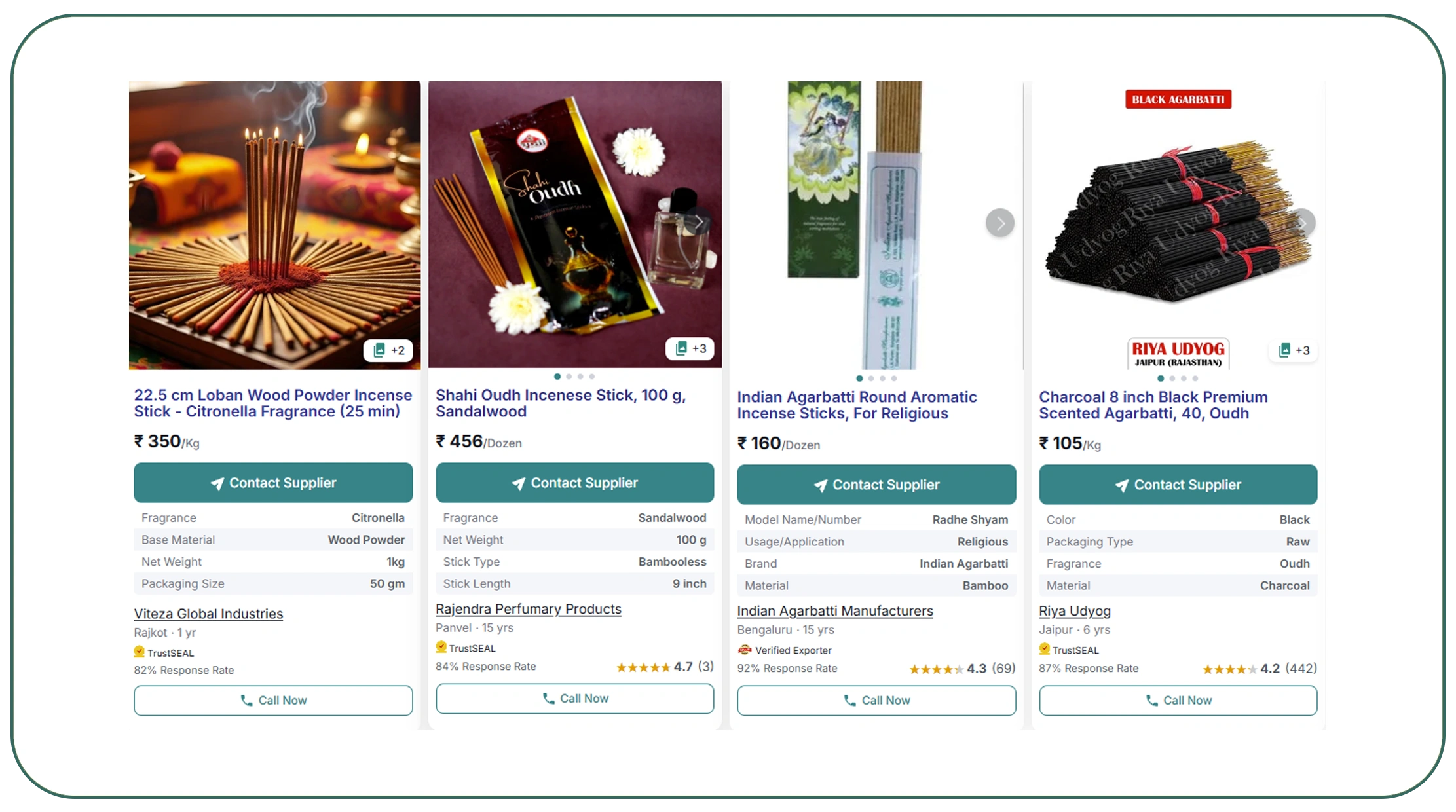
B2B pricing is rarely static. Prices can vary according to product specifications, order quantities, seller location, brand, packaging, availability, and supplier positioning. IndiaMART web data scraper for product price monitoring workflows can organize these variables into recurring datasets so buyers can compare marketplace movements rather than relying on occasional manual searches.
The historical trajectory also demonstrates why monitoring matters. IndiaMART reported more than 125 million registered buyers and 6.5 million suppliers in March 2021. By March 2022, the figures had increased to 149 million buyers and 7.1 million suppliers, with 83 million products and services listed. By March 2023, the platform reported 170 million buyers and 7.5 million suppliers.
| Period | Registered buyers | Registered suppliers | Marketplace signal |
|---|---|---|---|
| 2020 | Expanding digital B2B adoption | Growing supplier participation | Online sourcing accelerated |
| 2021 | 125M+ | 6.5M | 97,000 categories |
| 2022 | 149M | 7.1M | 83M products/services |
| 2023 | 170M | 7.5M | 202,690 paying suppliers |
| 2024 | Continued expansion | Continued expansion | Broader digital procurement |
| 2025 | 211M | 8.4M | 119M products |
| 2026 | Digital B2B ecosystem continues expanding | Increasing marketplace competition | Greater need for automated monitoring |
These figures show the growing scale of information that procurement teams may need to evaluate.
From 2020 through 2026, the practical requirement has shifted from one-time supplier discovery toward continuous market observation. A monitoring dataset can highlight price increases, decreases, new listings, discontinued products, and changes in supplier positioning. In 2026, this becomes even more relevant as India's broader e-commerce sector continues expanding; IBEF estimates India's e-commerce market reached about US$159.25 billion in 2026.
For procurement teams, the actionable objective is simple: establish a consistent baseline, collect comparable fields, normalize units, and calculate price movements over time.
How Can Supplier Intelligence Improve Competitive Analysis?
Supplier discovery becomes more valuable when businesses can compare suppliers systematically instead of reviewing individual listings. Extract IndiaMART supplier data for competitive analysis enables organizations to structure seller-level information around categories, locations, products, pricing, minimum order requirements, and other commercially relevant attributes.
The scale of the marketplace makes this approach particularly useful. IndiaMART's supplier network grew from 6.5 million suppliers in 2021 to 7.1 million in 2022, 7.5 million in 2023, and 8.4 million by March 2025.
| Year | Supplier milestone | Competitive-analysis opportunity |
|---|---|---|
| 2020 | Digital supplier discovery accelerated | Establish supplier baselines |
| 2021 | 6.5M registered suppliers | Compare supplier density |
| 2022 | 7.1M | Identify category expansion |
| 2023 | 7.5M | Track new supplier entrants |
| 2024 | Continued supplier growth | Benchmark assortment |
| 2025 | 8.4M | Scale supplier intelligence |
| 2026 | Increasing digital competition | Automate recurring comparisons |
A supplier dataset can answer questions such as: Which companies offer the same product? Which regions have the highest supplier concentration? Which sellers are entering a category? Which suppliers offer competitive minimum order quantities? Which product attributes are most frequently associated with premium pricing?
Between 2020 and 2026, these questions have become increasingly important as digital procurement expands beyond major metropolitan markets. India's e-commerce growth has also been supported by greater internet and smartphone adoption, with IBEF reporting continued expansion into Tier II and Tier III cities.
For manufacturers, supplier intelligence can reveal potential distribution partners. For wholesalers, it can identify competing sellers. For procurement teams, it can create a broader sourcing pool.
The most useful dataset should therefore preserve supplier identity, product relationships, location, pricing, category, and collection timestamp. This allows teams to distinguish genuine market movement from temporary listing changes.
What Can Structured B2B Marketplace Data Reveal?
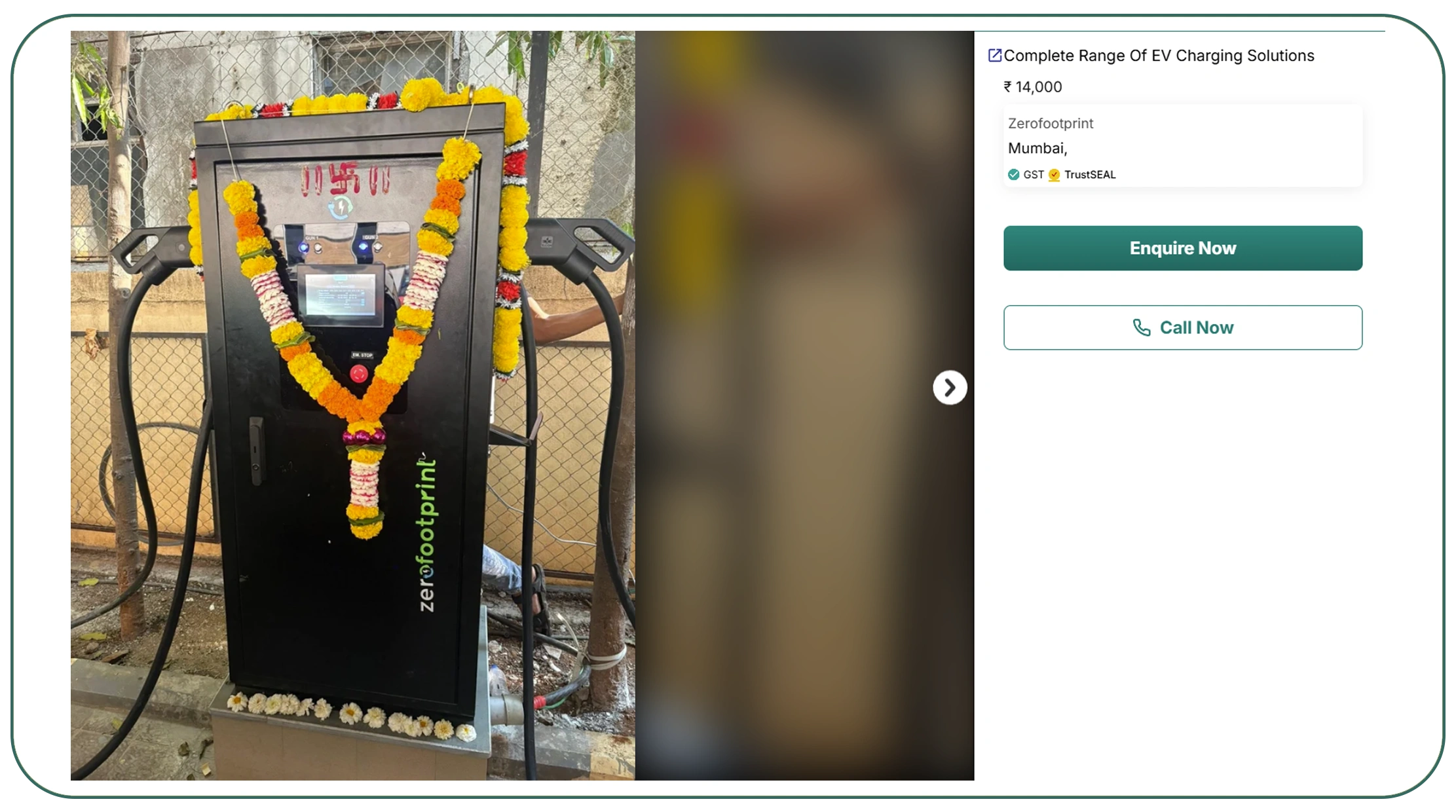
B2B data collection services using IndiaMART scraping can help organizations convert fragmented marketplace information into structured datasets for sourcing, competitive research, pricing analysis, and category intelligence.
The scale of digital commerce makes structured collection increasingly valuable. IndiaMART reported 83 million products and services listed in 2022 and 119 million products by March 2025. Its FY2024-25 traffic reached 110 crore.
| Data field | Business use |
|---|---|
| Product name | Catalog comparison |
| Product category | Category intelligence |
| Seller name | Supplier benchmarking |
| Price | Pricing analysis |
| Minimum order quantity | Procurement evaluation |
| Location | Regional sourcing |
| Product specifications | Product matching |
| Availability signals | Supply monitoring |
| Listing timestamp | Historical tracking |
| Seller/product URL | Record verification |
From 2020 to 2026, B2B research has increasingly moved toward structured, repeatable datasets. In 2020, many procurement processes still relied heavily on spreadsheets, sales contacts, and manual supplier searches. By 2022-2023, marketplace scale made systematic catalog and supplier comparison more useful. By 2025-2026, businesses can combine marketplace data with internal sales, procurement, inventory, and CRM datasets to create broader intelligence systems.
The wider Indian digital economy supports this transition. IBEF estimates India's e-commerce sector at US$125 billion in 2024 and projects substantial growth through 2030.
For a procurement manager, the value lies in reducing repetitive research. Instead of checking hundreds of supplier pages manually, teams can work from normalized records and focus on exceptions: major price changes, new suppliers, assortment gaps, or unusually competitive offers.
Turn fragmented marketplace information into structured B2B intelligence with scalable data extraction and monitoring solutions!
Get Insights Now!How Does Continuous Monitoring Strengthen B2B Competitive Analysis?
Businesses operating in competitive categories need more than a static supplier list. IndiaMART scraping for real-time B2B competitive analysis can support recurring collection of product listings, supplier information, pricing signals, and catalog changes, helping teams understand how the market evolves.
This is especially important because marketplace scale has expanded considerably. IndiaMART had 125 million registered buyers and 6.5 million suppliers in March 2021, compared with 211 million buyers and 8.4 million suppliers in March 2025. Product listings also reached 119 million by March 2025.
| Period | Key development | Intelligence implication |
|---|---|---|
| 2020 | Digital sourcing gains importance | Establish baseline datasets |
| 2021 | 125M+ buyers | Expand buyer-market analysis |
| 2022 | 83M products/services | Increase catalog coverage |
| 2023 | 170M buyers | Broaden competitive monitoring |
| 2024 | Marketplace ecosystem expands | Track category changes |
| 2025 | 119M products | Automate catalog intelligence |
| 2026 | Digital commerce continues scaling | Increase monitoring frequency |
A recurring workflow can compare today's listing against historical records. If a supplier changes a price, adds a new product, removes an item, changes an MOQ, or expands into another category, the change can become an analyzable event.
The 2020-2026 period also shows why historical context matters. A single price is not necessarily meaningful; a six-month or twelve-month price series can reveal whether the movement is seasonal, competitive, or structural.
For brands, distributors, and manufacturers, these signals can support competitor benchmarking and category strategy. For procurement teams, they can inform supplier negotiations. For market researchers, they can help quantify category expansion.
The objective should be a continuously refreshed dataset rather than an isolated scrape.
What Makes Product-Level Data Valuable for Procurement Teams?
IndiaMart Product Data Scraping can create product-level records that make large catalogs easier to compare, classify, and analyze. Product intelligence is particularly useful when multiple suppliers offer similar products with differences in specifications, pricing, packaging, minimum order quantity, or location.
IndiaMART's reported product scale illustrates the challenge. The platform had 83 million products and services listed in 2022 and 119 million products across 98,000 categories and 56 industries by March 2025.
| Product intelligence | Example analytical use |
|---|---|
| Product title | Identify matching products |
| Brand | Brand-level benchmarking |
| Specifications | Technical comparison |
| Price | Supplier price benchmarking |
| MOQ | Procurement suitability |
| Category | Assortment analysis |
| Seller | Supplier comparison |
| Location | Regional sourcing |
| Listing date | New-product tracking |
| Availability | Supply visibility |
From 2020 to 2026, B2B product research has evolved from simple product discovery toward catalog intelligence. Earlier workflows often focused on finding individual suppliers. Modern workflows can compare thousands of product records and connect them with supplier, location, pricing, and category dimensions.
This creates opportunities for product matching, assortment gap analysis, price-band analysis, and supplier segmentation. For example, a distributor could identify products with multiple competing suppliers but limited price differentiation. A manufacturer could discover categories where demand-facing listings are growing but supplier coverage remains fragmented.
India's broader e-commerce growth further strengthens the need for structured product intelligence. IBEF reports that India's online retail market reached approximately US$80 billion in FY2026, with 21% year-on-year growth.
The actionable advantage is consistency: standardized product records allow businesses to compare like-for-like information instead of manually interpreting different supplier pages.
How Can a B2B Dataset Support Long-Term Market Intelligence?
A structured IndiaMart e-commerce dataset can become a reusable intelligence asset rather than a one-time research output. It can combine product, supplier, pricing, category, location, and timestamp fields to create historical records for trend analysis.
The importance of historical data becomes clearer when viewed against marketplace expansion. Registered buyers increased from 125 million in 2021 to 149 million in 2022 and 170 million in 2023, reaching 211 million by March 2025. Supplier numbers increased from 6.5 million in 2021 to 8.4 million by March 2025.
| Dataset period | Recommended intelligence focus |
|---|---|
| 2020 | Establish market baseline |
| 2021 | Supplier and buyer expansion |
| 2022 | Product/category growth |
| 2023 | Competitive supplier movements |
| 2024 | Pricing and assortment trends |
| 2025 | Large-scale catalog benchmarking |
| 2026 | Continuous intelligence and forecasting |
From 2020 through 2026, businesses can use longitudinal datasets to identify recurring patterns instead of interpreting individual observations. Useful metrics include average listed price, median price, supplier count per category, new-listing rate, product availability, regional supplier concentration, and price volatility.
The dataset can also be integrated with internal procurement records. A company could compare external supplier pricing with its purchase costs, analyze sourcing alternatives, or identify categories where supplier competition is increasing.
India's expanding digital economy provides a strong context for this approach. IBEF projects India's e-commerce market to grow significantly beyond its 2024 valuation of US$125 billion, while its 2026 industry update estimates the market at US$159.25 billion.
For decision-makers, the key is to preserve collection dates and maintain consistent schemas. Historical consistency turns raw marketplace records into an analytical resource that can support quarterly reviews, supplier negotiations, category planning, and competitive strategy.
Why Choose Real Data API?
Choosing a data partner should depend on whether the solution can support the scale, consistency, and analytical requirements of modern B2B research. E-Commerce Dataset workflows can help organizations organize marketplace information into structured records that are easier to analyze, integrate, and refresh.
For businesses evaluating IndiaMART data extraction for B2B market intelligence, the solution should prioritize structured fields, repeatable collection, scalable processing, data normalization, and delivery formats that fit existing analytics systems.
What should buyers look for?
- Structured outputs: Product, supplier, price, category, and location fields should be organized consistently.
- Scalable collection: Large catalogs require automated workflows rather than manual copying.
- Historical tracking: Timestamped records make price and assortment changes measurable.
- Data normalization: Similar products and units should be standardized wherever possible.
- Flexible delivery: CSV, JSON, database, API, or cloud-compatible outputs can support different workflows.
- Quality checks: Duplicate detection, missing-field checks, and validation improve downstream analysis.
- Business-focused datasets: Data should be organized around procurement, competitive intelligence, sourcing, or market research objectives.
This approach is particularly useful for procurement managers, manufacturers, distributors, retailers, consulting firms, and research teams that need recurring visibility rather than a one-time spreadsheet.
Conclusion
IndiaMART has grown into a large-scale B2B marketplace, reporting 211 million registered buyers, 8.4 million suppliers, and 119 million products across 98,000 categories as of March 31, 2025. That scale creates both an opportunity and a challenge: businesses have access to extensive supplier and product information, but manually converting it into actionable intelligence is difficult.
IndiaMART data extraction for B2B market intelligence addresses this challenge by creating structured, repeatable datasets for supplier benchmarking, product comparison, pricing analysis, assortment research, and competitive monitoring.
The 2020-2026 progression also demonstrates why historical tracking matters. Supplier and buyer numbers have expanded substantially, while India's wider digital commerce ecosystem continues to grow.
For procurement teams, the priority should be turning marketplace observations into measurable signals: price movement, supplier changes, catalog expansion, regional opportunities, and competitive gaps.
Build a scalable B2B intelligence workflow with Real Data API and transform marketplace data into actionable sourcing, pricing, and competitive insights!
FAQs
1. What is IndiaMART data extraction?
It is the process of collecting structured marketplace information such as products, suppliers, prices, categories, locations, and listing attributes for procurement and competitive intelligence.
2. How can extracted B2B data help procurement teams?
Structured data enables procurement teams to compare suppliers, benchmark prices, identify alternative sourcing options, monitor product availability, and detect changes across competitive categories.
3. Can marketplace data support historical price analysis?
Yes. Timestamped records can create historical price series, allowing businesses to measure price movements, identify recurring patterns, and compare supplier pricing across defined periods.
4. What data fields are useful for B2B analysis?
Common fields include product names, specifications, supplier names, locations, prices, minimum order quantities, categories, availability indicators, and collection timestamps.
5. Why use Real Data API for marketplace intelligence?
A specialized data provider can help businesses create scalable, structured, and repeatable datasets suitable for competitive benchmarking, supplier research, pricing analysis, and broader market intelligence workflows.
Latest posts
Keeta scraper for monitoring food marketplace trends - Identify Discount Changes and Emerging Customer Demand
How to build a structured Nike product dataset for Product Intelligence and Retail Analytics
Allegro scraper for competitor price monitoring – How to Track Product Prices and Stay Ahead of Competitors
Ocado API data collection services for retailers - Track Competitor Prices and Deals






.png)



