
Introduction
India's Government e-Marketplace — universally known as GeM — is one of the most significant digital procurement transformations in the history of public sector commerce anywhere in the world. Launched in 2016 by the Ministry of Commerce and Industry, GeM has grown from a modest online catalogue for government buyers into a sprawling, multi-billion-dollar procurement ecosystem that processes millions of orders annually across every category of government expenditure — from stationery and office equipment to medical devices, IT infrastructure, construction materials, and consulting services.
As of 2025, GeM has onboarded over 70,000 government buyer organizations, registered more than 6 million sellers, and facilitated cumulative transactions exceeding ₹4 lakh crore (approximately $50 billion). Every day, thousands of new tenders, bids, reverse auctions, and direct purchase orders are published on the portal — each representing a procurement opportunity that registered sellers, market intelligence analysts, and government affairs consultants need to discover, evaluate, and act on with speed and precision.
The challenge is that GeM's scale and update frequency make manual monitoring practically impossible. A supplier registered on GeM cannot realistically browse the portal manually across every relevant product category, every buyer ministry, and every state to find the tenders most relevant to their business — let alone track bid outcomes, monitor competitor pricing, or analyze procurement trend patterns over time. This is the precise problem that a GeM Tender Data Scraping API solves: by systematically extracting, normalizing, and delivering GeM portal data in structured, queryable formats, it transforms the portal's publicly available procurement intelligence into a real-time Web Scraping Services and actionable business asset.
₹4L Cr+
Cumulative GeM GMV (2025)
70,000+
Government buyer organizations on GeM
6M+
Registered sellers on GeM portal
10,000+
New tenders published daily on GeM
What Is GeM and Why Does Its Data Matter?
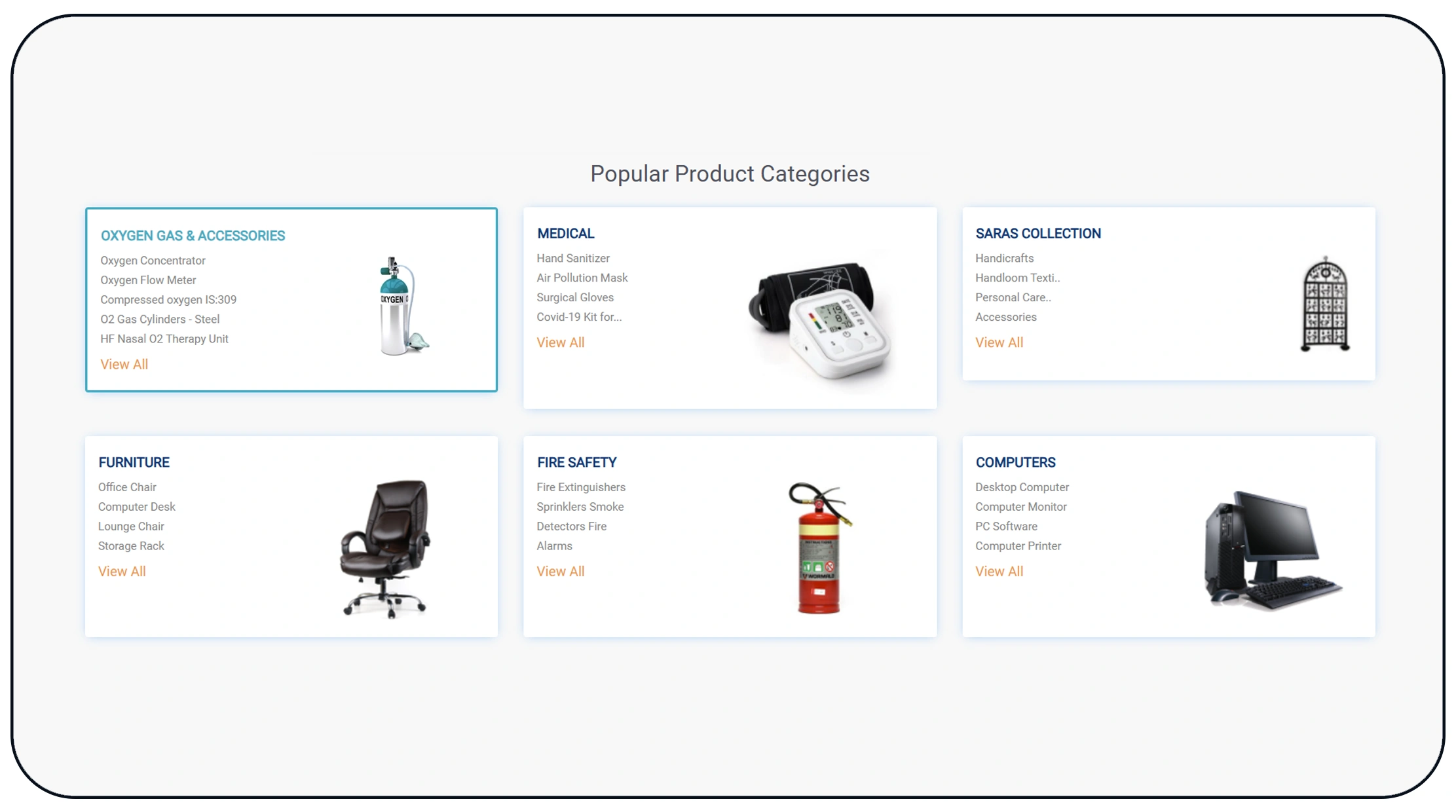
The Government e-Marketplace operates as India's centralized online procurement platform for all central government ministries, departments, public sector undertakings (PSUs), and state government organizations. Unlike traditional government tendering processes that were fragmented across department-specific portals, printed tender notices, and physical bid submissions, GeM consolidates procurement into a single digital ecosystem with standardized product catalogues, transparent pricing, competitive bidding mechanisms, and publicly accessible tender data.
The portal offers multiple procurement modes: direct purchase for low-value items, L1 (lowest price) bidding for competitive procurement, reverse auctions for price discovery, and custom bids for complex requirements. Each of these modes generates distinct data types that are valuable to different market participants — and each requires a different extraction strategy within a comprehensive Government eMarketplace data scraping program.
For suppliers, the immediate value of GeM tender intelligence is opportunity discovery: knowing which tenders have been published in their product categories before the bid window closes, understanding the estimated value and buyer ministry of each tender, and tracking historical bid outcomes to calibrate their pricing strategy. For market researchers and consultants, GeM bid data extraction provides a unique window into government spending patterns, category-level procurement volumes, and ministry-wise budget utilization that is publicly accessible but structurally complex to aggregate without automated data extraction.
"GeM tender data is India's most comprehensive, real-time public record of government procurement intent — and a GeM Tender Data Scraping API is the infrastructure that transforms that record from a browsable portal into a queryable competitive intelligence system."
Key Data Attributes from GeM Portal Data Extraction
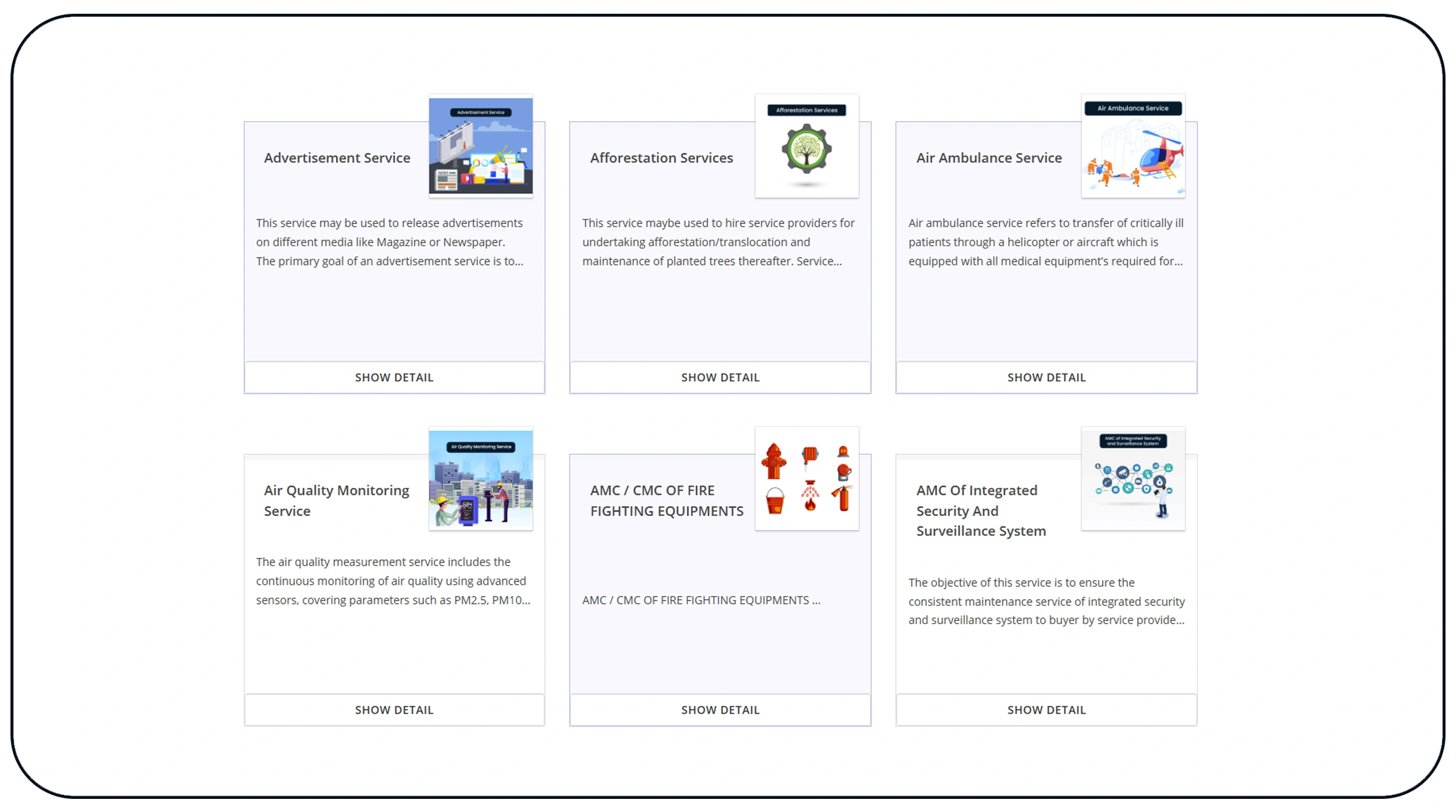
A comprehensive GeM portal data extraction service captures structured data attributes across four primary data objects: tenders, bids, sellers, and products. Each object contains the fields that procurement intelligence users need to evaluate opportunities and analyze market patterns.
| Data Attribute | Description |
|---|---|
| Tender ID & Title | Unique GeM tender identifier and descriptive title for search and classification across product categories |
| Buyer Organization | Ministry, department, PSU, or state agency publishing the tender — essential for ministry-wise spending analysis |
| Tender Category | GeM product or service category classification enabling category-level demand trend analysis and opportunity filtering |
| Estimated Value | Tender estimated or approved value in INR — the primary signal for opportunity prioritization by deal size |
| Bid Submission Deadline | Last date and time for bid submission — critical for real-time tender monitoring and alert-based opportunity notifications |
| Bid Type / Mode | Direct purchase, L1 bidding, reverse auction, or custom bid — determines the pricing strategy and competitive dynamics applicable to each tender |
| Quantity Required | Item quantity or service scope specified in the tender — enables total order value calculation and capacity assessment |
| Technical Specifications | Product or service specifications, quality standards, certifications required, and delivery terms stated in the tender document |
| Bid Outcomes & L1 Price | Winning bid prices, L1 vendor identity (where disclosed), and bid participation count for competitive benchmarking |
| Delivery Location | State and district-level delivery location for geographic opportunity filtering and logistics feasibility assessment |
| Seller Eligibility Criteria | MSME preference, startup eligibility, Make in India requirements, and turnover criteria specified for each tender |
| Tender Status | Active, closed, awarded, cancelled, or extended — enabling status-based filtering and tender lifecycle tracking |
GeM Tender API Output: JSON Structure
A well-designed Real-Time GeM Tender Data API delivers one structured JSON object per tender, paginated or bulk-delivered, in a format immediately consumable by procurement intelligence platforms, CRM systems, and analytics dashboards.
{
  "tender_id": "GEM/2026/B/4521893",
  "title": "Supply of Desktop Computers and Peripherals",
  "buyer_org": {
    "name": "Ministry of Education",
    "department": "Department of School Education and Literacy",
    "state": "Delhi"
  },
  "category": "IT Hardware and Peripherals",
  "bid_type": "L1 Bidding",
  "estimated_value_inr": 4250000,
  "quantity": 85,
  "unit": "Units",
  "bid_submission_deadline": "2026-05-15T17:00:00+05:30",
  "delivery_location": {
    "state": "Delhi",
    "district": "New Delhi",
    "pincode": "110001"
  },
  "specifications": {
    "processor": "Intel Core i5 12th Gen",
    "ram_gb": 16,
    "storage_gb": 512,
    "make_in_india": true
  },
  "eligibility": {
    "msme_preference": true,
    "startup_eligible": false,
    "min_turnover_inr": 5000000
  },
  "bid_outcome": {
    "status": "Active",
    "l1_price_inr": null,
    "total_bids_received": null
  },
  "gem_url": "https://gem.gov.in/tender/GEM-2026-B-4521893",
  "scraped_at": "2026-04-15T08:45:00Z"
}
GeM Tender Categories — Volume and Intelligence Value
| Category | Avg Monthly Tenders | Avg Tender Value | Intelligence Priority |
|---|---|---|---|
| IT Hardware & Peripherals | 8,000–12,000 | ₹12–80 Lakhs | Very High |
| Office Supplies & Stationery | 15,000–20,000 | ₹1–10 Lakhs | High |
| Medical Devices & Equipment | 3,000–6,000 | ₹25 Lakhs–5 Cr | Very High |
| Furniture & Fixtures | 5,000–8,000 | ₹5–40 Lakhs | High |
| Consulting & Services | 4,000–7,000 | ₹20 Lakhs–10 Cr | Very High |
| Vehicles & Transport | 1,500–3,000 | ₹15 Lakhs–3 Cr | Medium |
| Safety & Security Equipment | 2,000–4,000 | ₹8–60 Lakhs | High |
Key Use Cases for GeM Tender Intelligence API
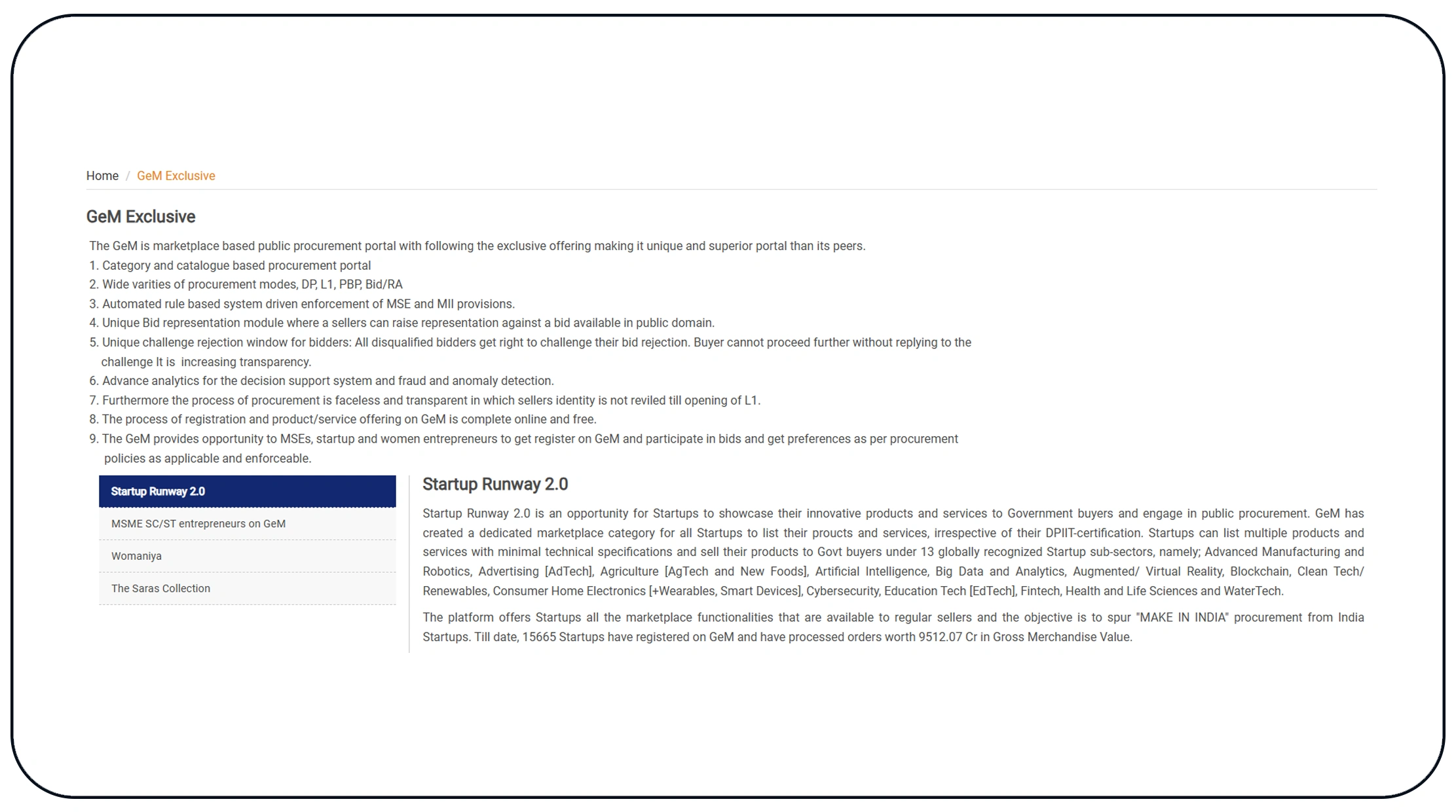
Real-Time Tender Discovery for Registered Sellers — Seller Enablement
The most immediate and commercially significant use case for a GeM Tender API is enabling registered sellers to discover relevant new tenders the moment they are published — without manual portal browsing. A GeM tender intelligence API configured with category, ministry, state, and minimum value filters delivers automated alerts to sellers' dashboards or email inboxes whenever a qualifying tender appears, ensuring zero missed opportunities within the bid submission window. For sellers managing multiple product categories across multiple buyer organizations, this real-time monitoring capability is transformative.
Competitive Bid Price Benchmarking — Pricing Strategy
GeM bid data extraction API services that capture historical bid outcomes — including L1 winning prices, participation counts, and losing bid ranges where disclosed — enable sellers to build empirical pricing models for each product category. A seller preparing a bid for desktop computers can query historical L1 prices for equivalent specifications across previous tenders from similar buyer organizations, calibrating their bid to be competitive without unnecessary margin sacrifice. This is one of the most direct financial benefits of systematic GeM auction data scraping services.
Ministry and Department Spend Analytics — Market Research
Government tender scraping solutions that aggregate GeM data at the ministry and department level over time produce a unique market research asset: a continuously updated map of government procurement spend by category, geography, and organization. Policy consultants, industry associations, market research firms, and budget analysts use this tender data monitoring API output to track how government spending priorities shift across ministries, how procurement volumes evolve across product categories through the fiscal year, and which state governments are the most active buyers in specific product segments.
GeM Seller and Competitor Monitoring — Competitive Intel
Beyond tender tracking, GeM portal data extraction services also capture seller catalogue data — including registered seller profiles, listed product prices, catalogue ratings, and order history signals. For businesses seeking to understand how competitors are pricing their products on GeM, what certifications and eligibility criteria they hold, and how active they are in specific categories, systematic GeM portal data extraction provides competitive intelligence that is publicly available but practically inaccessible without automated collection.
Technical Architecture: GeM Tender Data Scraping Infrastructure
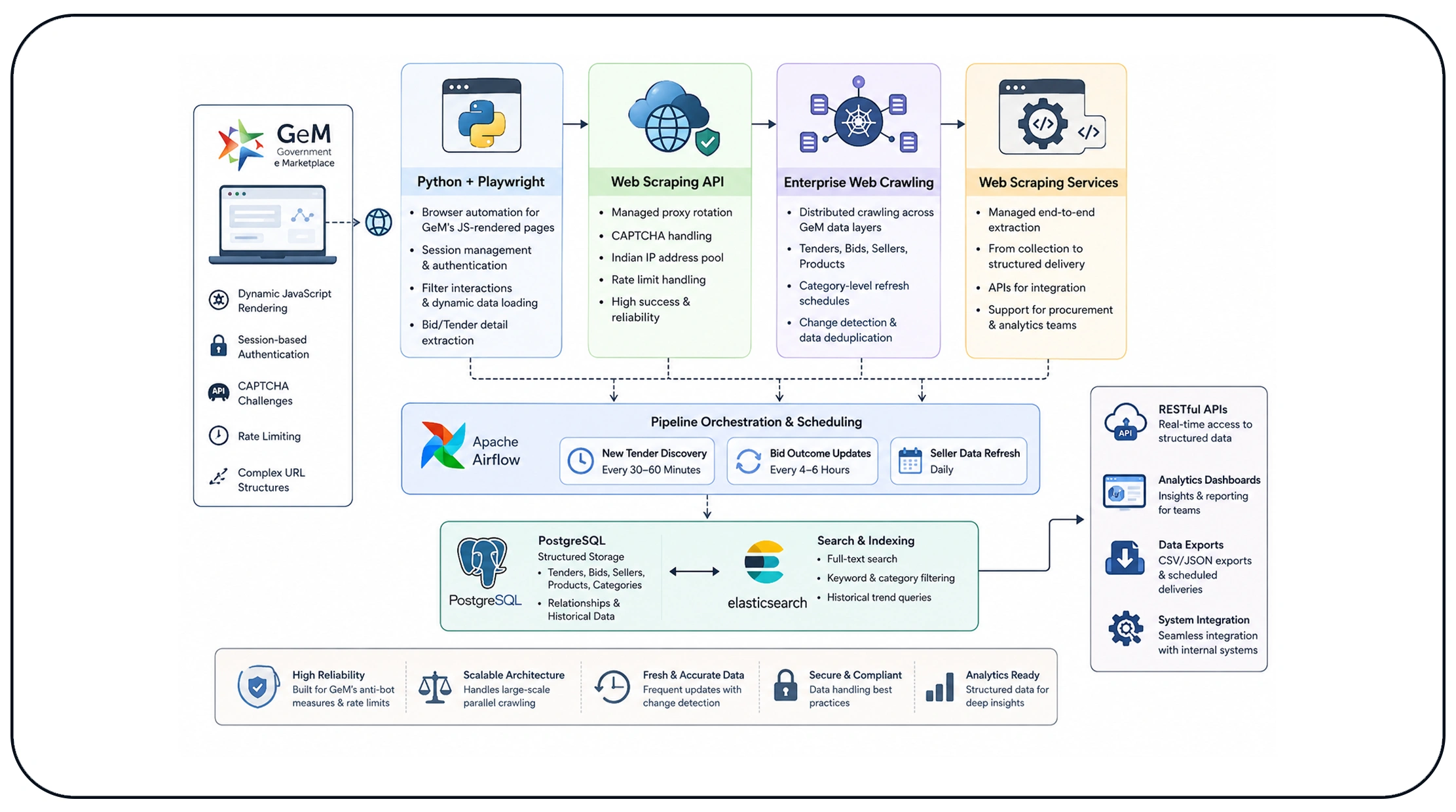
The GeM portal presents specific technical challenges for data extraction that require a purpose-built scraping infrastructure rather than generic web crawling tools. The portal uses dynamic JavaScript rendering, session-based authentication for certain data views, CAPTCHA challenges on high-frequency access, rate limiting on repeated queries, and a complex URL structure that encodes filter parameters differently across tender types, bid modes, and category hierarchies.
Python + Playwright
Browser automation for GeM's JS-rendered tender listing pages, handling session management, filter interactions, and dynamic bid detail loading.
Web Scraping API
Managed proxy rotation, CAPTCHA handling, and Indian IP address pool for sustained, reliable GeM portal data extraction without access disruption via Web Scraping API.
Enterprise Web Crawling
Distributed crawling across GeM's tender, bid, seller, and product data layers simultaneously — with configurable category-level refresh schedules and change detection.
Web Scraping Services
Managed end-to-end GeM tender data extraction for procurement teams and analytics firms without engineering resources — from collection through structured API delivery.
Apache Airflow
Pipeline orchestration scheduling GeM data collection jobs — new tender discovery every 30–60 minutes, bid outcome updates every 4–6 hours, seller data refresh daily.
PostgreSQL / Elasticsearch
Structured storage and full-text search indexing for GeM tender datasets enabling keyword-based tender search, category filtering, and historical trend queries.
GeM Tender Analytics API — Advanced Intelligence Outputs
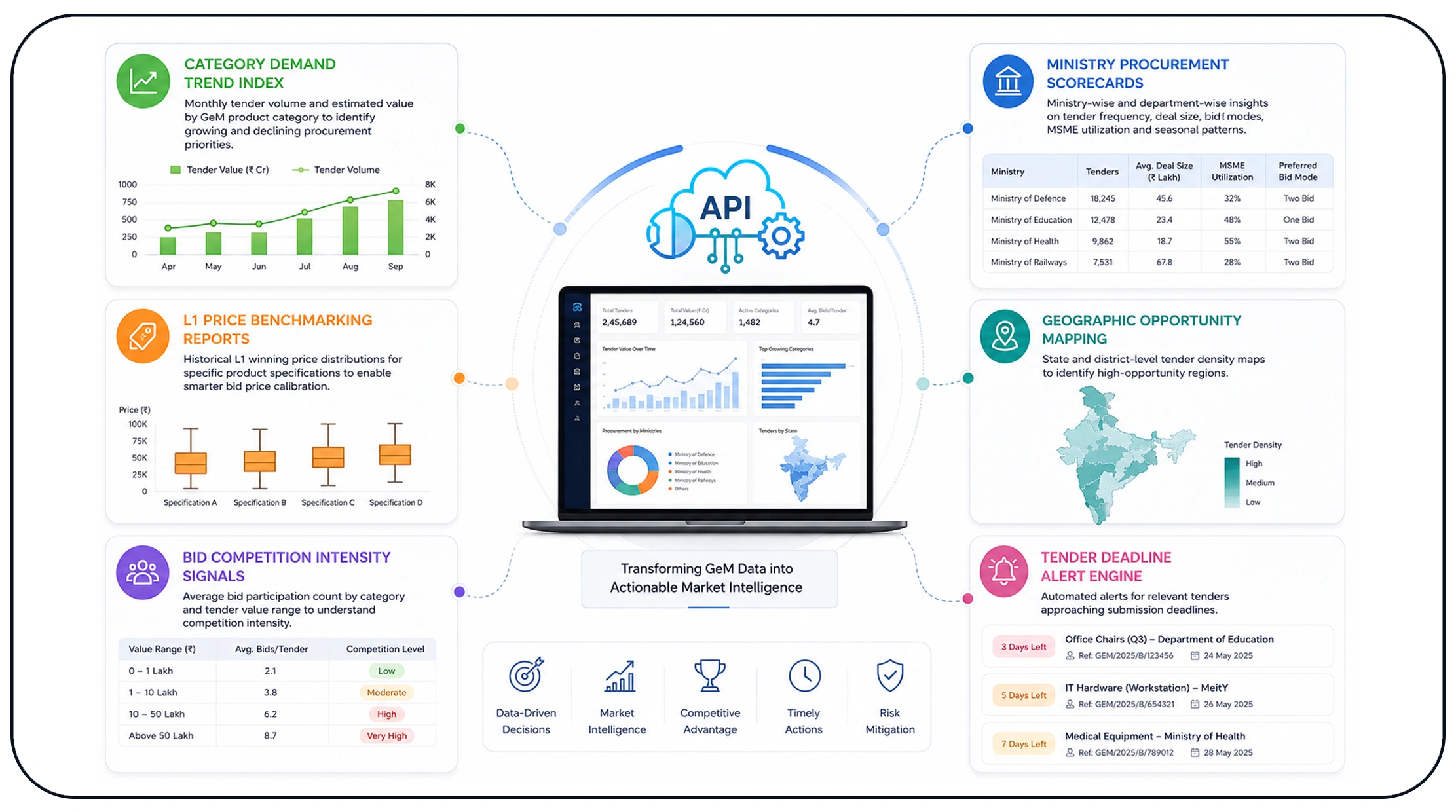
Beyond raw tender data delivery, a mature GeM tender analytics API generates computed intelligence outputs that go significantly beyond what manual portal browsing can produce — transforming structured extraction into actionable market insight.
GeM Tender Analytics API — Intelligence Output Types
- Category demand trend index — monthly tender volume and estimated value aggregated by GeM product category, tracking which categories are growing or declining in government procurement priority across fiscal quarters
- Ministry procurement scorecards — ministry-wise and department-wise procurement activity reports showing tender frequency, average deal size, preferred bid modes, MSME utilization rates, and seasonal spending patterns
- L1 price benchmarking reports — historical L1 winning price distributions for specific product specifications, enabling statistically grounded bid price calibration for registered sellers
- Geographic opportunity mapping — state and district-level tender density maps showing where procurement activity is concentrated, supporting sellers in geographic prioritization decisions
- Bid competition intensity signals — average bid participation count by category and tender value range, indicating how competitive specific segments of the GeM market are and where participation barriers are lower
- Tender deadline alert engine — automated notifications triggered when qualifying tenders approach submission deadline thresholds, ensuring sellers never miss bid windows for relevant opportunities
Who Benefits from GeM Tender Data Scraping Services?
The commercial applicability of GeM bid data extraction API services extends across a wide range of business types and use cases in the Indian market.
Registered GeM sellers — particularly MSMEs, startups, and large enterprise suppliers — benefit directly from real-time tender discovery and bid price intelligence that allows them to compete more effectively and win a greater share of government procurement. For a small manufacturer of office furniture registered on GeM, a tender monitoring API configured for their product category and target states is the difference between discovering a ₹40 lakh opportunity with three days remaining to bid, and missing it entirely.
Government affairs and procurement consultants use GeM tender analytics data to advise clients on which product categories offer the best government sales opportunities, which ministries are the most active buyers, and how to price competitively in each segment. This advisory work requires the kind of category-level trend data and historical bid outcome analysis that only systematic GeM portal data extraction can provide.
Market research firms and industry associations use GeM procurement data as a primary source for reports on government spending priorities, Make in India policy effectiveness, MSME participation rates, and sectoral procurement trends — research that would be impossibly labor-intensive without automated data collection. SaaS platforms building procurement intelligence tools for the Indian B2B market use GeM Tender API services as the data backbone for their product offerings.
Conclusion: GeM Tender Intelligence Starts with the Right API Partner
India's Government e-Marketplace has created one of the world's most transparent and data-rich public procurement ecosystems. The tens of thousands of tenders published daily across hundreds of product categories, the bid outcome data that reveals actual government transaction prices, and the seller and product catalogue intelligence that maps the competitive landscape — all of this is publicly accessible on the GeM portal. The only barrier to converting this wealth of government procurement data into business intelligence is the infrastructure to collect, normalize, and deliver it systematically.
A GeM Tender Data Scraping API, combined with a GeM tender intelligence API for analytics and a tender data monitoring API for real-time alerts, is that infrastructure. Whether the application is enabling registered sellers to never miss a relevant bid opportunity, helping procurement consultants build data-driven advisory practices, powering market research on government spending trends, or providing the data backbone for a B2B procurement intelligence SaaS platform, the data capability required is the same: clean, structured, continuously refreshed GeM portal data delivered through a reliable, scalable API.
For businesses and platforms seeking this capability without the complexity of building and maintaining GeM-specific scraping infrastructure in-house, Real Data API is the most complete and production-ready solution available. Real Data API provides a purpose-built GeM Tender Data Scraping API delivering structured, real-time tender data across all GeM categories, ministries, states, and bid types — complete with GeM bid data extraction for historical price benchmarking, GeM auction data scraping services for reverse auction intelligence, GeM portal data extraction services for seller and product catalogue monitoring, and a GeM tender analytics API for category-level procurement trend reports. All data is delivered in structured JSON format, paginated or bulk-delivered, with configurable category and geography filters, real-time alert capabilities, and enterprise web crawling infrastructure that ensures data freshness across the full GeM portal — making Real Data API the GeM tender intelligence API that procurement-focused businesses in India can build on with confidence.
Real Data API — GeM Tender Intelligence, Always Current
Access real-time GeM tender listings, bid outcomes, L1 price benchmarks, seller catalogue data, and ministry-wise procurement analytics across all categories and states — all through a single, production-ready GeM Tender Data Scraping API with enterprise web crawling infrastructure and configurable tender monitoring alerts.
All data attributes described are sourced from publicly accessible sections of the GeM portal (gem.gov.in). This article is for informational purposes only. Review GeM's Terms of Use before initiating any automated data collection program.
Latest posts
How Web Scraping Wine Market Data Via Wine-Searcher Helps Extract Real-Time Wine Market Data For Competitive Pricing?

How To Use Automated Zara Web Scraping For Fashion Market Research To Analyze Pricing, Products, And Consumer Demand?
How Meesho Marketplace Data Extraction For Businesses Solves Inventory, Pricing, And Product Assortment Problems?
How To Solve Product Data Tracking Challenges At Scale with Costco Web Data Scraper For Product Information







.png)