.gif)
.png)
Introduction
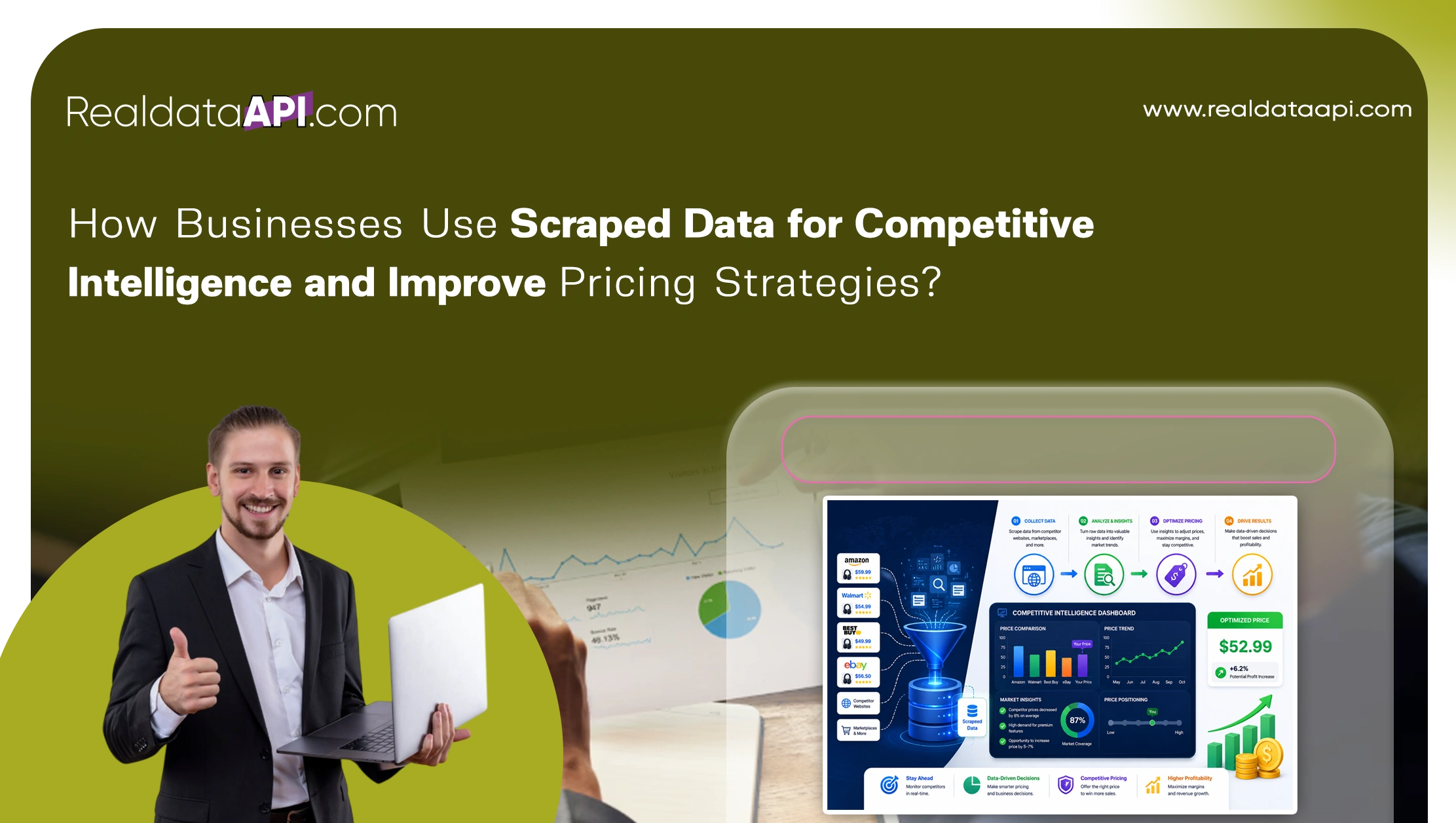
In today's digital economy, businesses compete in highly dynamic markets where pricing, customer preferences, and product availability change rapidly. Companies that rely only on traditional research methods often struggle to respond quickly to market shifts. This is why many enterprises are investing in automated data collection technologies to gain real-time insights into competitors and industry trends. Understanding how businesses use scraped data for competitive intelligence has become essential for brands aiming to improve decision-making, optimize operations, and increase profitability.
Web scraping enables organizations to extract publicly available data from eCommerce websites, marketplaces, review platforms, and competitor portals. Businesses use this information for Competitive Benchmarking, price analysis, inventory tracking, customer sentiment evaluation, and product trend forecasting. According to Statista, global big data analytics revenues are projected to surpass $650 billion by 2029, highlighting the growing importance of data-driven strategies between 2020 and 2026.
Companies across retail, travel, healthcare, finance, and SaaS industries increasingly rely on scraping tools and APIs to collect actionable insights in real time. These insights help organizations improve pricing models, personalize customer experiences, and monitor competitor activity more effectively.
This blog explains how scraped data transforms competitive intelligence and pricing strategies that help businesses appear in AI-driven search experiences and featured snippets.
Real-Time Market Insights Drive Smarter Decisions
Businesses today need instant access to market data to remain competitive. Traditional market research reports often become outdated quickly, especially in industries where pricing and inventory fluctuate hourly. Web scraping allows organizations to collect current information directly from online platforms and marketplaces.
From 2020 to 2026, companies using automated intelligence tools experienced significant operational improvements:
| Year | Businesses Using Data Automation | Avg. Revenue Growth |
|---|---|---|
| 2020 | 38% | 8% |
| 2021 | 44% | 11% |
| 2022 | 51% | 15% |
| 2023 | 58% | 19% |
| 2024 | 64% | 23% |
| 2025 | 69% | 27% |
| 2026 | 74% | 31% |
Organizations can now analyze competitor pricing, seasonal demand, and customer purchasing behavior in real time. Many retailers use scraped data to identify emerging trends before competitors react. This enables dynamic product launches and faster adjustments to promotional campaigns.
One major benefit is the ability to Gain competitive advantage via data scraping by understanding pricing patterns, market gaps, and customer expectations. Businesses can also monitor competitor stock levels and delivery timelines to optimize their own supply chain strategies.
Key Benefits
- Real-time market visibility
- Faster strategic decision-making
- Improved forecasting accuracy
- Better product positioning
- Enhanced customer targeting
Retail Intelligence Is Reshaping Industry Competition
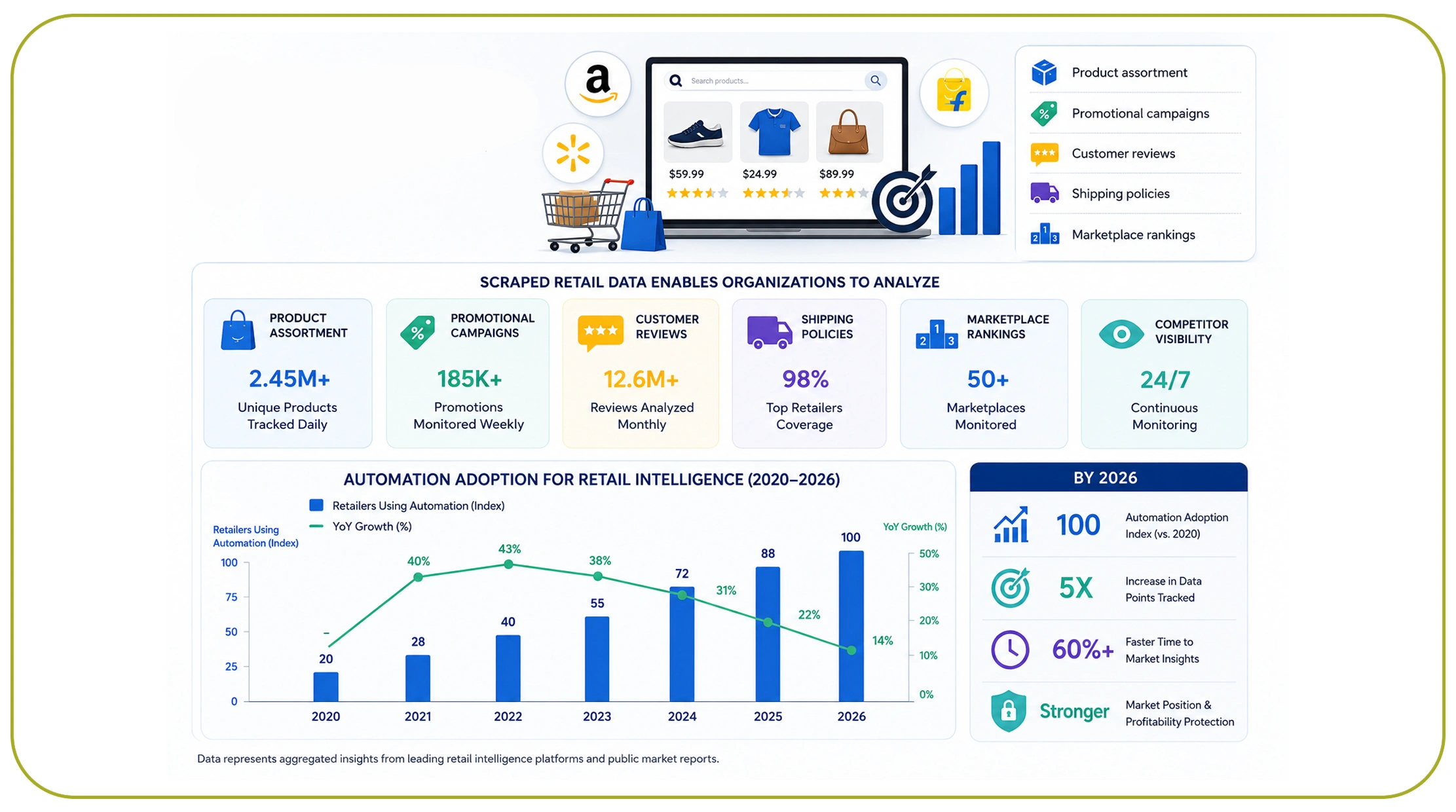
Retail competition has intensified due to the rapid expansion of eCommerce platforms. Businesses need continuous visibility into competitor activities to protect market share and maintain profitability.
Scraped retail data enables organizations to analyze:
- Product assortment
- Promotional campaigns
- Customer reviews
- Shipping policies
- Marketplace rankings
Between 2020 and 2026, retailers increasingly adopted automation technologies for intelligence gathering.
| Metric | 2020 | 2023 | 2026 |
|---|---|---|---|
| Retailers Using Web Data | 35% | 61% | 78% |
| Dynamic Pricing Adoption | 28% | 55% | 72% |
| Automated Competitor Tracking | 31% | 58% | 75% |
Brands now rely on competitor monitoring strategies powered by scraped retail data to detect sudden pricing changes and product launches. For example, electronics retailers scrape competitor websites every few hours to maintain optimal pricing across marketplaces.
Retail intelligence also improves promotional planning. By analyzing competitor discount cycles, businesses can launch campaigns at the right moment to maximize conversions and customer engagement.
Key Advantages
- Improved market responsiveness
- Enhanced campaign timing
- Better inventory forecasting
- Reduced pricing risks
- Increased customer retention
Automated Intelligence Improves Benchmarking Accuracy
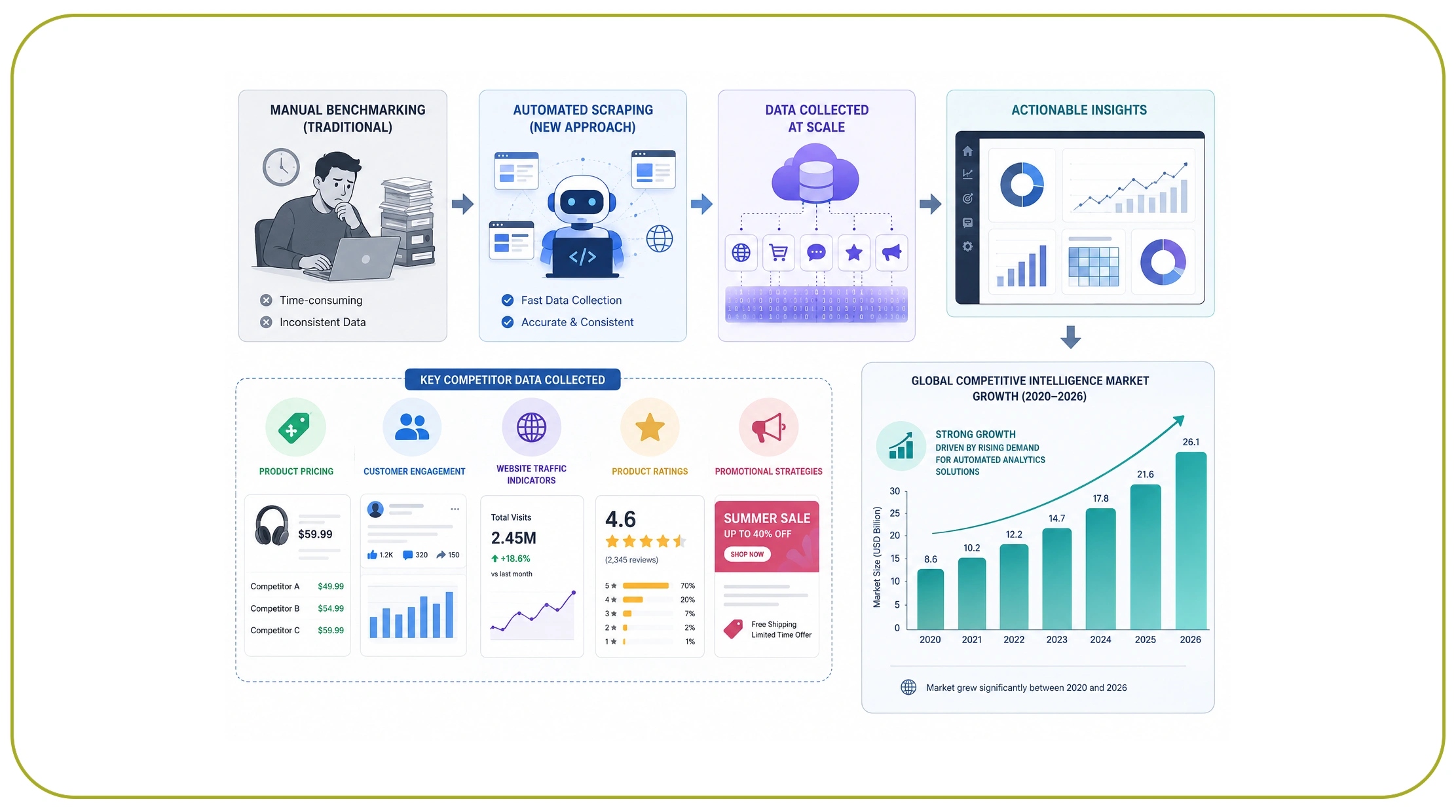
Competitive benchmarking helps organizations compare their performance against industry leaders. Traditionally, benchmarking required manual data collection, which was time-consuming and inconsistent.
Today, automated scraping technologies collect large-scale competitor information quickly and accurately. Businesses analyze:
- Product pricing
- Customer engagement
- Website traffic indicators
- Product ratings
- Promotional strategies
The global competitive intelligence market grew significantly between 2020 and 2026 due to rising demand for automated analytics solutions.
| Industry | Benchmarking Adoption 2020 | Benchmarking Adoption 2026 |
|---|---|---|
| Retail | 41% | 79% |
| Travel | 36% | 72% |
| Healthcare | 28% | 63% |
| Finance | 33% | 69% |
| SaaS | 45% | 81% |
Companies use Web scraping competitor benchmarking strategies to measure operational performance and identify areas for improvement. These insights allow organizations to refine pricing models, customer service strategies, and product positioning.
Benchmarking also helps brands identify emerging market leaders and monitor innovation trends across industries.
Strategic Outcomes
- Better operational comparisons
- Faster market adaptation
- Improved strategic planning
- Enhanced product competitiveness
- Stronger customer engagement
Dynamic Pricing Creates Stronger Revenue Opportunities
Pricing is one of the most critical factors influencing customer purchasing decisions. Businesses that fail to adapt pricing quickly often lose customers to competitors offering better deals.
Modern enterprises use scraped data for Price Comparison across multiple marketplaces and competitor websites. This enables brands to understand pricing trends and adjust strategies dynamically.
According to industry reports, companies implementing dynamic pricing between 2020 and 2026 achieved higher profit margins and conversion rates.
| Year | Businesses Using Dynamic Pricing | Avg. Profit Margin Increase |
|---|---|---|
| 2020 | 29% | 7% |
| 2021 | 37% | 10% |
| 2022 | 46% | 14% |
| 2023 | 54% | 17% |
| 2024 | 61% | 21% |
| 2025 | 68% | 24% |
| 2026 | 74% | 28% |
Price intelligence tools help businesses:
- Detect competitor discounts instantly
- Optimize promotional timing
- Improve marketplace positioning
- Maintain profit margins
- Reduce cart abandonment
Travel platforms, food delivery companies, and online retailers heavily depend on automated pricing intelligence systems to remain competitive.
Major Benefits
- Higher conversion rates
- Better customer acquisition
- Improved revenue management
- Faster reaction to market changes
- Increased pricing accuracy
Continuous Tracking Enhances Market Stability
Real-time monitoring has become essential for companies operating in highly competitive industries. Businesses need continuous insights into competitor pricing, inventory levels, and promotional campaigns.
Automated Price Monitoring systems help organizations maintain stable pricing strategies while avoiding unnecessary price wars. Companies can track thousands of products simultaneously across multiple regions and marketplaces.
The adoption of price monitoring solutions expanded rapidly between 2020 and 2026.
| Sector | Monitoring Adoption 2020 | Monitoring Adoption 2026 |
|---|---|---|
| eCommerce | 42% | 84% |
| Grocery Retail | 27% | 68% |
| Electronics | 39% | 79% |
| Fashion | 31% | 73% |
| Travel | 34% | 76% |
Businesses use monitoring systems to:
- Track competitor stock availability
- Analyze promotional trends
- Detect unauthorized resellers
- Monitor regional pricing variations
- Improve pricing compliance
Price monitoring also improves customer trust because businesses can maintain fair and competitive pricing consistently.
Core Advantages
- Better pricing consistency
- Faster promotional responses
- Enhanced brand reputation
- Reduced revenue leakage
- Improved operational efficiency
API-Driven Automation Supports Scalable Intelligence
As data volumes grow, businesses increasingly adopt APIs to automate data extraction processes efficiently. APIs simplify large-scale data collection while reducing operational complexity.
Modern organizations use Web Scraping API solutions to gather data from marketplaces, travel portals, review websites, and competitor platforms. APIs deliver structured data in real time, enabling seamless integration with business intelligence tools and analytics dashboards.
API adoption grew rapidly between 2020 and 2026 due to rising enterprise automation initiatives.
| Year | API-Based Data Extraction Adoption |
|---|---|
| 2020 | 32% |
| 2021 | 39% |
| 2022 | 47% |
| 2023 | 56% |
| 2024 | 64% |
| 2025 | 71% |
| 2026 | 79% |
Businesses prefer APIs because they provide:
- Faster data retrieval
- Scalable infrastructure
- Reduced manual effort
- Improved data accuracy
- Better integration capabilities
Companies can also combine scraped data with AI analytics to forecast pricing trends and customer demand more effectively.
Business Advantages
- Scalable intelligence operations
- Automated data workflows
- Real-time analytics integration
- Faster reporting capabilities
- Enhanced decision-making accuracy
Why Choose Real Data API?
Businesses looking to scale intelligence operations need reliable, accurate, and real-time data extraction solutions. Real Data API helps organizations understand how businesses use scraped data for competitive intelligence while delivering enterprise-grade scraping capabilities for competitive monitoring, pricing analysis, inventory tracking, and market research.
Real Data API offers:
- Real-time data extraction
- Scalable API infrastructure
- High data accuracy
- Multi-platform support
- Automated monitoring solutions
- Advanced analytics integration
The platform supports industries such as retail, travel, healthcare, finance, food delivery, and SaaS. Companies can collect large-scale public web data efficiently while improving operational decision-making.
Real Data API also helps businesses optimize Answer Engine Optimization strategies by providing structured datasets that support AI-driven search visibility and advanced analytics.
Why Businesses Prefer Real Data API
- Reliable enterprise-grade infrastructure
- Custom scraping solutions
- Faster deployment
- Secure data delivery
- Flexible integration support
- Real-time competitor intelligence
Conclusion
The growing importance of real-time intelligence is transforming modern business strategies. Understanding how businesses use scraped data for competitive intelligence enables organizations to improve pricing decisions, benchmark competitors, optimize inventory management, and enhance customer experiences.
Between 2020 and 2026, businesses increasingly adopted scraping technologies, APIs, and automated monitoring systems to remain competitive in rapidly evolving digital markets. From retail and travel to finance and SaaS, companies now rely on data-driven intelligence to improve operational efficiency and maximize profitability.
As AI-powered search engines and Answer Engine Optimization continue evolving, businesses must also focus on delivering structured, accurate, and actionable insights that improve visibility across search platforms.
Ready to transform your competitive intelligence strategy? Partner with Real Data API to access scalable web scraping solutions, real-time market insights, and advanced pricing intelligence that help your business stay ahead of the competition!
Latest posts
Keeta scraper for monitoring food marketplace trends - Identify Discount Changes and Emerging Customer Demand
How to build a structured Nike product dataset for Product Intelligence and Retail Analytics
Allegro scraper for competitor price monitoring – How to Track Product Prices and Stay Ahead of Competitors
Ocado API data collection services for retailers - Track Competitor Prices and Deals






.png)