.gif)
.jpg)
Quick Summary
- IndiaMART data scraper API helps businesses organize supplier listings, product information, contact details, and marketplace data for more efficient B2B research.
- IndiaMart E-Commerce Dataset supports supplier discovery, product comparisons, category analysis, and competitive market research.
- Structured data collection, validation, and enrichment can reduce manual research and help sales teams prioritize relevant supplier prospects.
Introduction
Finding suitable suppliers in a large B2B marketplace can be time-consuming when businesses must manually review product listings, compare prices, identify manufacturers, and organize contact information. The IndiaMART data scraper API can help businesses collect and structure accessible marketplace information, making supplier discovery and B2B lead research more systematic.
IndiaMART is one of India's major online B2B marketplaces, connecting buyers and suppliers across numerous product categories and industries. Buyers use marketplace listings to discover manufacturers, wholesalers, distributors, and service providers. However, finding a relevant supplier requires more than collecting business names. Companies must evaluate product relevance, business information, location, minimum order quantities, and other available commercial details.
A structured IndiaMart E-Commerce Dataset can help procurement teams, distributors, manufacturers, wholesalers, and sales organizations organize marketplace observations into searchable records. Businesses can use these records to compare suppliers, identify product alternatives, understand category coverage, and prioritize potential B2B opportunities.
The important distinction is that marketplace data collection does not automatically verify a supplier's legal identity, manufacturing capability, certifications, or current stock. Those details require independent checks and direct confirmation. A reliable collection process should therefore combine structured extraction with validation and enrichment.
How Can Structured Marketplace Information Improve Supplier Discovery?

Supplier discovery becomes difficult when businesses operate across multiple product categories, locations, and sourcing requirements. Procurement teams may need to identify manufacturers for industrial components, packaging materials, electrical equipment, textiles, chemicals, or construction supplies. Manually searching each category and recording supplier information can create repetitive work and inconsistent databases.
IndiaMART product listing data extraction describes the process of organizing permitted product and supplier information into structured records. Depending on the authorized source and available fields, these records can contain product names, categories, supplier business names, locations, listing descriptions, displayed prices, minimum order quantities, and available contact information.
A standardized supplier database helps procurement teams filter potential vendors using business requirements rather than relying on unorganized search results.
For example, a purchasing team can organize supplier records by:
- Product category and specification.
- Manufacturer, wholesaler, or distributor classification.
- Supplier location and service area.
- Available price and minimum order quantity.
- Business contact information.
- Listing freshness and last verification date.
These attributes help businesses create targeted supplier shortlists. However, a product listing does not establish that the listed company manufactures the product itself. Buyers should confirm the supplier's actual business role before initiating procurement discussions.
What does IndiaMART's business growth indicate between 2020 and 2026?
IndiaMART's published investor presentations and annual reports provide measurable evidence of the marketplace's expansion. The following figures represent reported platform metrics, not independently measured supplier quality or lead-conversion rates.
| Financial year | Registered buyers (million) | Supplier storefronts (million) | Live product listings (million) | Unique business enquiries (million) |
|---|---|---|---|---|
| FY2020 | 102 | 6.0 | 67 | 74 |
| FY2021 | 125 | 6.5 | 72 | 96 |
| FY2022 | 149 | 7.1 | 83 | 97 |
| FY2023 | 170 | 7.5 | 95 | 88 |
| FY2024 | 194 | 7.9 | 108 | 93 |
| FY2025 | 211 | 8.4 | 119 | 106 |
| FY2026 | 230 | 8.7 | 129 | 114 |
Sources: IndiaMART Q2 FY2026 Investor Presentation and IndiaMART Integrated Annual Report FY2025–26.
The figures demonstrate the growing scale of supplier discovery and product information available through the marketplace. For B2B businesses, this makes structured category research, supplier comparison, and data organization increasingly relevant.
How Can Detailed Product Information Help Buyers Shortlist Suitable Suppliers?
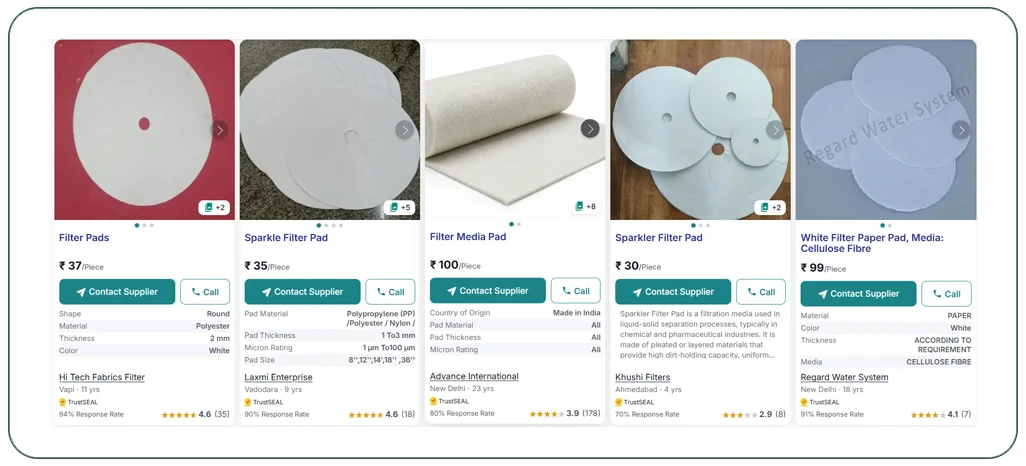
Supplier research becomes more effective when businesses can compare detailed product specifications instead of relying only on broad product names. Two suppliers may list similar products but offer different materials, dimensions, grades, packaging options, or order quantities. These differences can directly affect purchasing suitability.
The process to extract IndiaMART product details should focus on relevant product attributes and available supplier information. Depending on authorized access, useful fields may include product titles, descriptions, specifications, manufacturer details, displayed prices, minimum order quantities, product images, and listing locations.
Procurement teams can use these details to create comparable supplier records. For instance, industrial purchasing teams may organize listings according to equipment specifications, while packaging companies may compare material types, thickness, dimensions, and available customization options.
A practical product comparison workflow includes:
- Normalize product names and remove duplicate records.
- Standardize measurement units and product specifications.
- Separate manufacturer listings from reseller listings where identifiable.
- Compare displayed prices while recording their units and conditions.
- Identify missing specifications requiring supplier confirmation.
- Maintain timestamps to distinguish current observations from older records.
Businesses should avoid treating displayed prices as final quotations. Bulk discounts, transportation charges, taxes, customization, and minimum order quantities may change the final purchase cost.
The result is a more organized sourcing process. Procurement teams can focus their attention on suppliers whose listed offerings match actual purchasing requirements instead of repeatedly reviewing irrelevant listings.
How Can Catalog Organization Make B2B Research More Efficient?
Large supplier marketplaces contain products across different industries, making consistent classification essential for effective research. Without standardized categories, businesses may struggle to compare similar products listed under different names or descriptions.
An authorized IndiaMART catalogue scraper workflow can organize available product listings according to categories, subcategories, specifications, supplier details, and location attributes.
For example, a distributor researching electrical equipment may need to separate cables, switches, transformers, industrial motors, and electrical accessories. A structured catalogue helps purchasing teams review each product group independently and identify relevant sourcing opportunities.
Which catalogue attributes should businesses organize?
| Catalogue attribute | Purpose |
|---|---|
| Product category | Organizes products by industry or type |
| Product name | Identifies individual offerings |
| Brand or manufacturer | Supports brand-level comparison |
| Technical specifications | Helps assess product suitability |
| Supplier location | Supports geographic sourcing |
| Price information | Enables preliminary cost comparison |
| Minimum order quantity | Helps evaluate purchasing requirements |
| Listing timestamp | Supports freshness monitoring |
| Supplier identifier | Helps connect related product listings |
IndiaMART's FY2025–26 annual report identifies approximately 98,000 product categories across 57 industries and 129 million listed products. These are company-reported platform figures as of March 31, 2026. Source: IndiaMART Integrated Annual Report.
This scale illustrates why manual catalogue review can become difficult for businesses researching multiple industries.
A standardized catalogue can also support internal product mapping. Companies can match external product descriptions with their own SKU catalogues, procurement records, and supplier management systems.
However, catalogue collection should only be implemented through permitted access. IndiaMART's published Terms of Use, reproduced in a public legal filing, prohibit systematic retrieval of its content to create databases or directories without written permission. Businesses should obtain the necessary authorization before implementing automated collection. Source: IndiaMART Terms of Use reproduced in a public filing.
Want to build a structured supplier research workflow? Connect with Real Data API to discuss authorized data access, product information processing, and customized data integration requirements!
Get Insights Now!How Can Fresh Marketplace Observations Improve Supplier Research?
Supplier information can change over time. Businesses may update product descriptions, modify displayed prices, add new product variants, change their locations, or discontinue certain offerings. Using old marketplace records without checking their freshness can lead to poor procurement decisions.
real-time IndiaMART product data refers to recent marketplace observations collected at an agreed frequency through authorized access. The actual freshness depends on source availability, access permissions, and the collection method. A dataset should never be described as real-time simply because it is delivered through an API.
A practical monitoring workflow can help businesses identify important changes.
Product listing changes: Identify newly observed products and changes to existing descriptions.
Supplier information updates: Compare available business details across permitted observation periods.
Price movements: Record changes in displayed prices while retaining their units and applicable conditions.
Category expansion: Identify additional product offerings within monitored categories.
Listing freshness: Flag records that have not been checked within the required period.
How can businesses organize recurring supplier monitoring?
| Monitoring activity | Recommended business use |
|---|---|
| New listing identification | Discover additional sourcing options |
| Price comparison | Review preliminary supplier pricing |
| Product specification checks | Identify changes in product attributes |
| Supplier record updates | Maintain consistent research records |
| Duplicate detection | Prevent repeated supplier entries |
| Freshness validation | Prioritize records needing rechecking |
A timestamped dataset allows procurement teams to distinguish newly observed information from historical records. It also helps sales teams identify which prospects need further research before outreach.
Businesses should remember that a listing disappearing from a marketplace does not necessarily mean that the supplier has closed or stopped manufacturing a product. It may reflect a listing update or removal.
Fresh data is most useful when combined with direct supplier confirmation, commercial discussions, and internal procurement records.
How Can Automated Supplier Research Reduce Manual Work?
Manual supplier research often involves repeating the same activities: searching for products, opening supplier profiles, copying details, comparing specifications, and updating spreadsheets.
An authorized IndiaMART Scraper solution can help standardize permitted data collection and organize relevant marketplace observations into a consistent format.
The purpose is not simply to collect large volumes of records. Businesses need information that can be searched, validated, compared, and integrated into their existing sales or procurement workflows.
Which business processes can benefit?
Supplier discovery: Organize potential vendors according to products, categories, and locations.
Lead qualification: Prioritize business prospects based on available product relevance and company information.
Competitive research: Compare visible product offerings and preliminary pricing across relevant suppliers.
Procurement planning: Create searchable supplier records for purchasing teams.
Market mapping: Understand supplier presence across selected product categories and regions.
CRM preparation: Format authorized business information for compatible customer relationship management systems.
What does supplier research look like across different business functions?
| Business function | Data requirement | Potential application |
|---|---|---|
| Procurement | Supplier profiles and specifications | Vendor shortlisting |
| Sales | Business information and product categories | Prospect research |
| Distribution | Product availability and locations | Distribution planning |
| Manufacturing | Component and raw material suppliers | Sourcing research |
| Market research | Product and category information | Industry analysis |
| Business development | Supplier and company records | Opportunity identification |
Automation can reduce repetitive data-entry work, but it does not eliminate supplier qualification. Sales teams should still confirm whether a company is active, whether it can meet the required order quantity, and whether its products meet relevant standards.
A well-designed workflow should also include duplicate management, field validation, access controls, and regular record updates.
Businesses should use written permission or another expressly authorized data access arrangement before collecting marketplace information systematically. Automated collection should not bypass access restrictions or be used for unsolicited bulk messaging.
How Can API Integration Turn Supplier Information into Business Intelligence?
Collecting marketplace information is only one part of a successful B2B research process. Businesses also need a reliable way to transfer, standardize, store, and analyze the collected information.
An Ecommerce Scraping API can describe an integration approach that delivers authorized, structured product and supplier information to business applications through defined API endpoints. The term does not imply that IndiaMART provides an unrestricted public API for bulk supplier-directory extraction.
A typical integration architecture can include:
- Authorized data access: Establish approved access to the required marketplace or supplier information.
- Data collection: Retrieve permitted records according to the agreed collection scope.
- Data transformation: Standardize product names, categories, locations, and other fields.
- Data validation: Check missing values, duplicates, inconsistent formats, and outdated observations.
- Database integration: Store structured records in a centralized environment.
- Business intelligence: Generate supplier comparison reports and procurement dashboards.
What should a structured supplier dataset contain?
| Field | Example of business use |
|---|---|
| Supplier ID | Internal record identification |
| Business name | Supplier identification |
| Product name | Product discovery |
| Category | Industry classification |
| Product specifications | Requirement matching |
| Supplier location | Geographic filtering |
| Displayed price | Preliminary price comparison |
| Minimum order quantity | Procurement assessment |
| Business contact | Authorized business communication |
| Verification status | Due diligence tracking |
| Last updated | Record freshness |
The verification status should be maintained by the purchasing organization using independent evidence. A marketplace badge or contact verification should not automatically be interpreted as proof of legal registration, manufacturing capability, or product certification.
API-based integration can make supplier records more accessible to sales teams, procurement managers, analysts, and business development professionals.
The most valuable outcome is a reliable workflow that transforms permitted marketplace information into organized business intelligence while maintaining data quality and compliance.
Why Choose Real Data API?
Real Data API helps businesses develop customized data collection, processing, and integration workflows to support supplier research, B2B market intelligence, and product data management.
For organizations that work with large product catalogues and multiple supplier categories, structured information can improve research efficiency and make business records easier to manage.
What makes a reliable data solution valuable?
- 1. Customized Data Collection
Develop data workflows around specific product categories, supplier attributes, business requirements, and authorized sources.
- 2. Structured Dataset Delivery
Organize collected information into consistent formats such as CSV, Excel, JSON, and compatible database structures.
- 3. Data Cleaning and Validation
Identify duplicates, standardize product descriptions, normalize available specifications, and flag incomplete records.
- 4. Supplier and Product Research
Organize permitted supplier and product information to support market mapping, procurement research, and lead qualification.
- 5. API Integration Support
Connect processed datasets with business applications, reporting systems, and internal databases where technically supported.
- 6. Scalable Data Processing
Build workflows that accommodate changing data volumes, collection requirements, and business reporting needs.
Which services can support your data requirements?
- Web Scraping Services: Customized data collection from authorized websites and online sources.
- Product Data Extraction: Structured product attributes and catalogue information.
- Business Data Processing: Cleaning, enrichment, and standardization of business records.
- API Integration: Data delivery to compatible business applications.
- Market Intelligence: Organized datasets for product, supplier, and competitor research.
The objective is to help businesses spend less time organizing information manually and more time evaluating relevant suppliers, understanding market opportunities, and improving procurement decisions.
Conclusion
Finding suitable suppliers and reducing B2B lead generation time requires organized marketplace research, accurate product information, and consistent supplier validation. Businesses can improve their sourcing processes by maintaining structured records, comparing product specifications, identifying relevant vendors, and prioritizing qualified prospects.
An IndiaMART data scraper API strategy should begin with authorized access, clearly defined collection requirements, and a reliable data validation process. Marketplace information can support supplier discovery, but independent checks remain essential before businesses approve vendors or enter commercial agreements.
Real Data API helps businesses build customized data collection and integration workflows that turn permitted online information into structured, actionable business intelligence.
Looking to simplify supplier research, organize product information, and improve B2B lead generation? Connect with Real Data API today to discuss your customized data collection and integration requirements!
FAQs
1. How can businesses use marketplace information for supplier discovery?
An IndiaMART data scraper API can organize authorized supplier information, helping procurement teams compare business details, product categories, locations, and available commercial specifications.
2. What information can a product dataset contain?
An IndiaMart E-Commerce Dataset can include product names, categories, descriptions, prices, supplier details, locations, specifications, and other available listing attributes.
3. Why is structured product information important?
IndiaMART product listing data extraction helps businesses organize product records, identify relevant suppliers, compare specifications, and simplify procurement research.
4. Can businesses automate product specification collection?
Yes. Authorized workflows can extract IndiaMART product details and organize available product attributes into structured records for analysis and comparison.
5. How does catalogue organization improve B2B research?
An IndiaMART catalogue scraper approach can organize permitted catalogue information into searchable categories, helping businesses identify relevant product offerings and sourcing opportunities.
Latest posts

How to Identify Retail Pricing Trends and Improve Assortment Planning Using Biedronka API for product information

How to Track Competitor Odds and Improve Sportsbook Pricing Accuracy Through Live Betting Data Extraction

How KAYAK API Integration for Flight Search Helps Travel Businesses Compare Airfares and Find Better Deals

How to Use Amazon API integration for e-commerce analytics to Track Competitor Prices and Improve Product Performance




.png)


