

Introduction
The Japanese real estate sector has long been a focus of global investors due to its stable economy, urban development, and strong housing demand in major cities such as Tokyo, Osaka, and Yokohama. However, accurately understanding property trends across thousands of listings and neighborhoods requires more than traditional research methods. Modern analytics increasingly depend on automated data collection to uncover actionable insights from massive real estate datasets.
This is where Japan property market analysis using web scraping becomes a powerful solution for investors, property analysts, and real estate platforms. Web scraping technology enables businesses to collect large volumes of property listings, rental prices, housing demand indicators, and neighborhood trends directly from online real estate platforms. With this information, analysts can evaluate investment potential, identify price fluctuations, and predict future market behavior.
Using advanced tools such as the Web Scraping Real Estate Data API, organizations can automatically gather structured data including property descriptions, pricing history, amenities, and location information. This real-time access to real estate data allows investors to track evolving market patterns and make data-driven decisions. By converting unstructured listings into structured datasets, businesses gain a competitive advantage in understanding market demand, pricing trends, and emerging property investment opportunities.
As Japan’s property sector continues to digitize, data extraction technologies are becoming essential for transforming scattered online listings into valuable market intelligence.
Tracking Residential Value Changes Across Regions
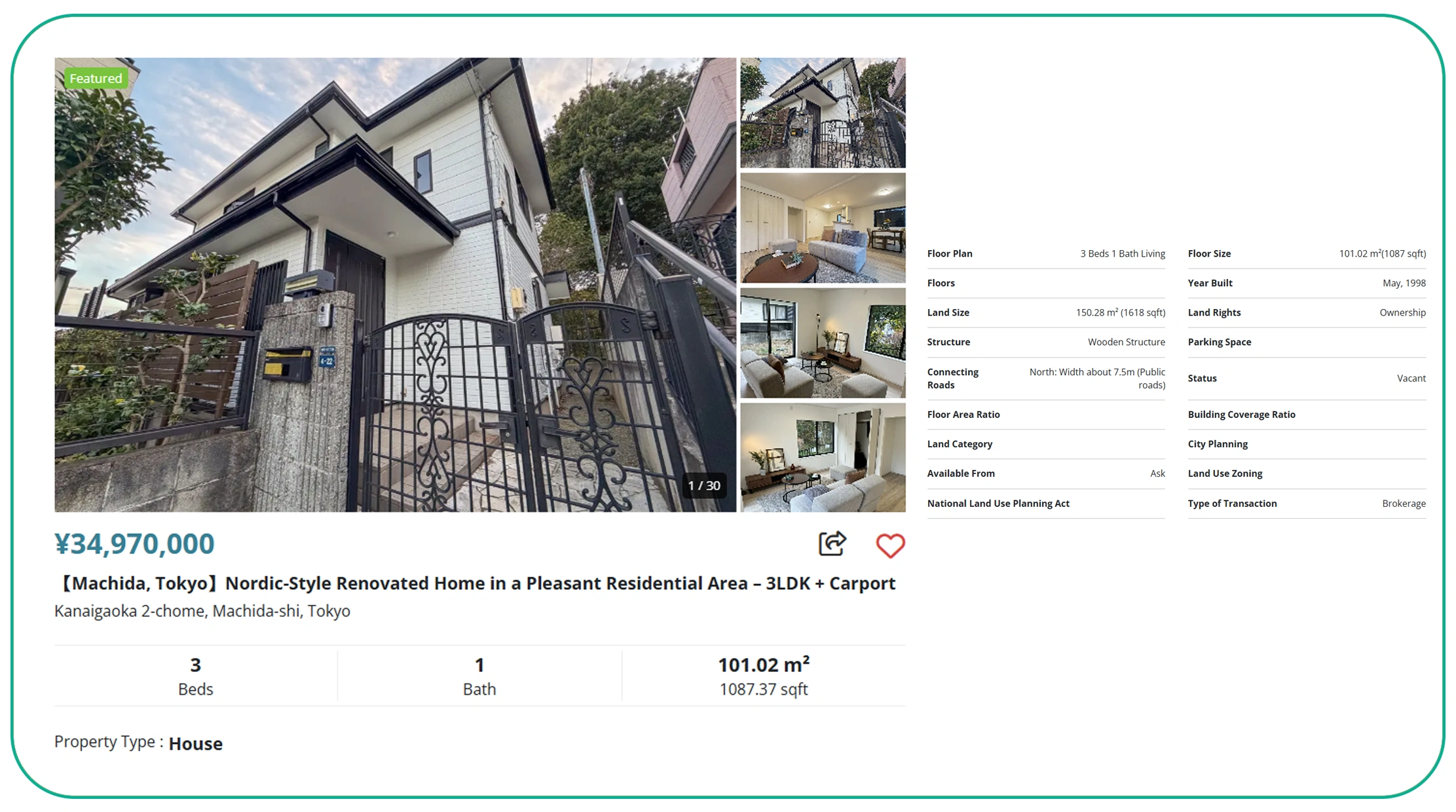
Understanding long-term housing price movements is essential for evaluating investment opportunities. Analysts often scrape housing price trends in Japan to examine property values across cities and regions. By collecting data from multiple listing platforms, businesses can analyze price growth, neighborhood demand, and historical market fluctuations.
Housing price trends can reveal where real estate demand is increasing and where prices are stabilizing. For instance, major urban areas often experience consistent demand due to employment opportunities and infrastructure development, while smaller regions may show slower growth.
Below is an estimated overview of housing price trend monitoring in Japan between 2020 and 2026.
| Year | Average Property Listings Analyzed | Average Housing Price Growth | Data Points Collected (Millions) |
|---|---|---|---|
| 2020 | 450,000 | 2.1% | 18 |
| 2021 | 520,000 | 2.8% | 22 |
| 2022 | 610,000 | 3.2% | 27 |
| 2023 | 720,000 | 3.7% | 32 |
| 2024 | 830,000 | 4.1% | 38 |
| 2025 | 940,000 | 4.5% | 45 |
| 2026 | 1,050,000 | 5.0% | 52 |
By analyzing this data, investors can detect areas experiencing rapid appreciation or stable rental demand. Automated housing price monitoring also allows real estate analysts to compare property types, locations, and amenities that influence property valuation.
With structured housing price datasets, investors can identify emerging neighborhoods and make strategic property investment decisions based on long-term market performance.
Transforming Online Listings into Market Intelligence
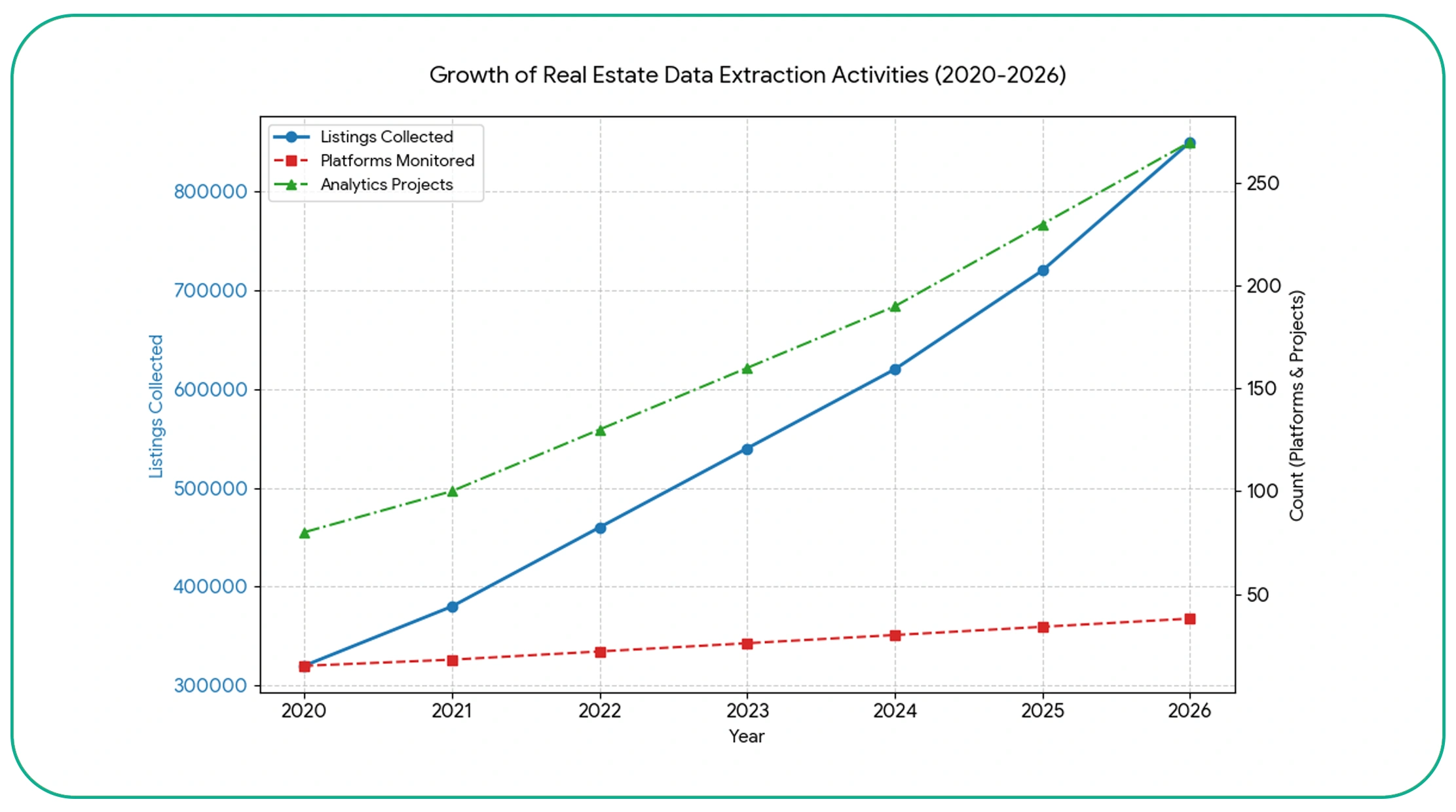
The digital transformation of the real estate sector has led to a massive volume of online listings across Japanese property platforms. Through Japan property market data extraction, organizations can collect structured information from these listings to analyze pricing patterns, property availability, and investment opportunities.
Property listings contain valuable information such as property size, building age, neighborhood amenities, and proximity to transportation systems. Extracting these details enables analysts to build comprehensive datasets that reveal hidden patterns within the housing market.
The table below highlights the growth of real estate data extraction activities between 2020 and 2026.
| Year | Listings Collected | Platforms Monitored | Real Estate Analytics Projects |
|---|---|---|---|
| 2020 | 320,000 | 15 | 80 |
| 2021 | 380,000 | 18 | 100 |
| 2022 | 460,000 | 22 | 130 |
| 2023 | 540,000 | 26 | 160 |
| 2024 | 620,000 | 30 | 190 |
| 2025 | 720,000 | 34 | 230 |
| 2026 | 850,000 | 38 | 270 |
By transforming unstructured property listings into structured data, analysts can evaluate pricing trends across property types such as apartments, houses, and commercial spaces. This data-driven approach enables businesses to better understand supply and demand dynamics in the Japanese real estate sector.
Automated data extraction also reduces manual research time while improving the accuracy of real estate market analysis.
Unlocking Insights from Large Property Listing Databases

Access to comprehensive listing datasets allows businesses to analyze property availability, location demand, and buyer preferences. Many analytics teams Extract real estate listings data in Japan to study how property supply fluctuates across cities and neighborhoods.
Property listings can reveal patterns related to property size, location popularity, and building age preferences among buyers. When this data is collected at scale, it becomes possible to identify high-demand regions and potential investment hotspots.
Below is an overview of property listing dataset growth between 2020 and 2026.
| Year | Property Listings Analyzed | Cities Covered | Market Insights Generated |
|---|---|---|---|
| 2020 | 250,000 | 12 | 50 |
| 2021 | 300,000 | 15 | 65 |
| 2022 | 380,000 | 18 | 85 |
| 2023 | 470,000 | 22 | 110 |
| 2024 | 560,000 | 26 | 140 |
| 2025 | 650,000 | 30 | 175 |
| 2026 | 750,000 | 35 | 210 |
Analyzing these datasets helps investors determine where property demand is rising and where new development opportunities exist. Data-driven insights also support real estate agencies in optimizing pricing strategies and identifying competitive property listings.
With automated listing extraction, businesses can continuously update property databases and maintain accurate market intelligence.
Monitoring Rental Demand and Pricing Dynamics
Japan’s rental market plays a significant role in urban housing, particularly in metropolitan areas where many residents prefer renting over purchasing property. Using a Japan rental market property API Data scraper, businesses can monitor rental prices, vacancy rates, and tenant demand across multiple cities.
Rental data analysis helps investors understand which neighborhoods offer the highest rental yields and consistent occupancy rates. This information is especially valuable for international investors seeking stable long-term returns.
The following table illustrates rental market data monitoring trends between 2020 and 2026.
| Year | Rental Listings Collected | Average Monthly Rent Growth | Cities Monitored |
|---|---|---|---|
| 2020 | 200,000 | 1.8% | 10 |
| 2021 | 240,000 | 2.1% | 12 |
| 2022 | 290,000 | 2.6% | 15 |
| 2023 | 350,000 | 3.0% | 18 |
| 2024 | 420,000 | 3.4% | 22 |
| 2025 | 500,000 | 3.8% | 26 |
| 2026 | 600,000 | 4.2% | 30 |
Rental market insights allow investors to identify properties that generate consistent rental income. Automated rental data collection also helps property management companies optimize rental pricing and track tenant demand patterns.
As Japan’s urban population continues to grow, rental market analytics will remain a key factor in real estate investment strategies.
Building Structured Data for Advanced Property Analytics

Access to high-quality real estate datasets enables deeper analysis of property trends, buyer behavior, and regional demand. A comprehensive Real Estate Dataset provides structured information such as property location, price history, listing duration, and property specifications.
These datasets allow analysts to apply machine learning models that predict price changes and identify profitable investment areas. By analyzing large volumes of historical property data, businesses can also forecast housing demand and evaluate development opportunities.
Below is a growth overview of real estate dataset usage between 2020 and 2026.
| Year | Dataset Size (TB) | Analytics Projects Using Data | Investment Firms Using Datasets |
|---|---|---|---|
| 2020 | 2.8 | 90 | 120 |
| 2021 | 3.4 | 120 | 150 |
| 2022 | 4.2 | 160 | 190 |
| 2023 | 5.1 | 200 | 230 |
| 2024 | 6.3 | 250 | 280 |
| 2025 | 7.6 | 300 | 340 |
| 2026 | 9.0 | 360 | 400 |
Structured property datasets help businesses develop predictive analytics models and uncover trends that are not visible through manual research alone.
Automating Data Collection for Scalable Property Insights

Automated data extraction technologies are transforming how real estate analytics teams collect and process market information. A reliable Web Scraping API enables organizations to gather property listings, price trends, and rental data automatically across multiple real estate platforms.
These APIs allow businesses to scale their data collection processes without manual intervention. Instead of individually analyzing listings, analysts can access structured datasets that update in real time.
Below is a projection of web scraping adoption for property analytics.
| Year | Companies Using APIs | Listings Collected Daily | Automated Data Requests |
|---|---|---|---|
| 2020 | 70 | 150,000 | 1.2M |
| 2021 | 95 | 190,000 | 1.6M |
| 2022 | 120 | 240,000 | 2.1M |
| 2023 | 150 | 300,000 | 2.8M |
| 2024 | 185 | 360,000 | 3.6M |
| 2025 | 220 | 420,000 | 4.5M |
| 2026 | 260 | 500,000 | 5.5M |
Automated data extraction not only improves efficiency but also ensures businesses receive accurate and up-to-date property market information. This enables faster decision-making and more precise investment analysis.
Why Choose Real Data API?
Real Data API provides scalable solutions for collecting structured real estate data from online platforms. Through advanced Live Crawler Services, businesses can gather large volumes of property listings, rental data, and market insights automatically.
These services allow organizations to perform Japan property market analysis using web scraping with reliable and continuously updated datasets. Real Data API supports real estate companies, investors, and analytics firms by delivering structured data that powers advanced market research and predictive analytics.
With high-performance infrastructure, automated data pipelines, and customizable data extraction solutions, Real Data API helps businesses transform raw property listings into valuable market intelligence.
Conclusion
The Japanese real estate market offers vast opportunities for investors, analysts, and property technology companies. However, identifying profitable opportunities requires accurate and large-scale market data. By leveraging Japan property market analysis using web scraping, businesses can collect property listings, rental trends, and pricing data directly from online platforms.
Automated data extraction technologies provide structured insights that help investors track housing demand, monitor rental yields, and identify emerging investment hotspots. With access to reliable datasets and scalable scraping tools, organizations can make more informed decisions in a highly competitive property market.
Start leveraging powerful data solutions from Real Data API today to unlock deeper insights and transform your real estate research with advanced web scraping technology.
Get Insights Now!Latest posts

How Scrape Xiaohongshu Product Trends in Real Time Solves Product Discovery and Competitor Monitoring Challenges?

How to Scrape Taobao Product Data to Solve Pricing, Inventory, and Competitor Monitoring Challenges?

How to Extract grocery product listings Data from SPAR to Build Accurate Grocery Intelligence and Competitive Market Insights?

Scrape Douyin follower growth and engagement data to track influencer performance and trends





.png)