TL;DR
- Levi's Fashion Dataset helps retailers, fashion analysts, and brands organize product, pricing, category, availability, and assortment information for more structured market intelligence.
- Levi's fashion data scraping can convert changing online catalog information into datasets that support competitive monitoring, assortment analysis, pricing research, and denim trend tracking.
- The resulting intelligence helps decision-makers identify product movements, price changes, category shifts, and availability patterns without relying entirely on manual research.
Introduction
Fashion intelligence increasingly depends on how quickly businesses can understand product, pricing, assortment, and availability changes. For denim-focused businesses, Levi's Fashion Dataset can provide a structured foundation for analyzing product catalogs, price movements, categories, styles, sizes, colors, availability, and promotional patterns.
Levi Strauss & Co. operates at significant global scale. The company reports approximately $6.3 billion in fiscal 2025 net revenue, products sold in approximately 120 countries, and a retail footprint of roughly 3,300 stores and shop-in-shops. (Levi Strauss)
That scale creates a substantial amount of market information for businesses interested in denim intelligence. A retailer, competitor, marketplace operator, fashion analyst, or investment research team may need to understand how products are positioned across categories and how those positions change over time.
The challenge is that online fashion catalogs are dynamic. Product pages can change prices, stock status, sizes, colors, promotional messages, imagery, and descriptions. Manual collection is difficult to scale and can create inconsistent datasets.
A structured data pipeline solves this by transforming publicly available product information into consistent records that can be compared historically. The objective is not simply to collect product pages. It is to create an analytical layer that helps businesses answer practical questions:
- Which product categories are expanding?
- Which styles appear repeatedly across collections?
- How do prices vary by category or product type?
- Which sizes and colors show recurring availability changes?
- Which products are discounted?
- How quickly does assortment information change?
- How does the digital assortment compare across markets or channels?
Levi Strauss & Co. has also highlighted the importance of e-commerce, reporting that its e-commerce business doubled from 5% of total net revenue in 2019 to 10% in 2024 and recorded 12 consecutive quarters of global double-digit growth as of May 2025. (Levi Strauss)
For data-driven fashion teams, this makes structured product intelligence increasingly useful for understanding the digital denim marketplace.
How Can Businesses Build a Reliable Product Intelligence Layer?
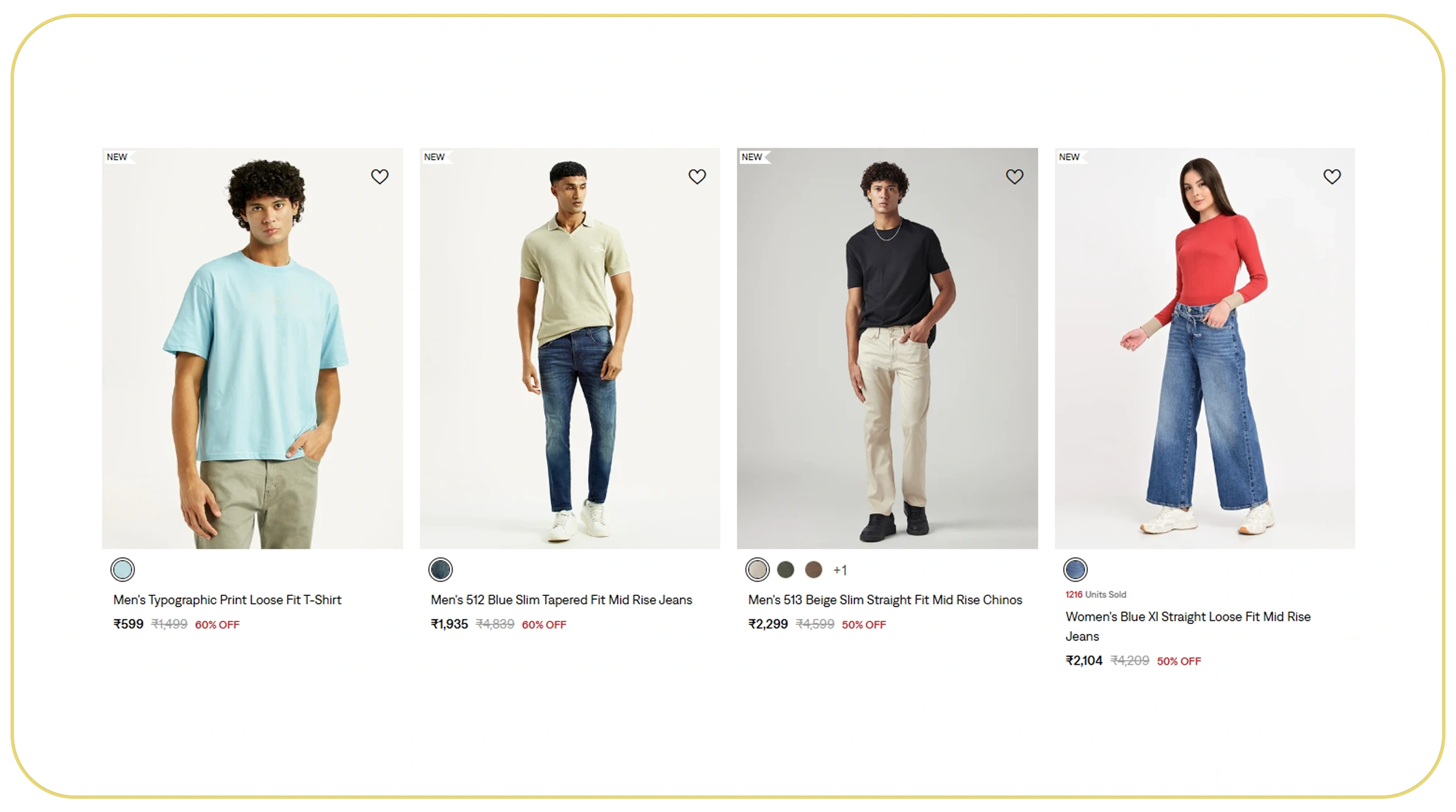
Levi's product data collection services can help businesses transform scattered online product information into structured records suitable for monitoring and analysis.
A useful product dataset can contain fields such as product name, product ID or SKU where available, category, subcategory, price, promotional price, currency, color, size, availability, product URL, description, image URL, collection information, and timestamp.
The value comes from collecting these attributes consistently rather than treating every product page as an isolated observation.
For example, a fashion intelligence team can create a historical product table in which each product is recorded periodically. This allows analysts to compare today's assortment against previous snapshots.
What Product-Level Data Can Be Structured?
| Data Attribute | Intelligence Use |
|---|---|
| Product name | Product identification |
| SKU/Product ID | Record matching |
| Category | Assortment analysis |
| Subcategory | Detailed product segmentation |
| Price | Pricing intelligence |
| Discount | Promotion tracking |
| Size | Availability analysis |
| Color | Assortment analysis |
| Stock status | Availability monitoring |
| Product URL | Source reference |
| Timestamp | Historical comparison |
| Product description | Attribute analysis |
The collection layer can also normalize differences in formatting. For example, prices can be converted into a standardized numerical field, sizes can be mapped into consistent labels, and categories can be organized into a common hierarchy.
2020–2026: How Has Digital Product Intelligence Evolved?
From 2020 through 2026, fashion data requirements have moved from periodic catalog research toward continuous digital monitoring. In 2020, many businesses were primarily concerned with establishing online visibility as shopping behavior rapidly shifted toward digital channels. By 2021, product assortment and online availability became increasingly important because consumers expected broader digital selection. During 2022, businesses increasingly needed structured pricing and promotional comparisons as inflationary pressures affected retail decision-making. In 2023, category-level analytics became more important as brands expanded beyond traditional product groups and invested in broader lifestyle positioning. By 2024, the growth of direct-to-consumer and e-commerce channels increased the importance of consistent digital shelf information. Levi Strauss & Co. reported that e-commerce grew 13% in 2023 and 19% year over year in the second quarter of 2024. (Levi Strauss) In 2025, the company reported continued e-commerce momentum and described a strategy centered on improving fundamentals, assortment, and digital experience. (Levi Strauss) By 2026, product intelligence increasingly connects historical catalog snapshots with automated analytics, allowing businesses to evaluate assortment changes, pricing movements, availability patterns, and category development over time.
What Can Businesses Learn by Structuring Fashion Catalog Information?
Businesses can extract Levi's fashion data to create a consistent analytical view of products and categories instead of repeatedly researching individual product pages.
The dataset can be designed around the specific questions a buyer or analyst needs to answer. A competitive intelligence team may prioritize product prices and promotions. A merchandising team may focus on assortment depth, colors, sizes, and categories. A market research team may need product descriptions and historical observations.
Levi's Fashion Dataset can therefore function as an analytical input rather than simply a list of scraped URLs.
Example Dataset Structure
| Dataset Layer | Example Fields | Business Question |
|---|---|---|
| Product identity | Name, SKU, URL | What products are listed? |
| Pricing | List price, sale price, currency | How is pricing positioned? |
| Category | Jeans, tops, jackets, accessories | Which categories are represented? |
| Attributes | Fit, color, material, size | What assortment characteristics dominate? |
| Availability | In stock, unavailable, size-level status | What can consumers purchase? |
| Promotion | Discount, promotional label | Which products receive offers? |
| History | Timestamp, previous price | What changed over time? |
This structure makes it easier to connect product-level information with higher-level market analysis.
For example, an analyst could calculate the percentage of monitored products on promotion, identify average prices by category, measure assortment changes, or compare availability across snapshots.
2020–2026: From Catalog Collection to Historical Intelligence
Between 2020 and 2026, fashion data increasingly shifted from static catalog documentation to historical intelligence. The initial objective was often to capture what products were available at a particular point in time. As online catalogs became more dynamic, businesses needed repeated observations to understand what changed. During 2021 and 2022, historical price information became particularly useful for identifying promotional cycles and pricing adjustments. By 2023, product-level datasets were increasingly used to connect product attributes with category-level trends. In 2024, the expansion of direct-to-consumer experiences created additional demand for structured online assortment monitoring. Levi Strauss & Co. reported that direct-to-consumer channels accounted for 43% of total net revenue in fiscal 2023, illustrating the growing relevance of digital and owned-channel information. (Levi Strauss & Co. Investor Relations) In 2025, the company reported $6.3 billion in net revenue and continued emphasis on its DTC-first strategy. (Levi Strauss & Co. Investor Relations) By 2026, the analytical opportunity is broader: historical product records can support price benchmarking, assortment comparisons, promotional analysis, category monitoring, and trend discovery. The key development is not simply collecting more data but maintaining structured, comparable observations that make changes measurable.
How Does Product Availability Affect Fashion Intelligence?
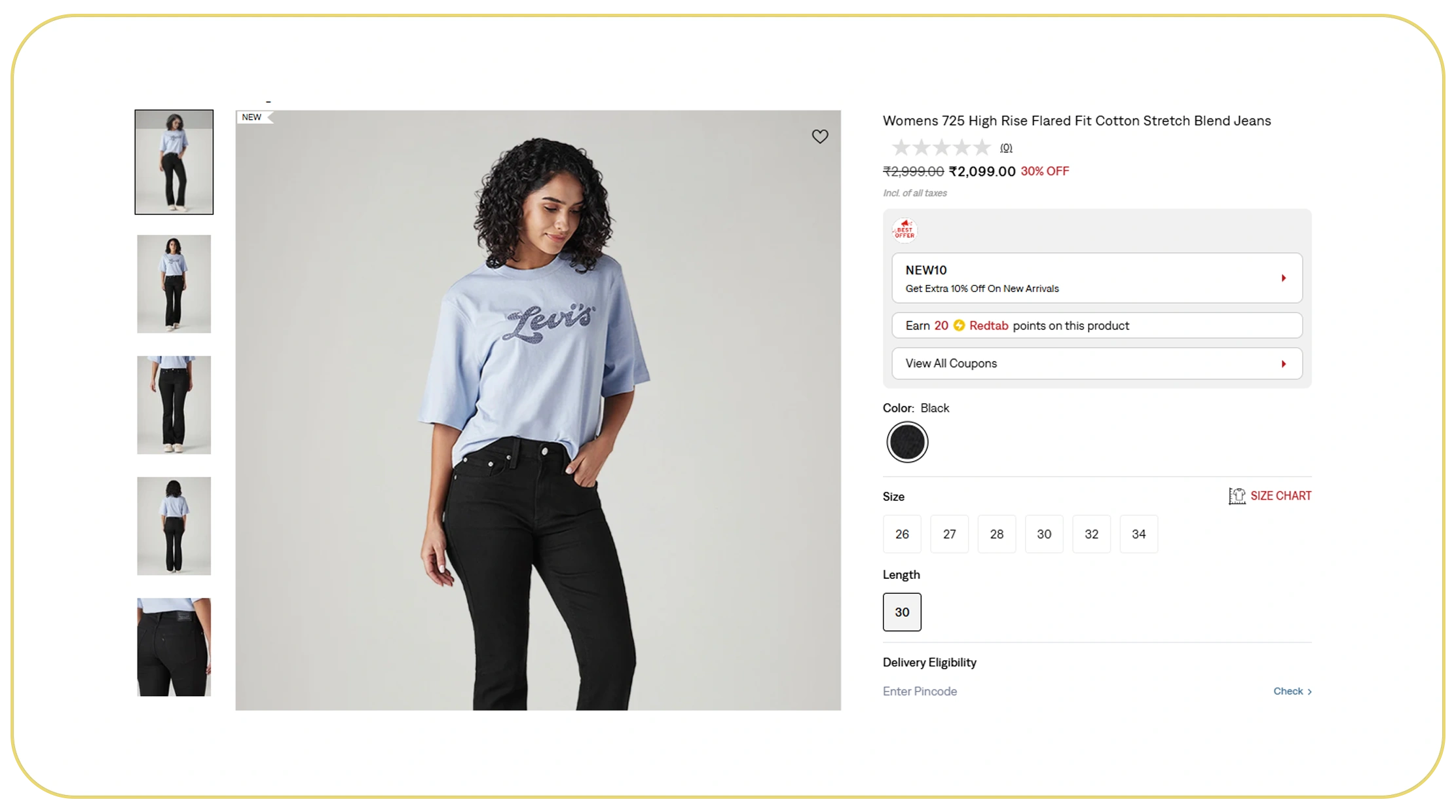
Real-time Levi's product availability data can help businesses understand whether products, sizes, colors, or specific variants are currently accessible to shoppers.
Availability is particularly important in fashion because a product appearing in a catalog does not necessarily mean every size or variant is purchasable.
A product-level availability system can distinguish between:
- Product listed
- Product available
- Product unavailable
- Selected sizes unavailable
- Selected colors unavailable
- Product discounted
- Product temporarily unavailable
This distinction creates more useful intelligence than a simple product count.
Availability Metrics Worth Monitoring
| Metric | Why It Matters |
|---|---|
| Overall availability rate | Measures accessible assortment |
| Size availability | Identifies size-level gaps |
| Color availability | Shows depth of variant assortment |
| Out-of-stock rate | Indicates potential supply constraints |
| New product appearances | Detects assortment expansion |
| Removed products | Identifies assortment changes |
| Promotional availability | Shows whether discounted products remain purchasable |
A timestamped approach is especially valuable. If the same product is monitored daily, analysts can identify how long it remains unavailable or whether certain variants repeatedly disappear.
This can support merchandising research, competitive monitoring, demand analysis, and assortment planning.
2020–2026: Why Availability Monitoring Became More Important
From 2020 to 2026, product availability became a more visible component of digital retail intelligence. In 2020, retailers faced rapid changes in shopping behavior and supply conditions, making online availability a critical customer experience factor. During 2021, brands and retailers increasingly invested in digital storefronts and omnichannel capabilities. In 2022, availability monitoring became more useful for identifying the practical difference between listed assortment and purchasable assortment. In 2023, size-level and variant-level availability became increasingly relevant as consumers expected online stores to provide accurate product information. In 2024, Levi Strauss & Co. continued emphasizing direct-to-consumer experiences and reported strong e-commerce growth, including 19% growth in the second quarter. (Levi Strauss) In 2025, the company reported continued DTC momentum, with fourth-quarter DTC net revenues increasing 19% on a reported basis and e-commerce revenue also increasing 19% on a reported basis. (Levi Strauss & Co. Investor Relations) In 2026, availability intelligence can therefore be treated as a historical signal rather than merely a current-status field. Tracking changes over time allows businesses to identify recurring availability gaps, product lifecycle patterns, and assortment movements. When combined with price and category information, availability becomes another dimension of digital fashion intelligence.
Want to monitor product availability, pricing, and assortment changes at scale? Connect with Real Data API to discuss a structured fashion data collection workflow tailored to your market intelligence requirements.
Get Insights Now!How Can Structured Collection Improve Product-Level Analysis?
Levi's product data extraction can turn unstructured online catalog information into normalized datasets that are easier to query, compare, visualize, and integrate with analytics platforms.
For a fashion business, extraction should focus on business-ready fields rather than collecting unnecessary page elements.
A robust workflow generally includes:
- Source discovery
- Product-page identification
- Data extraction
- Field normalization
- Duplicate handling
- Validation
- Timestamping
- Historical storage
- Delivery through a suitable format or API
- Analytics integration
The resulting dataset can be supplied in formats suitable for dashboards, business intelligence systems, databases, or custom analytical pipelines.
What Does a Business-Ready Dataset Look Like?
| Processing Stage | Output |
|---|---|
| Collection | Raw product records |
| Parsing | Individual attributes |
| Normalization | Consistent field values |
| Validation | Cleaner records |
| Deduplication | Unique product records |
| Timestamping | Historical observations |
| Storage | Structured database |
| Delivery | CSV, JSON, API, or other agreed format |
For example, $98.00, "98 USD," and "USD 98" should not be treated as three different prices in an analytical system. Standardization makes aggregation and comparison more reliable.
Similarly, category labels should be mapped consistently so analysts can calculate category-level metrics without manually cleaning every record.
2020–2026: The Rise of Automated Data Pipelines
From 2020 through 2026, fashion data extraction evolved from one-time collection toward automated, repeatable pipelines. In 2020, teams often depended heavily on spreadsheets and manual catalog checks. By 2021, recurring collection became more practical as online assortments expanded. In 2022, data normalization became increasingly important because businesses were combining information from multiple channels and markets. During 2023, automated validation and historical storage became more valuable for pricing and assortment research. In 2024, the growth of e-commerce and direct-to-consumer retail increased the volume and frequency of online product observations required by analytical teams. Levi Strauss & Co. described e-commerce as an important part of its DTC-first strategy and reported sustained growth across multiple quarters. (Levi Strauss) In 2025, the company's reported $6.3 billion net revenue and continued DTC growth highlighted the scale of its digital and retail operations. (Levi Strauss & Co. Investor Relations) By 2026, the priority is increasingly on automation, data quality, historical storage, and integration with analytics systems. A modern pipeline can repeatedly capture product information, normalize attributes, validate records, and deliver structured outputs. This reduces dependence on manual collection and creates a repeatable foundation for pricing, product, category, and availability intelligence.
Why Is Historical Fashion Data Important for Trend Analysis?
Historical observations make it possible to understand not only what is visible today but also how an assortment has changed.
A Levi's Fashion Dataset can support longitudinal analysis by storing product observations with collection dates. This allows analysts to compare product counts, prices, categories, promotional activity, and availability across different periods.
For denim market research, historical analysis can answer questions such as:
- Are certain product categories expanding?
- Are average prices changing?
- Are new fits appearing more frequently?
- Which products remain consistently listed?
- How often do products move into promotional pricing?
- Which colors or sizes show recurring availability gaps?
- How does seasonal assortment differ from previous periods?
Historical Intelligence Framework
| Historical Measure | Analytical Application |
|---|---|
| Product count | Assortment growth |
| Average price | Pricing movement |
| Median price | Price-position analysis |
| Discount rate | Promotional monitoring |
| Category share | Assortment mix |
| New products | Launch tracking |
2020–2026: How Historical Data Supports Denim Market Trends
The period from 2020 to 2026 demonstrates why historical product data has become increasingly useful for fashion analysis. In 2020, major shifts in retail behavior created a need to understand digital assortment changes quickly. In 2021, businesses increasingly tracked online product availability and assortment expansion as digital commerce became a core sales channel. During 2022, price movements and promotional intensity became important analytical dimensions. In 2023, fashion businesses increasingly connected product attributes with category and consumer trend research. In 2024, Levi Strauss & Co. continued expanding its digital and DTC capabilities while reporting strong e-commerce growth. (Levi Strauss) The company also emphasized broader product experiences, including denim lifestyle assortments and expanded fits in its retail strategy. (Levi Strauss) In 2025, continued revenue growth and DTC momentum reinforced the importance of understanding digital assortment and customer-facing product information. (Levi Strauss & Co. Investor Relations) By 2026, historical datasets can help analysts move beyond snapshots toward trend analysis. Comparing product records over multiple periods can reveal assortment expansion, price changes, promotional patterns, product introductions, product removals, and availability movements. For denim-focused businesses, this historical layer can support market research, category planning, competitive benchmarking, and more informed interpretation of changing product demand signals.
How Can Automated Collection Support Scalable Fashion Intelligence?
Fashion Data Scraping becomes more valuable when it is designed as an ongoing data pipeline rather than a one-time extraction exercise.
For businesses monitoring large catalogs, scalability depends on several technical factors:
- Automated source discovery
- Scheduled collection
- Structured extraction
- Data validation
- Duplicate detection
- Historical storage
- Error monitoring
- Scalable processing
- API or file-based delivery
- Dashboard integration
A Levi's Fashion Dataset can then become part of a broader fashion intelligence system.
Example Intelligence Architecture
| Layer | Function |
|---|---|
| Source layer | Collect product information |
| Extraction layer | Parse relevant fields |
| Processing layer | Normalize and validate |
| Historical layer | Store dated observations |
| Analytics layer | Calculate trends and metrics |
| Delivery layer | API, database, CSV, JSON |
| Visualization layer | Dashboards and reports |
The architecture should also account for changes in page structure, product URLs, category structures, and data availability. Automated validation can flag unexpected changes before they affect downstream reporting.
2020–2026: From Scraping Projects to Intelligence Infrastructure
Between 2020 and 2026, automated web data collection increasingly became part of broader business intelligence infrastructure. In 2020, companies often used scraping for specific research projects or periodic competitive checks. By 2021, recurring collection became more relevant as online catalogs expanded. In 2022, businesses increasingly connected product data with pricing and competitor intelligence systems. During 2023, automation, normalization, and historical storage became more important as data volumes increased. In 2024, digital commerce and DTC strategies strengthened the need for continuous monitoring. Levi Strauss & Co. reported that its e-commerce business represented 10% of total net revenue in 2024, compared with 5% in 2019. (Levi Strauss) In 2025, the company reported $6.3 billion in net revenue and continued investment in its DTC-first model. (Levi Strauss) By 2026, businesses can treat automated collection as an intelligence infrastructure layer connecting online product information with analytics and decision-making. The objective is not simply more records. It is reliable, repeatable, timestamped data that can support pricing analysis, assortment intelligence, availability monitoring, category research, and competitive benchmarking. This approach also makes it easier to scale monitoring across markets, categories, products, and time periods without rebuilding the analytical process for every project.
Why Choose Real Data API?
Real Data API can support businesses that need structured, scalable, and analytics-ready web data for fashion intelligence and competitive research.
A fashion data project typically requires more than extraction. It needs a complete workflow covering collection, parsing, normalization, validation, historical storage, and delivery.
Key advantages include:
- Structured datasets: Receive product information in consistent, analysis-ready formats.
- Scalable collection: Support large catalogs and recurring data requirements.
- Historical monitoring: Maintain dated observations for trend and change analysis.
- Custom fields: Design datasets around business-specific analytical requirements.
- Data validation: Improve consistency by checking and standardizing extracted records.
- Flexible delivery: Integrate datasets into databases, dashboards, analytics systems, or other workflows.
- Competitive intelligence support: Combine product, pricing, category, and availability information for deeper market research.
The broader Fashion Dataset approach can be customized around a company's specific objectives, whether the requirement is pricing intelligence, assortment tracking, product research, category analysis, or market trend monitoring.
Real Data API can also help organizations design recurring workflows rather than relying on isolated manual research exercises.
Conclusion
A structured Levi's Fashion Dataset can help businesses convert dynamic online product information into measurable intelligence across products, prices, categories, and availability.
The strongest value comes from historical, normalized, and consistently collected data. When product attributes are connected with timestamps, businesses can move beyond basic catalog visibility and analyze changes in assortment, pricing, promotions, availability, and category structure.
Levi Strauss & Co.'s global scale and growing emphasis on direct-to-consumer and e-commerce channels demonstrate why digital product information can represent an important source of market intelligence. The company reported approximately $6.3 billion in fiscal 2025 net revenue, products sold in approximately 120 countries, and roughly 3,300 retail stores and shop-in-shops. (Levi Strauss)
For retailers, fashion brands, marketplaces, analysts, and research organizations, the objective is therefore not simply to collect more product records. It is to build a reliable data foundation that makes market changes easier to measure, compare, and interpret.
Looking to build a scalable fashion data pipeline for product, pricing, category, availability, or denim market intelligence? Contact Real Data API to discuss your custom data collection and analytics requirements!
FAQs
What is a Levi's Fashion Dataset used for?
A Levi's Fashion Dataset can organize product, price, category, size, color, availability, and promotional information for competitive research, assortment analysis, pricing intelligence, and denim market trend analysis.
How does Levi's fashion data scraping support retailers?
Levi's fashion data scraping can provide structured product observations that retailers use to monitor assortment changes, pricing movements, promotional activity, availability, and category developments over time.
Why use Levi's product data collection services?
Levi's product data collection services can help businesses automate recurring product monitoring, standardize catalog attributes, maintain historical records, and receive structured information suitable for analytics and reporting.
Can businesses extract Levi's fashion data for historical analysis?
Yes. Teams can extract Levi's fashion data at scheduled intervals and compare dated records to identify changes in products, prices, categories, promotions, and availability across selected periods.
What does real-time Levi's product availability data provide?
Real-time Levi's product availability data can help businesses monitor current product and variant availability. A Levi's Fashion Dataset can support structured delivery for recurring analysis and business intelligence workflows.
Latest posts
How Myntra Fashion Dataset Solves Fashion Intelligence Challenges Across Products, Prices, Brands, and Fashion Market Trends?
How Hyatt Travel Dataset Helps Businesses Track Hotels, Room Prices, Amenities, Locations, and Travel Trends?

How Louis Vuitton Fashion Dataset Enables Better Analysis of Luxury Products, Prices, Brands, and Fashion Trends?
How Blinkit Grocery Dataset Enables Smarter Analysis of Products, Prices, Availability, and Quick-Commerce Trends?






.png)