
Quick Summary
- Meituan Scraper helps businesses structure restaurant, menu, pricing, rating, and marketplace information for competitive research and business intelligence.
- Meituan Quick Commerce Data Scraping supports recurring monitoring of fast-changing local commerce information, helping businesses compare products, prices, availability, and consumer signals over time.
Introduction
The growth of food delivery, local commerce, and on-demand retail has created a large volume of marketplace information that businesses can use for competitive and operational analysis. Meituan restaurant data web scraping can help organizations systematically collect publicly available restaurant information, menu details, pricing signals, ratings, locations, and other relevant marketplace attributes. A Meituan Scraper can support this process by organizing collected information into structured datasets for efficient analysis. Instead of depending on occasional manual checks, businesses can build structured datasets that support recurring monitoring and historical comparisons.
Meituan's scale makes structured data particularly relevant for businesses studying China's local commerce ecosystem. In 2024, Meituan reported more than 770 million annual transacting users and 14.5 million annual active merchants, both record highs at the time. The company also reported that its instant delivery peak reached 98 million daily orders on Lichun Day in 2024. (Meituan) A Food Scraping API can help businesses convert accessible marketplace information into standardized records for analytics, benchmarking, and research.
The importance of this data has continued into 2025 and 2026. Meituan reported revenue of RMB364.9 billion for 2025, while annual transacting users exceeded 800 million. Its 2025 annual report also documents the continued expansion of its core local commerce activities. (index.meituan.com) These developments illustrate why structured marketplace data can be useful for companies evaluating restaurant supply, pricing behavior, customer engagement, and local commerce trends.
Building a Structured View of Menu and Restaurant Supply
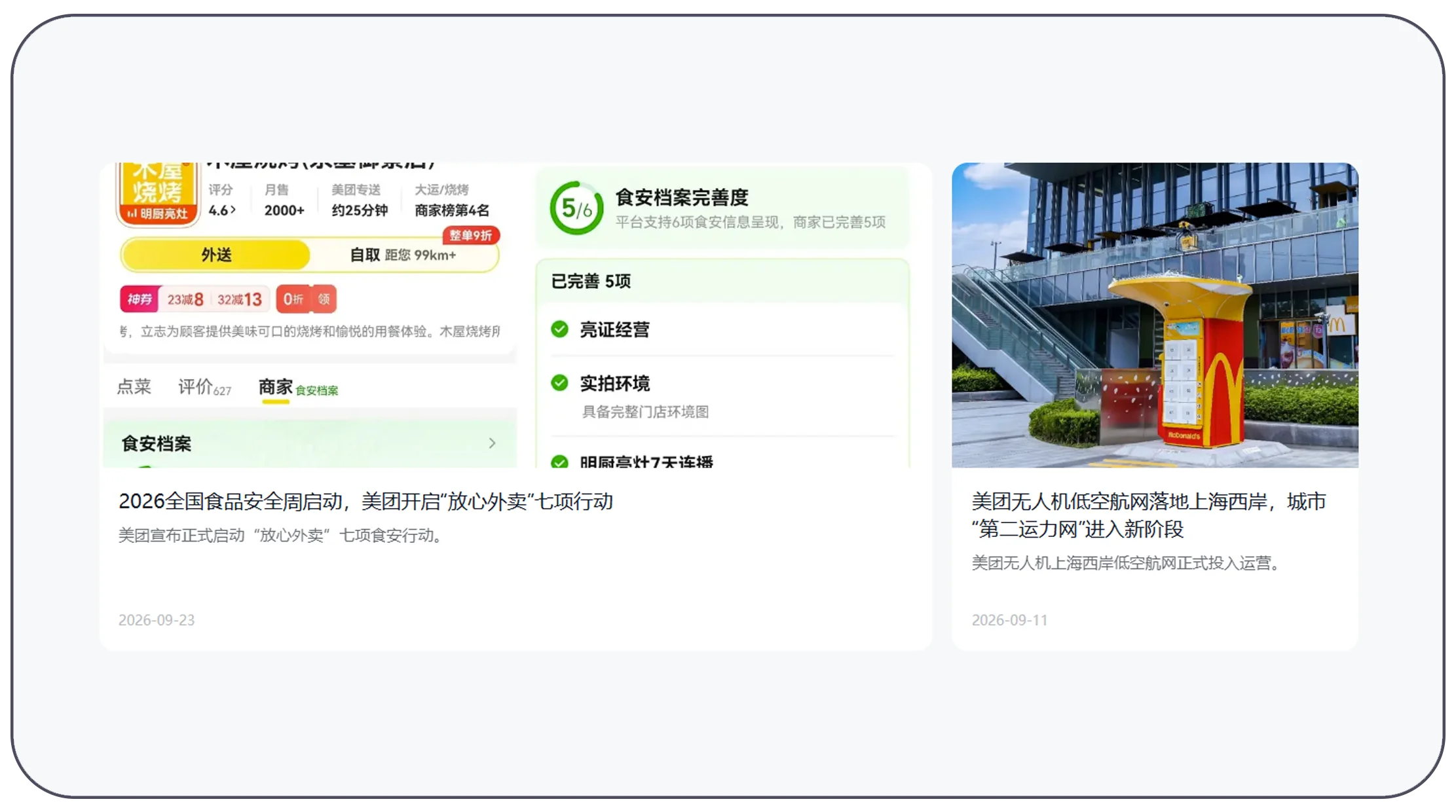
Restaurant menus are highly dynamic datasets. Items can be introduced, removed, renamed, repriced, discounted, or temporarily unavailable. For restaurant operators, aggregators, market researchers, and consumer brands, these changes can provide useful information about assortment and competitive positioning.
A structured process to scrape Meituan menu data can organize restaurant names, cuisine categories, menu items, descriptions, prices, promotional information, ratings, locations, and other accessible attributes. Instead of examining individual restaurant pages manually, businesses can create standardized records that make cross-restaurant comparisons easier.
| Year | Relevant Meituan development | Data-analysis implication |
|---|---|---|
| 2020 | Annual transacting users reached 510.6 million | Larger consumer and merchant datasets |
| 2021 | Revenue reached RMB179.1 billion | Expanding marketplace activity |
| 2022 | Revenue reached RMB220.0 billion | Continued platform scale |
| 2023 | On-demand delivery transactions reached 21.9 billion | Greater frequency of delivery activity |
| 2024 | Annual transacting users exceeded 770 million | Broader marketplace coverage |
| 2025 | Annual transacting users exceeded 800 million | Continued scale of local commerce |
| 2026 | Meituan published 2025 annual and 2026 interim reports | Ongoing data availability for market research |
Meituan's revenue increased from RMB114.8 billion in 2020 to RMB179.1 billion in 2021 and RMB276.7 billion in 2023. Its 2025 annual report records RMB364.9 billion in revenue. (HKEX News)
From 2020 through 2026, the evolution of the platform demonstrates why historical datasets matter. A menu snapshot collected once can show what a restaurant offered at a particular point in time, but recurring datasets can reveal how assortment, pricing, and promotional strategies change. In 2023, Meituan reported 21.9 billion on-demand delivery transactions, up 23.9% year over year. (Scribd) This scale creates opportunities for structured market research across categories and locations.
Track restaurant menus, pricing, and assortment changes with structured data.
Turning Merchant Information into Actionable Business Intelligence
Restaurant and merchant information extends beyond menus. Businesses may need to understand locations, categories, operating information, ratings, service attributes, promotional signals, and other publicly accessible details. These fields can be standardized into datasets that support geographic analysis and competitor intelligence.
Businesses looking to extract Meituan business data can create records organized by restaurant, category, city, location, or other relevant dimensions. A structured dataset may allow analysts to compare the number of restaurants within a category, examine price ranges, identify highly rated businesses, and evaluate differences between locations.
Meituan's merchant ecosystem has expanded considerably. In 2023, annual active merchants across its platform reached a record level, with annual active merchants for in-store, hotel, and travel businesses increasing by more than 60% year over year. (HKEX News) By 2024, the company reported 14.5 million annual active merchants across the platform. (Meituan)
| Indicator | 2020 | 2023 | 2024 | 2025 |
|---|---|---|---|---|
| Annual transacting users | 510.6M | Record high | 770M+ | 800M+ |
| Annual active merchants | 6.8M | Record high | 14.5M | — |
| Revenue | RMB114.8B | RMB276.7B | RMB337.6B | RMB364.9B |
| On-demand delivery activity | Expanding | 21.9B transactions | Continued expansion | Continued expansion |
The table illustrates how marketplace scale has changed over the period. The 2020 figures come from Meituan's annual results, while later figures come from subsequent annual reports and company disclosures. (Alpha Spread)
For analysts, the value is not limited to individual restaurant records. Combining location, category, pricing, ratings, and merchant attributes can create a broader picture of local market structure. Historical collection also makes it possible to identify newly listed businesses, changes in merchant positioning, and shifts in category concentration.
Using Current Rating Signals for Competitive Analysis

Ratings and customer feedback can influence how consumers evaluate restaurants and services. For businesses monitoring a competitive category, ratings provide another layer of information alongside price, menu composition, location, and availability.
A real-time Meituan rating data API can be incorporated into a recurring data workflow to capture accessible rating information according to a defined monitoring schedule. Instead of treating ratings as a one-time field, businesses can maintain historical observations and analyze changes across time periods.
| Period | Platform development | Potential analytical use |
|---|---|---|
| 2020 | 510.6M annual transacting users | Establish baseline marketplace scale |
| 2021 | Revenue grew 56% to RMB179.1B | Track expanding commercial activity |
| 2022 | Revenue reached RMB220.0B | Compare marketplace growth |
| 2023 | Food delivery user frequency increased | Analyze engagement-related signals |
| 2024 | 770M+ annual transacting users | Broaden rating and merchant coverage |
| 2025 | 800M+ annual transacting users | Expand longitudinal analysis |
| 2026 | New 2025 annual report available | Refresh historical datasets |
Meituan stated in its 2023 annual report that food delivery annual transacting users continued to grow and that mid- to high-frequency users and their purchase frequency increased steadily. (HKEX News) In 2024, the company again reported record annual transacting users and annual active merchants. (Meituan)
Rating data becomes more useful when connected to other fields. For example, analysts can compare ratings against menu prices, category positioning, promotional activity, or geographic location. This does not automatically establish causation, but it can help identify relationships worth further investigation.
Historical rating datasets can also help businesses detect changes in consumer perception. A restaurant that experiences a sustained rating movement may warrant closer analysis of menu changes, service offerings, pricing, or customer feedback.
Build historical rating datasets to identify changes in customer sentiment and marketplace positioning.
Scaling Marketplace Monitoring Across Categories and Locations
The challenge with local commerce data is rarely limited to finding individual records. The larger challenge is creating a repeatable process that can collect, standardize, validate, and organize information across large numbers of restaurants and locations.
A Meituan Scraper workflow can be structured around defined categories, geographic areas, restaurant groups, or monitoring schedules. The resulting dataset can contain fields such as restaurant name, address, category, cuisine, menu items, listed price, promotional price, rating, review count, business status, and URL, subject to what is publicly accessible.
The need for scalable monitoring has become more relevant as Meituan has expanded beyond traditional food delivery. In 2023, Meituan Instashopping order volume increased by more than 40% year over year, while annual active merchants grew by almost 30%. The company's InstaMart coverage reached more than 200 cities. (HKEX News)
By 2024, Meituan reported that Meituan Instashopping had partnered with more than 5,600 large chain retailers, 410,000 local small merchants, and more than 570 brands. (Meituan) In the first quarter of 2025, Meituan said Meituan Instashopping had more than 500 million cumulative transacting users and that non-food instant retail daily orders exceeded 18 million. (Meituan)
These developments demonstrate how local-commerce data is becoming broader than restaurant information alone. A scalable collection architecture allows businesses to expand monitoring from restaurants and menus to additional local-commerce categories as requirements evolve.
Connecting Marketplace Data Through an Automated Data Layer
API-driven data workflows can reduce the operational effort involved in collecting and preparing large datasets. Rather than treating every collection task as a separate project, organizations can establish a repeatable architecture in which source data is collected, normalized, validated, and delivered in a consistent format.
A Meituan API approach can support businesses that need structured access to relevant marketplace information for downstream analytics. Depending on the implementation and permitted data access, the workflow can be designed around specific fields, locations, categories, and collection intervals.
| Data component | Example fields | Business application |
|---|---|---|
| Restaurant | Name, location, cuisine | Market mapping |
| Menu | Item, category, price | Menu benchmarking |
| Pricing | Listed and promotional prices | Price monitoring |
| Ratings | Rating and review count | Customer perception analysis |
| Merchant | Business attributes | Competitor intelligence |
| Location | City, district, coordinates where available | Geographic analysis |
| Availability | Accessible status indicators | Supply monitoring |
Meituan's own financial reporting shows the scale of the ecosystem. Revenue increased from RMB114.8 billion in 2020 to RMB337.6 billion in 2024 and RMB364.9 billion in 2025. (MarketScreener)
For data teams, the practical implication is that collection architecture should be designed for change. Categories, merchant counts, pricing, promotions, and availability can change between collection cycles. A well-structured pipeline can preserve historical records while adding new observations, making longitudinal analysis possible.
Real Data API can support this type of structured workflow by helping businesses organize collection requirements around their specific analytical objectives. The emphasis should remain on data quality, repeatability, validation, and delivery rather than simply increasing the volume of raw records.
Creating a Unified Data Pipeline for Food and Local Commerce Research
Food-delivery and local-commerce datasets often contain multiple interconnected dimensions. Restaurant information can be linked with menus, prices, ratings, locations, and other marketplace signals. When these fields are stored in a consistent structure, businesses can perform more detailed comparisons across categories and geographic markets.
A Food Scraping API workflow can be designed to collect relevant publicly accessible information and transform it into analytics-ready records. The architecture can include scheduled collection, normalization, duplicate handling, field validation, historical storage, and delivery through formats or systems used by the client.
The 2020–2026 period shows why historical coverage is valuable. In 2020, Meituan reported 510.6 million annual transacting users and 6.8 million annual active merchants. (Alpha Spread) By 2024, annual transacting users had surpassed 770 million and annual active merchants reached 14.5 million. (Meituan) In 2025, annual transacting users exceeded 800 million, while company revenue reached RMB364.9 billion. (index.meituan.com)
The 2026 reporting cycle also provides new reference points. Meituan's investor-relations site lists its 2025 annual results released in March 2026 and its 2026 interim reporting released in August 2026. (Meituan) This continuing reporting cycle makes it possible for analysts to refresh market datasets and compare newer developments with historical observations.
A unified pipeline can therefore support recurring restaurant research, menu benchmarking, pricing analysis, rating monitoring, geographic comparisons, and broader local-commerce intelligence.
Turn restaurant and local-commerce information into structured datasets built for recurring analysis.
Why Choose Real Data API?
Businesses working with marketplace information need more than raw extraction. They need a process that can transform publicly available information into structured, validated, and reusable datasets. Meituan Scraper solutions can be designed around the client's required categories, locations, fields, and collection frequency.
Real Data API focuses on scalable data workflows that can support collection, normalization, validation, historical storage, and analytics-ready delivery. The approach can be adapted as businesses expand their monitoring requirements from a limited group of restaurants to larger categories or geographic markets.
A strong data workflow should also account for changing marketplace structures. Product names, prices, menus, ratings, merchant attributes, and availability can change between collection cycles. Maintaining historical records makes it possible to compare observations over time rather than relying on isolated snapshots.
For companies conducting restaurant intelligence, competitive analysis, market research, or local-commerce analytics, structured marketplace datasets can provide a consistent foundation for decision-making. Data quality and repeatability are particularly important when datasets are used in dashboards, forecasting models, benchmarking systems, or internal research.
Conclusion
The expansion of food delivery and local commerce has created an increasingly valuable environment for structured marketplace research. Restaurants, menus, prices, ratings, merchant information, and availability signals can provide different perspectives on market conditions when collected consistently and analyzed together.
A Meituan API workflow can help businesses organize relevant marketplace data into repeatable collection processes, while historical datasets can support comparisons across products, restaurants, categories, and locations. Meituan's growth from RMB114.8 billion in revenue in 2020 to RMB364.9 billion in 2025 illustrates the scale of the broader platform ecosystem. (HKEX News)
Businesses can use structured datasets for menu benchmarking, competitive research, pricing analysis, geographic market mapping, rating monitoring, and local-commerce intelligence. A Meituan Scraper can form part of a wider data architecture where collection, validation, normalization, storage, and delivery operate as a recurring workflow.
As marketplace conditions continue to evolve through 2026, maintaining reliable historical data can help businesses move from isolated observations toward more systematic market analysis.
Want to transform Meituan marketplace data into structured, analytics-ready datasets? Explore scalable data collection solutions with Real Data API!
FAQs
1. What is a Meituan Scraper?
A Meituan Scraper is a data collection solution used to gather publicly available restaurant, menu, pricing, rating, and business information for structured analysis and marketplace research.
2. How can Meituan Quick Commerce Data Scraping support research?
Meituan Quick Commerce Data Scraping can help businesses monitor changing local-commerce information, including products, prices, availability, merchants, and category-level marketplace activity.
3. What business information can be collected?
Businesses can use extract Meituan business data workflows to organize accessible merchant information such as names, locations, categories, ratings, and other relevant marketplace attributes.
4. Can Real Data API support pricing analysis?
Yes. Real Data API can support structured data workflows that organize relevant marketplace pricing information into datasets for benchmarking, monitoring, and historical analysis.
5. Why collect restaurant menu information regularly?
Using scrape Meituan menu data workflows can help businesses maintain historical menu records, compare assortment and pricing changes, and identify evolving restaurant and category patterns.
Latest posts

How Ixigo API Helps Businesses Solve Flight, Train, Hotel, Travel, and Pricing Data Challenges
How to Extract Restaurants, Menus, Prices, Ratings, and Business Data for Market Insights
How Brands Track Restaurant, Menu, Pricing, Rating, and Delivery Data for Competitive Intelligence

How Retailers Track Fashion Products, Prices, Brands, and Category Data for Competitive Intelligence Using AJIO API






.png)