
TL;DR
- Smiles API can support structured access to food, grocery, restaurant, product, pricing, promotion, availability, and delivery-context information for businesses building competitive intelligence workflows.
- A scalable Smiles Scraper workflow can convert frequently changing marketplace information into organized datasets for pricing analysis, assortment monitoring, restaurant intelligence, location-based comparisons, and market research.
Introduction
Businesses operating in food delivery, grocery, restaurant technology, quick commerce, and e-commerce increasingly need current marketplace information rather than occasional manual snapshots. Smiles is particularly relevant because its UAE super-app combines food delivery, groceries, dining, shopping, rewards, and other services in one ecosystem. The platform currently states that it has more than 6 million downloads and supports food, grocery, lifestyle, and other everyday services. (Smiles)
For data teams, the challenge is not simply collecting restaurant names or product prices. Useful intelligence requires structured information covering menu items, product attributes, prices, promotions, availability, retailers, delivery context, and location-dependent changes.
This is where Smiles API food data web scraping can become valuable when conducted against permitted and appropriate data sources. Instead of relying on manually captured screenshots or spreadsheets, organizations can create repeatable datasets that support dashboards, competitor monitoring, pricing analysis, assortment intelligence, and research.
The business case is becoming stronger as online food and grocery adoption expands. Dubai Chamber reported that UAE online food and beverage sales increased 255% year over year in 2020 to $412 million, while its analysis projected $619 million by 2025. (Government of Dubai Media Office) More recent market research estimates the UAE online food-delivery market at $793.9 million in 2025, although market definitions differ substantially between research providers. (IMARC Group)
The key question for data buyers is therefore straightforward: How can marketplace information become reliable, structured intelligence that supports decisions quickly?
How can businesses build a reliable product intelligence workflow?
Businesses collecting marketplace information need more than individual product records. They need a repeatable structure that can capture product identity, category, price, promotion, availability, retailer, location, and timestamp information consistently.
A properly designed extract Smiles product data API workflow can provide an integration-oriented approach for organizations that need recurring product intelligence. Depending on the permitted source and technical scope, fields can be mapped into JSON, CSV, database tables, dashboards, or downstream analytics systems.
The important distinction is between raw collection and usable intelligence. A raw dataset may contain thousands of records, but without normalization it becomes difficult to compare products across locations, dates, retailers, or categories.
What should a product intelligence dataset contain?
| Data Field | Business Use |
|---|---|
| Product name | Product identification |
| Brand | Brand-level comparison |
| Category | Assortment analysis |
| Price | Competitive pricing |
| Discount | Promotion analysis |
| Availability | Stock monitoring |
| Retailer | Seller comparison |
| Location | Geographic intelligence |
| Product URL | Record verification |
| Timestamp | Change detection |
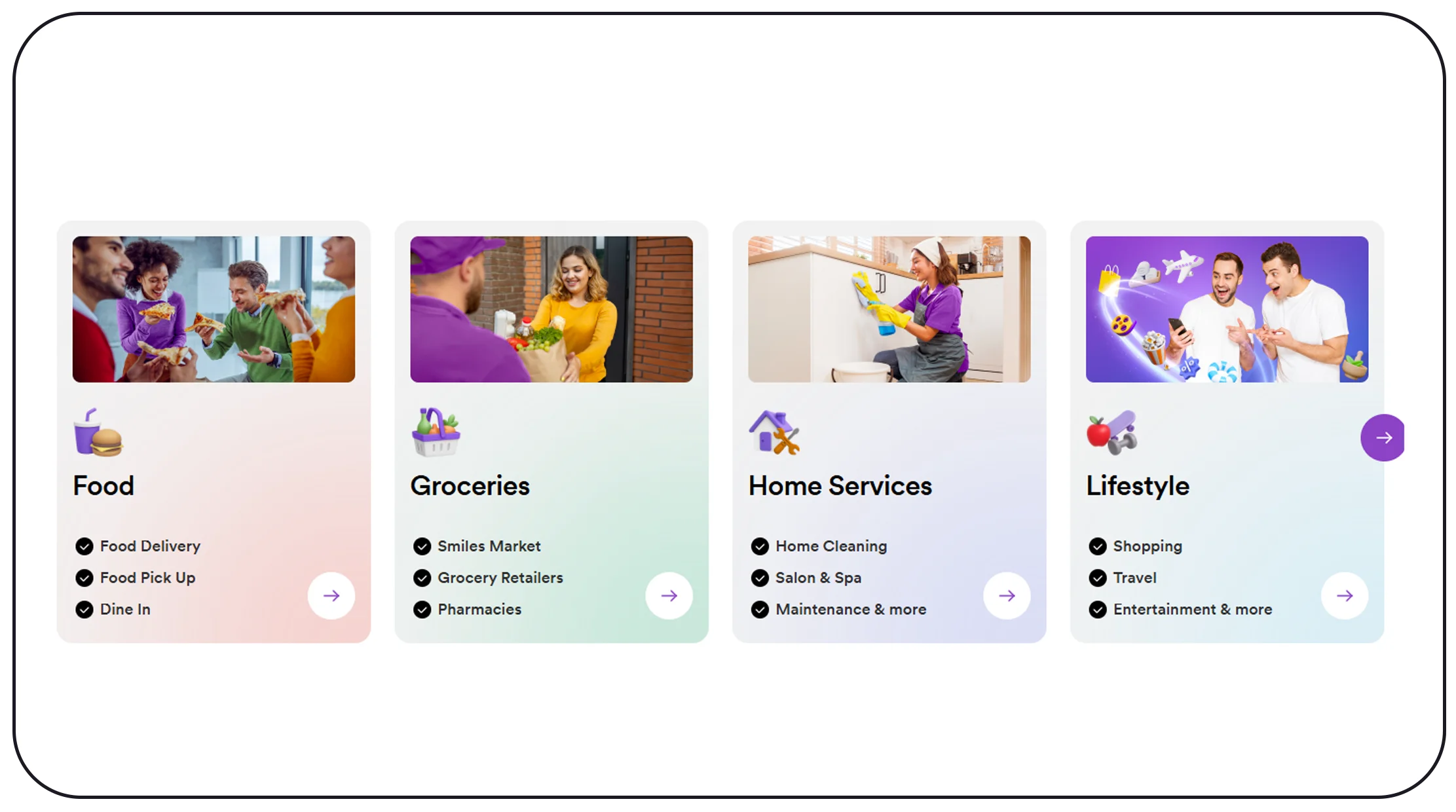
Smiles' grocery marketplace includes supermarket and grocery-retailer offerings, while its platform allows customers to see retailers delivering to their area. (Smiles) This makes location and delivery context particularly important dimensions for analysis.
2020–2026 market context
The 2020 shift toward online food and beverage purchasing accelerated digital marketplace adoption in the UAE. In 2020, online F&B sales reportedly grew 255% year over year. (Government of Dubai Media Office) During 2021–2023, businesses increasingly treated digital ordering channels as recurring sales and customer-engagement channels rather than temporary alternatives. By 2024, Grand View Research estimated UAE online food-delivery revenue at $2.51 billion under its market definition, forecasting $3.96 billion by 2030. (Grand View Research) In 2025–2026, the growing integration of grocery, food, rewards, and delivery services has increased the potential value of structured marketplace intelligence.
How does location-aware restaurant intelligence improve competitive analysis?
Restaurant intelligence becomes more useful when businesses can compare what customers actually see in different locations. Menu prices, promotions, restaurant availability, delivery times, and even restaurant visibility can change according to geography, operating hours, and demand.
real-time Smiles restaurant data can therefore support use cases such as restaurant benchmarking, menu-price tracking, cuisine analysis, promotional monitoring, and location-based competitive research.
Smiles currently states that its food service provides access to more than 13,000 restaurants and includes cuisines ranging from fast food and healthy food to Arabic, Indian, and Asian options. It also states that average delivery time is 30–45 minutes, although actual times vary by distance and traffic. (Smiles)
For a restaurant chain, this creates several practical questions:
- How does its menu price compare with nearby competitors?
- Which restaurants are offering discounts?
- Which cuisines have the broadest local assortment?
- Which menu items are consistently available?
- How does delivery information vary by location?
- Which competitors appear frequently in target neighborhoods?
Example restaurant intelligence structure
| Metric | Example Application |
|---|---|
| Restaurant | Competitor identification |
| Cuisine | Market segmentation |
| Menu item | Product-level comparison |
| Listed price | Price benchmarking |
| Promotion | Offer monitoring |
| Availability | Operational visibility |
| Delivery estimate | Service comparison |
| Location | Geographic segmentation |
2020–2026 market context
The UAE's digital food market expanded rapidly after the pandemic-driven acceleration of 2020. Dubai Chamber's 2020 analysis recorded a 255% annual increase in online F&B sales. (Government of Dubai Media Office) By 2024, the UAE online food-delivery market was estimated at $2.51 billion by Grand View Research. (Grand View Research) Market research published in 2026 by IMARC separately valued the market at $793.9 million in 2025, illustrating why analysts must always check definitions, geography, and methodology before comparing market-size statistics. (IMARC Group) For data buyers, the broader takeaway is the same: restaurant marketplaces now generate a large and frequently changing information layer that can be analyzed systematically.
What can automated restaurant collection reveal that manual research misses?
Manual restaurant research can work for a handful of competitors, but it becomes difficult when a business wants to monitor hundreds or thousands of restaurants across multiple locations.
A Smiles restaurant web data scraper can be designed to collect permitted and publicly accessible information on a recurring schedule. The resulting records can then be normalized and compared over time.
The value is particularly clear for restaurant groups, food-tech companies, market researchers, delivery platforms, and agencies that need to monitor competitive conditions.
For example, a restaurant intelligence workflow might capture a competitor's menu every day and compare it with the previous snapshot. If a burger price changes from AED 32 to AED 35, the system can flag the change. If a promotional offer disappears, the event can also be recorded.
From raw records to actionable intelligence
| Collection Stage | Output |
|---|---|
| Source discovery | Relevant marketplace pages |
| Extraction | Raw restaurant records |
| Normalization | Consistent fields |
| Validation | Quality-controlled records |
| Historical storage | Time-series dataset |
| Change detection | Price/menu/availability alerts |
| Analytics | Dashboards and reports |
2020–2026 market context
The importance of automated monitoring increased alongside online ordering. In 2020, UAE online F&B sales surged 255% year over year according to Dubai Chamber's analysis. (Government of Dubai Media Office) In the following years, food-delivery platforms became increasingly integrated into everyday purchasing behavior. A 2025 Gulf News analysis of data released by major UAE delivery platforms described food, groceries, and quick-commerce orders as established parts of everyday consumption. (Gulf News) By 2026, Smiles itself reports millions of downloads and a broad food and grocery ecosystem. (Smiles) For businesses, the implication is that competitive data can change frequently enough that periodic manual research may provide an incomplete view.
Want to turn marketplace information into a structured competitive intelligence workflow? Talk to Real Data API about your data requirements, fields, refresh frequency, and delivery format!
Get Insights Now!How does an integrated data layer support faster business decisions?
Smiles API can serve as a conceptual integration layer for businesses that need marketplace information connected to internal analytics, reporting, pricing, or research systems. However, businesses should distinguish between an official platform API and a third-party managed extraction service. Data collection should always be scoped around authorized, permitted, and technically appropriate sources.
The objective is not simply to collect more data. It is to create a consistent data pipeline in which information can move from collection to validation, storage, analytics, and decision-making.
A practical architecture
Source → Collection → Validation → Normalization → Storage → Analytics → Alerts
For example, an analytics team could maintain historical product records containing:
- Product identity
- Category
- Brand
- Listed price
- Promotional price
- Availability
- Retailer
- Restaurant or merchant
- Location
- Collection timestamp
This structure makes it possible to build time-series comparisons rather than one-off reports.
Why timestamps matter
Suppose a retailer runs a promotion for only six hours. A weekly dataset may never capture the event. A more frequent collection schedule increases the chance of recording short-lived changes, subject to source availability and collection permissions.
2020–2026 market context
The UAE digital food market's acceleration in 2020 created a stronger need for digital measurement. Dubai Chamber reported $412 million in online F&B sales during 2020 after a 255% year-over-year increase. (Government of Dubai Media Office) By 2024, Grand View Research estimated online food-delivery revenue at $2.51 billion in the UAE. (Grand View Research) Smiles' current platform combines food delivery, groceries, rewards, dining, shopping, and other services, while its grocery marketplace allows customers to compare retailers and delivery options. (Smiles) This convergence makes structured data increasingly useful for businesses that need a unified view of digital commerce.
Why are structured food datasets becoming important for AI and analytics?
Food Datasets are increasingly useful for organizations developing recommendation engines, competitive-intelligence dashboards, pricing systems, market research, and AI-driven analytics.
A dataset becomes significantly more valuable when it contains historical context. A single restaurant menu tells a business what is listed today. A six-month dataset can show how menu prices, promotions, availability, and assortment changed over time.
For AI systems, structured records are also easier to process than inconsistent spreadsheets or screenshots. Consistent schemas enable classification, clustering, trend detection, anomaly detection, and retrieval-based applications.
Example analytical use cases
| Use Case | Data Required | Output |
|---|---|---|
| Price intelligence | Product/menu prices | Price-change alerts |
| Assortment analysis | Product/menu catalog | Category comparison |
| Promotion monitoring | Discounts/offers | Promotion history |
| Restaurant benchmarking | Menu + location | Competitor dashboard |
| Availability analysis | Stock/status fields | Availability trends |
| AI applications | Structured historical data | Predictive/semantic insights |
2020–2026 market context
The move toward digital food purchasing accelerated sharply in 2020, when UAE online F&B sales increased 255% year over year. (Government of Dubai Media Office) From 2021 through 2024, online ordering became an increasingly established commercial channel. By 2024, Grand View Research reported $2.51 billion in UAE online food-delivery revenue under its methodology. (Grand View Research) In 2025, Gulf News reported that platform data covering food, grocery, and quick commerce reflected established online consumption patterns in the UAE. (Gulf News) In 2026, Smiles continues to combine food and grocery services within its super-app ecosystem. (Smiles) This progression creates a growing requirement for structured, historical, machine-readable marketplace information.
How can businesses turn marketplace collection into ongoing intelligence?
Food Data Scraping becomes more useful when it is treated as an ongoing data-engineering process rather than a one-time extraction project.
A successful workflow should define the business question first. For a grocery company, the objective may be price benchmarking. For a restaurant chain, it may be menu and promotion monitoring. For a food-tech startup, it could involve building a location-aware recommendation or comparison product.
The collection architecture should then be designed around the required fields, geography, refresh frequency, historical storage, validation rules, and delivery format.
Recommended workflow
| Step | Action | Business Benefit |
|---|---|---|
| 1 | Define KPIs | Clear measurement |
| 2 | Map required fields | Avoid unnecessary data |
| 3 | Establish source scope | Consistent collection |
| 4 | Collect records | Build raw dataset |
| 5 | Normalize | Enable comparisons |
| 6 | Validate | Improve reliability |
| 7 | Store history | Detect changes |
| 8 | Analyze | Generate insights |
| 9 | Deliver alerts | Enable action |
A location-aware model is particularly important for food and grocery platforms. Smiles states that users enter their address to determine which restaurants or grocery retailers deliver to their area. (Smiles) Therefore, a dataset that ignores geography may fail to represent what customers actually see.
2020–2026 market context
The period from 2020 to 2026 demonstrates why recurring data collection matters. The 2020 UAE online F&B market experienced a 255% year-over-year increase. (Government of Dubai Media Office) By 2024, the UAE online food-delivery market had reached an estimated $2.51 billion according to Grand View Research. (Grand View Research) In 2025, online food, grocery, and quick-commerce activity was sufficiently established for delivery-platform data to provide a snapshot of consumer ordering behavior. (Gulf News) In 2026, Smiles reports more than 6 million downloads and a broad ecosystem covering food and grocery services. (Smiles) These developments make historical, location-aware datasets increasingly relevant to businesses operating in digital commerce.
Why Choose Real Data API?
Real Data API approaches marketplace intelligence as a structured data problem rather than simply a scraping exercise. The focus should be on delivering information that is consistent, usable, validated, and aligned with a specific business objective.
A practical engagement can be designed around:
- Required food, grocery, restaurant, or product fields
- Location and market coverage
- Collection frequency
- Historical data requirements
- Data normalization
- Quality validation
- Change detection
- API, database, CSV, or JSON delivery
- Analytics-ready structures
This approach helps businesses avoid collecting large volumes of information that do not answer a specific commercial question.
For example, a restaurant brand may need only competitor menu prices, promotions, availability, cuisine, location, and delivery information. A grocery intelligence team may additionally require brand, pack size, category, discount, retailer, and historical price information.
The exact dataset should therefore be designed around the intended use case rather than around the maximum amount of information technically available.
Conclusion
The growing digital food and grocery ecosystem creates a continuously changing information environment. Smiles currently combines food delivery, groceries, restaurant discovery, retail offerings, rewards, and other services, making structured marketplace intelligence potentially valuable for companies operating across these categories. (Smiles)
The strongest data strategy is not simply to collect more records. It is to create a repeatable pipeline that captures relevant information, validates it, preserves historical changes, accounts for location, and delivers the results in a format business systems can use.
For restaurant groups, this can support menu and competitor monitoring. For grocery businesses, it can support pricing and assortment analysis. For food-tech companies, it can provide structured inputs for analytics and AI applications.
Ready to build a structured food, grocery, restaurant, product, and delivery intelligence workflow? Contact Real Data API to discuss your required fields, locations, refresh frequency, and delivery format!
FAQs
1. What is Smiles API used for?
Smiles API can support structured marketplace intelligence workflows involving food, grocery, restaurant, product, pricing, availability, and delivery information, depending on source access and technical scope.
2. What does Smiles Scraper collect?
A Smiles Scraper workflow can collect permitted marketplace fields such as restaurant information, menu items, visible prices, promotions, availability, grocery products, and location context.
3. Why is Smiles food data web scraping useful?
Smiles food data web scraping can help businesses build historical datasets for restaurant benchmarking, menu monitoring, pricing analysis, promotion tracking, assortment research, and competitive intelligence.
4. How does extract Smiles product data API support analytics?
Businesses can use extract Smiles product data API workflows to structure product information into consistent records suitable for dashboards, databases, pricing systems, research, and analytics.
5. Can real-time Smiles restaurant data support competitive intelligence?
Yes. real-time Smiles restaurant data can help teams monitor visible menu prices, promotions, restaurant availability, delivery context, and location-specific competitive changes where technically feasible and permitted.
Latest posts
How Smiles API Enables Real-Time Food, Grocery, Restaurant, Product, and Delivery Data Intelligence
How BigBasket API Helps Businesses Extract Grocery Products, Prices, Offers, and Availability Data
How Restaurant, Menu, Price, Rating, and Delivery Data Helps Businesses Track Food Delivery Markets

How Businesses Solve Restaurant Market Intelligence Challenges with Rating, Review, and Location Data






.png)