Quick Summary
- Ajio API helps retailers structure fashion product, pricing, brand, and category information for competitive analysis and assortment planning.
- Ajio Product Data Scraping supports recurring collection of marketplace information, helping teams identify price changes, new products, brand movements, and category trends.
- The approach creates a scalable data foundation for fashion retailers that need consistent marketplace intelligence across a rapidly changing online catalog.
Introduction
Retailers can improve competitive intelligence by continuously tracking product attributes, prices, brands, categories, promotions, and assortment changes instead of relying on occasional manual checks. Ajio API provides a structured foundation for collecting and organizing these marketplace signals so fashion teams can compare products, identify pricing movements, and understand assortment changes more efficiently.
India's online fashion market has become increasingly broad-based. Redseer reported in 2025 that fashion accounted for roughly one-fourth of consumer spending on online retail over the three years ending August 2025, while 59% of online fashion GMV came from Tier 2 and smaller cities. This geographic expansion increases the need for structured product intelligence across categories and consumer segments.
Ajio Product Data Scraping can support this requirement by organizing product names, brands, categories, prices, discounts, sizes, colors, availability, ratings, and other accessible attributes into a consistent dataset.
The buyer persona for this solution includes fashion retailers, D2C brands, marketplace sellers, category managers, pricing teams, distributors, and business intelligence teams. Their common pain point is fragmented information. When thousands or millions of fashion listings change over time, manual monitoring makes it difficult to identify which changes matter.
A structured data workflow helps convert those changes into comparable records that can support pricing intelligence, assortment planning, competitor monitoring, and marketplace strategy.
How Can Retailers Build a Reliable Fashion Product Dataset?
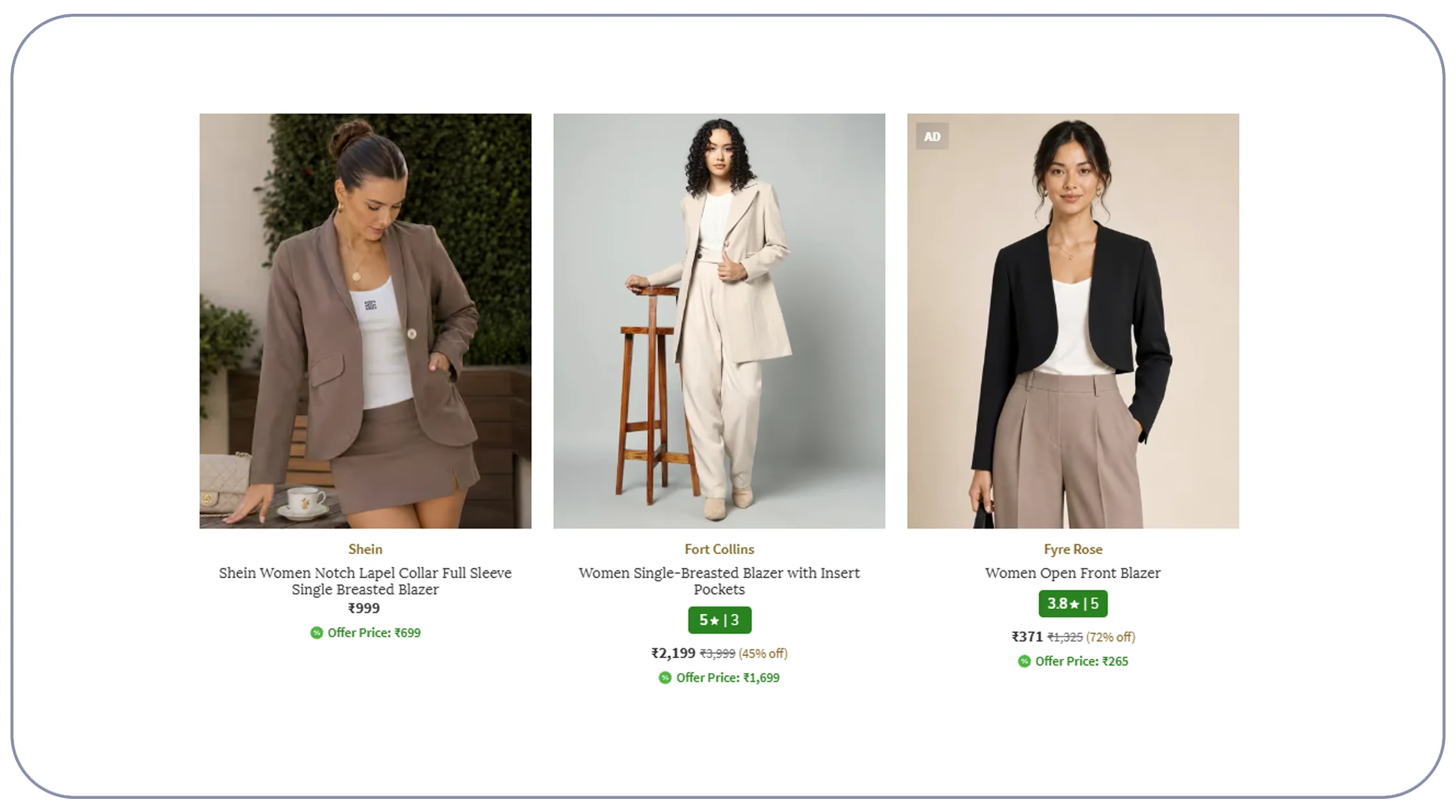
Ajio fashion product data web scraping enables retailers to collect structured information from fashion listings and convert changing marketplace pages into comparable records. For fashion businesses, product intelligence needs to go beyond product names. Useful datasets can include brand, category, gender, product type, color, size, material, price, discount, availability, rating, product URL, and timestamp.
Fashion E-Commerce Development Context
| Period | Market development | Data implication |
|---|---|---|
| 2020 | Online shopping accelerated | Digital catalog visibility became important |
| 2021 | E-commerce adoption remained elevated | Product monitoring expanded |
| 2022 | Fashion brands increased digital activity | Competitive assortment gained importance |
| 2023 | Online fashion expanded beyond major metros | Geographic analysis became more useful |
| 2024 | Broader marketplace assortment | SKU-level tracking became more valuable |
| 2025 | 59% of online fashion GMV came from T2+ cities | Regional intelligence gained importance |
| 2026 | Faster catalog and assortment changes | Recurring monitoring becomes increasingly relevant |
Redseer's 2025 research found that 59% of online fashion GMV came from Tier 2 and smaller cities during the three years ending August 2025.
From 2020 to 2022, many fashion companies were primarily concerned with establishing digital visibility and maintaining online catalogs. By 2023–2024, the challenge increasingly shifted toward comparing products and brands across a wider digital market. In 2025, the expansion of online fashion into smaller cities made geographic segmentation more relevant.
For 2026, retailers can build historical product datasets that show when a product entered a catalog, how its price changed, whether it remained available, and how its category position evolved.
The practical value comes from normalization. A retailer can group products by brand, category, gender, product type, price band, and other attributes. This makes it easier to identify assortment gaps and compare comparable products rather than simply comparing product titles.
How Can Retailers Monitor Brand Assortment Changes?
An Ajio brand web data scraper can help retailers monitor how brand presence and product assortment evolve over time. This is particularly useful for category managers who need to understand whether competitors are expanding into new categories, adding new products, changing price bands, or reducing assortment.
Reliance Industries has reported significant expansion in the platform's catalog. In 2024, its reporting stated that the catalog crossed 2 million options, up 25% year over year, while new brands including ASOS, H&M, and Timberland were added. In 2025, Reliance reported that the catalog expanded to more than 2.7 million options, up 35% year over year, with 20+ leading brands added.
Brand Monitoring Framework
| Metric | What to monitor | Business application |
|---|---|---|
| Brand count | Number of active brands | Marketplace breadth |
| SKU count | Products per brand | Assortment depth |
| Category presence | Categories served | Expansion tracking |
| Price bands | Entry to premium ranges | Positioning analysis |
| New listings | Newly appearing products | Launch monitoring |
| Removed listings | Disappearing products | Assortment changes |
| Discount activity | Promotional pricing | Campaign analysis |
Between 2020 and 2022, brand monitoring was often performed through manual catalog research. As online fashion expanded, the number of products and brands made that approach increasingly difficult to scale. In 2023 and 2024, automated collection became more useful for tracking larger catalogs. By 2025, the reported multi-million-option catalog demonstrated the scale of information that fashion teams may need to organize.
For 2026, retailers can use historical brand records to identify assortment expansion, product introductions, category diversification, and changes in price positioning.
The key insight is to track both brand-level and SKU-level movements. A brand adding 500 products is different from a brand adding only 20 premium products. A structured dataset allows teams to distinguish those patterns.
How Can Brands Automate Brand-Level Marketplace Intelligence?
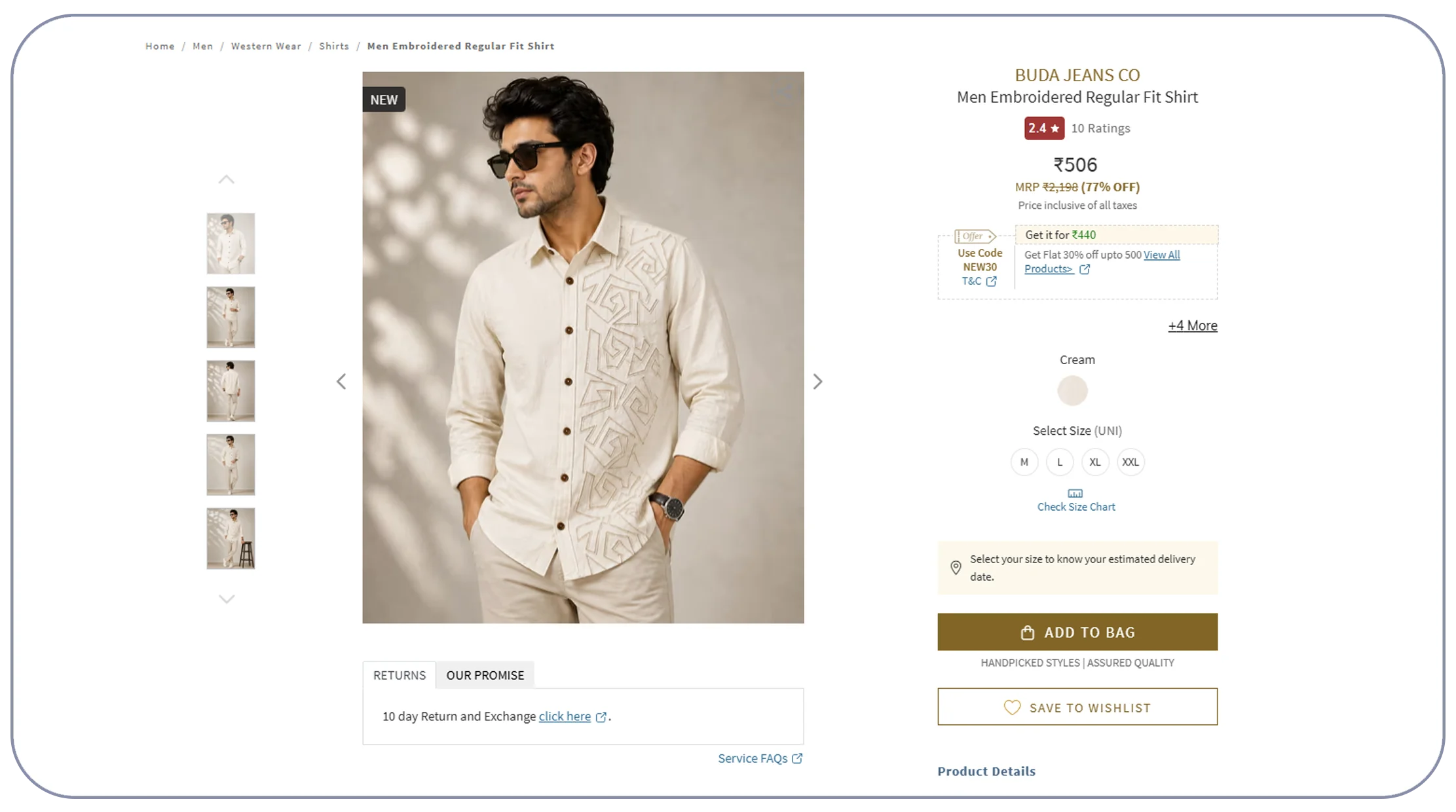
Businesses can extract Ajio brand data API records into standardized datasets that connect marketplace observations with internal analytics environments. This is particularly valuable for fashion organizations managing many brands, categories, and price segments.
The objective is not merely to collect more data. It is to make marketplace information consistent enough for comparison.
Brand Intelligence Data Model
| Data category | Example attributes | Analytical use |
|---|---|---|
| Brand identity | Brand name, brand URL | Brand mapping |
| Product catalog | Product name, SKU, URL | Assortment tracking |
| Category | Apparel, footwear, accessories | Category benchmarking |
| Pricing | MRP, selling price, discount | Price analysis |
| Attributes | Color, size, material | Product comparison |
| Availability | In stock, unavailable | Supply visibility |
| Time | Collection timestamp | Historical analysis |
Reliance reported that AJIO's catalog had expanded beyond 2.7 million options by 2025. Earlier company reporting showed a catalog exceeding 2 million options in 2024. These figures illustrate why scalable data architecture becomes more important as marketplace assortment expands.
From 2020 to 2022, brands could often manage online product intelligence through smaller datasets and periodic research. In 2023–2024, the growth of digital assortment created greater requirements for automated normalization. In 2025, multi-million-option catalogs made scalable processing even more relevant. In 2026, businesses can use accumulated historical records to analyze product lifecycle patterns.
For example, an analytics team can identify how long products remain listed, which price bands receive the most new listings, and which categories experience the greatest assortment changes.
A recurring data pipeline can also separate new products from existing products. This enables businesses to calculate new-SKU rates, category expansion, brand-level assortment growth, and product retirement patterns.
These metrics provide a more complete view of marketplace activity than a static product catalog.
How Can Retailers Improve Price Intelligence Across Fashion Categories?
Ajio product price data collection services can help retailers monitor selling prices, discounts, price bands, and promotional activity across comparable fashion products. Price intelligence becomes more useful when product characteristics are normalized before comparison.
For example, comparing a premium leather jacket with a basic synthetic jacket solely on selling price can create a misleading benchmark. Category, material, brand segment, product type, and other available attributes should be considered alongside price.
Fashion Price Intelligence Framework
| Metric | Calculation concept | Business use |
|---|---|---|
| Average price | Mean selling price | Category benchmark |
| Median price | Middle observed price | Reduce outlier impact |
| Discount depth | MRP vs selling price | Promotion analysis |
| Price index | Brand price / category benchmark | Positioning |
| Price change | Current vs previous price | Movement detection |
| Price-band share | SKUs in each price range | Assortment strategy |
Reliance's 2025 reporting showed that AJIO's catalog expansion was accompanied by promotions and festive buying, with the platform reporting its highest-ever daily sales during its All Stars Dussehra event.
This highlights why price monitoring should capture timestamps. A discount observed during a major sale should not automatically be treated as the normal market price.
Between 2020 and 2022, online fashion pricing was heavily influenced by the rapid transition toward digital shopping. During 2023–2024, retailers increasingly needed structured competitive benchmarks. In 2025, large promotional events and broader product catalogs created more opportunities for price intelligence. In 2026, historical price observations can help retailers identify recurring promotional periods and category-level pricing patterns.
A strong dataset should retain both regular and promotional prices where available. It should also capture collection time, brand, category, product type, and product identifiers.
This enables pricing teams to distinguish permanent price changes from temporary promotional events.
How Can Retailers Turn Marketplace Data Into Actionable Fashion Intelligence?
A structured AJIO API workflow can connect product, brand, category, pricing, and availability observations with business intelligence systems. The goal is to create a repeatable data layer that supports dashboards, category analysis, competitive monitoring, and historical reporting.
Example Intelligence Outputs
| Output | What it shows | Decision supported |
|---|---|---|
| Brand assortment report | Products by brand | Competitor benchmarking |
| Category price index | Relative price positioning | Pricing analysis |
| New-SKU tracker | Newly listed products | Trend monitoring |
| Availability report | In-stock patterns | Supply analysis |
| Discount tracker | Promotional movements | Campaign benchmarking |
| Price history | Historical changes | Pricing decisions |
Reliance reported that AJIO had expanded its catalog to 2.7 million-plus options in 2025, while its AJIO Rush service had expanded to more than 300 pincodes across six cities at that point. More recent company reporting indicates continued expansion, with AJIO's option count reaching around three million and AJIO Rush covering more than 600 towns.
These developments demonstrate why marketplace intelligence must be designed for scale and geographic variation.
From 2020 to 2022, businesses primarily needed reliable digital product information. In 2023 and 2024, the focus broadened toward competitive assortment and pricing. In 2025, the combination of large catalogs and faster delivery initiatives increased the value of frequent monitoring. In 2026, historical data can be connected to dashboards and analytical models to identify recurring patterns.
Retailers can create alerts for significant price changes, newly listed brands, unusual assortment movements, or category-level shifts.
The result is a marketplace intelligence system that supports both operational monitoring and strategic analysis.
How Can an API-Based Data Workflow Support E-Commerce Analytics?
An Ecommerce Scraping API can provide a standardized delivery layer between collected marketplace information and the retailer's existing data infrastructure. This is useful when teams want to connect product intelligence with data warehouses, dashboards, pricing systems, or business intelligence applications.
Data Workflow Structure
| Stage | Activity | Result |
|---|---|---|
| Collection | Gather marketplace observations | Raw records |
| Validation | Check missing or inconsistent fields | Cleaner data |
| Normalization | Standardize products and attributes | Comparable records |
| Matching | Link products and brands | Unified catalog |
| Historical storage | Retain timestamps | Trend analysis |
| Delivery | Send structured records | Analytics-ready data |
The importance of scalable data infrastructure has increased alongside marketplace assortment. Reliance reported a move from more than 2 million AJIO options in 2024 to more than 2.7 million in 2025.
From 2020 through 2022, a smaller volume of digital commerce data could often be handled through spreadsheets and periodic exports. By 2023–2024, larger product catalogs required better normalization and automated processing. In 2025, expanding assortment and faster marketplace activity strengthened the case for recurring data pipelines. For 2026, API-based delivery can make marketplace intelligence easier to integrate into existing technology stacks.
A useful architecture should separate raw collection from cleaned analytical datasets. This makes it possible to reprocess records when business rules change without recollecting everything.
Retailers can then create standardized tables for products, brands, categories, prices, availability, and historical observations. These tables can feed dashboards that answer practical questions such as which brands are expanding, which categories are becoming more competitive, and where pricing has shifted.
Why Choose Real Data API?
E-Commerce Datasets provide the structured foundation required to transform marketplace observations into usable business intelligence. Real Data API can help businesses organize product, brand, category, pricing, and availability information into consistent datasets designed for recurring analysis. The approach is suitable for fashion retailers, D2C brands, marketplace sellers, pricing teams, and category managers that need scalable data rather than isolated research snapshots. Data validation and normalization can improve comparability across records, while historical storage enables trend analysis. The resulting datasets can support competitive benchmarking, assortment intelligence, price monitoring, product research, and business intelligence workflows. This helps teams move from fragmented marketplace information toward a more systematic approach to digital commerce analysis.
Conclusion
The rapid expansion of online fashion has made marketplace data increasingly important for retailers and brands. India's online fashion market is no longer concentrated only in major metropolitan areas; Redseer reported that 59% of online fashion GMV came from Tier 2 and smaller cities over the three years ending August 2025. At the platform level, Reliance reported that AJIO's catalog exceeded 2.7 million options in 2025 and continued to expand.
AJIO API can therefore form part of a broader data strategy for monitoring products, prices, brands, categories, and marketplace movements.
Real Data API can help retailers turn recurring marketplace observations into structured datasets that support historical analysis, competitive benchmarking, assortment planning, and pricing intelligence.
Contact Real Data API to build scalable fashion marketplace datasets and transform product, price, brand, and category information into actionable competitive intelligence!
FAQs
1. What can retailers monitor with Ajio API?
Retailers can use Ajio API workflows to organize available product, pricing, brand, category, availability, and other marketplace information for recurring competitive analysis.
2. Why is Ajio Product Data Scraping useful for fashion brands?
Ajio Product Data Scraping helps fashion businesses collect structured catalog information and compare products, categories, prices, brands, and availability across recurring monitoring periods.
3. What information can Ajio fashion product data web scraping provide?
Ajio fashion product data web scraping can capture available product attributes such as names, brands, categories, prices, discounts, sizes, colors, availability, URLs, and timestamps.
4. How does an Ajio brand web data scraper support competitor research?
An Ajio brand web data scraper can organize brand-level and product-level observations, helping retailers monitor assortment expansion, new listings, category presence, and pricing patterns.
5. Can extract Ajio brand data API workflows support large catalogs?
Yes. Businesses can extract Ajio brand data API records into structured systems designed to process recurring product, brand, category, price, and availability information at scale. Real Data API can support this type of structured data workflow.
Latest posts
How Smiles API Enables Real-Time Food, Grocery, Restaurant, Product, and Delivery Data Intelligence
How BigBasket API Helps Businesses Extract Grocery Products, Prices, Offers, and Availability Data
How Restaurant, Menu, Price, Rating, and Delivery Data Helps Businesses Track Food Delivery Markets
How Businesses Solve Restaurant Market Intelligence Challenges with Rating, Review, and Location Data






.png)