Quick Summary
- Ixigo API can support structured access to travel information across flights, trains, hotels, routes, prices, and availability for research and analytics.
- Ixigo Travel Data Scraping helps businesses organize recurring travel-market observations into datasets for pricing analysis, competitor monitoring, route research, and travel intelligence.
Introduction
Travel businesses need timely information to understand changing fares, routes, availability, hotel rates, and transportation options. Ixigo API can be incorporated into a structured data workflow to help businesses collect, organize, and analyze relevant travel information across multiple categories. For travel agencies, OTAs, researchers, aggregators, and analytics teams, the challenge is not simply finding travel information but maintaining consistent datasets that can be compared over time.
ixigo operates across trains, flights, buses, and hotels and describes itself as a travel technology company focused on helping Indian travelers plan, book, and manage journeys. Its investor-relations materials report 544 million annual active users in FY25. (ixigo Investor Relations)
Ixigo Travel Data Scraping can complement structured travel-data workflows by helping businesses organize publicly accessible travel information into records covering routes, fares, schedules, hotel attributes, availability indicators, and other relevant fields. Historical collection is particularly useful because travel information changes frequently. A flight fare available today may differ tomorrow, while hotel availability and train information can also change as booking windows progress.
The period from 2020 to 2026 illustrates the expansion of ixigo's travel ecosystem and the growing importance of structured travel intelligence.
| Year | Selected ixigo development |
|---|---|
| 2020 | Travel demand was heavily affected by pandemic-related restrictions |
| 2021 | Digital travel planning and recovery became important marketplace themes |
| 2022 | Travel activity recovered as mobility restrictions eased |
| 2023 | ixigo expanded its multi-modal travel ecosystem |
| 2024 | More than 48 crore annual active users were reported for FY24 |
| 2025 | 544 million annual active users and ₹149.72 billion GTV were reported for FY25 |
| 2026 | FY26 results and Q1 FY27 disclosures became available through investor relations |
ixigo's FY25 annual report reported monthly active users of 82.02 million, gross transaction value of ₹149.72 billion, and revenue from operations of ₹9.14 billion. (rocket.ixigo.com)
How Can Travel Businesses Turn Marketplace Data into Intelligence?
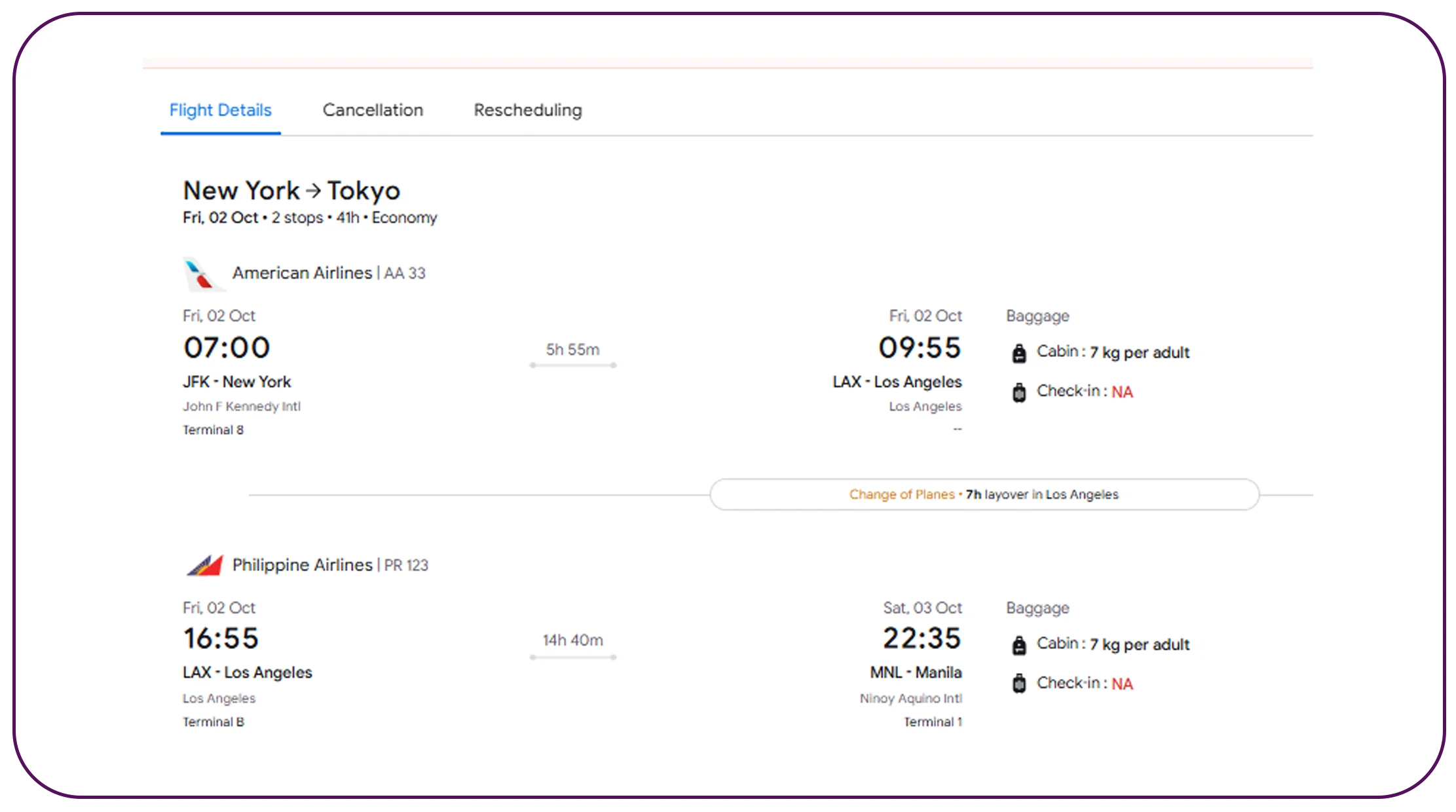
Travel-market intelligence depends on bringing multiple data points together. A flight fare by itself provides limited context. When combined with route, airline, departure date, travel class, availability, timing, and historical observations, it becomes more useful for comparative analysis.
Businesses building Ixigo travel market intelligence data can organize information around specific business questions. For example, a travel agency may monitor fares on high-demand routes, while a market researcher may compare hotel prices across cities. An airline analytics team could examine fare movements by route and booking window, while an accommodation company may analyze competing hotel rates.
The scale of ixigo's ecosystem makes structured data particularly relevant. The company reported more than 48 crore annual active users in FY24 and 544 million annual active users in FY25. Its FY25 annual report also reported ₹149.72 billion in gross transaction value. (ixigo Investor Relations)
| Period | Business context | Data opportunity |
|---|---|---|
| 2020 | Travel disruption | Establish historical baseline |
| 2021 | Recovery begins | Track demand normalization |
| 2022 | Mobility increases | Compare route and fare changes |
| 2023 | Multi-modal expansion | Combine transport categories |
| 2024 | 48+ crore FY24 annual active users | Broaden market coverage |
| 2025 | 544M FY25 annual active users | Increase analytical scope |
| 2026 | FY26 and Q1 FY27 reporting | Refresh current benchmarks |
From 2020 through 2026, travel-market analysis has increasingly shifted from static reports toward recurring datasets. A historical database allows companies to examine how fares and availability behave across seasons, holidays, routes, cities, and booking periods.
For a buyer persona such as a travel-data analyst, revenue manager, OTA strategist, or market-research team, the practical objective is to move from fragmented observations to standardized records. This can reduce spreadsheet-heavy workflows and make it easier to feed travel data into dashboards, forecasting systems, pricing models, and internal research.
The most useful datasets are therefore not necessarily the largest ones. They are datasets structured around specific analytical questions, collected consistently, validated carefully, and retained historically.
Build structured travel datasets that connect fares, routes, availability, and market signals over time.
How Can Businesses Monitor Flight Information More Frequently?
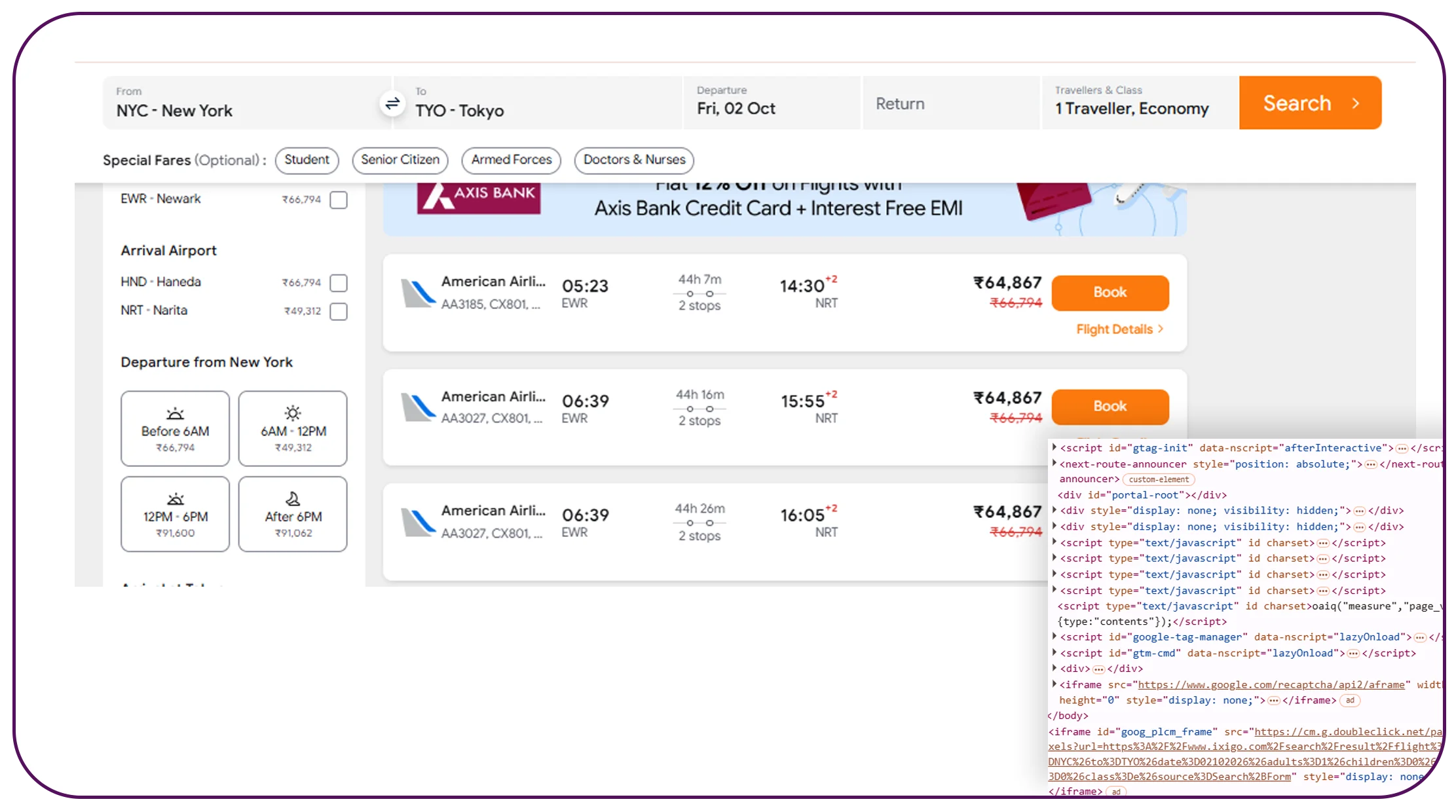
Flight pricing and availability can change rapidly based on travel dates, demand, inventory, airline schedules, booking windows, and other market conditions. This creates a practical challenge for businesses that depend on occasional snapshots. A fare observed during one collection cycle may no longer represent the market when the next customer searches.
A real-time Ixigo flight data API workflow can be designed around defined routes, dates, airlines, travel classes, or monitoring intervals. Depending on permitted data access, businesses can organize relevant flight observations into structured records and compare them with previous collection cycles.
ixigo itself provides flight-status and travel-planning features, including flight-status updates, fare alerts, and other travel utilities. Its website also provides flight-search pages containing route and airline information. (Ixigo)
| Data field | Example analytical use |
|---|---|
| Origin | Route-level analysis |
| Destination | Market comparison |
| Travel date | Demand-period analysis |
| Airline | Competitive comparison |
| Fare | Price benchmarking |
| Cabin class | Product comparison |
| Departure time | Schedule analysis |
| Availability signal | Inventory monitoring |
| Collection timestamp | Historical tracking |
The 2020–2026 period provides important context. In 2020 and 2021, travel markets were strongly affected by pandemic restrictions, making historical comparisons particularly important. By 2022, mobility and travel activity were recovering. During 2023 and 2024, online travel platforms continued expanding their multi-modal offerings. By FY25, ixigo reported 544 million annual active users across its ecosystem. (ixigo Investor Relations)
For a revenue-management or travel-intelligence team, recurring flight observations can help answer practical questions: Which routes show frequent fare movements? How do prices differ across travel dates? Which airline categories appear most frequently? How does availability change as departure approaches?
The goal is not simply to collect fares. It is to create a time-aware dataset that preserves when each observation was captured. This timestamp becomes essential for analyzing price movement and separating temporary changes from longer-term patterns.
A structured pipeline can also standardize airline names, airport identifiers, route formats, currency fields, and timestamps. Such normalization improves downstream comparison and reduces the manual preparation required before analysis.
What Can Businesses Learn from Travel Pricing Movements?
Pricing intelligence is valuable because travel prices are inherently dynamic. Businesses monitoring competitive travel markets need to distinguish between a single observed price and a broader pricing pattern. Historical observations make that distinction possible.
With scrape Ixigo pricing data, businesses can create datasets containing relevant fare observations, travel dates, routes, accommodation rates, or other accessible pricing fields. The data can then be compared across collection timestamps to identify movements and recurring patterns.
ixigo's platform includes pricing-related travel utilities such as fare-drop alerts and price-prediction features, illustrating the relevance of dynamic pricing information to travel planning. (Ixigo)
| Pricing dimension | What businesses can analyze |
|---|---|
| Route | Differences between origin-destination markets |
| Date | Seasonal and date-specific movement |
| Airline | Competitive fare positioning |
| Cabin | Product-level price differences |
| Hotel | Room-rate comparisons |
| Location | City and destination benchmarks |
| Timestamp | Price movement over time |
| Availability | Relationship between inventory signals and observed prices |
Between 2020 and 2026, the travel market changed from severe disruption to a much broader digital travel environment. Data collected during 2020–2021 can provide a baseline for unusual market conditions, while 2022–2024 observations can help researchers understand recovery and expansion. FY25 provides a newer benchmark, with ixigo reporting ₹149.72 billion in gross transaction value and ₹9.14 billion in revenue from operations. (rocket.ixigo.com)
For travel agencies, the key benefit of structured pricing history is context. A current fare can be compared with previous observations for the same route and travel date. This can help teams investigate whether a price is part of a normal pattern or represents a notable movement.
The same principle applies to hotels. A hotel rate without a timestamp is incomplete for competitive analysis because room rates can vary based on date, occupancy, booking window, room type, and promotional conditions.
Businesses should therefore store price observations alongside timestamps and relevant dimensions. This creates a historical layer that can power dashboards, alerts, research reports, and pricing analysis.
Create a timestamped pricing history to understand how travel-market prices change rather than relying on isolated snapshots!
How Can Pricing Data Be Standardized for Business Analysis?
Raw travel information is rarely ready for immediate business use. Different pages, categories, routes, and travel products may represent similar fields differently. A pricing dataset therefore needs a clear schema and normalization process before it can support reliable comparisons.
Ixigo pricing data extraction can be structured around fields such as route, travel date, provider, fare, currency, cabin class, hotel, room type, location, availability, and collection timestamp, depending on the intended use case and permitted data access.
A standardized data architecture can divide records into logical entities:
| Entity | Core attributes |
|---|---|
| Flight | Airline, route, date, fare, class |
| Train | Train, route, date, class, fare |
| Hotel | Property, location, room, rate |
| Travel route | Origin, destination, distance where available |
| Pricing event | Price, timestamp, product |
| Availability | Accessible availability signal and timestamp |
Historical development between 2020 and 2026 reinforces the need for consistent schemas. Travel conditions in 2020 were materially different from those in 2022, while 2023 and 2024 reflected continued digital travel expansion. In FY24, ixigo reported more than 48 crore annual active users, and its FY25 reporting showed 544 million annual active users. (ixigo Investor Relations)
For data teams, normalization can include standardizing airport and station names, converting currencies where appropriate, resolving duplicate routes, normalizing dates and times, and assigning consistent identifiers to travel products.
Validation should follow collection. A quality-control layer can identify missing values, unexpected fare formats, duplicate records, inconsistent timestamps, or sudden structural changes. This is especially important when the resulting dataset feeds automated dashboards or analytical models.
The buyer's objective should determine the schema. A hotel benchmarking project may prioritize property, room, location, date, and rate fields. A flight-monitoring project may require route, airline, cabin, departure time, fare, and availability.
The result is a reusable dataset rather than a one-off extraction.
How Can an API-Based Architecture Improve Travel Data Workflows?
Travel data becomes more valuable when collection is integrated into a repeatable technology workflow. Instead of repeatedly performing manual searches, businesses can define collection parameters, scheduling requirements, validation rules, and output formats in advance.
An Ixigo API architecture can be designed around the data fields required by the business. Depending on access rights and technical implementation, a workflow may collect relevant travel observations, normalize the records, validate them, and deliver structured outputs to databases, cloud storage, analytics platforms, or internal applications.
ixigo has continued to expand its technology-led travel ecosystem. In 2026, the company announced a fully AI-native app and agentic travel flows, and it also announced native travel apps on ChatGPT covering flights, trains, buses, and hotels. (ixigo Investor Relations)
| Workflow stage | Business purpose |
|---|---|
| Define scope | Select routes, products, dates, and markets |
| Collect | Capture permitted travel information |
| Normalize | Standardize fields and formats |
| Validate | Detect missing or inconsistent records |
| Store | Maintain historical observations |
| Analyze | Compare prices, routes, and availability |
| Deliver | Send datasets to business systems |
The 2020–2026 timeline also demonstrates why flexible architecture matters. Travel businesses have moved from disruption-era monitoring toward increasingly digital, multi-modal travel planning. ixigo now operates across trains, flights, buses, and hotels and describes its ecosystem as serving the "next billion users." (ixigo Investor Relations)
A scalable architecture should therefore accommodate changes in monitored categories. A project may begin with flight fares and later expand into train availability, hotel pricing, or bus routes. A modular schema reduces the need to rebuild the entire pipeline when requirements change.
Automation also improves operational consistency. Scheduled collection can reduce reliance on individual analysts remembering when to update spreadsheets. Historical storage allows the business to compare current observations with prior periods.
For travel-data buyers, the most important architecture questions are practical: What fields are needed? How frequently should they be collected? How should historical records be stored? Which validation rules are required? Where will the final dataset be consumed?
Answering these questions before collection creates a stronger foundation for long-term travel intelligence.
How Can Businesses Scale Travel Monitoring Across Multiple Categories?
Travel intelligence often begins with one specific problem but expands quickly. A business may initially need flight pricing and later require hotel rates, train information, route-level availability, or broader destination intelligence.
An Ixigo Scraper workflow can be designed around a defined set of travel categories and then expanded as analytical requirements grow. The architecture can support scheduled collection, structured fields, historical records, quality checks, and analytics-ready delivery.
ixigo's current ecosystem covers trains, flights, buses, and hotels. Its official site also highlights travel utilities such as PNR status, seat-availability alerts, flight-status updates, pricing alerts, deal discovery, and personalized recommendations. (Ixigo)
| Category | Potential data dimensions |
|---|---|
| Flights | Route, airline, fare, schedule |
| Trains | Train, route, class, availability |
| Hotels | Property, room, rate, location |
| Buses | Operator, route, schedule, fare |
| Destinations | Location, travel options, pricing |
| Marketplaces | Provider, product, price, timestamp |
From 2020 to 2026, ixigo's published financial and corporate materials show a progressively broader travel ecosystem. The investor-relations site provides annual reports from FY2020-21 onward and current FY26 and Q1 FY27 financial materials, allowing researchers to maintain a continuous reference framework. (ixigo Investor Relations)
FY25 provides a particularly useful benchmark: 544 million annual active users, ₹149.72 billion in gross transaction value, and ₹9.14 billion in revenue from operations. (rocket.ixigo.com) By 2026, the company was reporting FY26 results and Q1 FY27 materials, while continuing to expand AI-based travel products. (ixigo Investor Relations)
For a travel-data buyer, scalability means more than collecting more records. The pipeline should retain consistent identifiers and timestamps as coverage expands. This makes it possible to compare markets across categories without rebuilding the dataset from scratch.
A modular architecture can also support separate data layers for raw observations, cleaned records, historical snapshots, and business-ready outputs. That separation makes troubleshooting easier and protects historical datasets when source structures change.
The practical outcome is a travel-data foundation that can grow with the business.
Why Choose Real Data API?
Travel businesses need data workflows that are structured around measurable business requirements rather than generic extraction. A well-designed solution should define the target fields, collection frequency, geographic scope, validation rules, and delivery format before implementation begins.
Travel Scraping API solutions can support recurring collection architectures where permitted travel information is transformed into structured datasets for analytics. The workflow can include scheduling, normalization, deduplication, validation, timestamping, and historical storage.
Real Data API can help businesses organize these requirements into scalable data pipelines designed around specific travel intelligence use cases. The focus can be placed on producing consistent, analytics-ready information rather than delivering disconnected raw records.
For example, a flight-monitoring team may require route-level pricing observations at scheduled intervals. A hotel research team may need property-level rates by destination and travel date. A multi-modal travel analyst may require flight, train, bus, and hotel information within a unified schema.
The technology architecture should also account for changing marketplace structures. Travel pages, product fields, schedules, and pricing formats can change over time. A validation layer can flag unexpected changes before they affect downstream analytics.
Historical retention is another important consideration. Maintaining timestamped observations makes it possible to study price movement and availability patterns rather than relying solely on the latest snapshot.
Real Data API can therefore be positioned as a data-engineering partner for organizations that need recurring travel datasets, structured outputs, and scalable monitoring workflows.
Conclusion
Travel data has become increasingly dynamic as consumers compare flights, trains, buses, hotels, routes, prices, and availability through digital platforms. Businesses that rely on this information need structured datasets capable of capturing changes over time rather than isolated observations.
Ixigo API workflows can support a broader architecture for organizing relevant travel information around business requirements. With appropriate data-access permissions, businesses can structure records around routes, fares, travel dates, providers, hotel attributes, availability signals, and timestamps.
The 2020–2026 period provides a useful historical frame for understanding the evolution of digital travel. ixigo reported more than 48 crore annual active users in FY24 and 544 million annual active users in FY25, alongside FY25 gross transaction value of ₹149.72 billion. (ixigo Investor Relations) In 2026, the company continued publishing FY26 results and Q1 FY27 materials while expanding AI-based travel capabilities. (ixigo Investor Relations)
For travel agencies, OTAs, market researchers, revenue teams, and analytics companies, the practical value lies in creating consistent historical datasets. These datasets can support price benchmarking, route analysis, availability monitoring, competitive research, and travel-market intelligence.
The strongest implementation begins with a clearly defined business question, followed by an appropriate schema, collection schedule, validation framework, and delivery method.
Ready to build structured flight, train, hotel, travel, and pricing datasets? Connect with Real Data API to design a scalable travel-data workflow for your business!
FAQs
1. What is Ixigo API?
Ixigo API can refer to an API-based approach for organizing relevant ixigo travel information into structured workflows for analytics, monitoring, research, and business intelligence, subject to permitted access.
2. How does Ixigo Travel Data Scraping work?
Ixigo Travel Data Scraping involves collecting permitted publicly accessible travel information, normalizing fields, validating records, and maintaining structured datasets for recurring analysis and historical comparison.
3. What is Ixigo travel market intelligence data?
Ixigo travel market intelligence data can include structured observations related to routes, fares, schedules, hotel information, availability, and other relevant travel attributes used for market research.
4. How can businesses use real-time Ixigo flight data API information?
A real-time Ixigo flight data API workflow can help teams organize current flight observations around routes, dates, airlines, fares, schedules, and availability for monitoring and analysis.
5. Can businesses scrape Ixigo pricing data?
Businesses can scrape Ixigo pricing data where permitted and use structured observations for price benchmarking, historical analysis, competitive research, and monitoring travel-market movements. Real Data API can support the surrounding data workflow.
Latest posts
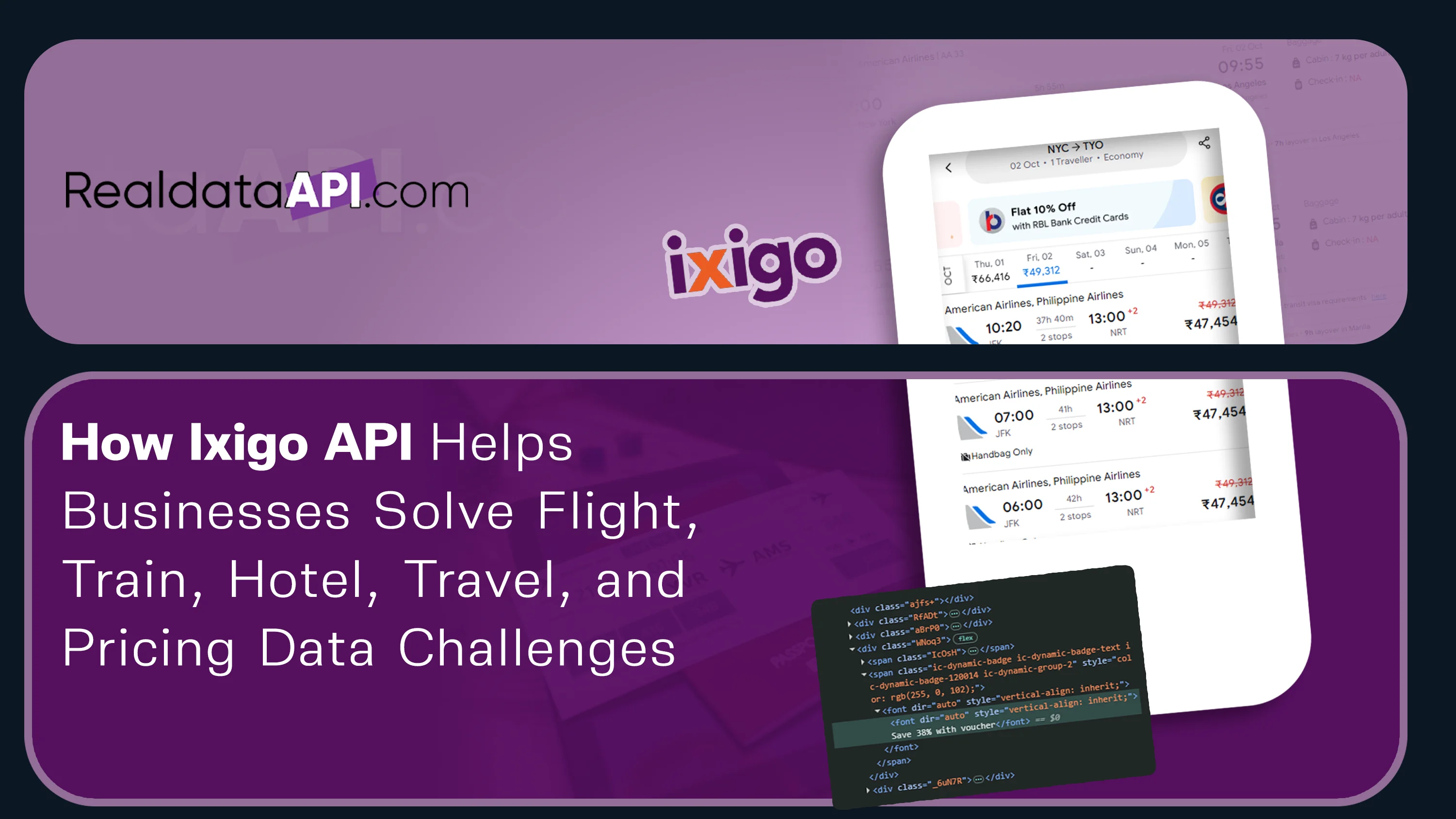
How Ixigo API Helps Businesses Solve Flight, Train, Hotel, Travel, and Pricing Data Challenges
How to Extract Restaurants, Menus, Prices, Ratings, and Business Data for Market Insights
How Brands Track Restaurant, Menu, Pricing, Rating, and Delivery Data for Competitive Intelligence

How Retailers Track Fashion Products, Prices, Brands, and Category Data for Competitive Intelligence Using AJIO API






.png)



