TL;DR
- Myntra API enables businesses to access structured fashion marketplace information, helping them monitor products, prices, brands, categories, and catalog changes at scale.
- Myntra Product Data Scraping can support competitor benchmarking, catalog intelligence, price monitoring, assortment analysis, and fashion-market research.
- For retailers, brands, marketplaces, and analytics companies, structured fashion data can reduce manual research and turn frequently changing marketplace information into actionable business intelligence.
Introduction
Fashion retailers need timely marketplace intelligence to understand what products are available, how prices are changing, which brands are gaining visibility, and how categories are evolving. Myntra API can help businesses collect structured marketplace information that supports pricing intelligence, product monitoring, catalog comparison, and fashion-market analysis.
The challenge is scale. Fashion marketplaces can contain thousands of products across numerous categories, brands, sizes, colors, discounts, ratings, and availability states. Manually tracking these attributes is slow and difficult to maintain. Myntra Product Data Scraping provides a systematic approach to gathering publicly available product information and converting it into structured datasets for analysis.
For fashion brands, retailers, D2C businesses, market researchers, and technology providers, this data can answer practical questions: Which products are competing in a category? How frequently do prices change? Which brands have broader assortments? What products are discounted? Which categories show increasing assortment depth?
The result is a more data-driven approach to fashion retail intelligence, where product and pricing information can be monitored continuously instead of being collected manually at irregular intervals.
What Has Changed in Fashion Marketplace Intelligence Between 2020 and 2026?
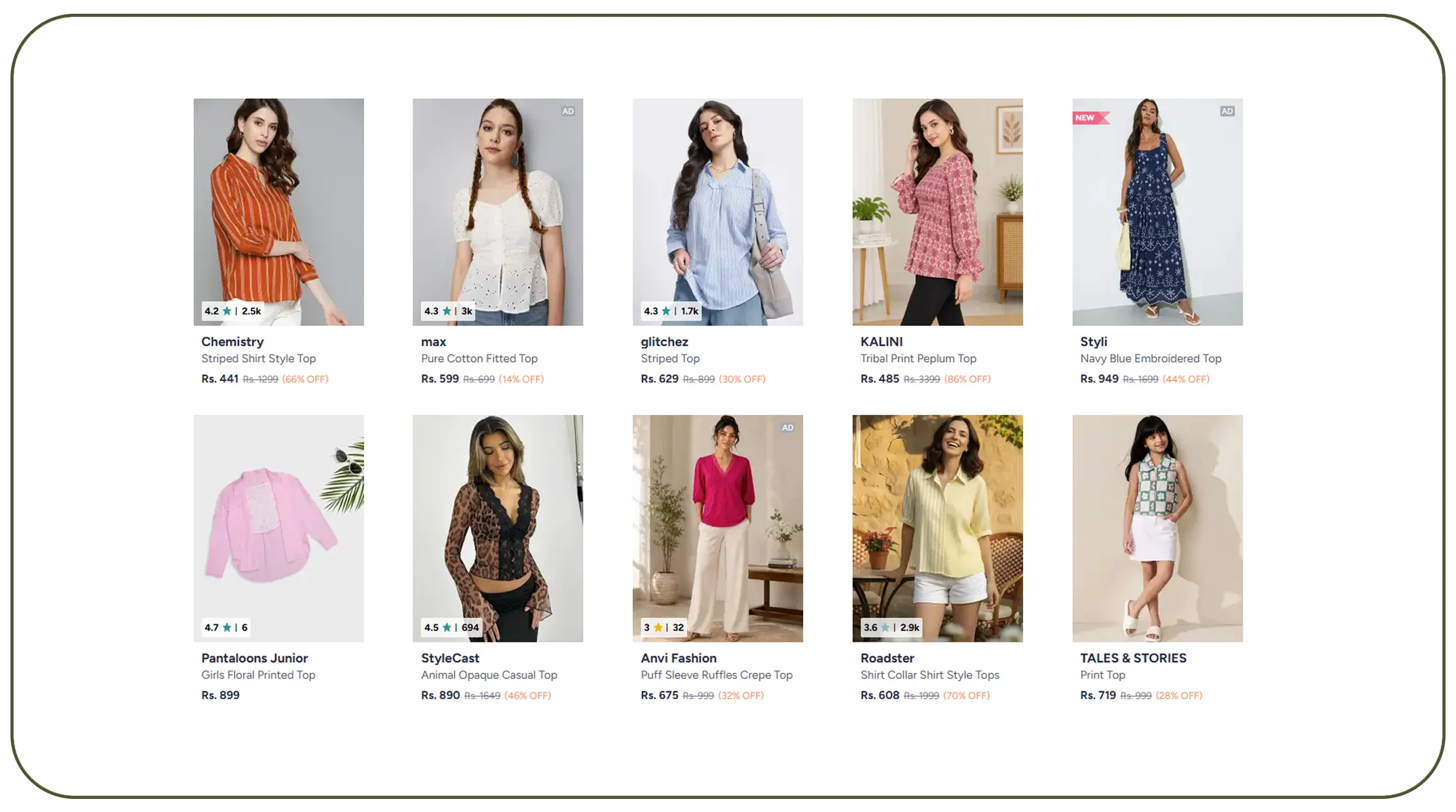
Between 2020 and 2026, fashion e-commerce has increasingly moved toward data-driven assortment planning, competitive pricing, digital merchandising, and marketplace monitoring. The expansion of online shopping has made product catalogs more dynamic, while customers can compare products and prices across multiple digital channels within minutes.
For retailers and brands, this creates a visibility challenge. A competitor can introduce new products, change a price, add discounts, modify availability, or expand into a category without providing direct notification to competing businesses. Structured marketplace data helps organizations observe these changes and incorporate them into their decision-making processes.
| Period | Major retail-data development | Business implication |
|---|---|---|
| 2020 | Rapid shift toward digital commerce | Greater dependence on online product visibility |
| 2021 | Expansion of online fashion catalogs | More products and attributes to monitor |
| 2022 | Stronger focus on competitive pricing | Increased demand for price benchmarking |
| 2023 | Growth of marketplace analytics | More structured competitor intelligence |
| 2024 | Greater automation in retail analytics | Faster recurring data workflows |
| 2025 | AI-assisted product and market analysis | Larger datasets become more actionable |
| 2026 | Integrated fashion intelligence | Product, price, brand, and category data increasingly analyzed together |
This evolution means businesses need more than isolated product records. They need historical datasets that can reveal changes over time.
What Does Product-Level Marketplace Monitoring Reveal?
Myntra fashion product data web scraping can help organizations build structured records containing attributes such as product name, brand, category, price, discount, rating, availability, product URL, and other accessible fields.
This enables businesses to compare their assortment with marketplace offerings and identify gaps. For example, a fashion retailer could examine whether competitors offer more products within a particular category, price range, or brand segment.
Measuring product availability
Availability data can provide another layer of intelligence. Businesses can track whether products are consistently available, temporarily unavailable, or removed from a catalog.
This information can support assortment planning and help analysts distinguish between a lack of demand and a lack of inventory visibility.
Understanding category movements
Category-level analysis can reveal how product assortments change. A business could compare the number of products observed across categories over different collection periods and identify categories with increasing or decreasing representation.
What can structured product data support?
| Data attribute | Potential business use |
|---|---|
| Product name | Catalog identification |
| Brand | Brand benchmarking |
| Category | Assortment analysis |
| Price | Competitive pricing |
| Discount | Promotion monitoring |
| Availability | Inventory visibility |
| Rating | Customer-perception analysis |
| Product URL | Product-level tracking |
| Images | Visual catalog analysis |
| Product attributes | Catalog comparison |
From a buyer's perspective, the value comes from transforming scattered marketplace information into a consistent analytical structure.
How Does Structured Data Improve Product Intelligence?
Myntra fashion product data extraction enables businesses to transform marketplace information into datasets that can be filtered, normalized, compared, and analyzed.
Raw product information is useful, but structured information is more valuable when it can be connected across time. A retailer may want to compare today's product price with the price observed several weeks earlier. A brand may want to identify when a competing product first appeared. An analyst may want to determine how many brands are active within a specific category.
These use cases require consistent data fields and recurring collection.
Historical comparison
Historical datasets make it possible to identify:
- Price increases and decreases
- New product launches
- Product removals
- Discount changes
- Availability changes
- Brand assortment expansion
- Category-level assortment changes
Data normalization
Marketplace information can contain inconsistent naming conventions, product descriptions, category labels, or brand formats. Normalization helps create consistent records so that analytical systems can compare similar products more effectively.
Validation
Automated validation can check whether required fields are present, whether prices follow expected formats, and whether duplicate records exist. This improves downstream analytics and reduces the amount of manual cleanup required.
Example structured dataset
| Product ID | Brand | Category | Price | Discount | Availability |
|---|---|---|---|---|---|
| SKU-001 | Brand A | Men's Shirts | ₹1,499 | 20% | Available |
| SKU-002 | Brand B | Women's Dresses | ₹2,199 | 30% | Available |
| SKU-003 | Brand C | Sports Shoes | ₹3,499 | 15% | Limited |
| SKU-004 | Brand D | Handbags | ₹1,899 | 25% | Available |
The exact fields collected depend on source availability and the organization's analytical requirements.
How Can Brand-Level Intelligence Strengthen Competitive Research?
Fashion competition is not limited to price. Brands compete through assortment, category presence, product depth, promotions, availability, and marketplace visibility.
A Myntra brand web data scraper can support systematic collection of brand-related marketplace information where publicly accessible. Instead of manually checking individual brand catalogs, analysts can organize products by brand and compare their marketplace presence.
Brand intelligence can answer questions such as:
- Which brands have the largest product assortment in a category?
- Which brands frequently introduce new products?
- Which brands operate across multiple fashion categories?
- What price ranges are associated with competing brands?
- Which brands have a higher proportion of discounted products?
- How does assortment depth change over time?
Illustrative brand comparison
| Metric | Brand A | Brand B | Brand C |
|---|---|---|---|
| Products observed | 1,250 | 980 | 1,540 |
| Categories covered | 8 | 6 | 10 |
| Average listed price | ₹2,450 | ₹1,980 | ₹2,760 |
| Discounted products | 42% | 51% | 38% |
| Availability rate* | 91% | 87% | 94% |
*Illustrative example for demonstrating analytical structure; not a current measurement of actual marketplace performance.
This type of comparison can help commercial teams understand competitive positioning without relying solely on manual market research.
How Can Businesses Turn Marketplace Data Into Pricing and Assortment Insights?
Scrape Myntra fashion product data workflows can be designed around the specific fields and frequency required by a business. A pricing team may prioritize price, discount, brand, product, and availability fields, while an assortment team may need deeper category and product-attribute information.
Pricing intelligence
Price monitoring can help businesses identify:
- Competitor price changes
- Discount patterns
- Promotional periods
- Price ranges by category
- Brand-level pricing differences
- Product-level price movement
Historical observations can be stored to create price timelines.
Assortment intelligence
Businesses can compare product counts across:
- Categories
- Subcategories
- Brands
- Price bands
- Product types
- Gender segments
- Seasonal collections
This can reveal assortment gaps that may otherwise remain hidden in manual research.
Promotion monitoring
Discount information can be analyzed alongside product and brand attributes. For example, analysts can determine whether promotions are concentrated within specific categories or whether certain brands consistently use deeper discounts.
Sample analytical framework
| Intelligence area | Data required | Business application |
|---|---|---|
| Price monitoring | Product, price, discount | Competitive benchmarking |
| Assortment analysis | Product, category, brand | Catalog planning |
| Promotion analysis | Price, discount, product | Campaign tracking |
| Brand analysis | Brand, category, product | Competitive research |
| Availability analysis | Product, availability | Inventory visibility |
| Market research | Product, category, price | Market intelligence |
The important point is that data collection should be designed around business questions rather than simply collecting the largest possible dataset.
How Does Automated Collection Make Recurring Monitoring Easier?
A Myntra Scraper can automate repetitive marketplace data collection so teams do not have to manually inspect large numbers of product pages.
Automation becomes particularly valuable when businesses need recurring datasets. A single snapshot can show what the marketplace looks like today, but repeated observations can reveal how the marketplace changes.
A recurring workflow can include:
Source identification → Data collection → Parsing → Normalization → Validation → Storage → Historical comparison → Analytics
Each stage serves a specific purpose.
Collection frequency
Different use cases require different collection schedules.
| Use case | Example monitoring frequency |
|---|---|
| Strategic market research | Weekly |
| Catalog monitoring | Daily or weekly |
| Price monitoring | Daily |
| Promotion tracking | Daily |
| Seasonal analysis | Multiple times during campaign periods |
| Historical research | Scheduled snapshots |
These are workflow examples rather than fixed requirements. The appropriate frequency depends on product volatility, business objectives, technical resources, and source accessibility.
Integration with analytics
Collected datasets can be delivered into databases, cloud storage, business intelligence systems, or analytics pipelines. Once integrated, teams can build dashboards showing product counts, price movements, category trends, and brand comparisons.
Automation therefore changes marketplace intelligence from an occasional research exercise into an ongoing data process.
How Can an API-Based Approach Support Scalable Fashion Intelligence?
A Myntra API can provide a structured approach for businesses that need marketplace information integrated into applications, analytics pipelines, or data platforms.
An API-oriented workflow can reduce the need for teams to repeatedly design manual extraction processes. Depending on the available implementation and source-access conditions, structured responses can be processed programmatically and connected with downstream systems.
Common business applications
- Competitive pricing dashboards
- Fashion product databases
- Catalog intelligence platforms
- Brand monitoring systems
- Category analytics
- Retail market research
- Product discovery applications
- E-commerce analytics
Example data pipeline
| Stage | Function |
|---|---|
| API/data access | Collect available marketplace information |
| Parsing | Convert responses into usable fields |
| Normalization | Standardize names and formats |
| Validation | Check completeness and consistency |
| Storage | Maintain historical records |
| Analytics | Generate product and pricing insights |
| Dashboard | Present findings to business teams |
For technical teams, structured access can also simplify integration with existing data infrastructure.
For business teams, the primary benefit is accessibility: product and marketplace information can be made available in a format suitable for analysis rather than requiring repeated manual research.
Why Choose Real Data API?
Choosing a data partner should involve more than simply collecting product records. Businesses should consider data consistency, scalability, field coverage, validation, delivery format, historical storage, and the ability to support recurring workflows.
Real Data API can help organizations design data workflows around specific use cases such as product intelligence, pricing research, catalog monitoring, and competitive analysis.
What should businesses evaluate?
| Evaluation area | Why it matters |
|---|---|
| Data coverage | Determines which attributes can be analyzed |
| Scalability | Supports larger product volumes |
| Data quality | Reduces errors in downstream analysis |
| Historical data | Enables trend and change analysis |
| Delivery format | Simplifies system integration |
| Automation | Reduces repetitive manual work |
| Customization | Aligns datasets with business requirements |
| Monitoring | Helps maintain recurring workflows |
A well-designed Myntra Fashion Dataset can combine product, brand, category, price, discount, availability, and other accessible attributes into a structured resource.
For fashion brands and retailers, this can create a foundation for competitive intelligence. For analytics companies, it can provide a repeatable data source for dashboards and research products. For technology teams, it can support integration into broader data pipelines.
The strongest approach is to begin with defined business questions and then determine the appropriate fields, collection frequency, storage structure, and delivery mechanism.
What Business Outcomes Can Structured Fashion Data Support?
The value of marketplace data ultimately depends on how effectively organizations use it.
A pricing team can use historical product observations to benchmark competitors. A merchandising team can study category depth. A brand team can monitor competitor assortment. A market researcher can analyze product and pricing patterns over time.
A practical implementation framework
- Define objectives — Determine whether the priority is pricing, catalog monitoring, brand intelligence, assortment analysis, or market research.
- Select data fields — Identify the exact attributes required for analysis.
- Establish collection frequency — Match monitoring intervals with product and price volatility.
- Normalize records — Standardize brand, category, product, price, and other fields.
- Store historical snapshots — Maintain previous observations to enable trend analysis.
- Connect analytics — Use dashboards, databases, spreadsheets, or business intelligence platforms to interpret the data.
- Review KPIs — Measure whether the dataset is helping teams improve research speed, monitoring coverage, pricing visibility, or assortment decisions.
This approach prevents businesses from collecting large volumes of data without a clear analytical purpose.
Conclusion
Fashion retail intelligence increasingly depends on timely visibility into products, prices, brands, categories, discounts, and availability. A structured Myntra API workflow can help businesses turn marketplace information into usable datasets for competitive research, pricing analysis, assortment planning, and catalog intelligence.
The most effective strategy is not simply to collect more data. It is to collect the right data consistently, validate it, preserve historical observations, and connect it to business analytics.
Ready to turn fashion marketplace data into actionable retail intelligence? Contact Real Data API to discuss a scalable data collection solution tailored to your product, pricing, brand, and category monitoring requirements!
FAQs
1. What is Myntra API used for?
Myntra API can support structured access to available marketplace information for product research, pricing analysis, catalog monitoring, and competitive fashion intelligence.
2. How does Myntra Product Data Scraping help retailers?
Myntra Product Data Scraping helps retailers collect structured product information for assortment comparison, price benchmarking, brand research, and recurring catalog monitoring.
3. What is Myntra fashion product data web scraping?
Myntra fashion product data web scraping is a process of collecting accessible marketplace product information and organizing fields such as product, price, brand, category, and availability.
4. Why use Myntra fashion product data extraction?
Myntra fashion product data extraction converts accessible marketplace information into structured datasets that can support historical analysis, competitive research, pricing intelligence, and assortment planning.
5. What does a Myntra brand web data scraper collect?
A Myntra brand web data scraper can organize accessible brand, product, category, price, discount, and availability information for structured competitive analysis and market research.
Latest posts

How Uber Eats API Helps Businesses Overcome Restaurant, Menu, and Pricing Data Challenges
How Myntra API Solves Fashion Retail Challenges with Fashion Product, Price, Brand, and Category Data
How Nykaa Fashion Dataset Solves Product, Price, Brand, and Fashion Market Trend Tracking Challenges
Harrods UK: The World's Leading Luxury Department Store - A Complete Guide to Harrods Data Scraping, API Access, and Datasets






.png)