
TL;DR
- Nykaa Fashion Dataset helps retailers, brands, analysts, and marketplaces organize product, pricing, brand, category, and availability information for structured fashion intelligence.
- Nykaa Fashion Data Scraping can support recurring monitoring of assortment changes, price movements, discounts, new launches, and category-level market signals.
- The approach helps teams replace fragmented manual tracking with standardized, analytics-ready data for pricing, assortment planning, competitive monitoring, and fashion trend analysis.
Introduction
Fashion businesses need timely marketplace intelligence because products, prices, brands, discounts, and category assortments change continuously. Nykaa Fashion Dataset gives businesses a structured way to analyze these changes instead of relying on scattered screenshots, spreadsheets, or occasional manual checks. Nykaa Fashion Data Scraping can systematically capture publicly available product information and convert it into organized records for analysis.
Nykaa Fashion was launched in 2018 and has developed into a broad fashion and lifestyle marketplace. Its official website says the platform houses 1,500+ brands and more than 1.8 million products across women, men, kids, tech, and home segments. Its assortment includes western wear, Indian wear, lingerie, footwear, bags, jewelry, accessories, athleisure, home décor, bath, bed, and kitchen categories.
The scale of the marketplace creates a practical data challenge. A retailer tracking hundreds or thousands of SKUs manually may miss price changes, new products, discontinued listings, brand movements, or shifts in category assortment. Automated data workflows can help transform those changing marketplace signals into a consistent historical dataset.
For fashion brands, the objective is not simply collecting more records. The real value comes from structuring product attributes, prices, brands, categories, discounts, availability, URLs, and timestamps so teams can compare changes over time and connect marketplace activity with commercial decisions.
What makes marketplace monitoring difficult at scale?
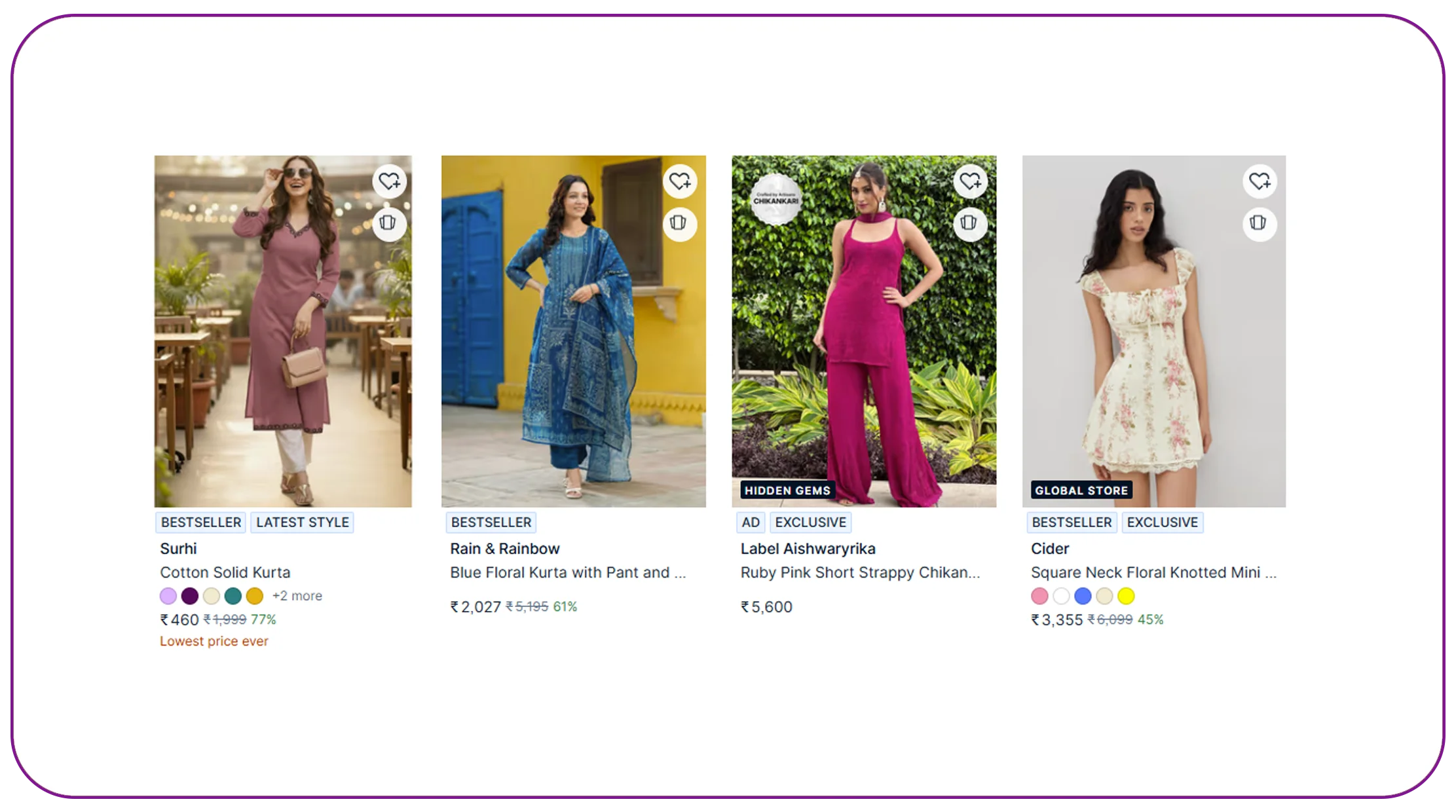
The first challenge is volume. Nykaa Fashion's current catalog pages show more than 1.4 million items in some catalog views, while its official corporate description reports more than 1.8 million products across five consumer segments. These figures can vary with catalog updates, filters, and reporting periods, but they demonstrate the scale involved.
A second challenge is product complexity. Fashion products have attributes such as size, color, material, occasion, pattern, gender, category, brand, discount, and price. Nykaa Fashion's catalog interface itself exposes filters including category, size, brand, price, discount, color, material, occasion, and other attributes.
A third challenge is change frequency. A product may remain in the catalog while its selling price, discount, availability, or merchandising position changes. Historical snapshots are therefore important for identifying patterns rather than simply viewing the marketplace at one point in time.
| Tracking challenge | Business impact | Useful data field |
|---|---|---|
| Large assortment | Difficult manual coverage | Product ID/SKU |
| Frequent price changes | Weak price benchmarking | Current price |
| Multiple discounts | Difficult promotion analysis | Discount percentage |
| Many brands | Difficult competitor comparison | Brand |
| Complex categories | Inconsistent reporting | Category/subcategory |
| Product availability changes | Missed assortment signals | Availability |
| New launches | Delayed trend identification | First-seen date |
| Historical changes | Limited trend visibility | Timestamp |
How can structured product intelligence improve marketplace visibility?
Nykaa Fashion product data web scraping can help businesses establish a repeatable process for collecting publicly available marketplace information. Instead of manually checking individual pages, organizations can define a product universe and monitor selected categories, brands, SKUs, or URLs according to their business requirements.
A useful monitoring framework normally captures product title, brand, category, subcategory, price, MRP, discount, availability, product URL, SKU or product identifier, color, size, material, and timestamp where available. The exact fields depend on the marketplace structure and the client's requirements.
For fashion businesses, this creates a historical baseline. Once multiple snapshots are collected, teams can identify whether prices increased, discounts changed, products disappeared, or new styles entered a category.
| Data layer | Example fields | Business use |
|---|---|---|
| Product identity | SKU, title, URL | Product matching |
| Brand | Brand name | Competitor monitoring |
| Pricing | Price, MRP | Benchmarking |
| Promotion | Discount, offer | Promotion tracking |
| Classification | Category, subcategory | Assortment analysis |
| Attributes | Color, size, material | Product comparison |
| Availability | In stock/out of stock | Availability monitoring |
| Time | Collection timestamp | Historical analysis |
2020–2026 development
From 2020 onward, fashion e-commerce increasingly required businesses to understand digital shelves rather than rely solely on offline retail observations. The pandemic accelerated online shopping adoption and increased the importance of digital assortment visibility. Between 2021 and 2023, brands increasingly focused on marketplace pricing, promotions, product availability, and assortment comparisons as online competition expanded. By 2024, structured product intelligence became increasingly relevant for brands operating across multiple digital channels.
Nykaa's own fashion business illustrates the scale of this evolution. Its investor presentation reported fashion-owned-brand GMV rising from ₹435 million in FY2021 to ₹4,149 million in FY2024, representing more than 110% CAGR over the period.
In FY2025, Nykaa reported Fashion GMV of ₹3,804 crore, up 12% year over year, along with 4,400+ brands, including 1,000+ global brands and 500+ D2C brands. By FY2026, the company's fashion business reported ₹4,954 crore GMV, up 30% year over year, with more than 1,280 brands launched during the year.
This progression demonstrates why historical marketplace monitoring matters. The objective has moved from simply knowing what products exist to understanding how product breadth, brands, prices, and categories evolve.
How does structured extraction support pricing and assortment analysis?
Nykaa Fashion product data extraction focuses on converting product-level information into standardized records that can be consumed by analysts, BI platforms, pricing teams, and data applications. A well-designed extraction workflow should preserve product identity while normalizing inconsistent attributes.
For example, two products may use different naming conventions for colors, materials, or categories. Standardization can make these records easier to compare. Similarly, price fields can be separated into selling price, MRP, discount, and promotional information so that pricing teams do not confuse temporary discounts with regular selling prices.
The resulting Nykaa Fashion Dataset can be organized around a stable product identifier where available. This helps connect today's record with historical observations and makes it possible to calculate changes over time.
| Analytical requirement | Data needed | Example output |
|---|---|---|
| Price monitoring | Price + timestamp | Daily price history |
| Discount analysis | MRP + selling price | Discount movement |
| Brand comparison | Brand + category | Brand benchmark |
| Assortment analysis | Category + SKU | SKU count |
| Launch tracking | First-seen date | New-product report |
| Availability | Stock status | Availability trend |
| Attribute analysis | Size/color/material | Assortment depth |
2020–2026 development
The 2020–2026 period saw a shift from basic e-commerce reporting toward continuous digital commerce intelligence. In the earlier phase, many businesses concentrated on catalog availability and basic price comparisons. As marketplaces expanded, the analytical requirement became more granular: teams wanted to know which brands were expanding, which products were receiving discounts, which categories were becoming crowded, and how assortment composition changed.
By 2023–2024, data teams increasingly combined marketplace data with internal sales, advertising, inventory, and customer data. This created opportunities to compare external market conditions against internal performance. For fashion companies, this can support decisions such as whether a product sits within a competitive price band or whether an assortment has sufficient breadth in an important category.
Nykaa Fashion's current marketplace structure demonstrates the number of dimensions that may need to be standardized. Its catalog includes filters for brand, category, price, discount, color, material, occasion, and other attributes.
In 2025, Nykaa reported 4,400+ brands in its fashion assortment and described significant participation from global and D2C brands. In FY2026, its fashion business reported broader category penetration and strong growth across men's wear, kids, and home categories.
For analytics teams, the implication is clear: extraction should not stop at product names and prices. A useful pipeline should preserve enough context to support category, brand, pricing, and temporal analysis.
How can businesses scale recurring marketplace monitoring?
Nykaa Fashion product data collection services can help businesses move from occasional catalog snapshots to scheduled monitoring programs. Recurring collection is particularly useful when the business needs historical comparison rather than a one-time view.
A scalable workflow can begin with URL discovery or category selection, collect product records, normalize fields, validate the output, remove duplicates, and store timestamped records. The frequency can then be aligned with the business requirement.
For example, a pricing team may require frequent monitoring of selected competitors, while a category team may only need weekly assortment snapshots. A brand protection team may focus on specific brand names and product categories.
| Monitoring model | Frequency example | Suitable use |
|---|---|---|
| High-frequency | Multiple times daily | Price/availability |
| Daily | Every 24 hours | Competitive intelligence |
| Weekly | Once per week | Assortment tracking |
| Monthly | Once per month | Market research |
| Event-based | Campaign periods | Sale monitoring |
2020–2026 development
Between 2020 and 2022, many e-commerce data projects emphasized rapid collection and basic reporting. From 2023 onward, the emphasis increasingly shifted toward repeatability, data quality, historical storage, and integration with analytics environments. This change reflects the growing need to distinguish temporary marketplace fluctuations from sustained market movements.
A recurring process creates a time series. Once historical observations accumulate, businesses can calculate metrics such as average selling price, median price, discount frequency, product additions, product removals, brand assortment share, and category growth.
The scale of Nykaa Fashion makes recurring collection particularly relevant. Its official About page describes more than 1.8 million products and 1,500+ brands, while its FY2025 annual report described a broader 4,400+ brand ecosystem. These numbers reflect different reporting contexts and should not be treated as identical measures.
By FY2026, Nykaa reported Fashion GMV of ₹4,954 crore and said it launched over 1,280 brands during the year. Such assortment movement creates an ongoing monitoring requirement for businesses that want to understand new entrants, expanding brands, and category developments.
Which categories can businesses monitor for competitive insights?
Businesses can scrape Nykaa Fashion product categories to understand how assortment is distributed across different consumer segments and product groups. Category-level monitoring allows teams to compare product counts, price bands, discount activity, brands, and availability.
Nykaa Fashion's official pages list women's Indianwear, westernwear, bags, footwear, jewelry, lingerie, sportswear, sleep and lounge, watches, and accessories. Men's categories include topwear, bottomwear, ethnicwear, footwear, accessories, watches, bags, athleisure, and sports and fitness. Kids and Luxe categories add further assortment depth.
| Segment | Example categories | Potential insight |
|---|---|---|
| Women | Westernwear, Indianwear | Assortment depth |
| Men | Topwear, footwear | Price benchmarking |
| Kids | Clothing, footwear, toys | Category expansion |
| Luxe | Luxury bags, watches | Premium assortment |
| Accessories | Jewelry, belts, sunglasses | Cross-category trends |
| Home | Décor, bath, bed, kitchen | Lifestyle expansion |
2020–2026 development
Fashion category analysis became more sophisticated between 2020 and 2026 as marketplaces expanded beyond traditional apparel. In 2020–2021, apparel and accessories remained central to digital fashion discovery. By 2022–2024, brands increasingly evaluated footwear, jewelry, athleisure, beauty-adjacent lifestyle products, home categories, and premium segments as interconnected consumer opportunities.
Nykaa Fashion's official positioning reflects this broader model. The platform says it serves women, men, and children while also covering tech and home. Its current site lists categories spanning apparel, footwear, jewelry, accessories, sportswear, luxury, and home.
Category monitoring can therefore reveal more than the number of products. It can identify shifts in price architecture, new subcategory introductions, changes in brand participation, and changes in promotional intensity.
FY2026 reporting provides another example of category expansion: Nykaa stated that men's wear grew 60% year over year, kids grew 50%, and home categories grew 40%. These company-reported figures show why category-level data can be useful when analyzing marketplace growth and assortment strategy.
A category intelligence system can track product additions and removals, average prices, discount ranges, brand counts, and availability over time. These metrics can then be compared across categories to identify where assortment is expanding or contracting.
How can historical datasets support fashion market trend analysis?
A structured Nykaa Fashion Dataset can support historical trend analysis when each observation is stored with a collection date and consistent product identifiers. Instead of asking only "What is available today?", analysts can investigate "What changed over the last week, month, quarter, or year?"
This distinction is important for fashion businesses because trends often emerge through repeated small signals. A growing number of products in a particular style, increasing brand participation, repeated price reductions, or new product launches can become useful indicators when monitored consistently.
| Trend metric | Calculation concept | Business question |
|---|---|---|
| New product rate | New SKUs / total SKUs | Is assortment expanding? |
| Price movement | Current vs historical price | Are prices changing? |
| Discount intensity | Discounted SKUs / total SKUs | How promotional is a category? |
| Brand participation | Brands per category | Is competition increasing? |
| Availability rate | Available SKUs / tracked SKUs | How much assortment is active? |
| Category share | Category SKUs / total SKUs | Which categories dominate? |
2020–2026 development
From 2020 through 2026, fashion analytics increasingly moved toward longitudinal analysis. Earlier dashboards often showed static product counts and current prices. Historical datasets made it possible to identify changes and calculate trends across time.
This evolution is especially relevant as Nykaa Fashion has expanded its brand ecosystem. Nykaa's FY2025 annual report described 4,400+ fashion brands, including 1,000+ global brands and 500+ D2C brands. Its FY2026 results reported more than 1,280 brands launched during the year and stronger penetration across several categories.
A historical dataset can help businesses separate individual product movements from broader category movements. For example, if the median price of a category increases while the number of brands also rises, the market may be experiencing both premiumization and increased competition. If discounts increase while availability declines, analysts may investigate whether the change relates to seasonal clearance, inventory conditions, or campaign activity.
These are analytical signals rather than automatic explanations. Marketplace data should be combined with internal sales, inventory, campaign calendars, and other relevant datasets before drawing commercial conclusions.
The 2020–2026 period also shows the importance of keeping historical snapshots. A current catalog page cannot reveal when a product first appeared, how often its price changed, or whether a brand expanded its assortment over several seasons. Timestamped records preserve that history.
How can APIs make fashion intelligence easier to integrate?
A Nykaa API can be considered as part of an integration strategy when an appropriate authorized API or data interface is available. Where direct API access is not available or does not expose the required information, organizations may use compliant data collection workflows based on publicly accessible information and applicable terms.
The goal is to make marketplace intelligence usable inside existing systems. Product, price, brand, category, and availability records can be transformed into structured formats such as CSV, JSON, databases, dashboards, or other analytics-ready destinations.
The Nykaa Fashion Dataset can then support downstream use cases such as price monitoring, category analysis, competitive intelligence, assortment planning, and market research.
| Integration layer | Example | Purpose |
|---|---|---|
| Collection | Product/category records | Capture marketplace signals |
| Processing | Cleaning + normalization | Improve consistency |
| Storage | Database/data lake | Preserve history |
| Analytics | BI dashboards | Visualize trends |
| Alerts | Price/availability rules | Detect changes |
| Applications | Internal systems | Operationalize insights |
2020–2026 development
The growth of e-commerce data infrastructure between 2020 and 2026 has made integration increasingly important. Data collection is no longer useful if analysts must manually download files and reconcile them every week. Modern workflows increasingly emphasize automated ingestion, validation, transformation, storage, and downstream consumption.
For fashion companies, this means marketplace data can become part of a broader intelligence environment. Pricing teams can compare external prices against internal pricing. Category managers can evaluate assortment breadth. Marketing teams can monitor product availability around campaigns. Procurement teams can examine brand and category movements.
Nykaa's scale makes this integration challenge particularly relevant. Its FY2025 report described ₹3,804 crore Fashion GMV and 4,400+ brands, while FY2026 reported ₹4,954 crore Fashion GMV and more than 1,280 brands launched during the year.
A robust architecture should also include validation. Duplicate products, missing attributes, inconsistent category names, temporary page errors, and price-format differences can affect downstream analytics. Automated quality checks can flag anomalies before data reaches business dashboards.
The strongest approach is therefore not simply "collect everything." It is to define the business question first, identify the fields required to answer it, establish a collection schedule, normalize the data, preserve historical snapshots, and connect the output to decision-making systems.
Why Choose Real Data API?
Nykaa Product Data Scraping can provide a structured foundation for monitoring product-level information, while Nykaa Fashion Dataset workflows can help convert recurring observations into historical business intelligence.
A practical data solution should focus on five capabilities:
- Scalable collection – Support large product and category inventories.
- Data normalization – Standardize prices, brands, categories, and product attributes.
- Historical tracking – Preserve timestamped records for trend analysis.
- Quality validation – Detect duplicates, missing fields, and inconsistent values.
- Flexible delivery – Make structured data available for dashboards, analytics, databases, or internal applications.
For fashion brands and retailers, this approach can reduce manual catalog monitoring and create a consistent foundation for pricing, assortment, brand, and market analysis.
Conclusion
Nykaa Fashion Dataset REAL DATA API solutions can help businesses move from fragmented marketplace observations toward structured, historical fashion intelligence. By tracking products, prices, brands, categories, discounts, and availability over time, organizations can build a clearer view of assortment and market changes.
The opportunity is especially relevant as the platform continues to operate at significant scale. Nykaa reports thousands of brands across its fashion business and substantial year-over-year Fashion GMV growth, demonstrating why manual monitoring becomes increasingly difficult as marketplace breadth expands.
The key is to build a data workflow around specific commercial questions rather than collect information without a defined purpose. Structured collection, normalization, validation, historical storage, and analytics integration can turn marketplace data into actionable business intelligence.
Ready to transform fashion marketplace data into structured product, pricing, brand, and trend intelligence? Start building a scalable data solution tailored to your business requirements!
FAQs
1. What is a Nykaa Fashion Dataset?
A Nykaa Fashion Dataset is a structured collection of marketplace information such as product names, brands, categories, prices, discounts, availability, attributes, URLs, and timestamps for analysis.
2. How does Nykaa Fashion Data Scraping help retailers?
Nykaa Fashion Data Scraping can help retailers monitor product assortments, prices, discounts, brands, availability, and category changes without relying entirely on manual marketplace tracking.
3. Why use Nykaa Fashion product data web scraping?
Nykaa Fashion product data web scraping can support recurring collection of publicly available product information, helping teams build historical records for competitive pricing, assortment, and market analysis.
4. What is the benefit of Nykaa Fashion product data extraction?
Nykaa Fashion product data extraction converts marketplace information into structured records that can be normalized, compared, stored historically, and integrated with analytics systems. Real Data API can support such structured data workflows.
5. Who needs Nykaa Fashion product data collection services?
Nykaa Fashion product data collection services can benefit fashion brands, retailers, market researchers, pricing teams, D2C businesses, and analysts that require recurring marketplace intelligence.
Latest posts

How Uber Eats API Helps Businesses Overcome Restaurant, Menu, and Pricing Data Challenges
How Myntra API Solves Fashion Retail Challenges with Fashion Product, Price, Brand, and Category Data
How Nykaa Fashion Dataset Solves Product, Price, Brand, and Fashion Market Trend Tracking Challenges

Harrods UK: The World's Leading Luxury Department Store - A Complete Guide to Harrods Data Scraping, API Access, and Datasets






.png)



