TL;DR
- Target API can help retailers, brands, marketplaces, and analysts organize Target.com product information into structured datasets for pricing, assortment, category, inventory, and competitive analysis.
- Target Web Scraping Services can complement API-based workflows when businesses need recurring collection, normalization, validation, historical tracking, and analytics-ready retail datasets.
Introduction
The core challenge for retail teams is not simply finding product information—it is collecting, structuring, and monitoring large volumes of changing product, price, category, and availability data consistently. Target's scale makes manual research difficult, particularly for brands monitoring thousands of SKUs or multiple categories.
Target reported $104.8 billion in net sales for fiscal 2025, following $106.6 billion in 2024 and $107.4 billion in 2023. Its digitally originated merchandise sales reached $21.1 billion in 2025, while 97.6% of merchandise sales were fulfilled through stores. (Target Corporation)
For businesses building competitive intelligence systems, this creates a need for structured retail data that can be refreshed and analyzed systematically. A well-designed collection workflow can capture product attributes, prices, category relationships, availability signals, and other publicly visible information and transform them into datasets suitable for dashboards, alerts, benchmarking, and market research.
This article explains how businesses can use structured Target data workflows to address retail intelligence challenges from 2020 through 2026.
How Has Target's Retail Data Environment Changed From 2020 to 2026?
The retail environment has become increasingly digital, making product and pricing visibility more important for competitive analysis. Target's own reporting illustrates the shift. In 2020, Target recorded $93.6 billion in total revenue and digital comparable sales growth of 144.7%. By 2022, digitally originated sales represented 18.6% of merchandise sales. In 2025, digitally originated merchandise sales reached $21.1 billion. (Target Corporation)
The transition continued in 2026. In Q2 2026, Target reported $26.5 billion in net sales, up 5.3% year over year, while comparable digital sales increased 8.7%. For the first six months of 2026, digitally originated merchandise sales represented 19.9% of merchandise sales. (Target Corporation)
For data teams, these developments matter because digital retail produces a continuously changing information layer. Product assortment, pricing, category placement, promotional messaging, and availability can change independently of annual financial reporting.
Selected Target business indicators
| Period | Target Revenue/Net Sales | Digital Indicator |
|---|---|---|
| 2020 | $93.56B | Digital comparable sales +144.7% |
| 2021 | $106.01B | Digitally originated sales: 18.9% |
| 2022 | $109.12B | Digitally originated sales: 18.6% |
| 2023 | $107.41B | Digitally originated sales: 18.3% |
| 2024 | $106.57B | Digitally originated sales: $20.5B |
| 2025 | $104.78B | Digitally originated sales: $21.1B |
| Q2 2026 | $26.54B | digitally originated sales +8.7% |
Sources: Target annual reports and 2026 earnings disclosures. (Target Corporation)
This progression demonstrates why historical and current retail datasets need to be treated differently. Annual financial reports provide high-level business context, whereas product-level collection can provide the granular information needed for SKU-level analysis.
What Can Category-Level Data Collection Reveal About Retail Assortments?
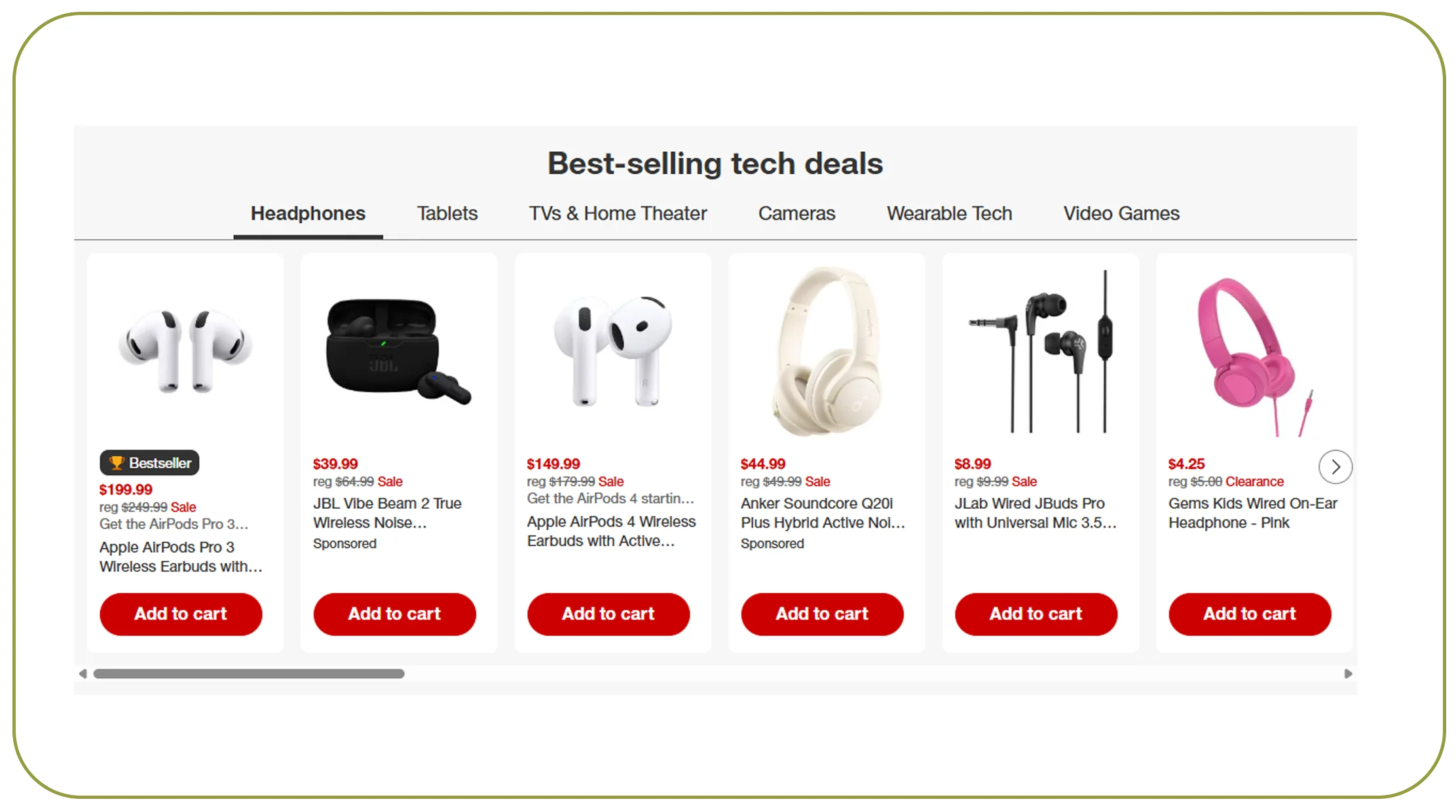
Target category data web scraping can help businesses convert publicly available category and product information into structured records. Instead of reviewing category pages manually, analysts can organize products by department, category, subcategory, brand, product name, SKU or identifier, price, rating, availability, and other accessible attributes.
The practical value comes from connecting product records with category relationships. A retailer or brand can use category-level datasets to identify assortment breadth, compare competing products, monitor changes in category composition, and detect products entering or leaving an assortment.
Target reported six core merchandising categories in its 2026 results, with Q2 net sales growth across all six. The company reported double-digit growth in Fun 101 and high-single-digit growth in Food & Beverage and Beauty during that quarter. (Target Corporation)
Example category-data structure
| Data field | Possible analytical use |
|---|---|
| Product name | Product matching |
| SKU/product identifier | SKU-level tracking |
| Brand | Brand benchmarking |
| Category | Assortment analysis |
| Subcategory | Granular segmentation |
| Current price | Price comparison |
| Promotion/discount | Promotional monitoring |
| Availability | Stock-status monitoring |
| Product URL | Record traceability |
| Rating/review count | Customer-interest analysis |
The important point is that category data becomes considerably more useful when it is collected repeatedly rather than treated as a one-time snapshot.
From 2020 to 2026, Target's business evolved from the exceptional digital acceleration seen during 2020 toward a more integrated store-and-digital model. In 2021, Target said more than 95% of all sales could be fulfilled from stores. By 2025, stores fulfilled more than 97% of merchandise sales. (Target Corporation)
That operating model makes availability and fulfillment context particularly relevant to retail intelligence. A product appearing online does not necessarily provide the same commercial signal as a product that is available for a particular fulfillment method or location.
Why Does Real-Time Product Visibility Matter for Retail Intelligence?
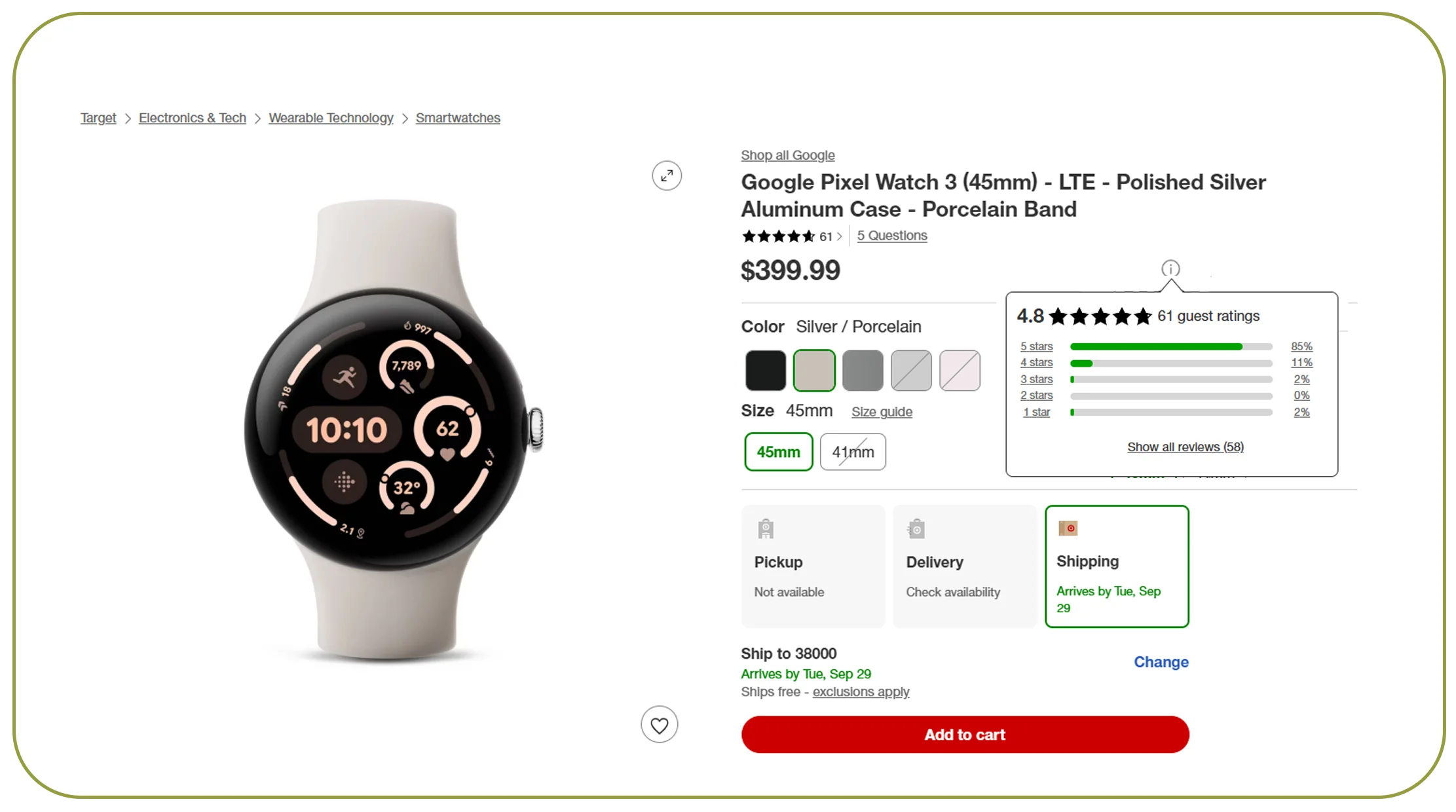
Real-time Target product data gives businesses a mechanism for tracking changes that may otherwise be missed between periodic research cycles.
For retailers and brands, the objective is not necessarily to collect every available field. The objective is to identify the fields that influence a specific business decision. A pricing team may prioritize current price, promotion, product identity, and competing SKUs. An assortment team may prioritize category, brand, product attributes, and availability. A marketplace team may focus on product visibility, ratings, and assortment changes.
Target's 2026 results illustrate the pace at which digital activity can change. In Q2 2026, digital comparable sales increased 8.7%, while same-day delivery grew by more than 25%. Target also reported that its same-day fulfillment services accounted for two-thirds of digital sales in its 2026 strategic plan. (Target Corporation)
For an analytics team, recurring collection can therefore support:
- Product assortment monitoring
- New-product discovery
- SKU-level change detection
- Category movement analysis
- Promotional-event tracking
- Availability monitoring
- Competitive benchmarking
- Historical price analysis
A robust workflow should also include timestamps. Without collection dates, analysts cannot reliably distinguish a current product state from a previous observation.
Recommended historical fields
| Field | Why it matters |
|---|---|
| Collection timestamp | Establishes when the observation occurred |
| Product identifier | Maintains SKU continuity |
| Price | Enables historical comparison |
| Availability | Tracks changes in purchasability |
| Category | Preserves classification |
| Brand | Enables brand-level analysis |
| Product URL | Supports source traceability |
The 2020–2026 period demonstrates why historical records are valuable. Target's total revenue increased from $93.56 billion in 2020 to $109.12 billion in 2022 before reaching $104.78 billion in 2025. Digital-originated sales also remained a significant component of merchandise sales throughout the period. (Target Corporation)
A historical product dataset allows businesses to analyze retail changes alongside these broader market developments instead of relying solely on current pages.
How Can Pricing Data Support Competitive Benchmarking?
Target price data API workflows can help businesses capture product-level pricing information and organize it for comparison, historical analysis, and monitoring.
Price intelligence becomes more actionable when products are matched correctly. Comparing two similarly named products without validating brand, size, pack count, model, variant, or identifier can produce misleading conclusions. Therefore, a pricing pipeline should combine product matching with price collection.
Target's 2026 disclosures show how dynamic pricing can be commercially relevant. In Q2 2026, Target said it had lowered prices on more than 10,000 frequently purchased items over the preceding year. (Target Corporation)
Pricing intelligence workflow
| Stage | Function |
|---|---|
| Discovery | Identify target products and categories |
| Collection | Capture publicly visible product information |
| Matching | Connect equivalent or comparable SKUs |
| Validation | Check field completeness and consistency |
| Historical storage | Preserve dated observations |
| Analysis | Compare prices and promotional changes |
| Alerts | Flag predefined price movements |
A recurring system can also distinguish between regular price, sale price, discount messaging, and other promotional signals where those fields are publicly available.
From 2020 through 2026, Target's sales performance demonstrates why price data should be interpreted alongside traffic, assortment, channel, and category information. For example, comparable sales increased 19.3% in 2020, 12.7% in 2021, and 2.2% in 2022, before declining 3.7% in 2023. (Target Corporation)
A pricing dataset should therefore support context rather than encourage isolated conclusions from individual price movements.
Build a structured pricing intelligence workflow with Real Data API to monitor product and competitive changes at scale!
Get Insights Now!What Inventory Signals Should Retail Teams Monitor?
A Target inventory web data scraper can be designed to capture publicly visible availability indicators and organize them into recurring records.
Inventory intelligence is particularly useful when a business wants to understand whether products are available, unavailable, newly listed, or changing across locations or fulfillment methods. The exact information available can vary by page, product, location, and site behavior, so collection systems should validate fields rather than assuming every SKU exposes identical inventory information.
Target's operating model makes fulfillment data particularly relevant. In 2025, 97.6% of merchandise sales were fulfilled through stores, including digitally originated sales handled through shipping, Order Pickup, Drive Up, and Same Day Delivery. (Target Corporation)
Inventory-oriented dataset
| Signal | Business application |
|---|---|
| Availability | Product availability status monitoring |
| Location context | Local assortment analysis |
| Fulfillment option | Delivery/pickup analysis |
| Product identifier | SKU continuity |
| Timestamp | Change tracking |
| Category | Inventory segmentation |
Between 2020 and 2022, Target's digitally originated sales accounted for approximately 18% of merchandise sales, while store fulfillment remained dominant. (Target Corporation) By Q2 2026, digitally originated merchandise sales represented 19.6% of quarterly merchandise sales and 19.9% for the first half. (Target Corporation)
This makes inventory data more than a stock/no-stock field. For businesses operating in omnichannel retail, the relationship between online visibility, local availability, and fulfillment can be a meaningful analytical dimension.
How Should Businesses Build a Scalable Retail Data Pipeline?
A structured Target API workflow should be treated as a data engineering process rather than a simple extraction task.
The first stage is defining the business question. A pricing team may need daily product-price observations, while a category team may need broader assortment coverage. The next stage is schema design: deciding which fields should become stable columns and which values should be retained as flexible attributes.
Data normalization is equally important. Product names, brands, categories, prices, availability labels, and identifiers should follow consistent formats. Validation rules can detect missing identifiers, malformed prices, duplicate records, unexpected category changes, and other anomalies.
Pipeline architecture
| Layer | Purpose |
|---|---|
| Source discovery | Define pages and products |
| Data acquisition | Collect permitted public data |
| Parsing | Extract relevant fields |
| Normalization | Standardize values |
| Validation | Identify data-quality issues |
| Storage | Maintain historical records |
| Analytics | Produce business insights |
| Delivery | Send datasets to dashboards or systems |
From 2020 to 2026, Target's digital channel continued to evolve. Digital comparable sales surged 144.7% in 2020, digitally originated sales represented 18.9% of merchandise sales in 2021, and 2026 Q2 digital comparable sales grew 8.7%. (Target Corporation)
These figures reinforce the need for a pipeline that can handle both historical datasets and recurring updates. For modern retail analytics, the useful output is not simply a collection of pages. It is a consistent, timestamped, validated dataset that can be queried over time.
What Should a Target E-Commerce Dataset Contain?
A Target E-Commerce Dataset should be designed around the decisions the buyer needs to make. A generic product table may be sufficient for basic catalog analysis, but competitive intelligence generally requires multiple dimensions.
A practical dataset can include product identifiers, product names, brand, category, subcategory, descriptions, specifications, prices, promotions, ratings, review counts, availability, fulfillment information, product URLs, and collection timestamps where publicly accessible.
Dataset design
| Dataset layer | Example fields |
|---|---|
| Product identity | SKU, product name, brand |
| Classification | Category, subcategory |
| Commercial | Price, promotion, discount |
| Availability | Stock/availability status |
| Customer signals | Rating, review count |
| Fulfillment | Pickup/delivery indicators |
| Traceability | URL, timestamp |
The dataset can then support multiple downstream applications:
- Competitive intelligence — compare equivalent products and market positioning.
- Price benchmarking — monitor changes against selected competitors.
- Assortment analytics — measure category and brand presence.
- Inventory visibility — identify availability changes.
- Market research — analyze product and category trends.
- Retail dashboards — create recurring management reports.
Target's 2025 merchandise sales were distributed across apparel and accessories, beauty, food and beverage, hardlines, home furnishings and décor, and household essentials, demonstrating the breadth of categories that a structured dataset can cover. (Target Corporation)
For 2026, Target reported growth across all six core merchandising categories in Q1 and Q2, making category-level monitoring relevant for businesses studying changes in retail demand. (Target Corporation)
Why Choose Real Data API?
For teams considering a Target.com Scraper, the key questions should include:
- Which products and categories need monitoring?
- How frequently should records be refreshed?
- Which fields are required?
- How should products be matched historically?
- Which output format fits the analytics environment?
- What validation rules should be applied?
- How should historical records be stored?
A scalable workflow can combine extraction, normalization, validation, historical storage, and delivery rather than treating data collection as a standalone activity.
This approach is particularly relevant in a market where Target reported $104.8 billion in 2025 net sales and $21.1 billion in digitally originated merchandise sales. In Q2 2026, digital comparable sales grew 8.7% and net sales increased 5.3% year over year. (Target Corporation)
The result is a dataset designed for business decisions—not simply a spreadsheet of scraped pages.
Conclusion
Retail intelligence depends on timely, structured, and historically consistent product information. Target's evolution from the sharp digital acceleration of 2020 to continued digital growth in 2026 demonstrates why businesses need systems capable of tracking products, prices, categories, availability, and fulfillment signals over time. (Target Corporation)
For brands, retailers, marketplaces, and research teams, the most valuable workflow combines product discovery, data collection, SKU matching, normalization, validation, historical storage, and analytics. This creates a reliable foundation for competitive benchmarking, assortment analysis, pricing intelligence, and retail market research.
Talk to Real Data API today to build a scalable retail data pipeline tailored to your product, pricing, category, inventory, and competitive intelligence requirements!
FAQs
What is Target API used for?
Target API can support structured access to retail information for product research, pricing analysis, category monitoring, competitive intelligence, and analytics workflows when the required data and access method are available.
What are Target Web Scraping Services?
Target Web Scraping Services automate the collection of publicly accessible retail information and can support recurring product, pricing, category, availability, and catalog monitoring for business intelligence.
What is Target category data web scraping?
Target category data web scraping organizes category-level product information into structured records, helping businesses analyze assortment breadth, brand presence, product attributes, and category changes.
How can real-time Target product data help retailers?
real-time Target product data can help retailers monitor product changes, pricing movements, availability signals, new listings, and assortment developments without relying exclusively on manual research.
What does Target price data API provide?
Target price data API workflows can organize product pricing observations into structured datasets for historical comparison, price benchmarking, promotional analysis, and competitive retail research.
Latest posts
How Target API Simplifies Product, Price, Category, Inventory & Retail Data Collection for Retail Intelligence
How Pull & Bear Fashion Dataset Solves Fashion Intelligence Challenges Across Products, Prices, Categories, and Apparel Trends?
How Levi's Fashion Dataset Improves Fashion Intelligence Across Products, Prices, Categories, and Denim Market Trends?
How Myntra Fashion Dataset Solves Fashion Intelligence Challenges Across Products, Prices, Brands, and Fashion Market Trends?






.png)