TL;DR
- Ocado API can support structured grocery-market research by organizing product, price, promotion, and availability information into datasets for competitive retail analysis.
- Ocado Quick Commerce Data Scraping can help businesses monitor fast-changing digital grocery signals, including assortment, pricing, promotional activity, and product availability across defined categories and locations.
- From 2020–2026, UK grocery conditions have been shaped by online-shopping adoption, food-price inflation, changing consumer preferences, and increasingly data-driven retail competition.
Introduction
Online grocery retail has become an increasingly data-intensive market. Businesses now need more than a product list to understand competition: they need visibility into assortment, pricing, promotional offers, availability, and changes over time. Ocado API data workflows can help transform these marketplace signals into structured datasets that support retail intelligence, category research, pricing analysis, and competitive benchmarking.
The scale of Ocado Retail API digital operation illustrates why this information can be valuable for market researchers. According to Ocado Retail's 2025 annual report, active customers reached 1.177 million, up 14.6% from 1.027 million in FY24. Average orders per week increased 15.2% to 478,700, while the retailer reported a 14.1% share of the online grocery market in FY25.
Ocado also states that its platform reaches more than 80% of the UK population and offers around 50,000 products.
This combination of scale, assortment, and changing prices creates a large information environment for businesses studying UK grocery retail.
What Does Product-Level Monitoring Reveal About Grocery Competition?
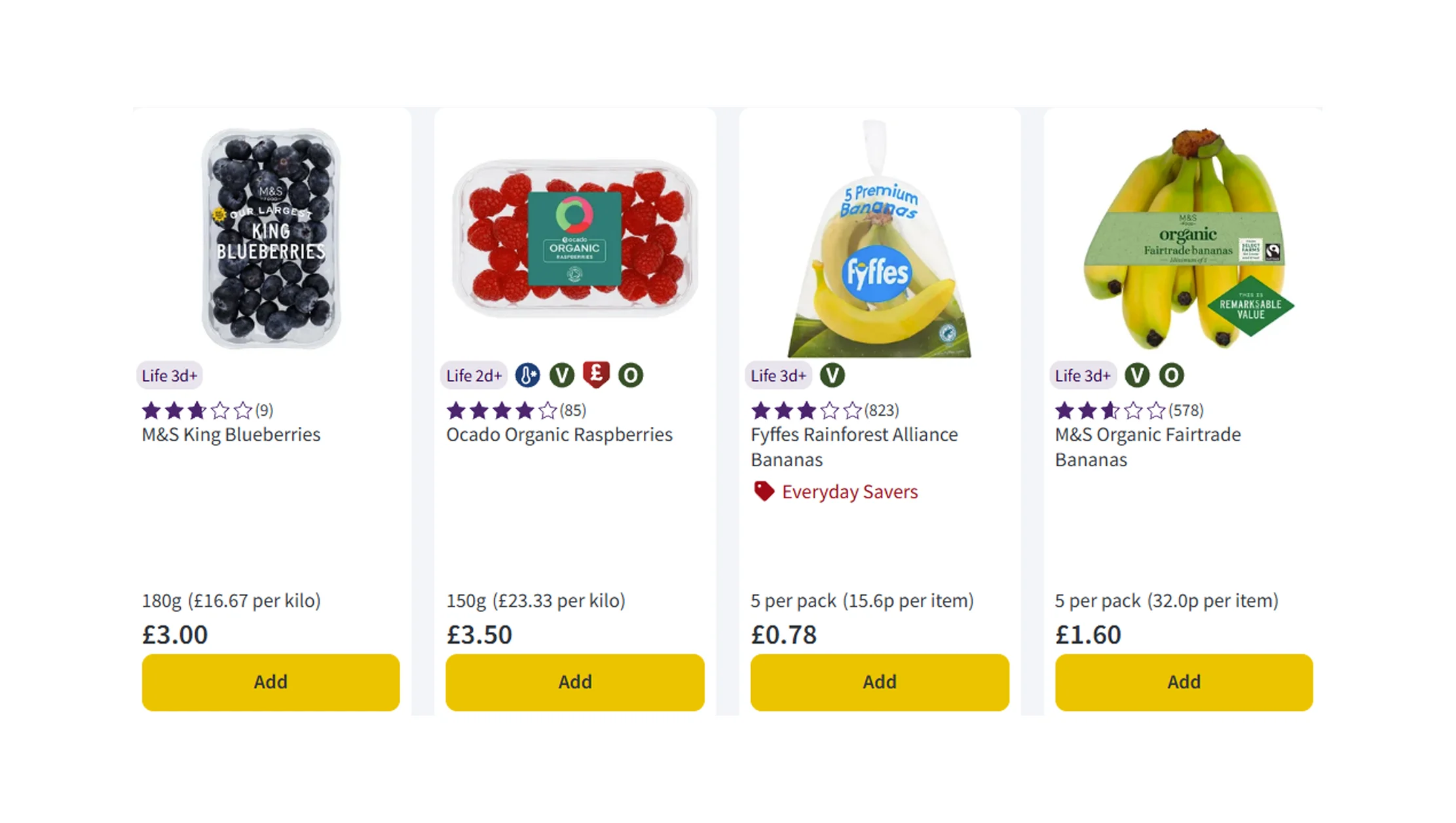
Ocado grocery product data web scraping can help businesses create structured records of products listed across grocery categories. Depending on the research requirement and permitted data access, fields may include product name, brand, category, size, pack quantity, product URL, price, promotional status, availability, and other publicly displayed attributes.
Product-level monitoring is important because grocery assortments are constantly changing. New products enter the market, existing products are reformulated or repackaged, seasonal products appear, and retailers adjust category depth according to consumer demand.
Ocado Retail says its current range includes around 50,000 products, including more than 7,000 M&S food and drink products. This makes product-level organization useful for analysts attempting to understand assortment breadth and category structure.
Market context, 2020–2026
The 2020–2026 period saw major changes in consumer shopping behavior. The pandemic accelerated online grocery adoption, while subsequent inflationary pressures increased interest in price and value. By 2025, Ocado Retail reported 1.177 million active customers and 478,700 average weekly orders.
| Year | Market signal | Data-analysis implication |
|---|---|---|
| 2020 | Online grocery adoption accelerated | Greater need for digital assortment visibility |
| 2021 | Digital grocery remained important | Broader product monitoring |
| 2022 | Food-price pressures intensified | More focus on product pricing |
| 2023 | Retailers emphasized value and promotions | Offer tracking became more relevant |
| 2024 | Online grocery remained competitive | Historical benchmarking gained importance |
| 2025 | Ocado reported 1.177M active customers | Larger digital customer base |
| 2026 | Grocery research increasingly data-led | More demand for recurring datasets |
Analysis: Product data becomes significantly more useful when captured repeatedly. A single product snapshot can show what is listed today, while historical collection can reveal assortment additions, removals, category expansion, and changes in pack formats.
For FMCG brands, this can support digital shelf research. For retailers, it can support assortment benchmarking. For investors and consultants, it can provide structured evidence for category-level research.
How Can Historical Price Tracking Improve Retail Benchmarking?
Ocado product price data extraction can provide the historical foundation required to study grocery pricing patterns. A structured price record can contain product identifiers, product names, pack sizes, current prices, promotional prices, timestamps, and category information.
Price comparisons must account for product equivalence. A £3.00 product and a £3.50 product may not be directly comparable if their pack sizes differ. Therefore, price-per-unit calculations can provide additional analytical value.
UK food-price context
Official UK statistics show how strongly food pricing changed during the period. The ONS food CPI series records annual food inflation of 1.1% in 2019, while the broader food-price index subsequently moved considerably higher during the early 2020s. The ONS producer-price series for food, beverages and tobacco products also rose from an index value of 107.9 in 2020 to 141.2 in 2025.
| Year | ONS food-related indicator | Retail research relevance |
|---|---|---|
| 2020 | Food, beverages & tobacco PPI: 107.9 | Baseline before major inflation |
| 2021 | 110.8 | Early upward movement |
| 2022 | 123.2 | Significant producer-price increase |
| 2023 | 134.8 | Continued elevated cost environment |
| 2024 | 136.4 | Price pressure remained |
| 2025 | 141.2 | Further increase at producer level |
| 2026 | Food & non-alcoholic beverages CPI: 1.7% YoY in June | Inflation rate moderated from earlier peaks |
Sources: ONS producer-price and consumer-price series. The indicators use different methodologies and should not be treated as one continuous retail-price series.
Illustrative competitive dataset
| Product | Pack | Previous Price | Current Price | Change |
|---|---|---|---|---|
| Example Cereal A | 500g | £2.50 | £2.75 | +10.0% |
| Example Pasta B | 1kg | £1.80 | £1.90 | +5.6% |
| Example Coffee C | 200g | £5.00 | £4.50 | -10.0% |
Figures are illustrative examples, not claimed live Ocado prices.
Analysis: Historical pricing allows analysts to separate permanent price changes from temporary promotions. When combined with product size, brand, category, and timestamp fields, the dataset can also support price-per-unit benchmarking.
Why Is Availability Monitoring Important for Digital Grocery Research?
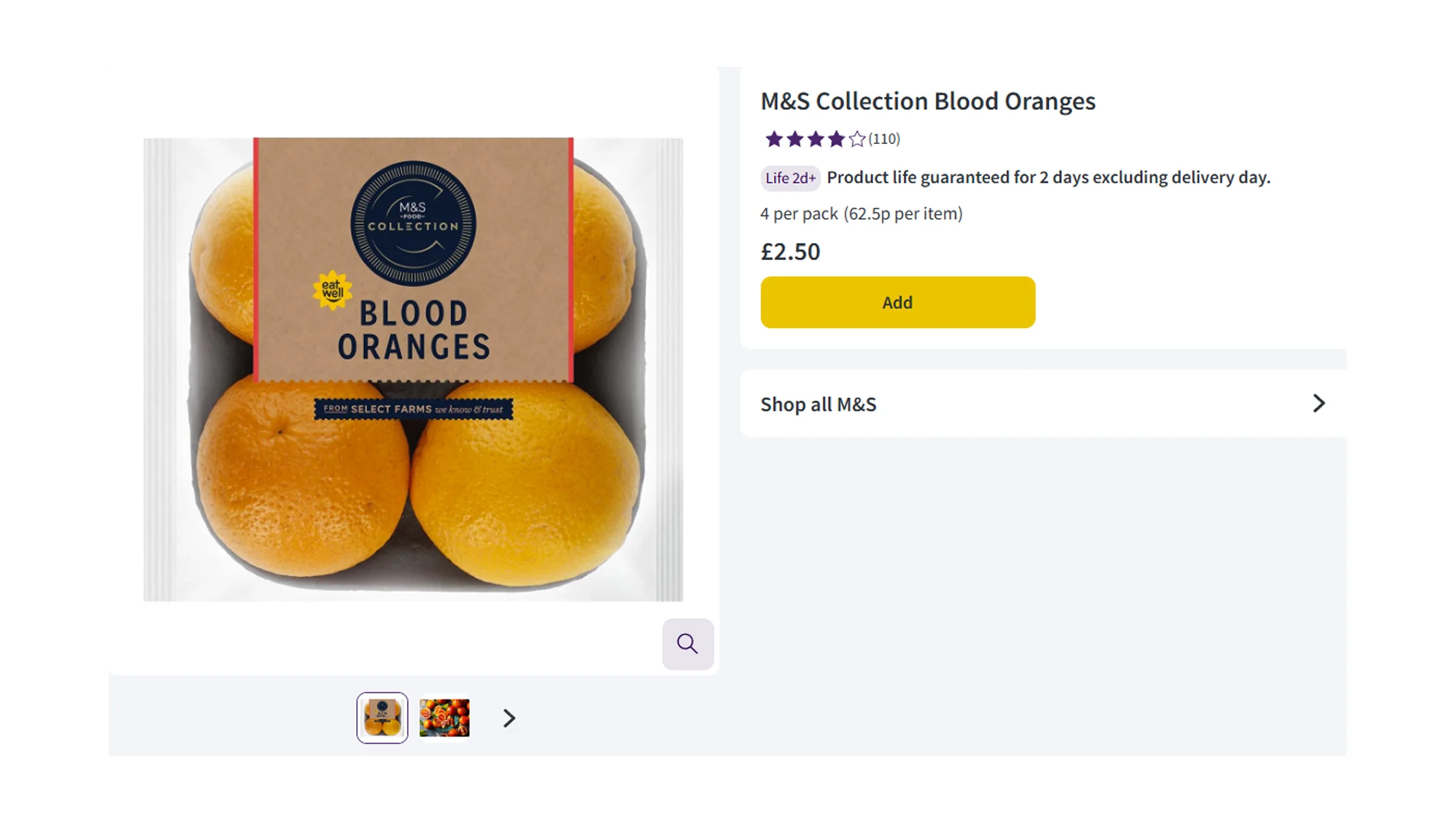
Ocado availability data collection services can help businesses monitor whether products are listed as available, unavailable, limited, or otherwise subject to changing fulfillment conditions where such information is publicly displayed.
Availability matters because an advertised assortment does not necessarily equal an accessible assortment. A product can remain part of a retailer's catalog while becoming temporarily unavailable. Repeated observations can therefore provide a clearer picture of assortment reliability.
2020–2026 market development
During the early 2020s, product availability became a major operational consideration across grocery retail. Supply-chain disruptions, changing consumer demand, and subsequent inflationary pressures created conditions in which retailers needed to balance assortment, inventory, and fulfillment.
By 2025, Ocado Retail reported expanding its physical distribution infrastructure, including a new regional distribution spoke in Nottingham intended to increase capacity and support customer demand.
| Availability metric | Example | Business use |
|---|---|---|
| In-stock status | Available | Assortment visibility |
| Out-of-stock status | Unavailable | Availability monitoring |
| Availability rate | 94% | Category benchmarking |
| Repeated stockout | 5 observations | Potential supply signal |
| Location availability | Available in A, unavailable in B | Geographic analysis |
| Timestamp | 10:00 AM | Time-based comparison |
Availability-rate figures above are illustrative.
Analysis: Availability data becomes more valuable when joined with price and promotional information. For example, a product experiencing repeated stockouts during a major promotion may require different interpretation from a product that is simply unavailable throughout a period.
Businesses can also calculate availability rates by category, brand, product, or observation period. This creates a quantitative framework for digital shelf monitoring.
How Can Promotional Intelligence Reveal Retail Strategy?
To scrape Ocado offers data API workflows effectively, businesses can structure promotional information around product identifiers, original prices, promotional prices, offer types, dates, and categories, subject to applicable access permissions and platform terms.
Promotional analysis is important because grocery pricing is not static. A product can have a standard price, temporary discount, multibuy offer, loyalty-linked promotion, or other promotional mechanism.
Ocado Retail's 2025 annual report provides a real-world example of value-oriented pricing activity. The company reported that its Ocado Price Promise matched customers' shops to Tesco.com on more than 10,000 products, including Clubcard prices, while it also made multiple rounds of price reductions across thousands of products.
Example promotion dataset
| Product | Standard Price | Offer Price | Discount | Offer Type |
|---|---|---|---|---|
| Example A | £4.00 | £3.00 | 25% | Temporary discount |
| Example B | £6.00 | £5.00 | 16.7% | Promotional price |
| Example C | £2.50 | £2.00 | 20% | Price reduction |
Ocado's own consumer data also demonstrates how product-level monitoring can reveal emerging demand. In June 2025, Ocado Retail reported that searches for condiments increased 45% year-on-year and that its range contained more than 430 condiments.
In 2025, the retailer also reported an 18% year-on-year increase in frozen-product sales, with frozen fruit and frozen vegetables up 23% and 38%, respectively.
Analysis: Promotional and demand data together can reveal category movements that are difficult to see from a single product snapshot.
How Can Automated Collection Support Recurring Grocery Research?
An Ocado Scraper can form part of a recurring data pipeline designed to collect permitted publicly accessible grocery information at defined intervals. The business value comes from turning repeated observations into a historical dataset rather than treating extraction as a one-time task.
A scalable workflow generally includes:
- Source identification – Define categories, products, brands, and locations.
- Data extraction – Collect the required permitted fields.
- Normalization – Standardize names, categories, pack sizes, and prices.
- Validation – Identify missing, duplicate, or anomalous records.
- Timestamping – Record when each observation was collected.
- Storage – Maintain historical records for longitudinal analysis.
- Monitoring – Detect collection failures or unexpected changes.
- Delivery – Provide structured outputs for databases, dashboards, or analytics systems.
Why recurring collection matters
| Collection frequency | Typical research value |
|---|---|
| One-time | Current market snapshot |
| Weekly | Promotion and assortment tracking |
| Daily | Price and availability monitoring |
| Multiple times daily | Short-term availability or dynamic changes |
The appropriate frequency depends on the business objective and permitted data-access conditions.
From 2020 to 2026, grocery businesses increasingly operated in an environment where price, availability, and consumer demand could change rapidly. Recurring collection therefore allows analysts to distinguish persistent changes from short-lived events.
For example, if a product disappears for one observation but returns the following day, the event should not necessarily be interpreted as a permanent delisting. A historical dataset provides the context required to make that distinction.
What Can a Structured Grocery Dataset Reveal?
An Ocado Grocery Dataset can bring product, pricing, promotional, and availability information together into one analytical framework.
A well-designed dataset might include:
| Data layer | Example fields | Analytical purpose |
|---|---|---|
| Product | Name, SKU, brand | Product identification |
| Category | Department, category, subcategory | Category analysis |
| Pricing | Regular price, offer price | Price benchmarking |
| Promotion | Offer type, discount | Promotion analysis |
| Availability | Stock status | Digital shelf monitoring |
| Pack | Weight, volume, quantity | Unit-price comparison |
| Time | Date and timestamp | Historical analysis |
| URL | Product page | Source reference |
2020–2026 insights
Real-world Ocado data shows why this structure can support trend research. In FY25, active customers reached 1.177 million and average weekly orders reached 478,700. The company also reported an average basket value of £119.80 and an average of 43.3 items per basket.
These figures provide context for the scale of the digital grocery environment, but they do not by themselves explain individual product performance. Product-level datasets are needed for deeper category analysis.
Ocado's published consumer research also shows the value of granular digital signals. In 2026, Ocado reported that searches for collagen increased 38% year-on-year, while searches for foods it associated with natural collagen content also increased substantially.
This demonstrates how search, assortment, sales, pricing, and availability signals can complement one another. A research team can use structured observations to investigate whether changes in consumer interest correspond with assortment expansion or product-level sales trends.
The strongest research frameworks therefore combine breadth—many products and categories—with depth—historical observations across time.
Why Choose Real Data API?
Businesses researching digital grocery markets need data that can be organized around clear analytical questions rather than isolated records.
Real Data API can support a structured data workflow focused on:
- Scalable collection: Designed around recurring grocery-data requirements.
- Structured datasets: Product, price, offer, and availability fields can be organized into consistent schemas.
- Historical tracking: Timestamped observations support trend analysis.
- Normalization: Product names, categories, pack sizes, and pricing fields can be standardized.
- Validation: Duplicate and incomplete records can be identified before analysis.
- Custom delivery: Data can be prepared for analytics platforms, databases, dashboards, or research workflows.
- Business-focused outputs: Collection can be aligned with competitive pricing, assortment, promotional, or availability research.
The approach should also account for applicable laws, contractual restrictions, robots directives, and platform terms when determining how data is collected and used.
For organizations building retail intelligence systems, the goal is not simply to collect large volumes of grocery records. The objective is to create reliable, comparable, time-stamped information that can answer specific business questions.
Conclusion
The UK grocery market has experienced substantial change between 2020 and 2026. Online shopping adoption, food-price inflation, changing consumer preferences, promotions, and expanding digital assortments have all increased the value of structured retail intelligence. ONS data shows significant movement in food-related price indicators during the period, while Ocado Retail's own reporting demonstrates the scale and continuing evolution of its online grocery operation.
Ocado API research can help businesses organize grocery products, prices, offers, and availability into datasets suitable for competitive analysis, historical benchmarking, assortment research, and digital shelf monitoring.
The greatest analytical value comes from recurring collection, accurate normalization, timestamping, validation, and structured delivery. These capabilities allow businesses to move beyond a simple product snapshot and investigate how grocery markets change over time.
Ready to turn online grocery information into structured competitive intelligence? Contact Real Data API to discuss your product, pricing, offer, and availability data requirements!
FAQs
1. What is an Ocado API used for?
An Ocado API workflow can organize grocery product, pricing, promotional, and availability information into structured datasets for competitive retail research and market intelligence.
2. How does Ocado Quick Commerce Data Scraping support research?
Ocado Quick Commerce Data Scraping can help monitor rapidly changing grocery assortment, prices, offers, and availability, creating historical observations for digital retail analysis.
3. What does Ocado grocery product data web scraping provide?
Ocado grocery product data web scraping can capture permitted product attributes such as names, brands, categories, pack sizes, prices, availability, and URLs for structured research.
4. Why is Ocado product price data extraction important?
Ocado product price data extraction supports historical price benchmarking by organizing product-level prices, promotional values, pack sizes, and timestamps for category and competitor analysis.
5. How can businesses use Ocado availability data collection services?
Ocado availability data collection services can help businesses track product availability patterns across categories and periods. Real Data API can structure these observations for analysis.
Latest posts
Using Flipkart API for e-commerce competitor benchmarking to Monitor Competitors Across Online Marketplaces

How Myntra scraper for online fashion retail analytics Helps Track Trends, Prices, and Product Demand

Web scraping services for real-time market insights - How Businesses Can Track Trends and Competitors

How to Use a Meesho ecommerce scraper 2026 to Analyze Product Listings, Pricing, and Market Opportunities



.png)


