.gif)
.png)
TL;DR
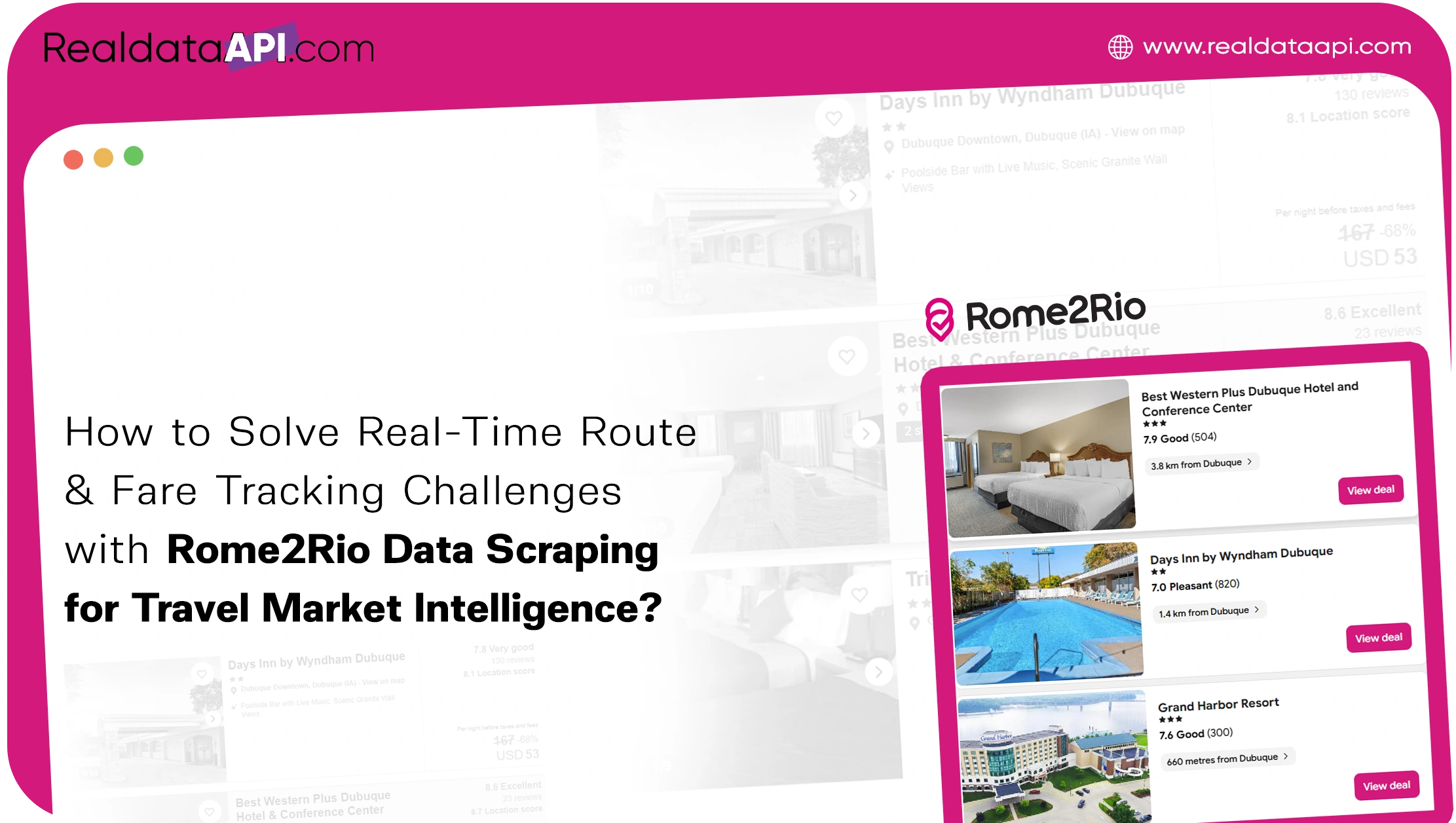
Rome2Rio data scraping for travel market intelligence helps businesses structure route, transport-mode, fare, and journey information for competitive travel analysis.
A scalable approach can improve route comparison, pricing research, and multimodal travel intelligence while reducing repetitive manual data collection.
With online travel bookings projected to reach $1.2 trillion by 2026, timely travel data is increasingly important for digital travel businesses.
Introduction
Travel planning has shifted from simply finding a flight or hotel to comparing complete journeys across multiple transportation modes. Travelers increasingly expect to see combinations of flights, trains, buses, ferries, driving routes, walking connections, journey times, and estimated costs before making a decision.
This creates a major data challenge for OTAs, travel agencies, mobility platforms, researchers, and destination marketers. Travel information is distributed across multiple transportation providers and can change according to schedules, availability, pricing, routes, and geographic conditions.
Rome2Rio data scraping for travel market intelligence provides a way to organize publicly available travel information into structured datasets for analysis. Businesses can use the resulting information to study route connectivity, compare transportation alternatives, monitor fare movements, and understand destination-level travel patterns.
The opportunity is expanding alongside digital travel. Phocuswright expects global online gross bookings to reach approximately $1.2 trillion by 2026, representing nearly 65% of global travel gross bookings.
A structured Travel Price Scraping Via Rome2Rio API strategy can therefore help businesses turn complex journey information into a usable intelligence layer for pricing research, route analysis, and travel-market decision-making.
How Travel Intelligence Evolved from 2020 to 2026
The travel industry experienced one of its most significant disruptions in 2020, when international mobility and tourism declined sharply. For travel-data teams, this created an unusual environment in which historical datasets suddenly became less representative of future demand. As borders reopened, businesses increasingly needed current route, fare, and transportation information rather than relying only on historical averages.
By 2021, domestic and regional travel began recovering in many markets. In 2022, international reopening accelerated the need for real-time travel intelligence. The online travel market also experienced a strong rebound as consumers returned to digital trip planning.
By 2024, international tourism had largely recovered to pre-pandemic levels. UN Tourism reported approximately 1.4 billion international tourist arrivals in 2024, marking recovery from the pandemic-era disruption.
For businesses conducting Rome2Rio travel data for market research, this recovery highlights why route-level datasets matter. Comparing transportation options across destinations can reveal changes in connectivity, travel costs, journey duration, and consumer alternatives.
| Year | Travel-data environment | Intelligence priority |
|---|---|---|
| 2020 | Severe travel disruption | Baseline and disruption analysis |
| 2021 | Domestic/regional recovery | Route availability |
| 2022 | International reopening | Cross-border connectivity |
| 2023 | Strong demand recovery | Fare and route comparison |
| 2024 | Tourism recovery | Multimodal travel intelligence |
| 2025 | Digital travel expansion | Real-time pricing and competition |
| 2026 | Continued digitalization | Predictive and automated intelligence |
The shift from disruption to recovery also changed how travel companies use data. Static research is increasingly insufficient when travelers can compare multiple transportation modes in real time.
A route may be attractive because of lower cost, shorter duration, fewer transfers, or better schedule availability. Travel businesses can analyze these variables to understand why one route or transportation option may be more competitive than another.
Building a Reliable Architecture for Route-Level Analysis
The next challenge is determining how travel information should be collected and structured. Route intelligence becomes significantly more useful when transportation options are represented consistently.
For example, a journey between two cities may include air travel, rail, bus, ferry, taxi, or combinations of several modes. A useful dataset should distinguish origin, destination, transport mode, journey duration, transfer points, fare indicators, and other relevant attributes.
Rome2Rio API data extraction for travel market analysis can support this type of structured approach when the relevant data-access method and terms permit its use. The objective is not simply to collect pages or records but to establish a repeatable data model.
The online travel sector provides strong justification for such infrastructure. Phocuswright estimated global travel gross bookings at nearly $1.6 trillion in 2024 and projected continued growth toward more than $1.8 trillion by 2027.
| Year | Digital travel trend | Business implication |
|---|---|---|
| 2020 | Digital trip research dominated limited travel activity | Need for resilient datasets |
| 2021 | Recovery increased route searches | More frequent updates |
| 2022 | Cross-border travel reopened | Expanded geographic coverage |
| 2023 | Travel demand strengthened | Competitive benchmarking |
| 2024 | Global tourism reached recovery levels | Larger route data requirements |
| 2025 | Online travel exceeded $700B in some market estimates | Greater data automation |
| 2026 | Online travel expected to continue expanding | Real-time intelligence becomes strategic |
Statista estimates the worldwide online travel market exceeded $700 billion in 2025, while online channels represented more than 70% of global travel and tourism revenue.
This makes data architecture particularly important for travel businesses. A route-intelligence platform may need to process thousands of origin-destination combinations, each containing multiple transportation alternatives.
A robust pipeline should therefore include source discovery, structured extraction, normalization, validation, storage, historical tracking, and analytics delivery.
The architecture can also support change detection. If a route becomes unavailable, a fare changes, or a transportation option disappears, an automated process can flag the change for analysts.
Turning Large-Scale Travel Data into Actionable Intelligence

Collecting information is only the first stage. The real value comes from transforming raw travel records into insights that businesses can act upon.
Modern data collection services for travel market analysis can combine automated extraction with normalization, validation, enrichment, and historical storage. This enables organizations to analyze travel information consistently across destinations and transportation modes.
A travel intelligence dataset might include:
- Origin and destination
- Transportation mode
- Journey duration
- Number of transfers
- Fare or price indicators
- Departure and arrival information
- Route alternatives
- Distance
- Availability indicators
- Historical observations
| Year | Primary analytical focus | Example use case |
|---|---|---|
| 2020 | Travel disruption | Route suspension analysis |
| 2021 | Recovery patterns | Domestic connectivity |
| 2022 | Reopening | International route tracking |
| 2023 | Demand normalization | Fare benchmarking |
| 2024 | Tourism recovery | Destination analysis |
| 2025 | Digital travel | Competitive monitoring |
| 2026 | Automation | Real-time intelligence |
The ability to compare historical and current observations can reveal patterns that individual snapshots cannot show.
For example, a business could determine whether a particular destination has become more accessible because additional transportation options were introduced. Similarly, an OTA could compare route costs across transportation modes and identify opportunities to improve travel recommendations.
Travel data can also support destination marketing. Tourism organizations can analyze how easily travelers can reach a destination from major origin markets and identify gaps in transportation connectivity.
Another advantage is segmentation. Data can be grouped by country, city, route, transport mode, price range, journey duration, or season. This allows businesses to build specialized intelligence dashboards.
Want to turn complex travel routes and pricing signals into actionable market intelligence? Explore Real Data API solutions for scalable travel data collection and analytics!
Get Insights Now!Solving Cross-Platform Data Consistency Challenges
Travel data becomes harder to analyze when different sources represent products, prices, routes, and transportation options differently. Even when two records describe the same journey, their naming conventions and attributes may not match.
This is where normalization becomes critical. Travel businesses need consistent schemas that allow them to compare routes across destinations and time periods.
The same principle applies to the requested Prom.ua product and pricing data use case. Although it belongs to e-commerce rather than travel, the underlying data-engineering principle is similar: raw information must be transformed into standardized records before meaningful comparisons can be performed.
| Year | Data-quality challenge | Recommended approach |
|---|---|---|
| 2020 | Disrupted schedules | Historical tagging |
| 2021 | Rapid availability changes | Frequent refreshes |
| 2022 | New routes returning | Route validation |
| 2023 | Increasing price variation | Price normalization |
| 2024 | Large-scale travel recovery | Automated processing |
| 2025 | More digital inventory | Scalable pipelines |
| 2026 | Higher real-time expectations | Continuous monitoring |
For travel intelligence, normalization may include converting currencies, standardizing transportation names, separating journey legs, identifying origin-destination pairs, and creating consistent duration fields.
Historical storage is equally important. A current fare tells a business what is happening now, but historical observations reveal whether the fare is unusually high or low.
This enables more sophisticated applications such as:
- Fare trend monitoring
- Route competitiveness scoring
- Destination accessibility analysis
- Transportation-mode comparison
- Seasonal travel research
- Market opportunity identification
As online travel becomes more digital, the ability to process these signals efficiently can become a competitive differentiator.
Improving Route Visibility Through Automated Extraction
One of the largest limitations of manual travel research is scale. An analyst may be able to compare a few routes manually, but doing the same for thousands of origin-destination combinations is inefficient.
Rome2Rio Web Scraping can provide an automation-oriented approach where permitted, helping organizations collect and structure travel information according to their analytical requirements.
Automation can address several operational problems. First, it reduces repetitive browsing. Second, it creates consistent extraction rules. Third, it allows datasets to be refreshed according to a defined schedule. Finally, it makes historical comparison easier because observations can be stored systematically.
| Year | Automation maturity | Potential benefit |
|---|---|---|
| 2020 | Primarily manual | Limited monitoring |
| 2021 | Basic automation | Faster collection |
| 2022 | Scheduled workflows | More frequent updates |
| 2023 | Structured pipelines | Better consistency |
| 2024 | Validation automation | Higher data quality |
| 2025 | API-led workflows | Faster integration |
| 2026 | Intelligent monitoring | Near-real-time insights |
However, successful travel-data collection requires more than extraction. A mature workflow should include validation, error handling, deduplication, historical storage, and monitoring for structural changes.
Data should also be delivered in formats suitable for downstream use. Depending on the business requirement, this could include databases, APIs, dashboards, CSV files, or analytics platforms.
The objective is to create a continuous intelligence pipeline rather than a one-time dataset.
For travel companies, this can support route comparison dashboards, pricing-monitoring systems, destination intelligence platforms, and internal research tools.
Creating a Historical Intelligence Layer for Travel Decisions
Travel businesses increasingly need historical context. A current route or fare is useful, but understanding how that value has changed over time can provide much deeper insight.
A Travel Dataset, Rome2Rio data scraping for travel market intelligence workflow can create a historical record of route characteristics, transportation alternatives, fare indicators, and journey conditions.
UN Tourism reported that international arrivals reached approximately 1.4 billion in 2024, indicating that global tourism had recovered to pre-pandemic levels. Meanwhile, Phocuswright expects online travel bookings to reach about $1.2 trillion by 2026.
| Year | Market condition | Intelligence opportunity |
|---|---|---|
| 2020 | Global disruption | Establish historical baseline |
| 2021 | Early recovery | Monitor route restoration |
| 2022 | Reopening acceleration | Track international connectivity |
| 2023 | Demand normalization | Compare fares and routes |
| 2024 | Tourism recovery | Expand destination coverage |
| 2025 | Digital booking growth | Increase automated monitoring |
| 2026 | Continued online adoption | Develop predictive intelligence |
Historical travel data can help answer questions such as:
- Which routes are becoming more competitive?
- Which destinations are gaining transportation options?
- Which transportation modes consistently offer lower fares?
- How does journey duration vary between alternatives?
- Which routes experience recurring price changes?
- How does connectivity evolve over time?
This information can support strategic planning for OTAs, travel agencies, destination organizations, mobility companies, and market researchers.
It can also help identify anomalies. If a route normally has several transportation alternatives but suddenly shows fewer options, the change can be flagged for investigation.
The combination of current observations and historical records therefore creates a much more powerful travel intelligence layer.
Why Choose Real Data API?
Travel businesses need data infrastructure that can move beyond one-time extraction. Real Data API provides a foundation for structured, scalable data workflows designed around business intelligence requirements.
With Travel Data Scraping, organizations can collect and organize information across relevant travel sources, transform raw records into structured datasets, and integrate the resulting information into analytics workflows.
For businesses focused on Rome2Rio data scraping for travel market intelligence, a scalable API-oriented architecture can make it easier to deliver travel information to dashboards, applications, databases, and internal analytics systems.
Key advantages include:
- Scalable data delivery: Support growing volumes of route and travel information.
- Structured outputs: Receive standardized data suitable for downstream analytics.
- Automation: Reduce repetitive collection and processing tasks.
- Integration readiness: Connect datasets with existing business systems.
- Historical intelligence: Store observations for trend and comparative analysis.
- Faster decision-making: Give analysts more timely access to structured information.
The broader online travel market reinforces the need for reliable data infrastructure. Phocuswright projects that nearly 65% of global travel gross bookings will be made online by 2026.
For travel businesses competing in this increasingly digital environment, structured data can become an important operational asset.
Conclusion
Travel market intelligence is becoming increasingly data-driven as consumers compare routes, transportation modes, prices, journey times, and alternatives across digital channels. Rome2Rio data scraping for travel market intelligence can help organizations transform complex travel information into structured datasets that support route research, pricing analysis, competitive benchmarking, and destination intelligence.
From the disruption of 2020 to the tourism recovery of 2024 and continued digital growth through 2026, the travel sector has demonstrated why timely and historical data matters. Online travel bookings are expected to reach approximately $1.2 trillion in 2026, highlighting the growing importance of digital travel infrastructure.
Businesses that combine automated collection, normalization, validation, historical storage, and analytics can respond faster to changing travel conditions.
Connect with Real Data API to explore structured travel data solutions tailored to your business requirements.
FAQs
1. What is Rome2Rio travel data used for?
It can support route comparison, transportation research, fare analysis, destination connectivity studies, competitive intelligence, and travel-market research when collected and used appropriately.
2. Why is real-time route data important?
Routes, schedules, transportation options, and prices can change frequently. Updated datasets help travel businesses make decisions using current market conditions instead of outdated information.
3. Can travel data support pricing intelligence?
Yes. Historical and current fare observations can help businesses identify pricing patterns, compare transportation alternatives, detect changes, and develop more informed travel-market strategies.
4. What does Real Data API provide?
Real Data API can support structured, scalable data workflows for businesses that need travel datasets integrated into analytics platforms, applications, dashboards, or internal systems.
5. Is automated travel-data collection scalable?
Yes. Properly designed pipelines can scale across routes and destinations while using normalization, validation, scheduling, monitoring, and historical storage to maintain consistent analytical datasets.
Latest posts
Keeta scraper for monitoring food marketplace trends - Identify Discount Changes and Emerging Customer Demand
How to build a structured Nike product dataset for Product Intelligence and Retail Analytics
Allegro scraper for competitor price monitoring – How to Track Product Prices and Stay Ahead of Competitors
Ocado API data collection services for retailers - Track Competitor Prices and Deals






.png)