
Introduction
Modern businesses rely on marketplace intelligence to stay competitive in fast-changing e-commerce environments. scrape product intelligence platform using marketplace data enables brands to monitor product pricing, inventory, customer reviews, seller activity, and market trends in real time. Combined with Scraping Product Intelligence Strategies for Marketplace Sellers, businesses can automate competitive analysis, improve pricing decisions, optimize inventory, and develop data-driven product strategies that accelerate growth.
According to industry reports, over 80% of leading retailers now use automated marketplace intelligence to monitor competitors and improve merchandising decisions. As online marketplaces continue to expand globally, real-time product data has become a critical asset for retailers, manufacturers, distributors, D2C brands, and market research firms.
Traditional manual product tracking is slow, inconsistent, and difficult to scale. Product catalogs change every hour, prices fluctuate frequently, and inventory levels shift constantly across marketplaces. Automated product intelligence platforms solve these challenges by collecting structured marketplace data continuously. This enables businesses to make faster decisions, reduce operational risks, identify market opportunities, and respond proactively to competitive changes.
How Can Marketplace Intelligence Improve Business Decisions?
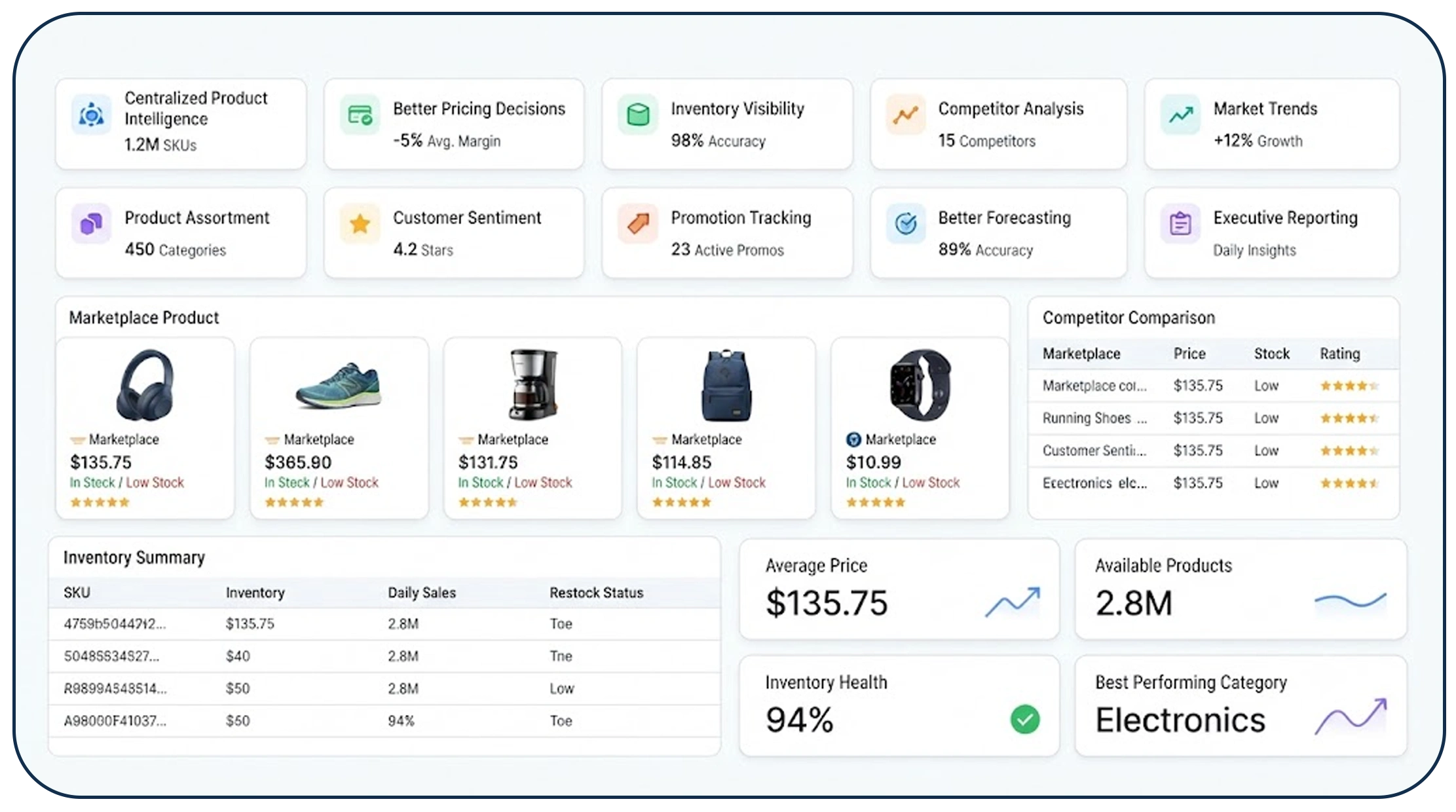
Today's digital marketplaces generate millions of product updates every day. Businesses that collect and analyze this information gain deeper visibility into pricing trends, inventory movement, customer preferences, and competitor strategies. These insights help organizations make informed operational and strategic decisions.
Modern enterprises increasingly invest in Marketplace product data collection for business intelligence to automate the extraction of product catalogs, specifications, prices, promotions, stock availability, ratings, and reviews. Instead of manually gathering information from multiple marketplaces, automated platforms deliver standardized datasets that support reporting, forecasting, and executive decision-making.
Industry estimates indicate that organizations using automated marketplace intelligence improve operational efficiency while significantly reducing manual research time.
Key business advantages
- Centralized product intelligence
- Better pricing decisions
- Improved inventory visibility
- Competitor analysis
- Market trend identification
- Product assortment optimization
- Customer sentiment monitoring
- Promotion tracking
- Better forecasting
- Faster executive reporting
Marketplace Intelligence Growth (2020–2026)
| Year | Products Tracked (Million) | Businesses Using Product Intelligence | Data Accuracy |
|---|---|---|---|
| 2020 | 30 | 27% | 87% |
| 2021 | 39 | 35% | 89% |
| 2022 | 51 | 45% | 91% |
| 2023 | 66 | 57% | 94% |
| 2024 | 84 | 68% | 96% |
| 2025 | 106 | 79% | 97% |
| 2026* | 132 | 89% | 98% |
*Illustrative industry estimates based on marketplace analytics trends.
Marketplace intelligence also supports multiple departments within an organization. Marketing teams analyze promotions, merchandising teams monitor product availability, finance teams evaluate pricing performance, and executives track overall market movement. By integrating structured marketplace data into BI dashboards and analytics platforms, organizations can make faster, data-driven decisions while minimizing uncertainty in rapidly evolving e-commerce markets.
Why Is Continuous Competitor Monitoring Essential?
Competition across online marketplaces is becoming more intense every year. New sellers enter the market daily, products are updated continuously, and pricing strategies change several times a day. Businesses that fail to monitor competitors in real time often lose valuable market opportunities.
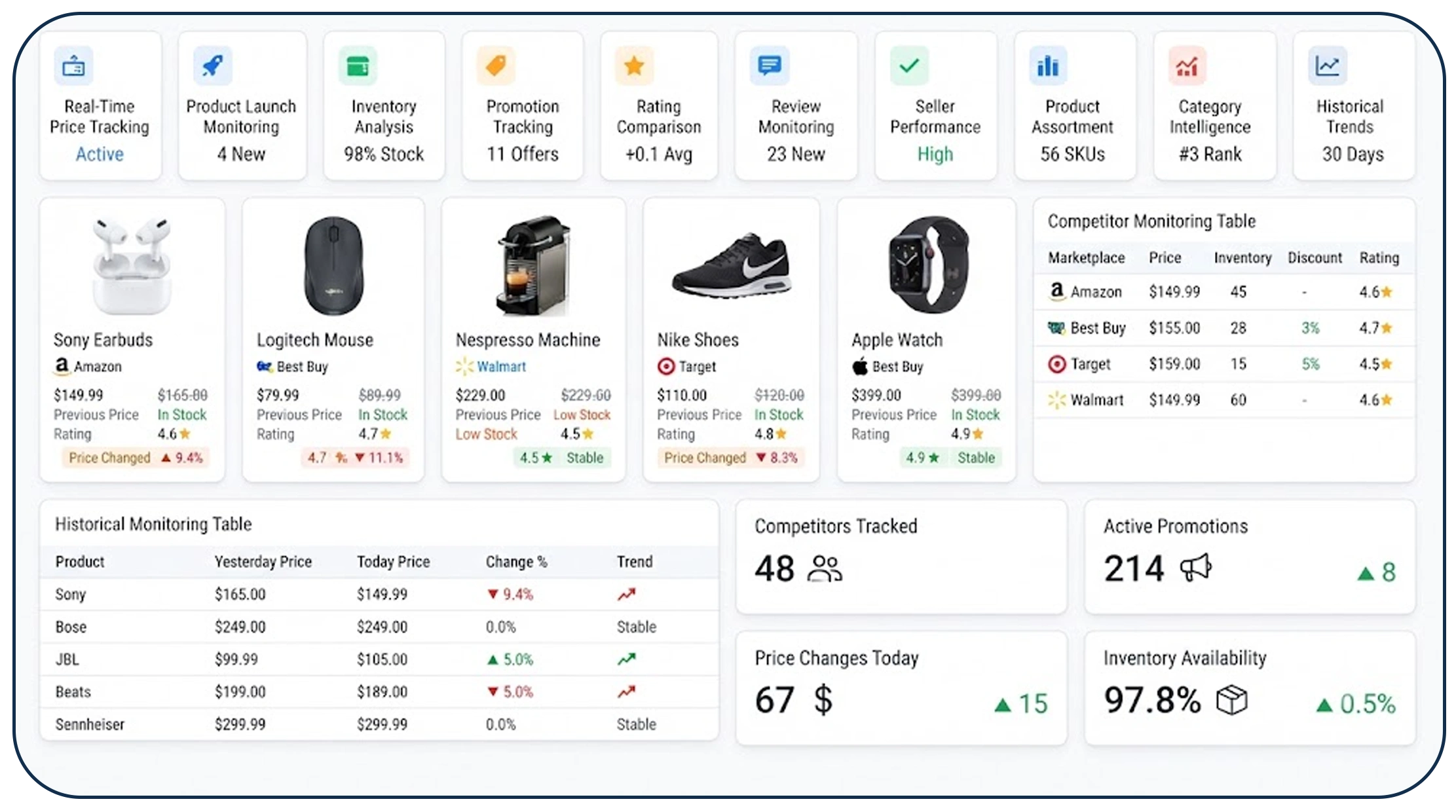
This is why companies increasingly use web scraping Competitor product monitoring using marketplace data to automate competitor intelligence. Automated monitoring systems collect product listings, pricing updates, stock availability, ratings, reviews, discounts, and promotional campaigns from multiple marketplaces simultaneously. This provides businesses with comprehensive visibility into competitor strategies.
Industry research suggests that brands implementing automated competitor monitoring improve pricing responsiveness by more than 60% while significantly enhancing product positioning and merchandising effectiveness.
Major monitoring capabilities
- Real-time price tracking
- Product launch monitoring
- Inventory analysis
- Promotion tracking
- Rating comparison
- Review monitoring
- Seller performance analysis
- Product assortment comparison
- Category intelligence
- Historical trend analysis
Competitor Intelligence Adoption (2020–2026)
| Year | Businesses Monitoring Competitors | Products Compared (Million) | Automated Monitoring |
|---|---|---|---|
| 2020 | 25% | 18 | 21% |
| 2021 | 34% | 24 | 30% |
| 2022 | 46% | 33 | 42% |
| 2023 | 58% | 46 | 55% |
| 2024 | 69% | 61 | 67% |
| 2025 | 80% | 80 | 79% |
| 2026* | 90% | 104 | 89% |
*Illustrative industry estimates based on global e-commerce monitoring trends.
Continuous competitor monitoring enables organizations to identify market changes before they affect business performance. Product managers can compare assortments, pricing teams can adjust prices dynamically, inventory planners can anticipate demand shifts, and executives can evaluate overall competitive positioning. As marketplaces continue expanding across global markets, automated competitor intelligence becomes an essential component of sustainable growth, helping businesses remain agile, informed, and competitive in an increasingly data-driven retail landscape.
How Can a Centralized Product Intelligence Platform Improve E-commerce Performance?
Managing thousands of products across multiple online marketplaces is challenging without a centralized intelligence system. Product information changes continuously as sellers update prices, inventory, descriptions, images, and promotional offers. Businesses need a unified platform that collects, organizes, and analyzes this data automatically.
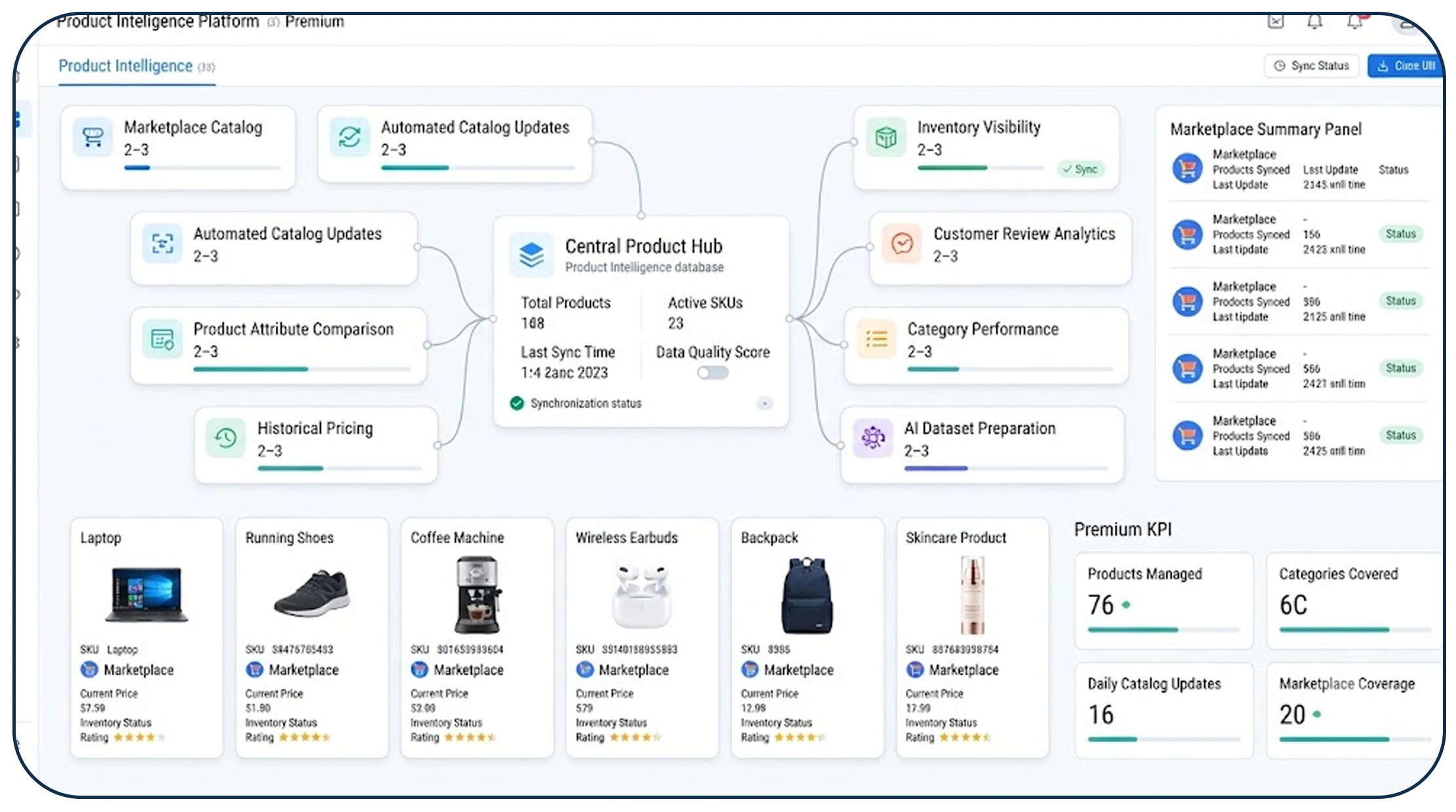
A Product data scraping platform for eCommerce enables organizations to aggregate marketplace information from multiple sources into a single structured database. Product managers, category teams, pricing analysts, and executives can monitor product performance, compare competitor catalogs, analyze customer feedback, and identify emerging opportunities from one dashboard instead of manually visiting numerous marketplaces.
Industry reports indicate that companies using centralized product intelligence platforms improve operational efficiency while reducing manual product research by more than 70%.
Key platform capabilities
- Centralized product database
- Multi-marketplace monitoring
- Automated catalog updates
- Product attribute comparison
- Historical pricing analysis
- Inventory visibility
- Customer review analytics
- Category performance tracking
- AI-ready datasets
- Executive dashboards
Product Intelligence Platform Adoption (2020–2026)
| Year | Companies Using Product Platforms | Products Managed (Million) | Centralized Data Coverage |
|---|---|---|---|
| 2020 | 1,600 | 32 | 43% |
| 2021 | 2,150 | 42 | 51% |
| 2022 | 2,980 | 56 | 60% |
| 2023 | 4,050 | 74 | 70% |
| 2024 | 5,480 | 96 | 79% |
| 2025 | 7,050 | 122 | 88% |
| 2026* | 8,950 | 154 | 95% |
*Illustrative industry estimates based on digital commerce and analytics adoption.
A centralized product intelligence platform also improves collaboration across departments. Marketing teams evaluate campaign performance, pricing teams monitor competitor movements, merchandising teams optimize product assortment, and supply chain teams forecast inventory requirements using the same trusted dataset. This unified approach eliminates data silos, improves reporting accuracy, and enables faster strategic decision-making. As marketplaces continue expanding globally, centralized product intelligence becomes essential for organizations seeking scalable growth and stronger competitive positioning.
How Can Product Availability Insights Improve Retail Performance?
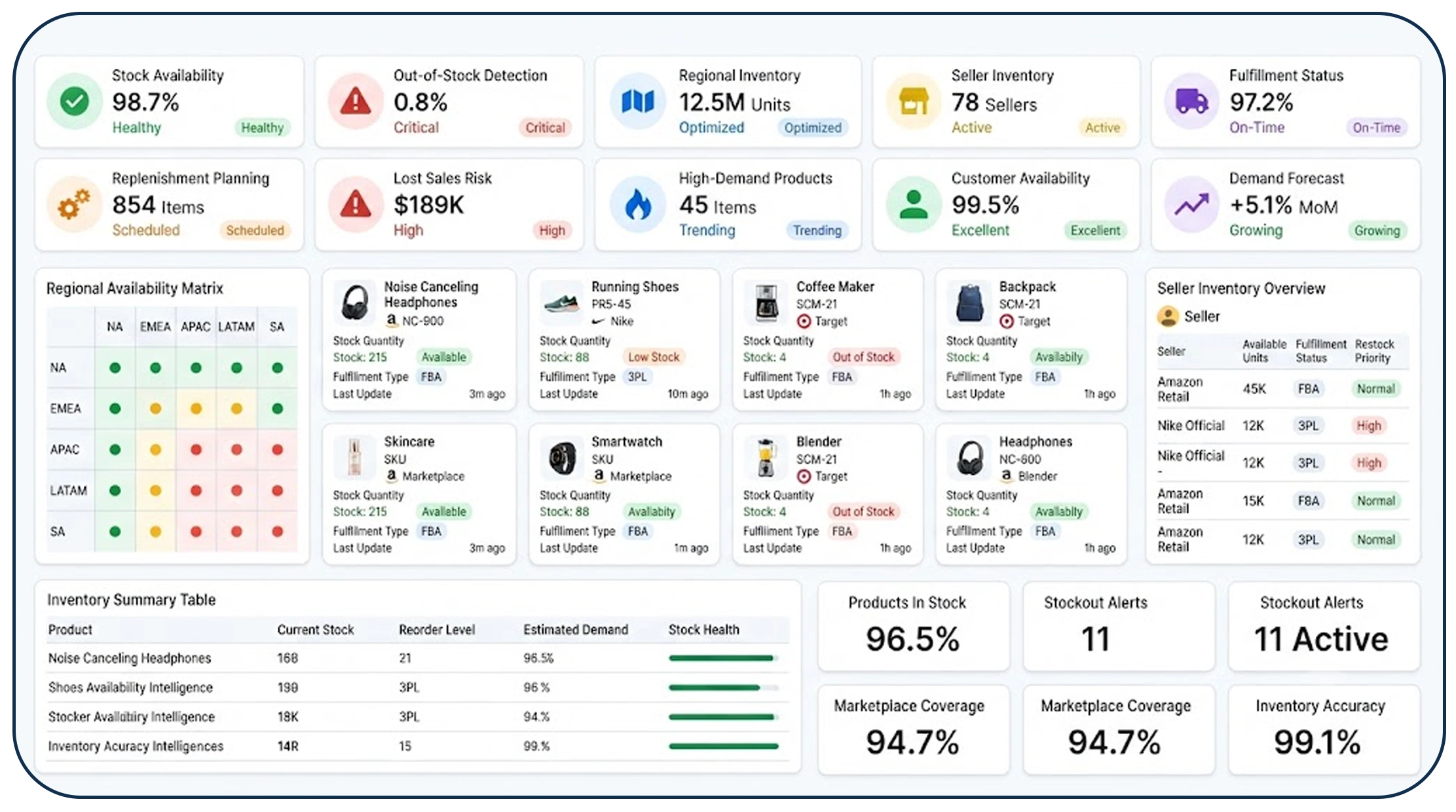
Product availability directly influences customer satisfaction, sales performance, and brand reputation. Out-of-stock products often result in lost revenue, while excess inventory increases operational costs. Monitoring availability across marketplaces helps businesses maintain the right balance between supply and demand.
Organizations increasingly Scrape Product Availability Data For Modern Trade Brands to monitor stock levels, regional product availability, seller inventory, fulfillment status, and assortment consistency across multiple online marketplaces. Automated availability monitoring enables retailers and manufacturers to identify inventory gaps before they impact sales.
According to industry research, businesses using automated availability tracking experience improved inventory accuracy and reduced stockout incidents compared to organizations relying on manual monitoring.
Benefits of availability intelligence
- Monitor stock availability
- Detect out-of-stock products
- Compare regional inventory
- Improve replenishment planning
- Optimize fulfillment operations
- Reduce lost sales
- Track seller inventory
- Identify high-demand products
- Improve customer experience
- Support demand forecasting
Marketplace Availability Intelligence (2020–2026)
| Year | Products Monitored (Million) | Businesses Using Availability Tracking | Inventory Accuracy |
|---|---|---|---|
| 2020 | 26 | 24% | 85% |
| 2021 | 35 | 33% | 88% |
| 2022 | 46 | 44% | 90% |
| 2023 | 61 | 56% | 93% |
| 2024 | 79 | 68% | 95% |
| 2025 | 101 | 80% | 97% |
| 2026* | 128 | 90% | 98% |
*Illustrative industry estimates based on modern retail analytics trends.
Availability intelligence also supports strategic planning by identifying regional demand patterns and seasonal inventory shifts. Manufacturers can evaluate product distribution across marketplaces, retailers can improve replenishment cycles, and category managers can optimize product assortment based on availability trends. Combined with pricing, customer reviews, and promotional insights, inventory intelligence creates a comprehensive marketplace analytics ecosystem that helps organizations improve profitability, strengthen customer satisfaction, and respond quickly to changing market conditions.
How Can APIs Simplify Marketplace Product Intelligence?
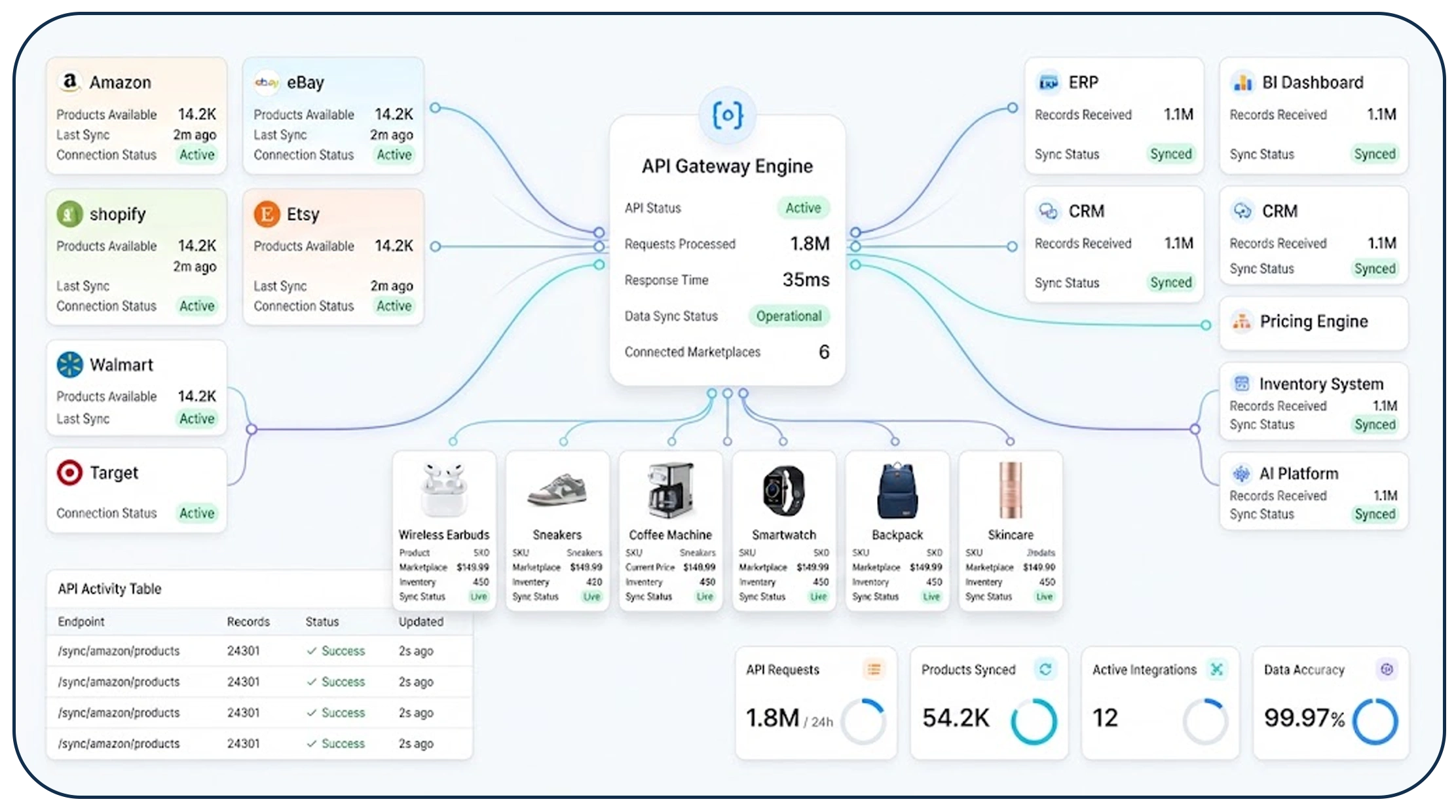
As marketplace data grows rapidly, businesses require automated methods to collect, process, and integrate product information into existing business systems. Manual exports and spreadsheets are no longer sufficient for organizations managing thousands of SKUs across multiple marketplaces.
A robust Web Scraping API enables businesses to automate marketplace data collection and seamlessly integrate product intelligence into ERP platforms, BI dashboards, pricing engines, CRM systems, inventory software, and AI models. Instead of repeatedly scraping websites manually, APIs provide structured and continuously updated datasets that improve operational efficiency and support faster business decisions.
Industry reports suggest that enterprises using API-driven marketplace intelligence reduce data integration time by more than 65% while improving data consistency across departments.
Key API capabilities
- Automated product extraction
- SKU-level pricing updates
- Inventory synchronization
- Product specification monitoring
- Customer review collection
- Promotion tracking
- Marketplace comparison
- Historical product records
- Custom data delivery
- Enterprise integrations
API Adoption in Marketplace Intelligence (2020–2026)
| Year | Businesses Using APIs | Products Processed (Million) | Enterprise Integrations |
|---|---|---|---|
| 2020 | 1,450 | 28 | 31% |
| 2021 | 2,020 | 38 | 40% |
| 2022 | 2,830 | 52 | 51% |
| 2023 | 3,940 | 71 | 63% |
| 2024 | 5,260 | 93 | 74% |
| 2025 | 6,940 | 121 | 84% |
| 2026* | 8,820 | 156 | 92% |
*Illustrative industry estimates based on enterprise digital transformation trends.
API-driven product intelligence also enables organizations to automate repetitive workflows. Pricing teams receive instant updates whenever competitors modify prices, inventory planners monitor stock availability continuously, and executives access real-time dashboards without manual intervention. As AI-powered analytics become more sophisticated, APIs serve as the backbone of scalable marketplace intelligence by ensuring reliable, structured, and continuously refreshed data across the enterprise.
How Can Marketplace Intelligence Drive Better Product Innovation?
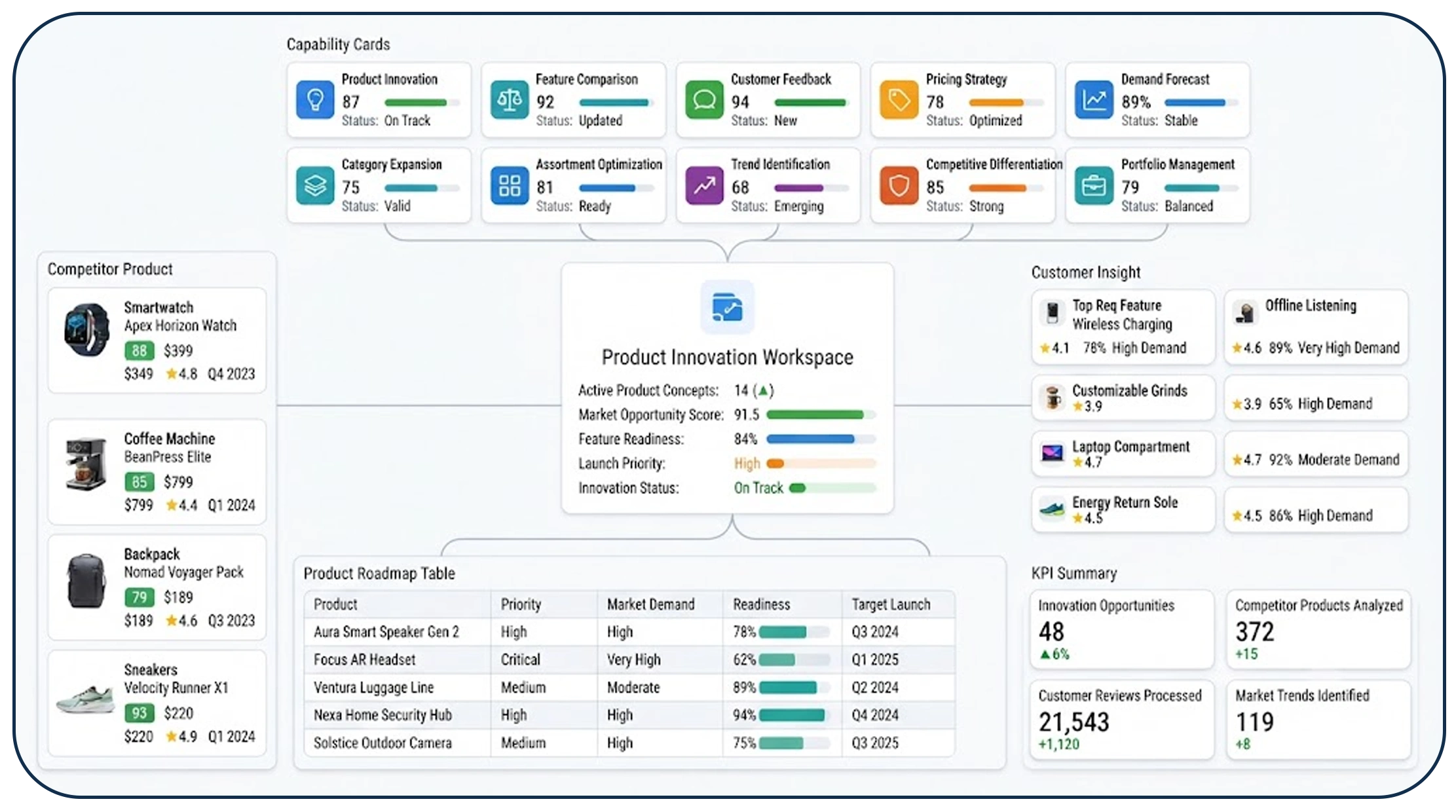
Successful products are built on reliable market insights rather than assumptions. Understanding customer preferences, competitor strategies, pricing patterns, and category trends enables businesses to create products that meet evolving consumer demand.
Marketplace intelligence has become an essential component of Product Development because it provides continuous visibility into new product launches, customer feedback, product specifications, pricing movements, and emerging market trends. Businesses can analyze marketplace data to identify unmet customer needs, compare competing features, and prioritize product enhancements based on actual consumer behavior.
Industry research indicates that organizations using marketplace intelligence in product planning launch products more efficiently while improving alignment with market demand.
Marketplace intelligence supports
- Product innovation
- Feature comparison
- Customer feedback analysis
- Pricing strategy development
- Demand forecasting
- Category expansion planning
- Assortment optimization
- Trend identification
- Competitive differentiation
- Portfolio management
Product Innovation Using Marketplace Data (2020–2026)
| Year | Businesses Using Product Intelligence | New Product Success Rate | Data-Driven Product Planning |
|---|---|---|---|
| 2020 | 28% | 54% | 25% |
| 2021 | 37% | 58% | 34% |
| 2022 | 48% | 63% | 45% |
| 2023 | 60% | 69% | 58% |
| 2024 | 71% | 75% | 69% |
| 2025 | 82% | 81% | 80% |
| 2026* | 91% | 87% | 89% |
*Illustrative industry estimates based on product intelligence adoption trends.
Integrating marketplace intelligence into product development helps businesses reduce uncertainty throughout the innovation lifecycle. Product teams gain early visibility into customer expectations, marketing teams validate positioning strategies, and leadership teams prioritize investments using measurable market data. As consumer preferences evolve more rapidly, organizations that continuously analyze marketplace intelligence are better equipped to launch competitive products, optimize existing portfolios, and sustain long-term business growth.
Why Choose Real Data API?
Real Data API provides enterprise-grade marketplace intelligence solutions that help businesses transform raw marketplace information into actionable insights. Our advanced data extraction technology enables retailers, manufacturers, D2C brands, marketplace sellers, consulting firms, and market research organizations to automate product monitoring, pricing intelligence, inventory analysis, and competitive benchmarking.
With scrape product intelligence platform using marketplace data, businesses gain structured, reliable, and continuously updated datasets that support pricing optimization, inventory planning, competitor monitoring, market research, and strategic product development.
Why businesses choose Real Data API
- Enterprise-scale marketplace data extraction
- Multi-marketplace product intelligence
- Real-time pricing and inventory monitoring
- Automated competitor tracking
- SKU-level product datasets
- API-ready structured data
- Historical marketplace analytics
- AI-ready data processing
- Secure and scalable infrastructure
- Customized data delivery solutions
Whether your objective is competitive intelligence, pricing optimization, inventory management, or product innovation, Real Data API delivers reliable marketplace data that supports confident, data-driven decision-making.
Conclusion
Marketplace competition is becoming increasingly dynamic. Product catalogs, pricing, inventory, promotions, and customer preferences change continuously across digital commerce platforms. Businesses that rely on manual monitoring often struggle to respond quickly enough to these changes.
By adopting scrape product intelligence platform using marketplace data, organizations can automate marketplace intelligence, improve pricing strategies, optimize inventory, strengthen competitive analysis, and accelerate product innovation. Real-time access to structured marketplace data empowers decision-makers to act faster, reduce operational risks, and identify new business opportunities before competitors.
As digital commerce continues to evolve, marketplace intelligence will remain a critical driver of sustainable business growth and long-term competitive success.
Ready to transform marketplace data into actionable business intelligence? Contact Real Data API today for customized marketplace web scraping solutions that help you optimize pricing, inventory, product strategy, and competitive performance with real-time data!
Latest posts

How Ixigo API Helps Businesses Solve Flight, Train, Hotel, Travel, and Pricing Data Challenges
How to Extract Restaurants, Menus, Prices, Ratings, and Business Data for Market Insights

How Brands Track Restaurant, Menu, Pricing, Rating, and Delivery Data for Competitive Intelligence

How Retailers Track Fashion Products, Prices, Brands, and Category Data for Competitive Intelligence Using AJIO API






.png)



