Quick Summary
- Shipt API for grocery data extraction helps businesses structure grocery product, pricing, availability, and category information for market analysis and competitive monitoring.
- A Shipt Grocery Dataset can support price benchmarking, assortment analysis, inventory visibility, and location-level grocery intelligence.
- Automated data workflows help retailers, brands, researchers, and analysts turn frequently changing grocery information into actionable business insights.
Introduction
Shipt API for grocery data extraction helps businesses collect and structure grocery product information, pricing signals, availability indicators, categories, brands, and location-level data at scale. Instead of manually checking multiple grocery listings, businesses can organize recurring observations into datasets that support pricing intelligence, assortment monitoring, competitive research, and demand analysis.
Shipt currently supports same-day delivery from 120+ stores and operates in more than 5,000 U.S. cities, according to its website. Its marketplace includes grocery retailers and other categories, while available stores and products can vary by location. (Shipt Grocery Delivery)
A Shipt Grocery Dataset can therefore be designed around the business questions that matter most: Which products are available? How do prices differ? Which brands dominate a category? Which products disappear from a local assortment? How frequently do prices or availability conditions change?
For grocery brands, retailers, pricing teams, market researchers, and data analysts, the challenge is not simply obtaining information. The larger challenge is converting changing digital shelf information into standardized, comparable, and historically useful records.
How Can Businesses Build a Reliable Grocery Data Pipeline?
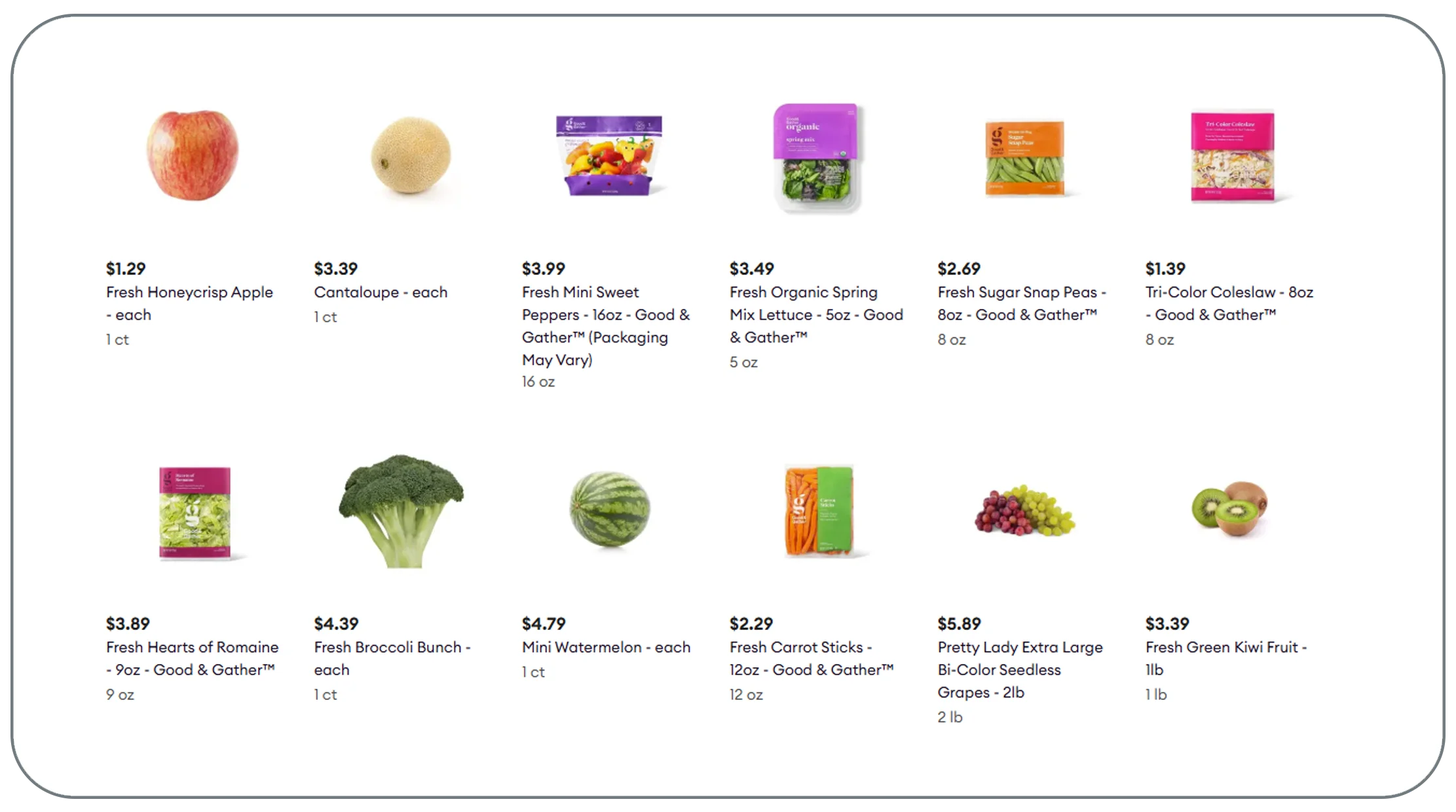
A Shipt grocery data API workflow can help businesses organize grocery information into structured records for downstream analytics. Depending on the permitted data source and collection architecture, a dataset can contain product name, brand, category, size, price, promotional information, availability, retailer, location, product URL, timestamp, and other relevant attributes.
The value comes from consistency. Grocery websites and delivery platforms can contain thousands of products, while the same item may appear differently across stores or locations. Normalization allows analysts to compare equivalent products and identify meaningful changes.
Shipt's marketplace demonstrates the breadth of information involved. The platform lists grocery categories such as produce, meat and seafood, beverages, and household goods, while its store network includes retailers such as Target, Publix, Kroger, CVS, Walgreens, and others. (Shipt Grocery Delivery)
| Data Element | Intelligence Use |
|---|---|
| Product name | Product identification |
| Brand | Brand benchmarking |
| Category | Assortment analysis |
| Price | Competitive pricing |
| Discount | Promotion tracking |
| Availability | Inventory visibility |
| Store/location | Regional comparison |
| Timestamp | Historical analysis |
2020–2026 trend: Grocery data intelligence changed significantly between 2020 and 2026. In 2020, the rapid adoption of online grocery shopping increased the importance of digital assortment and availability information. During 2021 and 2022, businesses increasingly needed frequent visibility into product availability and pricing. In 2023 and 2024, attention shifted toward competitive assortment, promotions, regional differences, and digital shelf performance. By 2025 and 2026, automated collection and historical datasets have become more useful for identifying recurring price changes, product introductions, assortment gaps, and location-level differences. The modern grocery data workflow therefore emphasizes continuous observation rather than one-time collection.
What Makes Location-Level Grocery Information Valuable?
Businesses increasingly need real-time Shipt grocery catalog data because grocery assortment is not necessarily identical across every location. Shipt states that available stores vary by area, and customers can enter an address to determine which stores and delivery options are available. (Shipt Help)
This creates an important analytical opportunity. A grocery brand may want to determine whether a product is widely available or limited to particular markets. A retailer may want to compare assortment depth between cities. A pricing team may want to identify whether a promotional price appears consistently or only in selected locations.
Location-aware records can include ZIP code, city, retailer, product, price, availability, promotion, and collection timestamp. When these records are collected repeatedly, analysts can measure changes rather than simply observe them.
| Location-Level Metric | Business Question |
|---|---|
| Product availability | Where is the product sold? |
| Price by location | Where is it more expensive? |
| Assortment depth | Which markets have broader selection? |
| Promotion presence | Where are discounts active? |
| Out-of-stock frequency | Which products face availability issues? |
| New product appearance | Where is assortment expanding? |
2020–2026 trend: In 2020, location-level grocery intelligence became particularly important as consumers moved toward digital ordering and retailers faced rapidly changing inventory conditions. During 2021–2022, regional availability became a key consideration for brands monitoring supply and customer access. In 2023, businesses increasingly connected product-level information with geographic market analysis. During 2024–2025, regional pricing and assortment monitoring became more relevant to competitive intelligence programs. By 2026, location-aware datasets can help businesses distinguish nationwide trends from market-specific changes. This is particularly valuable for companies operating across multiple regions where prices, inventory, promotions, and assortment may vary.
How Can Businesses Monitor Grocery Prices More Efficiently?
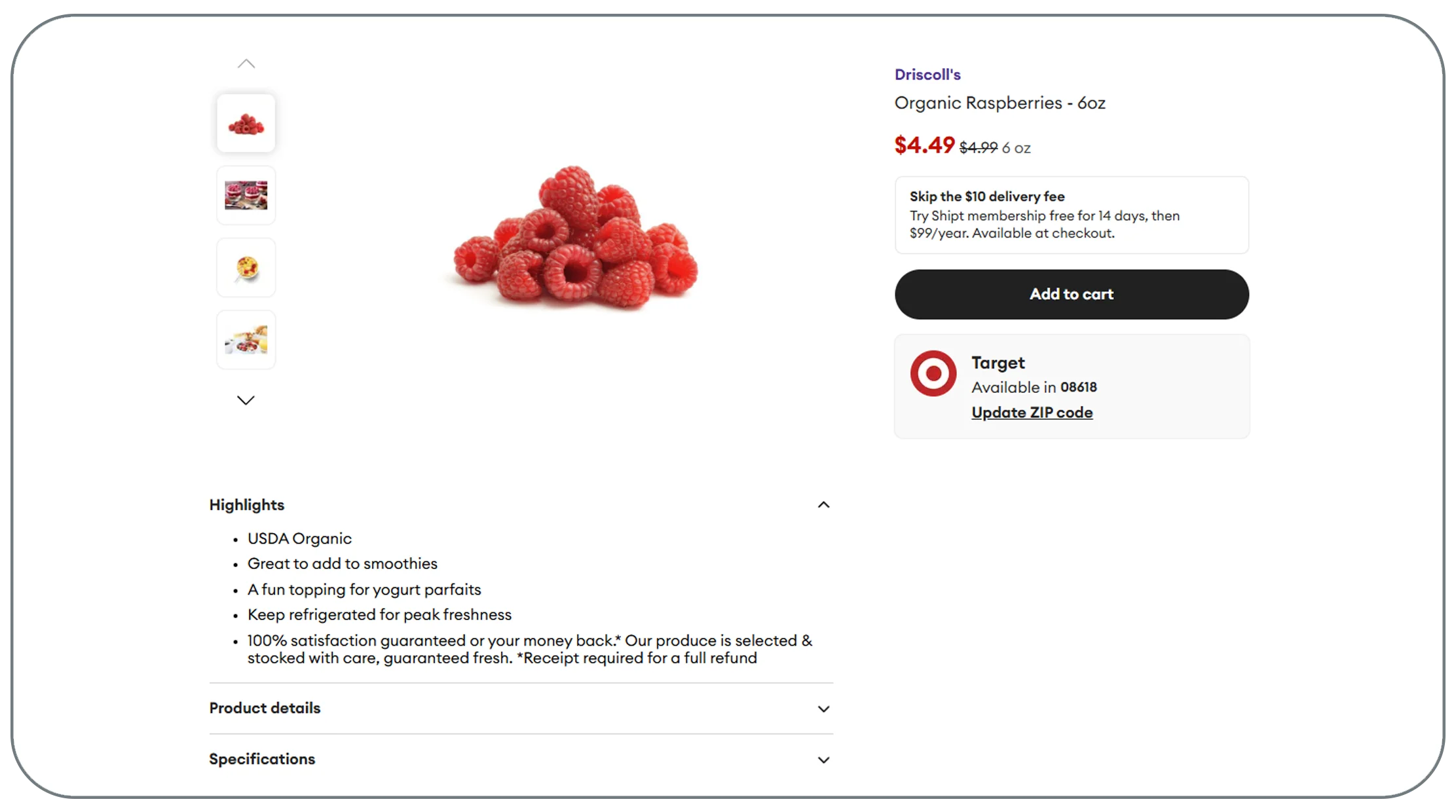
A Shipt grocery price web data scraper can support recurring collection of publicly accessible product and pricing information, subject to applicable website terms, technical restrictions, and data-use requirements. The primary advantage is frequency: instead of relying on occasional manual checks, businesses can establish repeatable workflows that capture observations at defined intervals.
Price monitoring becomes more useful when the dataset contains historical timestamps. Analysts can calculate price changes, promotional frequency, average prices, minimum and maximum observed prices, and category-level movements.
Shipt explains that displayed prices can differ from in-store prices depending on membership and retailer circumstances. Its pricing documentation also notes that prices and availability can change and that in-store deals may not always apply. (Shipt Help)
| Pricing Metric | Example Application |
|---|---|
| Current price | Price benchmarking |
| Previous price | Change detection |
| Discount | Promotion monitoring |
| Average price | Category analysis |
| Minimum price | Deal identification |
| Maximum price | Price dispersion |
| Price frequency | Promotional intelligence |
2020–2026 trend: Grocery pricing intelligence became more important after 2020 as consumers increasingly compared digital and physical shopping experiences. In 2021 and 2022, price volatility and supply-related pressures increased the need for frequent monitoring. During 2023, brands increasingly used digital shelf information to benchmark competitors. In 2024 and 2025, promotional monitoring and historical price analysis became more valuable for understanding consumer-facing pricing strategies. By 2026, automated price-change detection can help pricing teams identify meaningful movements without requiring analysts to manually inspect thousands of products every day.
Want to monitor grocery prices at scale? Build a structured data workflow that converts recurring product observations into actionable pricing intelligence!
Get Insights Now!What Can Businesses Do With Structured Grocery Information?
Grocery Datasets provide the foundation for grocery market research, category intelligence, assortment analysis, pricing benchmarks, and competitive monitoring. A useful dataset should be designed around the buyer's specific business questions rather than simply collecting as many fields as possible.
For example, a consumer packaged goods brand may prioritize brand visibility, product availability, competitor prices, pack sizes, and promotional activity. A retailer may require assortment comparisons, location-level pricing, stock signals, and category coverage. A market research company may need historical observations across multiple retailers and geographic areas.
The dataset can also be enriched with calculated fields such as price-per-unit, price-change percentage, discount depth, assortment count, availability rate, and competitor price position.
| Dataset Layer | Possible Fields |
|---|---|
| Product | Name, SKU, brand, category |
| Pricing | Current price, previous price |
| Promotion | Discount, offer, sale status |
| Availability | In stock, unavailable |
| Geography | City, ZIP code, market |
| Retailer | Store/provider |
| Technical | URL, timestamp |
| Analytics | Price change, price index |
2020–2026 trend: From 2020 to 2022, grocery datasets were increasingly used to understand rapidly changing digital shopping conditions. In 2023, structured product records became more useful for competitive assortment and pricing research. During 2024, businesses increasingly combined product, price, and location information for digital shelf analysis. In 2025, historical datasets helped organizations evaluate promotional patterns and product availability over longer periods. By 2026, grocery datasets are becoming more valuable when they are continuously refreshed, standardized, and connected to analytics systems. This enables businesses to move from simple product lists toward decision-ready market intelligence.
How Does an Automated Grocery Data API Support Faster Analysis?
A Grocery Scraping API can provide a structured delivery layer between grocery data collection and business applications. Instead of manually downloading files and preparing them for analysis, businesses can integrate structured records into dashboards, databases, analytics platforms, or internal research systems.
An API-oriented architecture is particularly useful when data must be refreshed frequently. Product prices, availability, promotions, and assortment can change, so a historical workflow can preserve previous observations while adding new records.
For example, a business can create a pipeline where product information is collected, validated, standardized, timestamped, and delivered to a database. A dashboard can then highlight products with price changes, availability changes, or newly detected promotions.
| API Capability | Business Benefit |
|---|---|
| Structured responses | Easier integration |
| Scheduled collection | Recurring monitoring |
| Standardized fields | Better comparisons |
| Timestamped records | Historical analysis |
| Automated delivery | Lower manual effort |
| Validation rules | Better data quality |
2020–2026 trend: In 2020, many grocery analytics workflows relied heavily on manual research and spreadsheets. During 2021 and 2022, growing digital grocery activity increased the need for automated collection. In 2023 and 2024, API-based delivery became increasingly useful for connecting product data with dashboards and analytics platforms. During 2025, businesses focused more on continuous monitoring and event-based change detection. By 2026, API-driven grocery data workflows can support near-real-time analytical environments where product, pricing, availability, and promotional signals are refreshed according to business requirements.
How Can Businesses Turn Grocery Data Into Competitive Intelligence?
A Shipt Scraper can be incorporated into a broader market intelligence workflow to collect structured observations from permitted public-facing sources. The objective should be to create reliable historical records rather than simply generate a large volume of raw pages.
For a grocery brand, the workflow might monitor 1,000 priority SKUs across selected markets. Every observation can contain product information, price, availability, promotion, retailer, location, and timestamp. Change-detection logic can then classify records as new products, price increases, price decreases, availability changes, promotions, or unchanged listings.
This approach helps analysts prioritize meaningful changes. Instead of manually reviewing every product, teams can focus on exceptions and trends.
| Intelligence Output | Decision Supported |
|---|---|
| Price-change alerts | Pricing response |
| Availability alerts | Supply monitoring |
| Assortment changes | Category strategy |
| Promotion tracking | Campaign analysis |
| Competitor benchmarking | Market positioning |
| Historical trends | Forecasting |
| Regional comparisons | Market expansion |
2020–2026 trend: In 2020 and 2021, grocery businesses primarily focused on maintaining product access and understanding rapidly changing online demand. By 2022, digital assortment and availability monitoring had become more strategically important. During 2023–2024, businesses increasingly combined pricing, product, and geographic data to understand competitive positioning. In 2025, recurring monitoring supported deeper analysis of promotional behavior and assortment changes. In 2026, the strongest workflows connect collection with automated validation, historical comparison, alerts, dashboards, and decision-making. The key shift is from data collection alone toward continuous grocery market intelligence.
Why Choose Real Data API?
Real Data API can help businesses design scalable data workflows around specific product, pricing, availability, location, and competitive intelligence requirements. The focus should be on delivering structured information that can be integrated into existing research and analytics processes.
A customized workflow can support:
- Product and category data collection
- Price and discount monitoring
- Availability tracking
- Location-level comparisons
- Historical data storage
- Product matching and normalization
- Competitor assortment analysis
- Scheduled data refreshes
- Analytics-ready datasets
- API or file-based data delivery
For grocery brands, retailers, CPG companies, market researchers, and pricing teams, the biggest benefit is turning fragmented digital shelf observations into consistent records. This can make large-scale grocery research easier to analyze and operationalize.
A strong data workflow should also include quality checks. Duplicate products, inconsistent pack sizes, missing values, unexpected price changes, and unavailable pages should be identified before the data reaches downstream analytics.
The result is a more dependable foundation for pricing intelligence, competitive benchmarking, category research, and market monitoring.
Conclusion
Shipt API for grocery data extraction can help businesses transform changing grocery product, pricing, availability, and assortment information into structured intelligence. The strongest approach combines recurring collection, normalization, validation, historical storage, and analytics rather than relying on isolated snapshots.
For grocery brands and retailers, the business value comes from answering practical questions: Which products are available? Where are prices changing? Which competitors offer similar products? Which markets have assortment gaps? How frequently do promotions appear? Which products become unavailable?
Real Data API can help organizations build data workflows around these requirements while delivering information in formats suitable for databases, dashboards, research platforms, and analytics systems.
Ready to turn grocery market information into actionable intelligence? Contact Real Data API to build a scalable, structured, and business-focused grocery data extraction workflow tailored to your market research and competitive monitoring needs!
FAQs
1. What can businesses collect through Shipt API for grocery data extraction?
Businesses can structure product names, brands, categories, prices, promotions, availability, locations, and timestamps, creating datasets for competitive monitoring, pricing analysis, assortment research, and grocery intelligence.
2. How is a Shipt Grocery Dataset useful for market research?
A Shipt Grocery Dataset helps researchers compare products, prices, availability, promotions, and assortment across locations, enabling historical analysis and more consistent grocery market benchmarking.
3. Can businesses extract Shipt grocery availability data by location?
Yes, businesses can design location-aware workflows to monitor availability signals across selected markets, helping identify regional assortment differences, product gaps, and changing inventory conditions.
4. Why use Shipt grocery data API instead of manual collection?
A Shipt grocery data API workflow can reduce repetitive research by organizing recurring observations into structured records that can feed databases, dashboards, analytical models, and reporting systems.
5. Can real-time Shipt grocery catalog data support pricing intelligence?
Yes. Real-time Shipt grocery catalog data can help pricing teams monitor product listings, price movements, promotions, and assortment changes when collected through compliant and appropriately permitted workflows.
Latest posts
How real-time food data scraping services Help Food Brands Track Products, Prices, and Market Trends
Why Sainsbury's grocery data web scraper Is Essential for Smarter Grocery Pricing and Product Intelligence
How Talabat Scraper Helps Brands Monitor Talabat Listings, Discounts, Reviews, and Availability at Scale

How Twitter Scraper Enables Faster Social Media Data Collection for Trend, Competitor, Audience Intelligence, and Social Media Data Collection







.png)