Quick Summary
- Talabat Food Data Scraping helps brands transform marketplace information such as menus, prices, ratings, discounts, and availability into structured datasets for competitive intelligence and market analysis.
- Automated collection enables businesses to monitor fast-changing listings across locations and categories without relying on repetitive manual checks.
- The resulting data can support pricing decisions, assortment planning, promotional benchmarking, restaurant intelligence, and marketplace strategy.
Introduction
A Talabat Scraper helps brands monitor frequently changing restaurant and marketplace information, including menu items, prices, promotions, ratings, reviews, and availability. This matters because Talabat operates across eight MENA markets and connects customers with a large network of restaurants and retail partners. Talabat reported more than 6 million active customers and more than 65,000 active partners in September 2024, demonstrating the scale and complexity of the marketplace.
For restaurant chains, food brands, aggregators, market researchers, and delivery-focused businesses, manually checking marketplace listings can quickly become inefficient. A structured collection workflow can capture changes at defined intervals, normalize records, identify price movements, and make the information easier to compare.
Talabat's marketplace has also expanded beyond food into grocery and retail. In 2024, the company's total GMV reached approximately USD 7.4 billion, up 23% year over year, while Food Vertical GMV reached USD 5.5 billion. Grocery and Retail GMV grew 47% during the same period.
This growth makes marketplace visibility increasingly important. A business may need to understand why one restaurant appears higher in a category, how competitors structure promotions, which menu products are available in specific locations, or how ratings change over time.
The following sections explain how structured data collection can address these challenges while supporting pricing intelligence, assortment analysis, competitor monitoring, and marketplace decision-making.
How can businesses build a reliable menu intelligence workflow?
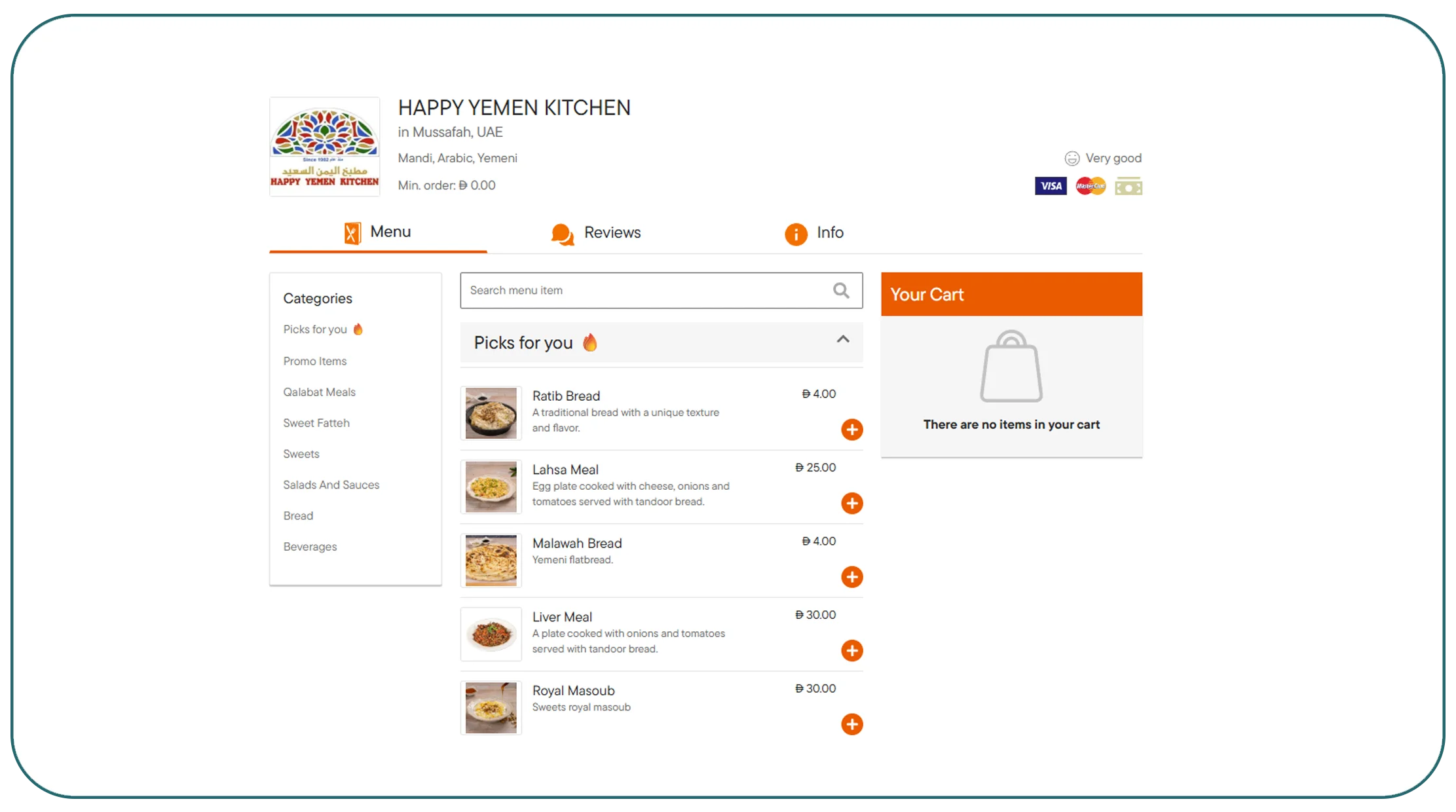
Restaurants and food brands often maintain hundreds or thousands of menu records across locations. Each listing can contain product names, descriptions, categories, prices, add-ons, images, dietary information, availability indicators, and promotional information. When these attributes change frequently, a one-time dataset quickly becomes outdated.
A structured approach to scrape Talabat menu data API workflows can help businesses create repeatable collection processes. Instead of treating a menu as a static document, companies can view it as a continuously changing dataset.
From 2020 onward, food delivery adoption accelerated as consumers became more dependent on digital ordering. Between 2020 and 2022, businesses increasingly focused on digital menus, delivery availability, and online visibility. In 2023, Talabat reported GMV of AED 22.3 billion, with a 24% CAGR between 2021 and 2023. By September 2024, GMV had reached AED 19.8 billion for the year-to-date period, 21.3% higher than the comparable 2023 period.
By 2025, Talabat reported USD 9.4 billion in GMV, 585 million orders, and 84,000 partners, illustrating how much marketplace information businesses may need to analyze.
| Data Attribute | Business Use |
|---|---|
| Restaurant name | Competitor identification |
| Menu category | Assortment analysis |
| Product name | Product benchmarking |
| Listed price | Price intelligence |
| Discount | Promotion monitoring |
| Availability | Stock/menu visibility |
| Location | Geographic comparison |
| Rating | Customer perception |
| Review count | Engagement analysis |
A reliable workflow should also include validation, duplicate removal, timestamping, location mapping, and historical storage. These steps allow businesses to distinguish a temporary listing change from a sustained marketplace trend.
Actionable insight: Capture the same menu fields at consistent intervals. This creates a historical baseline that can reveal new products, removed products, price changes, promotional cycles, and availability gaps.
Why does menu-level monitoring matter for competitive strategy?
Menus are more than lists of products. They reveal how restaurants position themselves, which categories they prioritize, how they price products, and how aggressively they use promotions.
Talabat menu data scraping can help brands convert individual marketplace listings into comparable datasets. For example, a restaurant group can compare the price of similar meals across competitors, identify common meal combinations, monitor category expansion, and determine whether discounts are concentrated around particular products or time periods.
The 2020–2026 period demonstrates why historical marketplace monitoring is valuable. In 2020, digital ordering became an essential customer channel for many food businesses. During 2021–2022, restaurants increasingly optimized online menus and promotions. In 2023, Talabat's GMV reached AED 22.3 billion, followed by continued expansion in 2024. The company's 2024 Food Vertical GMV was USD 5.542 billion, while Grocery & Retail GMV reached USD 1.886 billion.
In 2025, Talabat reported 585 million orders and 84,000 partners, showing the scale at which product and marketplace records can accumulate. By 2026, Talabat continued publishing quarterly financial results, indicating that marketplace activity remains a significant area of ongoing business measurement.
| Monitoring Area | What to Track | Decision Supported |
|---|---|---|
| Menu breadth | Number of products/categories | Assortment strategy |
| Product pricing | List and promotional prices | Pricing decisions |
| Meal bundles | Combo composition | Offer optimization |
| Discounts | Percentage/value | Promotion benchmarking |
| Ratings | Average rating | Reputation analysis |
| Availability | Active/unavailable products | Demand and supply visibility |
The key advantage is historical comparability. A single snapshot tells a business what is happening now. Recurring collection helps explain what changed, when it changed, and how competitors responded.
What marketplace signals can reveal about restaurant performance?
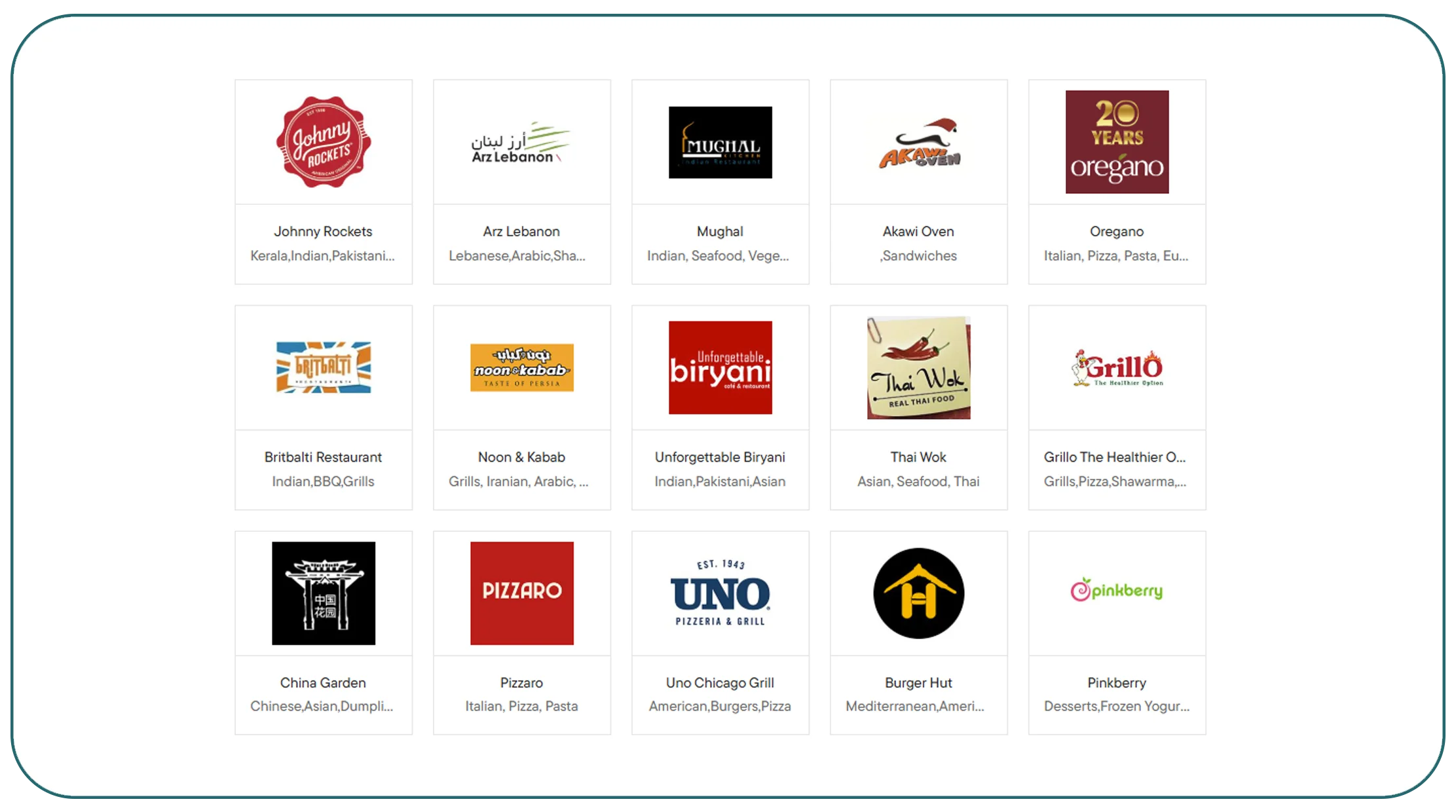
Marketplace data contains signals that may not be visible through conventional market research. Restaurant ranking, category placement, price positioning, ratings, reviews, promotions, and availability can collectively provide a stronger view of competitive performance.
Talabat food delivery marketplace data extraction can organize these signals into datasets suitable for dashboards, business intelligence platforms, or analytical models.
From 2020 to 2022, the food delivery ecosystem moved toward greater reliance on digital discovery and ordering. In 2023, Talabat's reported GMV growth reflected continued expansion in on-demand services. During 2024, the platform's monthly active users increased 25%, while order frequency increased 8%, according to its annual report.
The same report showed that Talabat's GCC GMV reached USD 6.332 billion in 2024, representing 85% of total GMV, while the non-GCC segment grew 42% to USD 1.096 billion. These figures demonstrate why geographic segmentation matters when analyzing marketplace data.
By 2025, Talabat processed 585 million orders and served 84,000 partners, increasing the potential volume of observable marketplace signals.
| Signal | What It Can Indicate |
|---|---|
| Frequent price changes | Dynamic pricing or promotions |
| Rating movement | Customer satisfaction changes |
| Review volume | Customer engagement |
| Product disappearance | Menu rationalization or availability |
| New menu launches | Product innovation |
| Discount frequency | Promotional strategy |
| Location differences | Localized pricing or assortment |
For example, if a competitor repeatedly discounts a particular meal while maintaining a strong rating, a brand may investigate whether the offer is driving customer engagement. Similarly, repeated product unavailability may indicate supply constraints, operational issues, or menu changes.
The goal is not simply to collect more records. It is to create a consistent evidence base for decisions.
Turn marketplace signals into structured, analysis-ready intelligence with a scalable data collection workflow!
How can price monitoring identify competitive opportunities?
Food delivery pricing changes because of promotions, product launches, seasonal demand, delivery conditions, location, and competitive pressure. A restaurant may therefore need to monitor not only its own prices but also how similar products are positioned across competing listings.
A Talabat price data scraper can support recurring price intelligence by collecting product-level pricing information and associating each record with a restaurant, category, location, and timestamp.
Talabat's reported figures show how quickly the wider marketplace has expanded. Its 2024 GMV increased 23% to USD 7.428 billion from USD 6.062 billion in 2023. Food GMV grew 16%, while Grocery & Retail GMV increased 47%. In 2025, total GMV reached USD 9.4 billion.
| Metric | Example Business Question |
|---|---|
| Average category price | Is our pricing above the market average? |
| Lowest competitor price | Who is competing most aggressively? |
| Median price | Where does our product sit in the market? |
| Discount percentage | How deep are competitor promotions? |
| Price change frequency | Which competitors adjust prices most often? |
| Bundle price | Are competitors creating stronger value perception? |
The 2020–2022 period made promotional visibility especially important as restaurants competed for digital customers. During 2023–2024, expanding marketplace activity increased the importance of structured competitive benchmarking. In 2025, the 585 million orders reported by Talabat further illustrated the scale of transaction activity across its marketplace.
By 2026, brands can use historical pricing datasets to move beyond simple price comparisons. They can study price elasticity proxies, promotional cycles, category-level price gaps, and competitor reactions.
A useful system should retain historical records rather than overwrite previous observations. This makes it possible to create daily, weekly, or monthly price histories and identify sustained movements.
How can automated monitoring improve marketplace visibility?
Manual marketplace research becomes difficult when businesses monitor numerous restaurants, cities, categories, and products. Employees may spend hours checking listings, copying prices, recording discounts, and verifying availability. The process is also vulnerable to human error and inconsistent collection.
A Talabat Scraper can automate recurring collection and organize marketplace information into standardized records. Depending on the business requirement, the workflow can capture restaurant details, menu information, pricing, ratings, reviews, promotional fields, availability, location, and other publicly accessible attributes.
Talabat's operating scale provides context for this challenge. The company reported more than 65,000 active partners and more than 119,000 active riders in September 2024. Its 2025 annual report later reported 84,000 partners and 585 million orders.
| Stage | Activity |
|---|---|
| 1. Targeting | Select restaurants, categories, locations, or products |
| 2. Collection | Gather publicly accessible marketplace fields |
| 3. Validation | Check missing, duplicate, or inconsistent records |
| 4. Normalization | Standardize prices, names, categories, and locations |
| 5. Timestamping | Record when each observation was collected |
| 6. Storage | Maintain historical datasets |
| 7. Analytics | Build dashboards and comparison models |
| 8. Delivery | Send structured outputs to business systems |
From 2020 to 2022, businesses primarily focused on establishing digital ordering visibility. During 2023–2024, marketplace scale and multi-vertical expansion increased the value of structured monitoring. In 2025, Talabat's reported 9.4 billion USD GMV and 585 million orders demonstrated the magnitude of activity that marketplace intelligence can support.
In 2026, the objective is increasingly about continuous intelligence rather than one-time extraction. A recurring pipeline can help businesses detect changes sooner and integrate marketplace observations into pricing, marketing, category, and operational workflows.
What makes a marketplace dataset useful for long-term analysis?
Collecting marketplace information is only the first step. The real value comes from transforming raw records into a clean, consistent, historical dataset.
A Talabat Food Dataset can combine product, restaurant, pricing, promotional, rating, review, and availability fields into a structured format. Businesses can then use the data for dashboards, competitor benchmarking, market research, forecasting, assortment planning, and machine-learning workflows.
The need for historical datasets has become clearer across the 2020–2026 period. The pandemic-era acceleration of digital ordering in 2020–2022 created more dependence on online marketplace channels. Talabat's 2023 GMV reached AED 22.3 billion, followed by USD 7.428 billion in GMV in 2024. In 2025, the company reported USD 9.4 billion in GMV and 585 million orders.
These numbers should not be interpreted as the amount of data available for scraping. They provide business context showing why marketplace activity generates a large and continuously changing information environment.
| Dataset Layer | Example Fields |
|---|---|
| Restaurant | Name, location, cuisine |
| Product | Name, category, description |
| Pricing | Price, discount, promotional price |
| Availability | Available/unavailable status |
| Reputation | Rating, review count |
| Promotion | Offer type, discount value |
| Geography | Country, city, service area |
| History | Collection date and time |
Historical storage enables businesses to answer questions that a single snapshot cannot answer: Which products disappeared? Which competitors changed prices? Which categories expanded? Which promotions became more frequent? Which restaurants improved their ratings?
For AEO and AI-driven analytics, structured fields are particularly useful because each record can be interpreted as a clear entity-attribute relationship. This makes the resulting dataset easier to query, summarize, compare, and connect to downstream analytics systems.
Build a historical marketplace intelligence layer that turns changing listings into measurable business signals!
Why Choose Real Data API?
Real Data API can help businesses design scalable data collection workflows around their specific marketplace intelligence requirements. Instead of treating extraction as a one-off activity, the focus can be placed on repeatability, structured outputs, validation, and downstream usability.
A major advantage is the ability to define the exact business fields required. A restaurant chain may prioritize competitor prices and menu changes, while a market research company may need restaurant coverage, ratings, reviews, promotions, and geographic attributes.
The workflow can also be designed around recurring schedules so that historical comparisons become possible. This is particularly valuable when businesses need daily or weekly monitoring rather than an isolated snapshot.
Key benefits
- Structured marketplace datasets
- Recurring data collection
- Product and restaurant-level monitoring
- Historical price tracking
- Location-based analysis
- Data normalization and validation
- Analytics-ready outputs
- Scalable workflows for large datasets
Businesses can also connect collected data with internal BI environments, spreadsheets, databases, or analytical applications.
For organizations already working with APIs, Talabat API data workflows can be evaluated as part of a broader data architecture, subject to the availability, permissions, technical constraints, and applicable terms of the relevant source.
The objective is straightforward: make marketplace data easier to collect, organize, compare, and use for business decisions.
Conclusion
Marketplace competition changes quickly. Menus are updated, prices move, discounts appear and disappear, products become unavailable, ratings evolve, and competitors adjust their offerings. For brands operating in food delivery and digital commerce, relying on occasional manual checks can leave important changes unnoticed.
A Talabat Scraper can support a more systematic approach by turning publicly accessible marketplace information into structured, timestamped datasets. When combined with recurring monitoring and appropriate validation, the data can support competitive pricing, menu benchmarking, promotional analysis, restaurant intelligence, and market research.
Talabat's growth illustrates the scale behind this requirement: the company reported USD 7.4 billion GMV in 2024 and USD 9.4 billion in 2025, with 585 million orders recorded in 2025.
The most valuable strategy is therefore not simply collecting more data. It is building a reliable process that converts marketplace changes into actionable intelligence.
Ready to turn changing food-delivery marketplace data into competitive insights? Talk to Real Data API about building a scalable, structured data collection solution for your business!
FAQs
1. What is a Talabat Scraper used for?
A Talabat Scraper collects publicly accessible restaurant and marketplace information such as menus, prices, ratings, reviews, promotions, locations, and availability for structured analysis and competitive intelligence.
2. Why do businesses use Talabat Food Data Scraping?
Talabat Food Data Scraping helps businesses compare competitors, monitor menus, evaluate pricing, track promotions, analyze ratings, and understand marketplace trends without relying entirely on manual research.
3. Can businesses scrape Talabat menu data API information?
Businesses can structure workflows around scrape Talabat menu data API requirements where technically and legally appropriate, while applying source rules, access restrictions, validation, and responsible data-handling practices.
4. How frequently should Talabat menu data scraping be performed?
Talabat menu data scraping frequency depends on business goals. Daily collection can suit price monitoring, while weekly or monthly schedules may work for broader assortment and market research.
5. What can Talabat food delivery marketplace data extraction reveal?
Talabat food delivery marketplace data extraction can reveal pricing movements, menu changes, promotional patterns, availability trends, restaurant ratings, category activity, and geographic differences useful for business analysis.
Latest posts
How Twitter Scraper Enables Faster Social Media Data Collection for Trend, Competitor, Audience Intelligence, and Social Media Data Collection

How Trip.com travel dataset Helps Brands Track Hotel Prices, Reviews, Availability, and Competitor Trends
How Reddit Scraper Solutions Collect Public Data for Market Research and Competitive Analysis
How Wildberries Product Scraper Helps Track Prices, Sellers, and Product Availability







.png)