Introduction
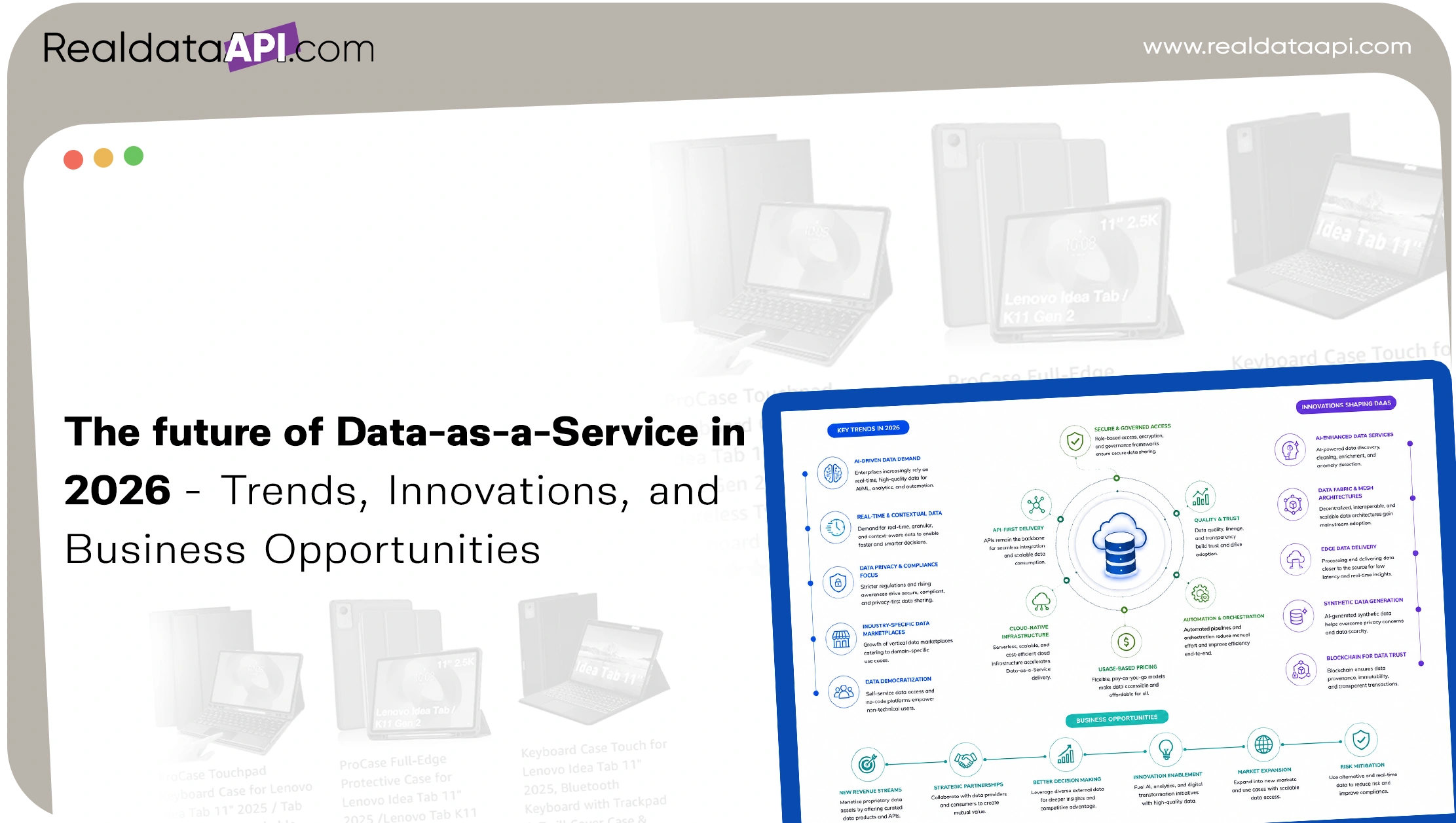
The future of Data-as-a-Service in 2026 is centered on delivering real-time, scalable, and high-quality data that powers AI, analytics, and faster business decisions. Organizations that invest in DaaS can improve forecasting, automate operations, and increase the ROI of Data Scraping for Business Intelligence Teams through reliable, data-driven insights.
Industry Insight: Industry analysts estimate that the global adoption of Data-as-a-Service (DaaS) solutions will continue growing rapidly through 2026, with enterprises increasingly relying on cloud-based data platforms to reduce infrastructure costs, improve operational efficiency, and accelerate digital transformation.
For business leaders, data engineers, market researchers, business intelligence teams, and digital transformation managers, access to fresh and accurate data has become a competitive necessity. Traditional data collection methods often struggle to keep pace with rapidly changing markets, customer behavior, and competitor activity.
Data-as-a-Service addresses this challenge by delivering structured datasets on demand through cloud-based platforms and APIs. Instead of investing heavily in data infrastructure, businesses can access continuously updated information whenever it is needed.
From predictive analytics and AI applications to pricing intelligence and customer insights, DaaS enables organizations to transform raw information into actionable intelligence that supports smarter strategic planning and sustainable business growth.
Why Are More Enterprises Moving to Cloud-Based Data Services?
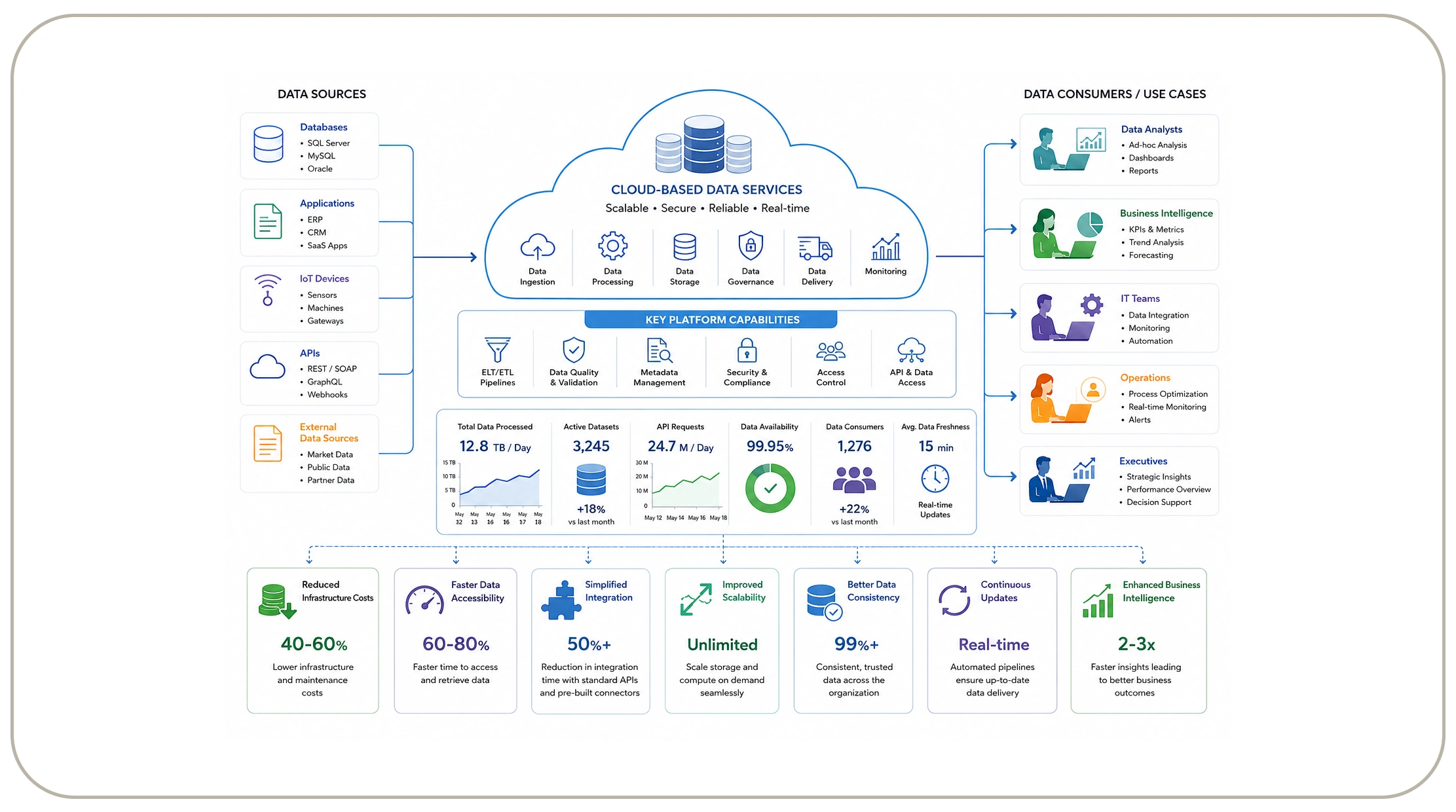
Modern enterprises generate and consume enormous volumes of data every day. Managing multiple databases, storage systems, and integration pipelines internally increases operational complexity and costs. Cloud-based data delivery simplifies this process while providing instant access to business-critical information.
The adoption of Data-as-a-Service trends for enterprises reflects a growing demand for scalable, flexible, and cost-efficient data solutions. Organizations can subscribe to continuously updated datasets instead of maintaining expensive in-house data infrastructure.
Businesses benefit from enterprise DaaS through:
- Reduced infrastructure costs
- Faster data accessibility
- Simplified integration
- Improved scalability
- Better data consistency
- Continuous updates
- Enhanced business intelligence
Cloud-native architectures also improve collaboration by allowing different departments to access the same trusted datasets simultaneously. This creates a single source of truth that supports better strategic planning and operational efficiency.
Enterprise DaaS Adoption (2020–2026)
| Year | Enterprises Using DaaS | Average Infrastructure Cost Reduction | Organizations Reporting Better Decision-Making |
|---|---|---|---|
| 2020 | 30% | 15% | 48% |
| 2021 | 38% | 19% | 54% |
| 2022 | 47% | 23% | 61% |
| 2023 | 58% | 28% | 69% |
| 2024 | 69% | 33% | 77% |
| 2025* | 79% | 37% | 84% |
| 2026* | 87% | 42% | 90% |
*Projected industry estimates
As organizations continue modernizing their technology stacks, Data-as-a-Service is becoming an essential foundation for enterprise-wide analytics and digital transformation initiatives.
How Can Organizations Modernize Their Data Strategy?

Businesses increasingly require flexible data ecosystems that support AI, machine learning, predictive analytics, automation, and real-time reporting. Legacy systems often lack the scalability needed to process growing volumes of structured and unstructured information.
Implementing Enterprise Data-as-a-Service solutions enables organizations to centralize data delivery while supporting multiple business functions through secure cloud platforms and APIs.
Modern enterprise data strategies support:
- AI model development
- Customer analytics
- Market intelligence
- Revenue forecasting
- Risk management
- Operational reporting
- Supply chain optimization
Rather than maintaining isolated databases across departments, organizations can integrate centralized DaaS platforms with existing enterprise applications. This reduces duplication, improves governance, and enhances overall data quality.
Enterprise Data Modernization Trends (2020–2026)
| Year | Organizations Modernizing Data Platforms | AI Integration Rate | Enterprise Productivity Improvement |
|---|---|---|---|
| 2020 | 28% | 24% | 12% |
| 2021 | 36% | 31% | 16% |
| 2022 | 46% | 40% | 21% |
| 2023 | 57% | 52% | 27% |
| 2024 | 68% | 63% | 34% |
| 2025* | 78% | 74% | 41% |
| 2026* | 86% | 83% | 48% |
*Projected industry estimates
Organizations that modernize their data strategies gain greater agility, faster reporting, improved collaboration, and stronger capabilities for AI-driven decision-making.
What Business Value Does Data-as-a-Service Deliver?

Organizations invest in technology to generate measurable business outcomes. Data-as-a-Service creates value by providing reliable access to high-quality information without requiring businesses to manage complex collection processes or infrastructure.
The growing adoption of Benefits of Data-as-a-Service for businesses demonstrates how cloud-based data platforms improve operational efficiency, reduce costs, and support strategic growth initiatives.
Key business advantages include:
- Faster business intelligence
- Lower IT costs
- Real-time decision support
- Better customer insights
- Improved forecasting
- Higher operational efficiency
- Easier system integration
- Greater scalability
Businesses also gain flexibility because DaaS platforms can expand as organizational needs evolve. Whether supporting startups or multinational enterprises, cloud-based data delivery ensures consistent access to reliable information that powers analytics and innovation.
Business Impact of DaaS (2020–2026)
| Year | Companies Using DaaS | Operational Efficiency Improvement | Average ROI Increase |
|---|---|---|---|
| 2020 | 29% | 13% | 9% |
| 2021 | 37% | 18% | 12% |
| 2022 | 47% | 24% | 16% |
| 2023 | 58% | 31% | 21% |
| 2024 | 69% | 38% | 27% |
| 2025* | 79% | 44% | 33% |
| 2026* | 87% | 51% | 40% |
*Projected industry estimates
Organizations leveraging Data-as-a-Service gain a stronger competitive position by making faster decisions, improving operational performance, reducing infrastructure investments, and enabling data-driven innovation across every business function.
How Can Real-Time Data Create a Competitive Advantage?
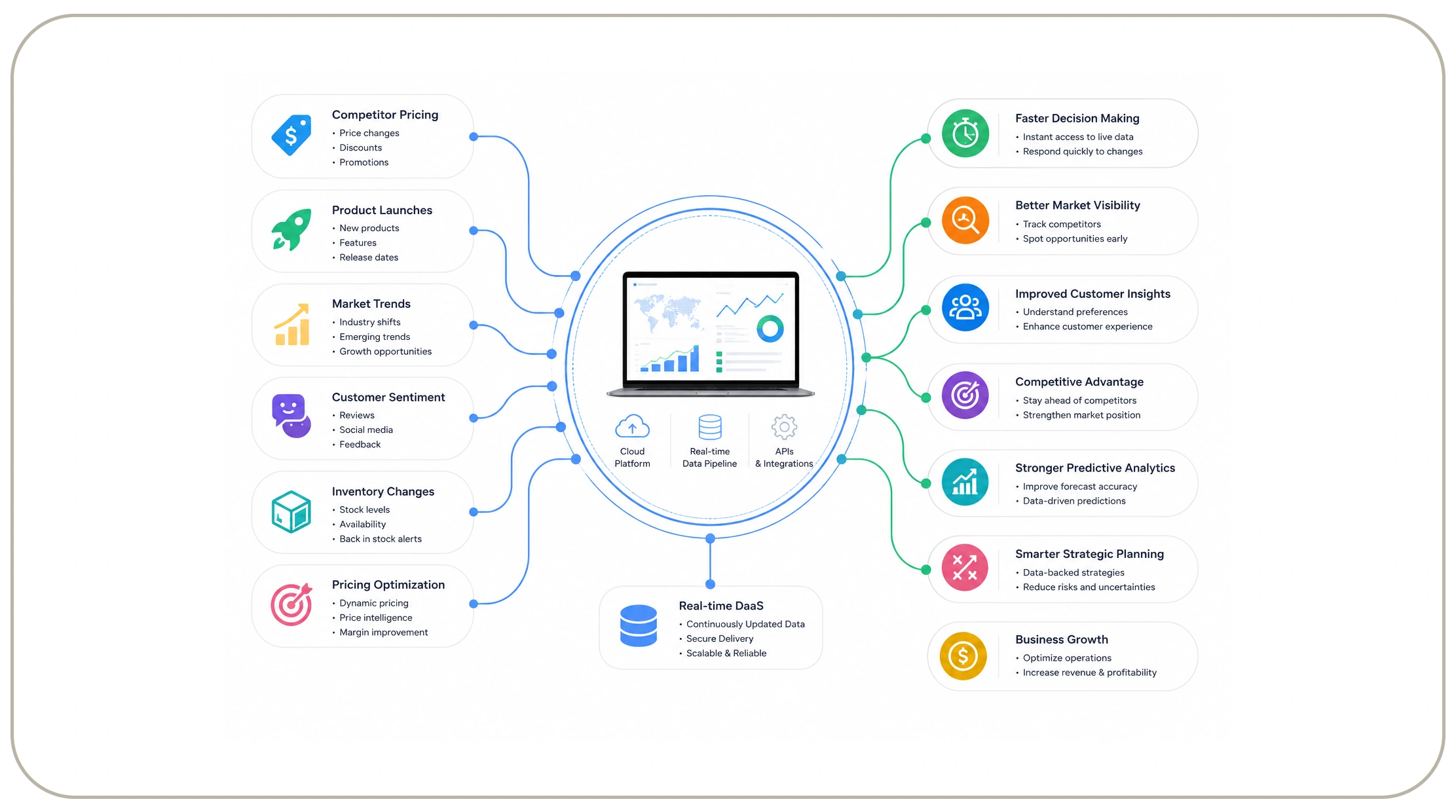
Markets change continuously. Competitor pricing, product availability, customer preferences, and industry trends can shift within minutes. Businesses that rely on outdated information often miss valuable opportunities and react too slowly.
Implementing Real-time DaaS for competitive intelligence enables organizations to receive continuously updated market information that supports faster and more informed decision-making. Instead of collecting data manually, enterprises can subscribe to live datasets delivered through secure cloud platforms and APIs.
Real-time competitive intelligence helps organizations:
- Monitor competitor pricing
- Track product launches
- Identify market trends
- Analyze customer sentiment
- Detect inventory changes
- Support pricing optimization
- Improve strategic planning
Access to continuously refreshed datasets also strengthens predictive analytics and AI models by ensuring decisions are based on the latest available information.
Real-Time Competitive Intelligence Adoption (2020–2026)
| Year | Organizations Using Real-Time DaaS | Average Response Time Improvement | Revenue Growth |
|---|---|---|---|
| 2020 | 27% | 18% | 6% |
| 2021 | 35% | 24% | 8% |
| 2022 | 45% | 31% | 11% |
| 2023 | 56% | 39% | 14% |
| 2024 | 67% | 47% | 18% |
| 2025* | 78% | 55% | 22% |
| 2026* | 86% | 63% | 27% |
*Projected industry estimates
Organizations that access live business intelligence can identify opportunities faster, minimize risks, and respond proactively to changing market conditions.
How Do APIs Simplify Enterprise Data Delivery?

Modern businesses require seamless access to structured data across multiple applications. APIs provide a secure and scalable method for delivering information directly into analytics platforms, CRM systems, ERP software, and AI applications.
A reliable Web Scraping API automates data collection from websites, marketplaces, public databases, and digital platforms. Instead of manually extracting information, organizations receive structured datasets in standardized formats such as JSON, CSV, XML, or API endpoints.
Benefits of API-driven data delivery include:
- Automated data collection
- Faster integration
- High-quality structured data
- Reduced manual effort
- Better scalability
- Continuous updates
- Improved reporting
API-based delivery also improves consistency by eliminating duplicate collection processes across departments while ensuring everyone works with the same trusted information.
API Adoption Trends (2020–2026)
| Year | Enterprises Using APIs | Daily Records Processed | Automation Rate |
|---|---|---|---|
| 2020 | 31% | 2 Million | 38% |
| 2021 | 39% | 3 Million | 45% |
| 2022 | 48% | 4.8 Million | 54% |
| 2023 | 59% | 7 Million | 64% |
| 2024 | 70% | 9.6 Million | 73% |
| 2025* | 80% | 12.8 Million | 81% |
| 2026* | 88% | 16.5 Million | 89% |
*Projected industry estimates
As enterprise data requirements continue expanding, APIs remain a critical foundation for scalable, secure, and efficient data delivery.
Why Are Managed Data Solutions Becoming More Popular?

Many organizations prefer outsourcing data collection instead of building internal scraping infrastructure. Managed services reduce development time while providing access to experienced specialists, enterprise-grade technology, and ongoing maintenance.
Professional Web Scraping Services help businesses collect structured information from thousands of online sources while ensuring accuracy, reliability, and scalability. These services support projects involving market intelligence, competitor monitoring, product analytics, financial research, and business intelligence.
Managed services provide:
- Custom scraping solutions
- Continuous monitoring
- Data quality assurance
- Scheduled updates
- Scalable infrastructure
- Technical support
- Compliance-focused processes
Outsourcing also enables internal teams to focus on analytics and strategic planning rather than maintaining data collection systems.
Growth of Managed Web Data Services (2020–2026)
| Year | Businesses Using Managed Services | Customer Satisfaction | Average Cost Savings |
|---|---|---|---|
| 2020 | 30% | 81% | 14% |
| 2021 | 38% | 84% | 18% |
| 2022 | 47% | 87% | 22% |
| 2023 | 58% | 90% | 27% |
| 2024 | 69% | 92% | 33% |
| 2025* | 79% | 94% | 39% |
| 2026* | 87% | 96% | 45% |
*Projected industry estimates
Managed data services continue growing because they help organizations accelerate digital transformation while minimizing infrastructure costs and operational complexity.
Why Choose Real Data API?
Real Data API empowers businesses with enterprise-grade data solutions designed to support analytics, AI, automation, and digital transformation. Our platform delivers reliable Web Scraping Datasets that enable organizations to build smarter forecasting models, improve business intelligence, and accelerate innovation.
Whether your business is preparing for The future of Data-as-a-Service in 2026 or modernizing existing data workflows, Real Data API provides scalable solutions that transform raw online information into valuable business intelligence.
Why businesses choose Real Data API
- Enterprise-grade data extraction
- Real-time data delivery
- Custom API integrations
- High-quality structured datasets
- Global data coverage
- Automated monitoring solutions
- Scalable cloud infrastructure
- Reliable technical support
- Secure data processing
- Flexible enterprise solutions
From startups to global enterprises, Real Data API helps organizations unlock the full value of data through reliable, scalable, and intelligent data services.
Conclusion
Data has become one of the most valuable business assets, and organizations need scalable solutions to access, manage, and analyze it efficiently. Data-as-a-Service simplifies this process by delivering reliable, real-time information that supports AI, analytics, forecasting, and strategic decision-making.
As The future of Data-as-a-Service in 2026 continues to evolve, businesses that embrace cloud-based data delivery, automation, and intelligent analytics will gain a significant competitive advantage. By leveraging high-quality datasets and modern data infrastructure, organizations can improve operational efficiency, reduce costs, and make faster, more informed business decisions.
Ready to future-proof your data strategy? Contact Real Data API today to access enterprise-grade DaaS solutions that power business intelligence, AI innovation, and long-term growth!
Latest posts

How Louis Vuitton Fashion Dataset Enables Better Analysis of Luxury Products, Prices, Brands, and Fashion Trends?
How Blinkit Grocery Dataset Enables Smarter Analysis of Products, Prices, Availability, and Quick-Commerce Trends?

How Chanel Fashion Dataset Enables Smarter Analysis of Luxury Products, Prices, Categories, and Fashion Trends?
How Foodpanda Food Dataset Helps Businesses Track Restaurants, Menus, Prices, Ratings, and Food Delivery Trends?






.png)