Introduction
A single-city view of quick commerce is no longer enough. A brand might perform well in Mumbai, struggle in Hyderabad and be missing entirely from a Tier-2 city where a competitor has just launched. To manage this, companies need a continuous, structured data feed from platforms such as Zepto and Swiggy Instamart that covers many cities at once. This is the purpose of a quick commerce data feed. It is also a practical use case for Zepto Instamart data scraping when brands need consistent location-level product intelligence.
In this guide, we explain how a multi-city feed is designed, what data it contains, how scraping scales across cities, which technical problems appear along the way and how brands and analysts use the results.
What is a quick-commerce data feed?
A data feed is a recurring, structured delivery of product data, as opposed to a one-time export. Instead of receiving a file once, you receive fresh data every day, every few hours or on demand through an API. For quick commerce, a feed usually includes product listings, prices, discounts, availability and delivery times for a defined set of cities and categories. A quick commerce data feed therefore gives analytics teams a repeatable source for monitoring changing catalogues.
The key difference from a simple scrape is reliability. A feed has a fixed schema, a predictable schedule, monitoring and alerts. Your dashboards and models can depend on it.
Why Zepto and Swiggy Instamart together
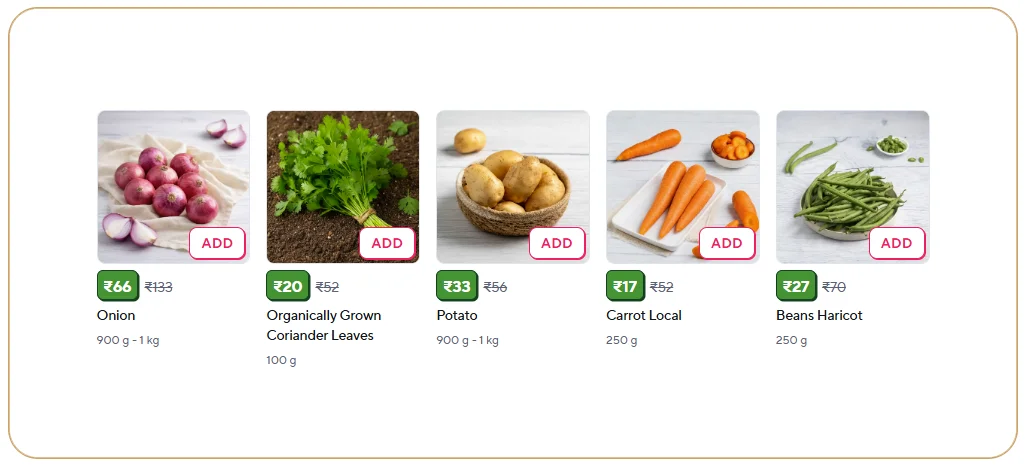
Zepto and Swiggy Instamart compete in many of the same cities, often with overlapping assortments. Looking at them together lets you compare the output of a Swiggy Instamart API with Zepto data in a consistent multi-city workflow:
- Compare price and discount for the same product across both platforms
- See which platform lists a product first
- Identify cities where one platform has better availability
- Measure delivery-time differences by area
- Understand the depth of each platform's private-label and branded range
Designing the multi-city setup
City and pincode selection. Start with the cities that matter to your business, such as Delhi NCR, Mumbai, Bengaluru, Hyderabad, Chennai, Pune and Kolkata. Within each city, select pincodes that represent different customer segments. Quick-commerce catalogues are location-specific, so the pincode list directly determines the quality of your insights.
Category or SKU scope. Decide whether to collect full categories, such as dairy, snacks or personal care, or a fixed list of SKUs. Many teams use both: full categories for market understanding and a SKU watchlist for their own products and key competitors.
Refresh schedule. Daily collection works for many use cases. Fast-moving categories and promotion periods may need two to four runs a day.
Data fields in the feed
- City, pincode and platform
- Product name, brand, variant and pack size
- Category and sub-category
- MRP, selling price, discount amount and percentage
- Unit price per 100 g, kg or litre
- Availability status and any stock-limit message
- Delivery time promise
- Search or category rank
- Ratings, review counts and image URLs where displayed
- Sponsored tag and offer labels
- Collection timestamp
How multi city scraping scales
- Location registry. A list of cities and pincodes is stored with coordinates, so the scraper can switch location programmatically.
- Parallel workers. Instead of scraping cities one by one, jobs run in parallel across workers, so a multi-city run finishes in a reasonable time.
- Standard schema. Zepto and Instamart pages differ, but their data is mapped to one common schema, so downstream tools do not care about the source.
- Incremental storage. Each run is stored with a timestamp. You can query the latest snapshot or compare any two dates.
- Monitoring. The system tracks the record count per city and platform and raises an alert if the number drops sharply, which usually signals a layout change or a block.
- Delivery. The feed is exposed through an API endpoint, or delivered as daily files to cloud storage.
Technical challenges
- App-first design: these platforms are mobile-first, so a Zepto scraper or similar collector often relies on mobile endpoints or browser emulation, which require ongoing maintenance.
- Location-sensitive catalogues: the same product can be present in one city and missing in another, so a missing record is not always an error.
- Anti-bot protection: platforms limit abnormal traffic. Requests need pacing and rotation so the collection stays stable.
- Product matching: Zepto and Instamart name products differently. Matching depends on brand, pack size and attribute rules, supported by human review for uncertain cases.
- Data volume: a feed covering ten cities and several categories can contain millions of rows a month. Storage, indexing and retention policies must be planned.
Use cases for a multi-city feed
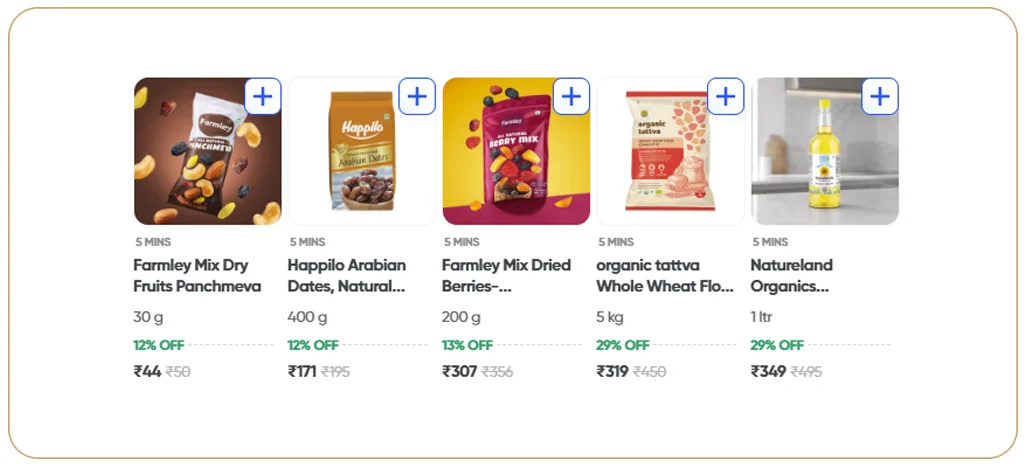
- Price benchmarking: use quick commerce price monitoring to compare your price index to competitors in each city.
- Assortment and distribution: find cities where your SKUs are not listed.
- Promotion monitoring: track discount depth and duration by platform and city.
- Demand signals: use stock-out frequency as a proxy for demand and supply gaps.
- Retail media and ad planning: understand which products win top positions in search and where sponsored placements dominate.
- Investment research: analysts study platform expansion by comparing city coverage and catalogue depth over time.
Example: a personal-care brand across six cities
A personal-care brand sells shampoos and face washes. It sets up a feed for Zepto and Instamart across six cities, with daily collection. After a month, it finds that one shampoo pack is priced 8 percent higher on Instamart in two cities, that Zepto lists a competitor's new variant a week earlier than Instamart, and that a face wash is out of stock in Hyderabad on three weekends. The brand adjusts price, flags the listing gap and fixes replenishment.
Quality checks that keep the feed trustworthy
- Compare today's record count against the seven-day average
- Flag prices that change by more than a set percentage in one day
- Check for missing pack sizes or units
- Validate that MRP is greater than or equal to the selling price
- Review samples manually every week against the live app
Delivery formats
Options include a REST API returning JSON, scheduled CSV or Parquet files in cloud storage, or direct loads into a data warehouse. For dashboards, many teams choose a daily file drop and a weekly summary.
Responsible data collection
Collect only publicly visible product information, avoid personal data, respect platform terms and keep request rates reasonable. Review local laws for your own use case.
Why choose Real Data API for Zepto and Instamart data feeds
Real Data API designs multi-city feeds with a stable schema, parallel collection and active monitoring. We maintain the scrapers as Zepto and Swiggy Instamart evolve, so your team receives consistent data. A small pilot with two cities and a limited category set is a practical way to validate quality and cost.
Conclusion
A multi-city quick-commerce data feed turns Zepto and Swiggy Instamart pages into a reliable, comparable dataset. With careful city selection, a standard schema and active monitoring, Zepto Instamart data scraping helps brands see price, availability and assortment differences across India and act on them quickly.
Planning a multi-city quick commerce feed? Real Data API can design and deliver a pilot for your cities and categories.
FAQs
1. How many cities can a feed cover?
There is no technical cap. Most clients begin with 3 to 5 cities and add more once the process is proven.
2. Can the feed include both Zepto and Instamart in one file?
Yes. Both platforms share one schema, with a column that identifies the source.
3. What if a platform is not available in a city?
The feed simply has no records for that platform and city, and the report flags the gap.
4. Can I request on-demand data for specific SKUs?
Yes. An API can accept a SKU list and a pincode and return the latest data.
5. How do you handle discontinued or renamed products?
Product identifiers and matching rules track items over time, and removed items are marked as unavailable instead of deleted.
Latest posts
India Seller-Level Information API for Electronics: Apple SKUs on Amazon, Flipkart, Croma, Vijay Sales & Reliance Digital
Multi-City Quick-Commerce Data Feed for Zepto and Swiggy Instamart
Blinkit Data Scraping Bangalore: Packed Grocery SKU, Price & Stock
Indian Quick-Commerce Grocery Category Data: Staples, Snacks & Beverages Across Blinkit, Zepto and Instamart



.png)


