Introduction
When a premium electronics brand sells through many channels, price is only half the story. The other half is who is selling. Is the seller an authorised partner or an unknown third party? Is the same iPhone model listed at different prices by different sellers on the same marketplace? Is an offline retailer matching online prices, or undercutting them? A seller-level information API answers these questions by tracking each SKU across platforms and recording the seller, price, availability and fulfilment for every listing.
This article explains how a seller-level API works for Apple products and similar premium electronics across Amazon, Flipkart, Croma, Vijay Sales and Reliance Digital, what data you receive, how SKUs are matched and how brands use the output.
What Is Seller-Level Data?
Platform-level price tracking gives you one price per product per platform. Seller-level data goes deeper and records every seller who lists a product, along with their individual price, stock, delivery promise and rating. On marketplaces like Amazon and Flipkart, a single product page can show many sellers. On retailers like Croma, Vijay Sales and Reliance Digital, the seller is the retailer itself, but pricing and offers still vary by city and channel. Businesses that need structured product, seller, pricing and availability fields can also use our e-commerce data scraping solutions.
For brands, this level of detail is key to channel management. It also supports ongoing price monitoring by helping teams compare listed prices and visible offers across sales channels.
Why Apple Skus Are A Special Case
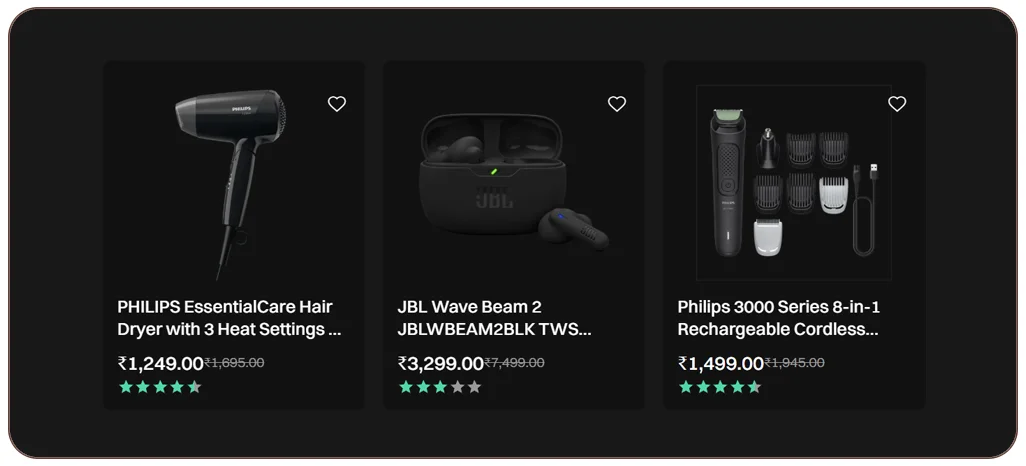
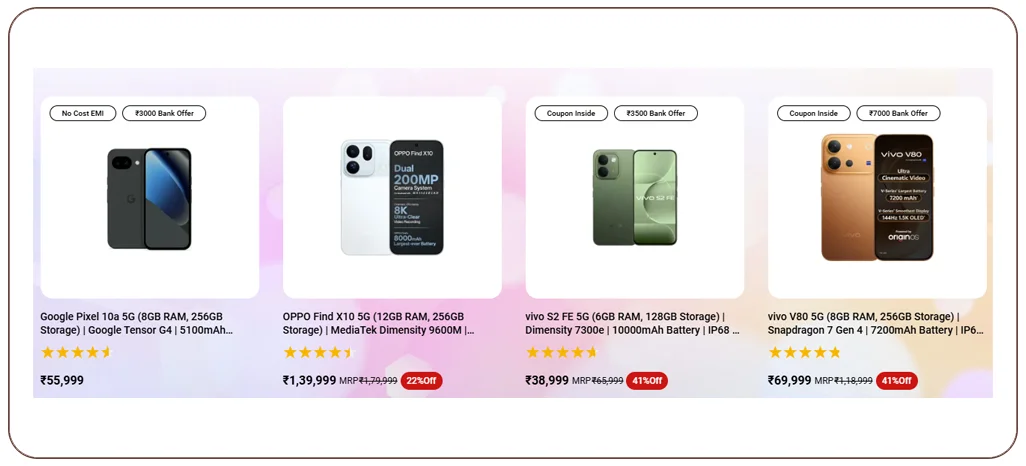
Apple products are premium, brand-controlled and heavily discounted through bank offers and exchange schemes. The same model can exist in multiple configurations, such as storage size and colour, each with its own SKU and price. Marketplaces and retailers show offers that mix instant discounts, card discounts and exchange bonuses. Tracking only the headline price misses the real effective price.
Because Apple SKUs are tightly defined by model, storage and colour, the brand or client usually provides the list. This makes exact matching possible across platforms.
Inputs For The Api
- SKU list: model, storage, colour and, where available, model number, EAN or product URL
- Platforms: Amazon, Flipkart, Croma, Vijay Sales, Reliance Digital
- Locations: pincodes or cities where prices and delivery should be checked
- Frequency: daily, several times a day or on demand
- Authorised seller list: optional list of approved partners, so unauthorised sellers can be flagged
Data Returned For Each Sku And Seller
- Platform, product URL and listing ID
- Seller name, seller ID and seller rating where shown
- Fulfilment type, such as fulfilled by the platform or by the seller
- Listed price, MRP, discount percentage and effective price after visible offers
- Bank offers, exchange offers and no-cost EMI messages
- Stock status and delivery estimate for the pincode
- Condition: new, refurbished or open box
- Warranty or invoice information where displayed
- Buy Box or featured offer indicator on marketplaces
- Number of sellers for the product
- Collection timestamp and pincode used
These fields can be combined with broader e-commerce product data extraction to support catalog benchmarking, seller analysis and historical comparisons.
How Sku Matching Works
Matching is critical. A listing for iPhone 128 GB black must not be confused with 256 GB black or with a refurbished unit. The matching process uses: Standardized product attributes can also feed a broader E-Commerce Dataset for cross-marketplace analysis.
- Model number or EAN when the listing provides it
- Title parsing to extract model, storage and colour
- Attribute checks from the specification table
- Image and URL checks to catch edge cases
- Confidence scoring with flagged uncertain matches for manual confirmation
Only confirmed matches enter the API output, which keeps the data trustworthy.
How The Scraping Runs
- For each platform and SKU, locate the product page or search results.
- On marketplaces, open the seller list for each product to collect all offers.
- Set the pincode to get local price and delivery data.
- Collect price, offer and stock fields for each seller.
- Standardise sellers, since the same company may appear with slightly different names.
- Compare sellers with your authorised list and flag unknown ones.
- Store results with timestamps and push them through the API or file delivery.
Technical Challenges
- Seller lists behind extra clicks: marketplaces show the main offer first and others under a separate view. For Amazon workflows that need offer-level seller collection, the Amazon seller data resource provides a related implementation reference.
- Dynamic pricing: prices and offers change several times a day, sometimes within hours.
- Offer complexity: effective price depends on card type, exchange value and other conditions, so only publicly visible offers can be recorded.
- Anti-bot protection: large platforms strongly limit automated access, which requires careful pacing and rotation.
- Seller name variations: the same seller may be listed under different names, so name matching is needed.
- Refurbished and grey-market listings: these need clear flags so they are not mistaken for new, authorised stock.
Use Cases
- Channel and pricing compliance: detect sellers listing below agreed minimum advertised prices. This can be paired with dedicated price monitoring workflows to flag pricing changes and potential MAP issues.
- Unauthorised seller detection: find sellers not on the authorised list and send takedown or enforcement notices.
- Competitive monitoring: compare offers between online platforms and national retail chains.
- Promotion tracking: record bank offers and exchange schemes across platforms during sales events.
- Distribution analysis: see which platforms and cities have stock and which do not.
- Retail partners: a retailer can check whether competitors are matching its price.
Example: Protecting Price Integrity During A Festive Sale
A brand supplies a list of 20 Apple SKUs and its authorised seller list. During the festival season, the API runs every four hours on Amazon and Flipkart and daily on Croma, Vijay Sales and Reliance Digital. The team sees that one unknown seller lists a popular model well below the agreed price on a marketplace, and that another platform stacks a bank offer that makes the effective price lower than expected. The channel team escalates both issues the same day, and reports the cause to its retail partners. Teams can extend this approach with structured e-commerce data scraping across additional product categories and marketplaces.
Sample Record
Platform: marketplace A. SKU: model, storage, colour. Seller: seller name. Fulfilment: seller-fulfilled. Listed price: value. MRP: value. Bank offers: text. Stock: in stock. Delivery estimate: two days. Authorised: no. Timestamp and pincode included.
Delivery And Integration
A REST API can take a SKU and pincode and return all seller records, or you can receive scheduled files in cloud storage. Alerts can be sent to email or messaging tools when rules are triggered, such as a new seller, a price below a threshold or a stock-out. For teams comparing delivery options, E-Commerce Scraping API integration can also support product and seller data collection at scale.
Responsible Use
Collect only publicly visible listing information, avoid personal data and respect platform terms and local laws. When acting on findings, such as sending notices to sellers, follow your legal advisor's guidance.
Why Choose Real Data Api For Seller-Level Data
Real Data API builds seller-level collection with careful SKU matching, location control and alerting across Amazon, Flipkart, Croma, Vijay Sales and Reliance Digital. A pilot with 10 to 20 SKUs and a few pincodes helps you check match accuracy and data depth. Related capabilities include Amazon seller data collection and price monitoring across ecommerce channels.
Conclusion
A seller-level information API for Apple SKUs and other premium electronics gives brands real control over their online channels. With careful SKU matching, seller tracking and alerting across Amazon, Flipkart, Croma, Vijay Sales and Reliance Digital, you can protect price integrity and respond quickly to unauthorised or aggressive listings.
Need seller-level tracking for your SKUs? Real Data API can set up a pilot for your products and platforms.
FAQs
1. Can you collect the SKU list from the platforms for me?
Usually the brand supplies the SKU list for accuracy. If not, we can build an initial list from product pages and have you confirm it.
2. How many sellers does the API return per SKU?
It returns all visible sellers. The number depends on what each platform displays.
3. Can effective price after offers be calculated?
Where offers are publicly visible, they are captured. Some offers depend on login or card type and may not be fully available.
4. Can you track offline stores?
The API covers online listings of retail chains. Physical store prices need separate methods.
5. How quickly can alerts be sent?
Alert timing depends on your refresh schedule. More frequent collection allows faster alerts.
Latest posts
India Seller-Level Information API for Electronics: Apple SKUs on Amazon, Flipkart, Croma, Vijay Sales & Reliance Digital
Multi-City Quick-Commerce Data Feed for Zepto and Swiggy Instamart
Blinkit Data Scraping Bangalore: Packed Grocery SKU, Price & Stock
Indian Quick-Commerce Grocery Category Data: Staples, Snacks & Beverages Across Blinkit, Zepto and Instamart



.png)


