Quick Summary
- AliExpress API integration for automated data collection helps eCommerce businesses organize product information, monitor pricing changes, and evaluate seller activity for better decisions.
- AliExpress Web Scraping Services can complement authorized data access when businesses need structured product listings, category information, and competitive market insights.
- A well-designed data workflow supports product research, competitor benchmarking, catalog monitoring, and seller evaluation while improving reporting consistency and reducing repetitive manual work.
Introduction
AliExpress API integration for automated data collection helps eCommerce retailers, marketplace analysts, dropshippers, and product sourcing teams gather structured marketplace information for faster decision-making. Instead of manually checking individual listings, businesses can develop automated workflows to organize product titles, prices, specifications, availability indicators, seller details, and other accessible attributes. This information supports product monitoring, competitive pricing, and catalog analysis across changing marketplace conditions.
For businesses that require broader coverage or specialized extraction, AliExpress Web Scraping Services can provide an alternative or complementary approach, depending on source accessibility, platform permissions, and technical requirements. The objective is to transform scattered marketplace information into reliable, analysis-ready datasets.
For Real Data API, the key opportunity is helping businesses build practical data pipelines that connect marketplace intelligence with their existing analytics and business systems. When product information is collected responsibly, validated consistently, and refreshed according to business needs, teams can identify pricing opportunities, evaluate product demand signals, and make more informed sourcing and merchandising decisions.
How Can Product Research Reveal Better Selling Opportunities?
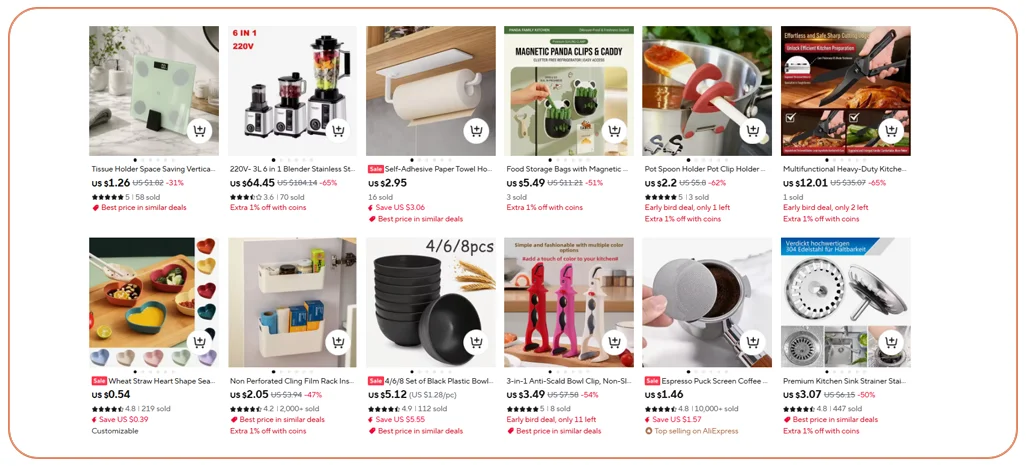
Product research helps eCommerce businesses determine which items deserve attention before they invest in inventory, advertising, or supplier relationships. An AliExpress API for e-commerce product research can help organize accessible listing attributes into a consistent research dataset, depending on the API's available fields and permitted usage.
Useful attributes include product titles, category paths, listed prices, product identifiers, seller information, ratings, review counts, and availability indicators where provided. Researchers can use these fields to compare similar products, identify catalog gaps, and evaluate whether an item aligns with their target market.
What does the broader eCommerce trend indicate?
Global retail eCommerce sales demonstrate why structured marketplace research matters. The following figures are worldwide retail eCommerce estimates and forecasts, not AliExpress sales or performance statistics.
| Year | Global retail eCommerce sales |
|---|---|
| 2020 | $4.25 trillion |
| 2021 | $4.98 trillion |
| 2022 | $5.08 trillion |
| 2023 | $5.58 trillion |
| 2024 | $6.01 trillion |
| 2025 | $6.42 trillion |
| 2026 | $6.88 trillion projected |
Sources: Capital One Shopping's eCommerce statistics and Shopify's summary of eMarketer forecasts. Figures are rounded; 2025–2026 values are forecasts.
These figures provide context for the expanding online retail environment, although marketplace-level demand must be assessed separately.
How can businesses apply the data?
- Compare products across categories and price bands.
- Group similar listings using identifiers and normalized product names.
- Assess ratings and review counts as indicators of customer feedback.
- Shortlist products for further supplier, margin, and demand analysis.
The most useful research dataset combines consistent product attributes with collection timestamps, validation rules, and documented limitations. This enables teams to repeat analyses and distinguish observed marketplace information from assumptions about future sales.
How Can Competitor Listings Improve Product Positioning?
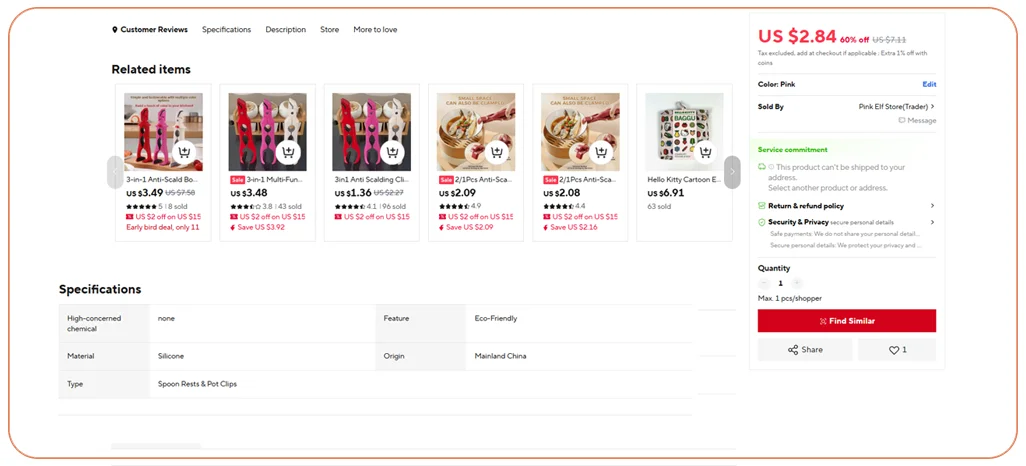
Competitor research helps sellers understand how similar products are presented, priced, and differentiated across the marketplace. Businesses that scrape AliExpress competitor product data through permitted methods can create structured comparisons instead of manually reviewing individual listings.
The process begins by identifying relevant competitor products using product identifiers, categories, titles, specifications, and images where permitted. Next, collected attributes are standardized so that genuinely comparable products can be grouped together. This step is essential because two listings may describe similar items while differing in size, material, quantity, accessories, or included components.
Which attributes should businesses compare?
| Attribute | Business application |
|---|---|
| Product title and category | Identify comparable items |
| Listed price and currency | Compare advertised pricing |
| Specifications and variants | Avoid mismatched comparisons |
| Seller details | Evaluate supplier alternatives |
| Ratings and review counts | Understand available customer feedback |
| Listing availability | Identify products currently presented as available |
| Collection timestamp | Track when the information was observed |
A practical comparison workflow should distinguish direct competitors from adjacent products. For example, a seller evaluating wireless earbuds should separate standard models from premium versions with different features. Otherwise, pricing comparisons could create misleading conclusions.
How does this support better decisions?
Structured competitor data can help businesses identify underrepresented categories, improve product descriptions, evaluate promotional positioning, and investigate unusual price differences. It can also support assortment planning by revealing recurring product attributes across competing listings.
Teams should avoid assuming that a high review count guarantees demand or that a lower listed price automatically creates a stronger offer. Shipping costs, taxes, delivery estimates, product quality, return policies, and seller reliability may influence the final customer proposition.
A useful output is a regularly refreshed competitor comparison table linked to source records. Analysts can then prioritize opportunities based on defined criteria, such as margin potential, product differentiation, supplier risk, and target-market fit.
How Can Price Intelligence Support Competitive Decisions?
Price monitoring becomes more useful when businesses can compare equivalent products over time instead of relying on isolated observations. A real-time AliExpress competitor price analysis workflow can help identify price changes, promotional activity, and differences between competing listings when source access and refresh frequency support timely updates.
The first requirement is establishing a reliable baseline. Each product should have a stable identifier or a documented matching method, while the dataset records its observed price, currency, variant, seller, and collection time. If a listing offers several sizes or configurations, each variant should be tracked separately where relevant.
Which metrics should teams monitor?
| Metric | Calculation or purpose |
|---|---|
| Absolute price change | Current observed price minus previous observed price |
| Percentage price change | Price change divided by previous price × 100 |
| Price position | Comparison with matched competitor listings |
| Price volatility | Variation in observed prices over a defined period |
| Promotional frequency | Number of observed promotional periods |
| Data freshness | Time elapsed since the last successful observation |
For example, if a comparable product moves from $25 to $22, its observed price decreases by 12%. This is a hypothetical calculation, not a reported AliExpress price movement. Before interpreting the difference, analysts should confirm that the product variant, currency, and included items are equivalent.
How can businesses act on these signals?
- Set alerts when observed prices cross predefined thresholds.
- Review repeated price movements rather than reacting to a single observation.
- Compare advertised prices with shipping charges and other applicable costs.
- Evaluate pricing decisions against margins, inventory costs, and brand positioning.
Price intelligence should inform decisions rather than automatically dictate them. An observed competitor discount may be temporary, targeted at a specific customer, or linked to a different product configuration.
Want to turn marketplace pricing signals into actionable insights? Contact Real Data API to discuss a tailored product monitoring and competitive intelligence workflow.
Get Insights Now!How Can Seller Intelligence Improve Supplier Selection?
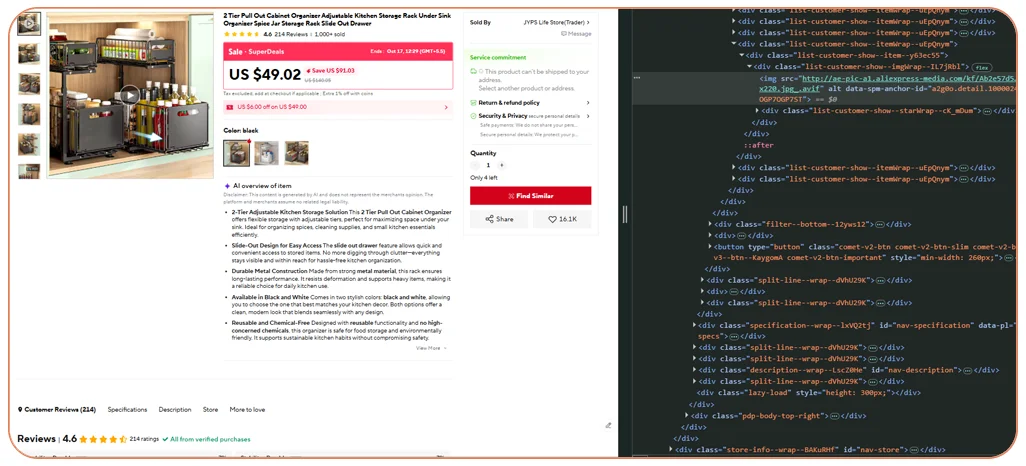
Seller intelligence helps eCommerce businesses evaluate marketplace sellers using consistent, observable information. AliExpress seller data collection services can organize available seller attributes into a structured dataset that supports supplier discovery, competitor evaluation, and sourcing decisions.
Depending on permitted access and available fields, useful attributes may include seller identifiers, storefront names, product counts, ratings, review indicators, shipping information, and seller-associated listings. These attributes should be collected with their source references and timestamps so analysts can distinguish current observations from older records.
What should a seller evaluation framework include?
| Evaluation factor | What to examine | Why it matters |
|---|---|---|
| Seller rating | Displayed rating and its context | Provides one indicator of customer feedback |
| Review volume | Available review count | Adds context to rating interpretation |
| Product assortment | Range of relevant listings | Helps assess catalog breadth |
| Price consistency | Prices across comparable listings | Identifies unusual differences |
| Shipping information | Available delivery estimates and terms | Supports fulfillment evaluation |
| Listing stability | Observed availability over time | Helps identify changing listings |
A seller scoring model can combine these factors, but the weights should reflect business priorities. A dropshipping business may prioritize shipping information and listing stability, while a wholesale sourcing team may emphasize assortment, supplier communication, and product specifications.
How can teams reduce sourcing risks?
Analysts should avoid treating ratings as guarantees of quality. Reviews may be incomplete, product listings can change, and sellers may offer different variants or fulfillment arrangements. Verification should therefore include product samples, supplier communication, shipping terms, and applicable compliance requirements.
The resulting seller intelligence dataset can help teams shortlist suppliers more systematically, document why a seller was selected, and identify listings requiring additional review. It should support human judgment rather than replace due diligence or guarantee supplier performance.
How Can Automated Extraction Improve Data Operations?
An AliExpress Scraper is a collection tool designed to retrieve accessible marketplace information and organize it into structured records. Depending on the implementation, it may use an authorized API, permitted page extraction, or another approved data access method.
For business teams, the important consideration is not simply how many records a tool can collect. The real value comes from collecting the correct fields, matching products consistently, handling failures, and delivering data in a format that downstream systems can use.
What should a reliable extraction workflow include?
- Source discovery: Identify relevant product categories, listings, and permitted data sources.
- Field mapping: Define the required attributes and their expected formats.
- Extraction: Retrieve available information using the approved collection method.
- Normalization: Standardize prices, currencies, text, identifiers, and category labels.
- Validation: Check for missing fields, duplicate records, and implausible values.
- Delivery: Export validated records to databases, spreadsheets, or analytics systems.
- Monitoring: Track failures, schema changes, and data freshness.
Which operational metrics are useful?
| KPI | Measurement |
|---|---|
| Extraction success rate | Successful records or requests divided by attempts |
| Required-field completeness | Records containing required fields divided by total records |
| Duplicate rate | Duplicate records divided by total records |
| Data freshness | Time since the latest successful collection |
| Processing time | Time from collection to validated output |
These metrics should be measured against a baseline established during a pilot. There is no universal success rate because outcomes depend on source structure, access conditions, product scope, and validation requirements.
A production workflow should also include controlled request rates, secure credential management, retry limits, logging, and clear error handling. Collection should respect applicable terms, access controls, privacy obligations, and intellectual property requirements. This makes the system easier to maintain as business needs and source structures evolve.
How Can Product-Level Data Support Better Decisions?
Aliexpress Product Data Scraping can help businesses organize product information across large catalogs when the data is accessible through permitted methods. Rather than relying on isolated listing snapshots, companies can build a repeatable record of product attributes, observed prices, category assignments, and listing changes.
The first step is defining the business question. A retailer evaluating a new category may need product specifications, price ranges, and competitor assortment. A dropshipper may focus on variant availability, shipping information, and seller indicators. A market analyst may require historical observations to study changes in listing prices or product composition.
How should the data be structured?
A practical product record can contain:
- A stable product identifier or matching key.
- The original title and a normalized product name.
- Category, brand, and specifications when available.
- Price, currency, and variant information.
- Seller reference and listing availability indicators.
- Source URL and collection timestamp.
- Validation status and relevant data-quality notes.
Maintaining original values alongside normalized fields helps preserve traceability. For instance, converting currencies for reporting should not overwrite the original listed amount or its currency.
What business insights can this enable?
Product-level datasets can reveal gaps in a retailer's assortment, identify products with changing advertised prices, and support comparisons between similar listings. Historical snapshots can also help analysts separate short-term fluctuations from recurring patterns, provided collection frequency and coverage are sufficient.
However, listing information is not the same as verified sales volume, actual inventory, or customer demand. Those measures require suitable supporting data. A well-designed workflow clearly distinguishes directly observed attributes from derived metrics and business estimates.
The result is a more dependable foundation for category planning, sourcing research, competitive benchmarking, and product portfolio decisions.
Why Choose Real Data API?
Real Data API can be positioned around the practical needs of businesses that require structured marketplace information rather than disconnected product records. A successful data collection project begins with clear business objectives, a defined schema, and realistic expectations for source coverage and update frequency.
- Business-focused data design: Define collection fields around product research, competitor monitoring, seller assessment, and reporting needs.
- Flexible integration: Prepare structured outputs for spreadsheets, databases, dashboards, and existing business applications.
- Quality assurance: Use normalization, duplicate detection, validation rules, and exception reporting to improve dataset consistency.
- Monitoring and maintenance: Track collection failures, source changes, and data freshness to support dependable workflows.
- Scalable implementation: Begin with a focused category or pilot and expand only after evaluating coverage, quality, and operational costs.
Businesses with mobile-specific research requirements may also investigate AliExpress Mobile App Scraping, where the necessary data is accessible and collection is authorized. Mobile and desktop experiences can differ, so any comparison should document the source environment and avoid assuming that the same fields are always available.
The best implementation is one that fits the client's technical environment, respects platform restrictions, and produces measurable value. Before deployment, teams should agree on required fields, delivery formats, refresh schedules, quality thresholds, and acceptance criteria. This creates a clear basis for evaluating performance and deciding whether the workflow should expand.
Conclusion
Automated marketplace data collection helps eCommerce businesses monitor products, compare competitors, evaluate sellers, and make informed pricing decisions. When structured carefully, AliExpress API integration for automated data collection connects product information with repeatable research and reporting workflows. The right solution combines permitted source access, consistent extraction, reliable validation, and practical analytics rather than simply collecting large volumes of information.
Real Data API can help businesses explore tailored data workflows aligned with their catalog, monitoring, and reporting requirements. Start with a focused pilot, define measurable KPIs, and validate data quality before scaling.
Ready to improve your marketplace intelligence? Contact Real Data API to discuss your requirements and build a data collection solution tailored to your business goals.
FAQs
1. What is AliExpress API integration?
AliExpress API integration for automated data collection connects accessible marketplace information with business systems, helping teams organize product listings, prices, and other available attributes for analysis and reporting.
2. Can businesses collect competitor pricing information?
AliExpress Web Scraping Services can support permitted collection of publicly accessible listing information, helping businesses compare equivalent products, identify price changes, and evaluate competitive positioning across relevant categories.
3. How often should product data be updated?
An AliExpress Scraper can run on an agreed schedule, depending on source access, platform restrictions, and business needs. Frequent collection does not guarantee immediate updates or complete coverage.
4. Which seller attributes are useful?
AliExpress seller data collection services can organize available ratings, review counts, storefront details, and product listings to support supplier comparisons. These indicators complement independent quality and compliance checks.
5. How can Real Data API support implementation?
Real Data API can help define data fields, delivery formats, and validation requirements. A pilot using Aliexpress Product Data Scraping can assess feasibility, completeness, and usefulness before expansion.
Latest posts
E-commerce data scraper for inventory analysis 2027 - Real-Time Stock Tracking and Demand Forecasting

How Meesho API data extraction for product research Helps E-Commerce Brands Improve Product Selection and Market Intelligence?
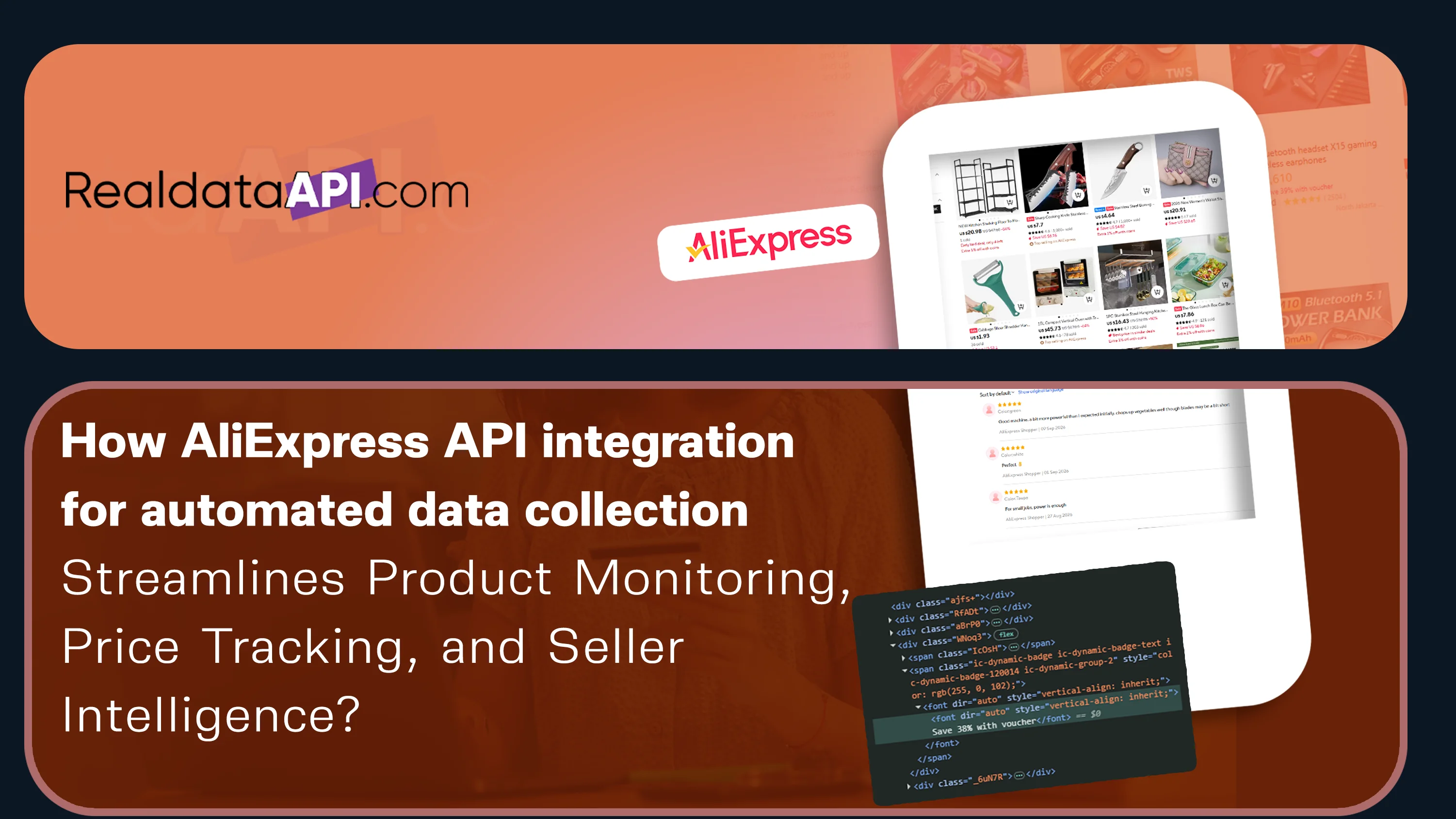
How AliExpress API integration for automated data collection Streamlines Product Monitoring, Price Tracking, and Seller Intelligence
How H&M data scraping for fashion retail analytics Enhances Stock Monitoring, Apparel Pricing, and Product Category Insights







.png)