Quick Summary
- Meesho API data extraction for product research helps e-commerce brands organize product, pricing, seller, rating, and availability information to make faster product-selection decisions.
- Meesho Product Data Scraping supports structured marketplace intelligence, enabling teams to compare catalogs, identify pricing movements, study competitors, and discover emerging product opportunities.
- The approach is particularly useful for brands targeting India's rapidly expanding value-commerce and non-metro shopper segments.
Introduction
Meesho API data extraction for product research helps e-commerce brands answer a critical question: Which products should we sell, at what price, and how can we differentiate them? By turning marketplace information into structured datasets, businesses can evaluate product demand signals, pricing patterns, seller activity, ratings, reviews, and catalog characteristics without depending entirely on manual research.
The need for this intelligence is increasing as India's e-commerce market expands. India had more than 270 million online shoppers in 2024, while the e-retail market was valued at about $60 billion and is projected to reach $170–190 billion in GMV by 2030. India Brand Equity Foundation Meesho is particularly relevant to product researchers because its shopper base is heavily concentrated beyond India's largest metros. In FY25, Meesho reported 198.77 million annual transacting users, including 174.43 million from outside the top eight cities. The Economic Times
For brands, this creates an opportunity to study products that appeal to value-conscious consumers and smaller-city markets. Instead of treating marketplace research as a one-time exercise, companies can create repeatable datasets that reveal changes in assortment, pricing, seller activity, and product positioning.
How can brands improve pricing visibility across marketplace categories?
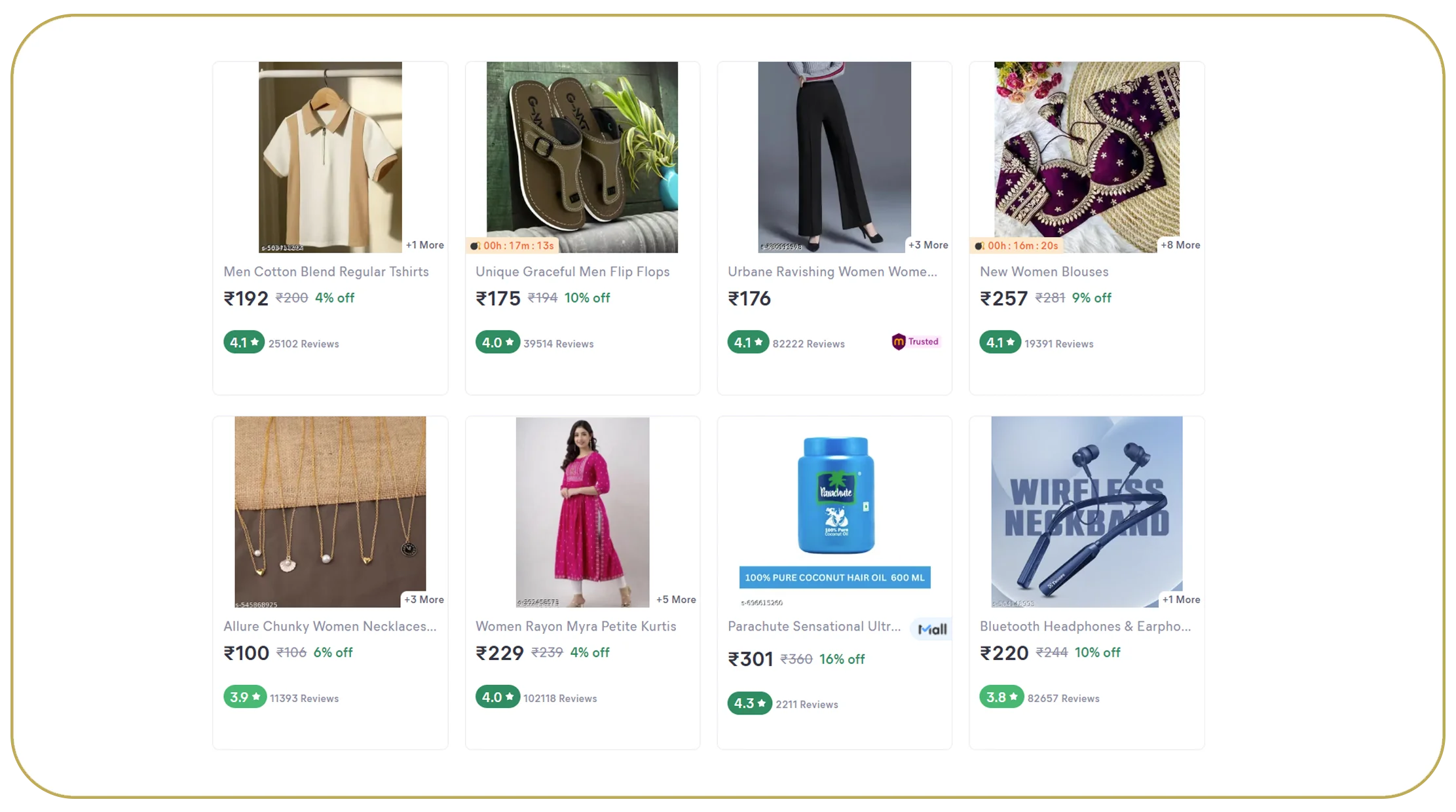
Meesho price monitoring for e-commerce businesses enables brands to continuously examine listed prices, discounts, product variants, sellers, and category-level price movements. The objective is not simply to record the lowest price. It is to understand how pricing changes across products, sellers, brands, pack sizes, and time periods.
For a product research team, a structured dataset can answer questions such as:
- What is the prevailing price range for a category?
- Which products repeatedly receive discounts?
- Which sellers compete at similar price points?
- How frequently do prices change?
- Which products combine high ratings with competitive pricing?
- Where are there gaps in the current price range?
This information can improve assortment planning. For example, if a category contains many products between ₹299 and ₹399 but relatively few products around ₹499 with stronger specifications, that gap could indicate an opportunity for differentiated positioning.
India's broader e-commerce growth makes this type of analysis increasingly important. The market was estimated at $125 billion in 2024 and is projected to reach $345 billion by 2030. India Brand Equity Foundation
Market growth context
| Year | India e-commerce market / indicator | Source |
|---|---|---|
| 2020 | COVID accelerated online shopping adoption | IBEF |
| 2021 | Leading 10 shopping apps averaged >7M DAUs in Q2 | IBEF |
| 2022 | India e-commerce market around $84B | IBEF |
| 2024 | E-commerce market around $125B | IBEF |
| 2025 | Online shopper base nearly 290–300M | IBEF |
| 2030 | Market projected around $345B | IBEF |
Sources: IBEF industry reports and market updates. India Brand Equity Foundation
2020-2026 perspective
Between 2020 and 2026, Indian e-commerce moved from pandemic-led adoption toward a much broader, data-intensive marketplace environment. In Q4 2020, Indian e-commerce order volume increased 36% year over year, while Tier-II and Tier-III cities accounted for 90% incremental volume and value growth in the cited report. India Brand Equity Foundation By 2024, India had more than 270 million online shoppers, and by 2025 the online shopper base was estimated at nearly 290–300 million. India Brand Equity Foundation For product teams, this progression means that historical price observations alone are insufficient. Brands need recurring data to distinguish temporary promotions from persistent market pricing. A structured monitoring process can therefore support category entry, price-band analysis, discount benchmarking, and product positioning decisions.
How can businesses identify price changes before they affect product strategy?
real-time Meesho product price tracking gives e-commerce teams a way to monitor pricing changes at shorter intervals and identify meaningful movements rather than relying on occasional manual checks.
Real-time or near-real-time monitoring becomes particularly useful for products with frequent promotions. A product can move from full price to a discounted price and return to its previous level within a short period. If a researcher captures only one observation, the resulting analysis may incorrectly represent the market.
A better approach is to collect:
- Product title and URL
- Current selling price
- Original or crossed-out price
- Discount percentage
- Product category
- Seller information
- Ratings and review counts
- Availability status
- Product variants
- Timestamp of collection
This creates a historical price series. Analysts can then calculate minimum, maximum, average, and median observed prices.
Example analytical structure
| Metric | Example use |
|---|---|
| Current price | Understand present market positioning |
| Previous price | Detect price movement |
| Discount % | Measure promotional intensity |
| Median price | Establish normal category positioning |
| Price range | Identify market segments |
| Seller count | Estimate competitive density |
| Rating count | Assess product traction |
| Availability | Identify potential assortment gaps |
These measurements can feed dashboards for category managers, pricing teams, marketplace managers, and product researchers.
2020-2026 perspective
The importance of continuous pricing intelligence has increased alongside marketplace scale. In the 2024 festive season, Indian e-commerce platforms generated approximately £1 trillion in sales, more than 20% higher than the previous year, while Meesho reportedly recorded a 40% increase in orders during the period. India Brand Equity Foundation Such spikes demonstrate why a single monthly snapshot may not capture actual market behavior. Between 2020 and 2026, promotional events, digital adoption, non-metro demand, and expanding online assortments have made pricing more dynamic. For product researchers, historical observations can reveal whether a price reduction is seasonal, event-driven, seller-specific, or part of a longer-term market trend. This helps businesses avoid making product decisions based on temporary marketplace conditions.
How can brands understand what competitors are selling?
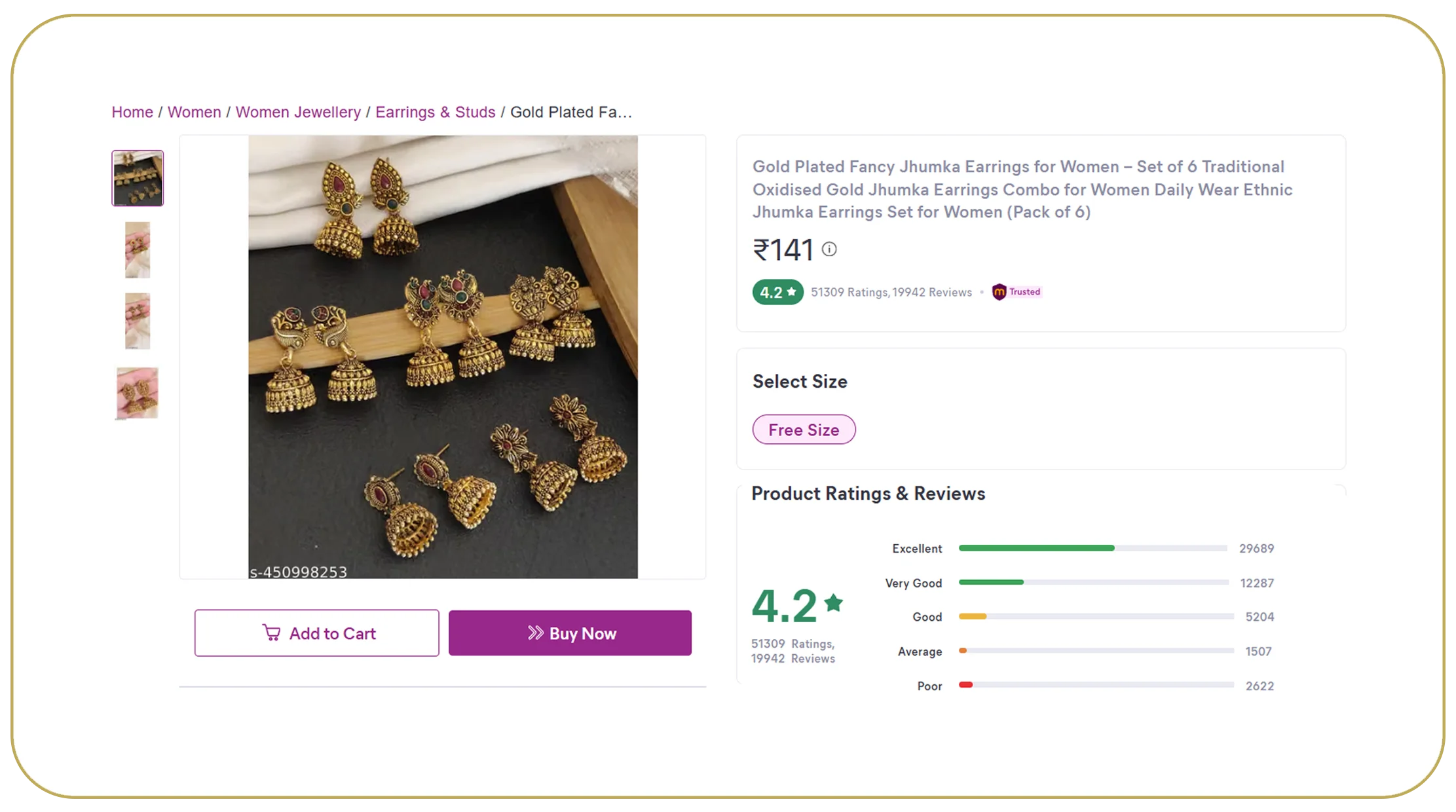
Meesho web scraping for competitor analysis helps businesses transform publicly visible marketplace information into structured competitor datasets for comparison.
Competitor research becomes difficult when product catalogs contain hundreds or thousands of listings. Manually checking every listing can consume substantial time and can introduce inconsistent observations.
A structured collection process can organize competitor information around:
- Product assortment
- Brand and seller
- Product category
- Listed price
- Discount
- Ratings
- Review volume
- Product variants
- Availability
- Product descriptions
- Listing URLs
- Images and specifications where accessible
This allows analysts to construct competitor matrices. For example, a fashion brand can compare product types, price bands, seller density, ratings, and discount behavior across a category.
Competitor analysis framework
| Dimension | Business question |
|---|---|
| Assortment | What products are competitors offering? |
| Price | Where are competitors positioned? |
| Discounts | How aggressively are they promoting products? |
| Ratings | Which listings demonstrate stronger customer response? |
2020-2026 perspective
The competitive environment has expanded substantially as Indian online shopping moved beyond major cities. The share of online shoppers from Tier-II and Tier-III cities increased from 46% in FY20 to 56% in FY24 and is projected to reach 64% by FY30. India Brand Equity Foundation This shift makes competitor research more granular because a product successful in metropolitan markets may not represent demand in smaller cities. Marketplace data can help brands compare products across categories and identify patterns associated with value-oriented shoppers. From 2020 to 2026, the key shift has been from simply asking "What does my competitor sell?" toward "How does the competitor position its complete assortment, price, discount, and customer-facing proposition?" That broader view can support better product selection and market-entry decisions.
How can structured APIs improve marketplace data workflows?
A Meesho pricing data API can provide an organized pathway for delivering pricing information into analytics environments, subject to the availability and permitted use of the relevant data interface.
For product researchers, an API-oriented workflow can reduce repetitive data handling. Instead of manually downloading information and cleaning it every time, businesses can build pipelines that standardize fields and feed them into databases, spreadsheets, BI dashboards, or internal applications.
A useful workflow includes:
Data collection → validation → normalization → storage → analysis → reporting
Important validation rules can identify missing prices, duplicate listings, unexpected field changes, invalid URLs, or inconsistent category values.
Example data architecture
| Layer | Purpose |
|---|---|
| Collection | Gather permitted marketplace information |
| Validation | Check completeness and consistency |
| Normalization | Standardize prices, categories, sellers |
| Storage | Maintain historical records |
| Analytics | Calculate trends and benchmarks |
| Dashboard | Deliver actionable insights |
2020-2026 perspective
The broader retail industry has increasingly adopted data and AI to improve decision-making. IBEF reports that 48% of Indian businesses had already initiated GenAI proof-of-concept projects, while another 32% were planning investments or had allocated budgets for AI adoption. India Brand Equity Foundation This illustrates the movement toward technology-assisted decision-making. Between 2020 and 2026, product research has increasingly shifted from spreadsheets based on occasional observations toward automated, repeatable pipelines. For marketplace teams, structured interfaces and APIs can become valuable components of this architecture when legally and technically available. The objective is not simply to collect more records, but to create reliable datasets that can be refreshed, validated, and connected with business intelligence systems.
How can an API support better product intelligence?
A Meesho API can serve as an integration layer between marketplace information and a company's internal research or analytics environment, where an authorized interface is available.
For product teams, the main benefit of an API-driven approach is workflow consistency. Product information can be mapped into a predefined schema, allowing analysts to compare records over time instead of repeatedly creating new spreadsheets.
A product intelligence schema could contain:
| Data field | Product research application |
|---|---|
| Product ID | Unique product identification |
| Product name | Catalog comparison |
| Category | Category-level analysis |
| Seller | Seller benchmarking |
| Price | Price positioning |
| Discount | Promotion analysis |
| Rating | Customer response |
| Reviews | Engagement signal |
| Availability | Stock visibility |
| URL | Listing reference |
| Timestamp | Historical tracking |
The same structure can support dashboards, alerts, research reports, pricing analysis, and category intelligence.
2020-2026 perspective
India's online retail ecosystem has grown from a pandemic-accelerated channel into a large and increasingly sophisticated consumer market. In 2021, Meesho alone contributed more than 12 million shopping-app downloads in July, according to data cited by IBEF. India Brand Equity Foundation By FY25, Meesho reported nearly 199 million annual transacting users, demonstrating the scale of the marketplace. The Economic Times As marketplace scale increases, manual product research becomes progressively harder to maintain. Between 2020 and 2026, the practical requirement has therefore evolved toward structured data pipelines that can accommodate large catalogs, repeated observations, historical comparisons, and downstream analytics. For businesses, the value comes from converting marketplace signals into a consistent research asset rather than treating each research project as a standalone exercise.
How can automated scraping support scalable product research?
A Meesho Scraper can automate the collection and structuring of permitted marketplace information at scale. This can be useful when research teams need to monitor many categories, products, sellers, or price points repeatedly.
The key advantage is repeatability. A well-designed workflow can follow predefined collection rules, capture required fields, validate results, and deliver standardized datasets.
For example, a product research project might track 10,000 listings across 20 categories. Instead of asking analysts to manually record every listing, an automated process can organize the information into a consistent schema.
Scalable research workflow
| Stage | Output |
|---|---|
| Define scope | Categories, products, sellers |
| Collect | Marketplace product records |
| Validate | Completeness checks |
| Normalize | Consistent formats |
| Deduplicate | Cleaner product universe |
| Store | Historical dataset |
| Analyze | Pricing and assortment insights |
| Report | Dashboards and research outputs |
Businesses should also establish responsible collection policies, respect applicable laws and platform terms, and avoid collecting unnecessary personal information.
2020-2026 perspective
The scale of Indian e-commerce makes automation increasingly relevant. India's online retail market was approximately $80 billion in FY26 according to IBEF, with 21% year-over-year growth, while the broader market is projected to reach $345 billion by 2030. India Brand Equity Foundation The progression from 2020 through 2026 shows why manual catalog research does not scale efficiently with marketplace expansion. Automation allows teams to move from sporadic snapshots to repeatable monitoring. It can also improve consistency by applying the same collection and validation rules to every product. For e-commerce brands, this creates a foundation for product discovery, competitor benchmarking, price analysis, assortment optimization, and market intelligence.
Want to make smarter product decisions in the competitive e-commerce market? Explore scalable data extraction solutions for smarter e-commerce research.
Get Insights Now!Why Choose Real Data API?
Meesho Data Scraping for Ecommerce Market Intelligence can help brands turn large volumes of marketplace information into structured datasets designed for research and analysis.
A practical data solution should focus on accuracy, scalability, consistency, and usability rather than simply maximizing the number of records collected.
Real Data API can support businesses that need structured marketplace intelligence by helping organize information into analysis-ready formats. Depending on the project requirements and permitted data sources, datasets can be prepared around product attributes, pricing, sellers, ratings, reviews, categories, availability, and historical observations.
Key advantages for product research teams
- Structured datasets: Standardized fields make analysis easier.
- Scalable workflows: Suitable for larger product and category universes.
- Historical monitoring: Repeated collection can support trend analysis.
- Data validation: Helps identify incomplete or inconsistent records.
- Business-ready delivery: Data can be prepared for analytics and reporting workflows.
- Custom scope: Collection can be aligned with specific categories, products, sellers, or research requirements.
For a brand manager, the outcome is a more reliable product intelligence workflow. For a category manager, it can support assortment and price benchmarking. For a market researcher, it can provide structured evidence for identifying emerging patterns.
Conclusion
Meesho API data extraction for product research enables e-commerce brands to move beyond manual marketplace observation and build structured intelligence around products, pricing, competitors, sellers, ratings, and availability.
The opportunity is especially significant as India's online shopper base and e-commerce market continue expanding. Meesho's reported scale, including nearly 199 million annual transacting users in FY25, demonstrates why marketplace product intelligence can no longer depend solely on occasional manual checks. The Economic Times
For businesses, the goal should be actionable intelligence: identify attractive price bands, discover assortment gaps, benchmark competitors, monitor market movements, and use historical data to make better product decisions.
Ready to turn marketplace data into actionable product intelligence? Connect with Real Data API to build a scalable, structured product research data solution tailored to your business needs!
FAQs
1. What is Meesho API data extraction for product research?
Meesho API data extraction for product research collects structured product information such as prices, categories, sellers, ratings, and availability to support product selection and market analysis.
2. How does Meesho Product Data Scraping help e-commerce brands?
Meesho Product Data Scraping helps brands organize product, pricing, seller, rating, and availability information for competitor benchmarking, assortment analysis, and market intelligence.
3. Why is Meesho price monitoring for e-commerce businesses important?
Meesho price monitoring for e-commerce businesses helps teams identify price movements, discount patterns, competitive price ranges, and potential pricing opportunities across marketplace categories.
4. What is real-time Meesho product price tracking?
real-time Meesho product price tracking monitors marketplace pricing changes at frequent intervals, helping businesses detect promotions, price fluctuations, and competitive movements.
5. How does Meesho web scraping for competitor analysis work?
Meesho web scraping for competitor analysis organizes permitted marketplace information into comparable datasets covering products, sellers, prices, ratings, discounts, and availability. Real Data API can support structured workflows.
Latest posts
E-commerce data scraper for inventory analysis 2027 - Real-Time Stock Tracking and Demand Forecasting

How Meesho API data extraction for product research Helps E-Commerce Brands Improve Product Selection and Market Intelligence?
How AliExpress API integration for automated data collection Streamlines Product Monitoring, Price Tracking, and Seller Intelligence
How H&M data scraping for fashion retail analytics Enhances Stock Monitoring, Apparel Pricing, and Product Category Insights






.png)