Quick Summary
- H&M data scraping for fashion retail analytics helps retailers organize product listings, monitor displayed prices, analyze category trends, and track available stock indicators.
- Scrape H&M store locations to structure accessible store information for regional retail analysis, location planning, and market coverage assessments.
- Automated data workflows turn fragmented fashion retail information into structured datasets, supporting competitor benchmarking, assortment planning, discount analysis, and more informed merchandising decisions.
Introduction
H&M data scraping for fashion retail analytics helps fashion retailers, eCommerce businesses, market researchers, and merchandising teams transform accessible product and retail information into actionable insights. By collecting product names, categories, listed prices, sizes, colors, and displayed availability where permitted, businesses can analyze apparel assortments, evaluate price positioning, and identify changes in product listings. This structured approach reduces repetitive manual research and supports more consistent reporting across fashion categories.
Retail intelligence can extend beyond online products to physical store information. Businesses that Scrape H&M store locations can organize publicly accessible store addresses, location details, and other available attributes to support geographical analysis and retail planning. The resulting datasets can help teams understand market coverage, compare regional assortments where information is available, and evaluate potential opportunities for expansion.
For fashion retailers, the primary benefit is a clearer view of changing market conditions. A well-designed collection workflow combines responsible data access, reliable validation, historical observations, and useful reporting to support decisions about pricing, product selection, and inventory planning.
How Can Category-Level Insights Improve Fashion Assortment Planning?
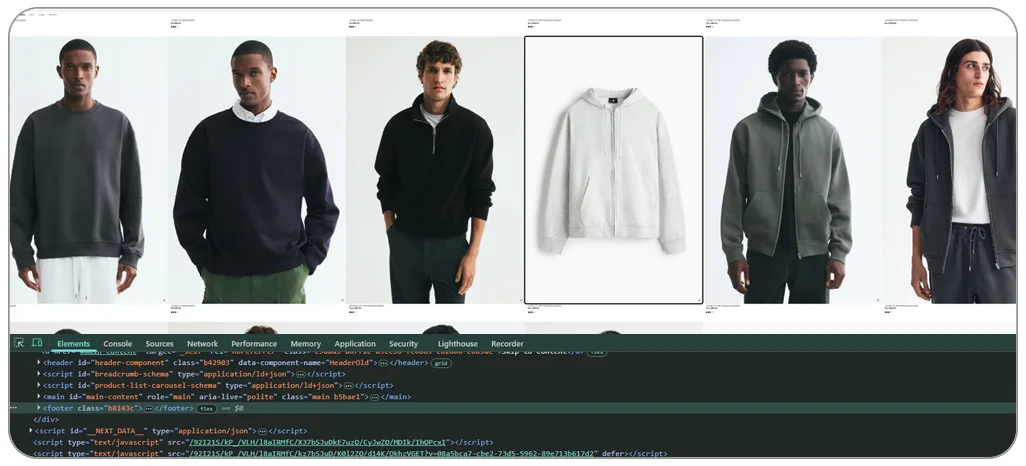
Fashion retailers need to understand which categories offer opportunities for differentiation, competitive pricing, and better assortment planning. H&M product category scraping helps organize available product listings into categories such as dresses, denim, knitwear, shirts, outerwear, activewear, and accessories. Analysts can then compare category breadth, product attributes, displayed prices, and assortment changes over time.
For example, a retailer comparing denim products could group listings by fit, color, waist style, and price band. This creates a more meaningful comparison than simply counting product pages. Similarly, tracking dresses by occasion, length, and material can reveal how assortment structures differ across seasonal collections.
What does the market data show?
Global apparel eCommerce revenue provides context for the importance of online assortment analysis. The figures below are modeled estimates published by Statista, not H&M-specific revenue or scraping results.
| Year | Global apparel eCommerce revenue |
|---|---|
| 2020 | $462.08 billion |
| 2021 | $560.86 billion |
| 2022 | $535.47 billion |
| 2023 | $529.99 billion |
| 2024 | $589.38 billion |
| 2025 | $662.70 billion |
| 2026 | $691.33 billion |
Source: Statista, worldwide apparel eCommerce revenue series. Figures for 2025 and 2026 are modeled estimates or forecasts, not final audited results.
The figures show that apparel eCommerce revenue does not necessarily rise uniformly every year. Retailers therefore need to interpret category changes alongside seasonality, promotions, and broader market conditions.
H&M data scraping for fashion retail analytics can help organize product-level observations into comparable category datasets. Useful measures include active listing counts, average listed price, category price ranges, size availability, and the proportion of records with complete attributes. Analysts should distinguish unavailable sizes from products that have disappeared from a listing. This distinction improves assortment planning and reduces the risk of treating incomplete observations as genuine demand signals.
Which Product Attributes Matter Most for Competitive Analysis?
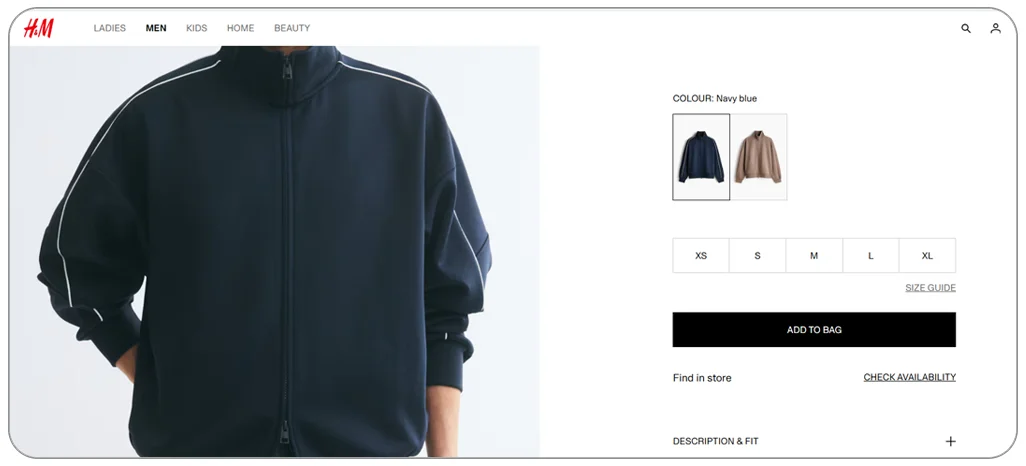
Product-level information helps retailers compare the details that influence merchandising and customer choice. Extract H&M product details through permitted data access methods to build structured records containing product titles, identifiers, categories, descriptions, colors, sizes, material information, listed prices, and displayed availability where accessible.
The most valuable attributes depend on the intended business decision. A pricing team may prioritize the current price, original displayed price, discount information, and currency. A merchandising team may focus on category, color, fit, material, and size range. A product development team may be more interested in recurring design characteristics and differences between collections.
Which fields should a product dataset contain?
| Data field | Analytical purpose |
|---|---|
| Product ID or URL | Helps identify and revisit listings |
| Product title | Supports product matching and catalog organization |
| Category and subcategory | Enables assortment comparisons |
| Current displayed price | Supports price benchmarking |
| Original price, when shown | Helps evaluate displayed markdowns |
| Color and size variants | Enables variant-level availability analysis |
| Material and fit | Supports attribute-based comparisons |
| Collection timestamp | Establishes when the information was observed |
A reliable collection workflow should preserve original product text alongside standardized fields. For example, a color name may be normalized into a common category while the original wording remains available for auditing.
Product matching also requires care. Similar product titles do not prove that two listings represent identical garments. Different materials, cuts, fabrics, or variant identifiers can materially affect comparability. Matching rules should therefore use several attributes rather than product names alone.
For operational reporting, teams can monitor required-field completeness, duplicate rates, and the number of records requiring manual review. These measures provide a clearer view of dataset quality than raw record counts.
The resulting product catalog can help fashion businesses benchmark assortment structures, understand price positioning, and investigate category gaps. It can also feed dashboards and reporting systems, provided the collected information is accurate, appropriately licensed, and refreshed at a suitable frequency.
How Can Discount Tracking Support Better Pricing Decisions?
Fashion discounts can change throughout a season as retailers respond to inventory conditions, campaign schedules, and product lifecycle stages. A structured workflow to scrape H&M fashion discounts can help analysts capture displayed promotional information and compare it across products and observation dates, where permitted.
The first step is to distinguish the current listed price from the original or reference price shown on a product page. A discount should be calculated only when both values are available and comparable. Currency, product variant, and any relevant pricing conditions should also be recorded.
How can discount metrics be calculated?
| Metric | Calculation |
|---|---|
| Absolute markdown | Original displayed price − current displayed price |
| Discount percentage | (Original displayed price − current displayed price) ÷ original displayed price × 100 |
| Price change | Current observed price − previous observed price |
| Discount duration | Time between the first and last observed discounted listings |
| Discount coverage | Discounted eligible listings ÷ eligible listings observed × 100 |
Consider a hypothetical jacket with an original displayed price of €60 and a current displayed price of €45. The observed markdown is €15, equivalent to 25%. This is an illustrative calculation, not a verified H&M promotion.
H&M data scraping for fashion retail analytics can support the creation of historical price observations that reveal when products enter or leave promotional periods. Analysts can use this information to compare markdown patterns across categories and evaluate whether particular price bands experience more frequent promotions.
However, a displayed discount does not automatically demonstrate increased demand, inventory pressure, or a successful campaign. Those conclusions require supporting information such as sales, stock movement, or other relevant business data.
Retailers should also avoid treating the lowest observed price as the ideal price for every product. Pricing decisions need to consider costs, margins, positioning, seasonality, and customer expectations. Historical observations provide context for these decisions, but they should complement rather than replace internal sales and inventory records.
Need a clearer view of fashion promotions and competitor pricing? Contact Real Data API to discuss a tailored collection workflow and define the KPIs most relevant to your retail business.
Get Insights Now!How Can Retail Data Integration Improve Reporting?
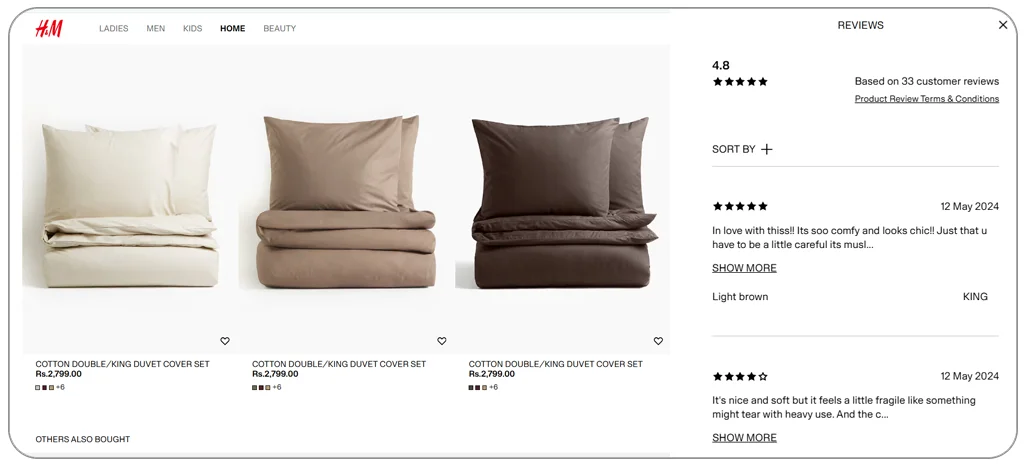
A well-designed H&M fashion data API for retail analytics workflow can connect permitted product information with internal reporting systems, business intelligence tools, and data warehouses. The goal is to make collected information usable across teams rather than leaving it in isolated spreadsheets or disconnected files.
Integration starts with a clearly defined data schema. Each record should have consistent field names, appropriate data types, source identifiers, and timestamps. Prices should retain their original currency, while normalized values can be added separately when conversion is necessary. Product identifiers and URLs can help connect observations from different collection runs.
What should an integration workflow include?
- Collection layer: Retrieve accessible product information using authorized interfaces or other permitted methods.
- Transformation layer: Normalize categories, product attributes, prices, and variant information.
- Validation layer: Check missing values, duplicate records, and unexpected changes in field formats.
- Storage layer: Maintain current records and historical observations where retention is permitted.
- Analytics layer: Deliver validated information to dashboards, reports, or internal applications.
- Monitoring layer: Track collection failures, update delays, and schema changes.
A practical example is a retailer dashboard that displays the latest observed product prices alongside historical observations. Merchandising teams can filter results by category, price range, color, or availability indicator, depending on the data collected.
Integration should also distinguish between an observation and a business outcome. A product marked unavailable on a website does not necessarily mean that all inventory is exhausted across every store or channel. Similarly, a changed listing price does not establish why the change occurred.
Before deployment, businesses should define acceptable update delays, mandatory fields, quality thresholds, and recovery procedures. These requirements make the integration easier to test and maintain.
A pilot involving a limited number of product categories can reveal whether the chosen source provides sufficient coverage and whether the output supports actual reporting needs. Once validated, the workflow can be expanded in stages, subject to access conditions and operational costs.
How Can Continuous Monitoring Reveal Product Changes?
H&M Fashion Data Scraping can support ongoing observation of publicly accessible product listings, allowing retail analysts to compare current records with earlier snapshots. Rather than treating each collection as a separate file, a well-managed process maintains consistent identifiers and records when individual attributes were observed.
For example, a product may remain listed while its price changes, a size becomes unavailable, or its description is updated. Comparing successive observations can help analysts detect these events and investigate whether they affect merchandising decisions.
Which changes should trigger attention?
| Observed change | Potential business use |
|---|---|
| Price increases or decreases | Review competitor positioning |
| New product listing | Identify assortment additions |
| Listing no longer found | Investigate possible removal or source changes |
| Size availability changes | Review displayed variant availability |
| Category assignment changes | Maintain consistent product classification |
| Product description changes | Track alterations to displayed attributes |
These observations require cautious interpretation. A listing that cannot be collected may reflect a temporary technical issue, a page redesign, or access restrictions rather than a genuine product removal. Change detection should therefore distinguish confirmed differences from collection failures.
H&M data scraping for fashion retail analytics can also support historical comparisons across product categories and reporting periods. Useful KPIs include the percentage of records successfully refreshed, the proportion of products with complete required fields, the number of detected changes, and the average time needed to identify a collection issue.
Retail teams should select refresh schedules according to the speed of the business decision. Frequently changing prices may warrant more regular checks than relatively stable descriptive attributes. However, collection frequency must remain consistent with applicable platform rules and technical limits.
The strongest monitoring workflow includes exception alerts, source timestamps, retry handling, and an audit trail. These safeguards help analysts understand whether a reported change reflects the source, the extraction process, or a transformation rule.
By separating observed events from assumptions, businesses can use product monitoring to support assortment reviews, promotional analysis, and competitive reporting without overstating what online listing data can prove.
How Can Fashion Data Turn Into Actionable Retail Intelligence?
Fashion Data Scraping helps retailers organize accessible information from product listings and other permitted sources into datasets designed for analysis. The business value comes from connecting product-level observations with specific decisions, such as evaluating price positioning, reviewing category coverage, and prioritizing products for further research.
A useful dataset should include source identifiers, collection timestamps, standardized categories, listed prices, available product attributes, and validation indicators. Where historical analysis is required, previous observations can be retained according to agreed data retention policies. This makes it possible to compare records across collection periods instead of relying exclusively on the latest snapshot.
How should teams turn collected data into insights?
- Define the decision: Identify whether the objective is price benchmarking, assortment planning, promotional research, or availability monitoring.
- Select relevant attributes: Collect only the fields needed to support the intended analysis.
- Establish a baseline: Record initial coverage, data quality, and reporting turnaround time.
- Create comparison rules: Match products carefully and distinguish equivalent variants from similar but different items.
- Measure changes: Compare historical observations and flag meaningful differences.
- Validate conclusions: Use internal sales, inventory, and margin data where necessary before making business decisions.
Which KPIs should be measured?
| KPI | What it reveals |
|---|---|
| Product coverage | How many relevant listings are represented |
| Attribute completeness | Whether essential fields are available |
| Price observation frequency | How regularly prices are captured |
| Change detection accuracy | Whether reported changes are genuine |
| Category coverage | Whether the dataset represents target assortments |
| Reporting turnaround | How quickly teams can produce useful analysis |
These KPIs should be evaluated against project-specific targets rather than unsupported industry benchmarks. For example, a pilot could measure whether automated reporting reduces manual preparation time compared with the team's existing process.
The dataset can also support segmentation by product type, price band, or season, provided the relevant attributes are available. It should not be treated as direct evidence of sales, consumer demand, or actual inventory levels unless those measures are independently verified.
Ultimately, actionable retail intelligence depends on accurate collection, sensible comparison rules, transparent limitations, and clear business ownership of the resulting insights.
Why Choose Real Data API?
Fashion retail data projects require more than collecting product pages. They need a reliable process for turning accessible information into consistent records that analysts can use across research, merchandising, and reporting workflows.
Real Data API can help businesses plan a solution around their target categories, required product attributes, data delivery preferences, and monitoring objectives.
- Flexible data requirements: Define the product fields, category structures, and pricing attributes needed for your business.
- Structured data delivery: Organize validated records for spreadsheets, databases, dashboards, and analytics applications.
- Data quality management: Apply normalization, duplicate detection, validation checks, and exception handling.
- Historical analysis: Maintain suitable time-stamped observations to support price comparisons and product change tracking.
- Scalable implementation: Begin with a focused pilot and expand after reviewing data coverage, quality, and operational feasibility.
- Business-focused support: Align collection workflows with specific decisions, such as competitor benchmarking, assortment analysis, and promotional monitoring.
How can customized datasets help?
Fashion Datasets can be structured around a retailer's specific objectives instead of relying on a generic collection of product fields. A pricing team may need current and previous listed prices, while a merchandising team may prioritize categories, colors, materials, and available sizes.
Before implementation, businesses should confirm the permitted source access method, required fields, update frequency, retention rules, and expected output format. A pilot can then establish a measurable baseline for completeness, freshness, and reporting efficiency.
This approach gives retailers a clearer way to assess whether automated data collection supports their commercial objectives and whether a larger implementation is justified.
Conclusion
Fashion retailers can make better-informed decisions when product listings, pricing observations, and category information are organized into reliable datasets. H&M data scraping for fashion retail analytics provides a practical framework for studying displayed prices, tracking listing changes, comparing apparel categories, and supporting merchandising research. The greatest value comes from combining structured collection with validation, historical comparisons, and clearly defined performance indicators. Businesses should begin with a focused pilot, assess data quality, and expand only when the workflow demonstrates measurable value. Real Data API can help you plan a tailored data collection solution aligned with your retail goals.
Ready to improve your fashion retail intelligence? Contact Real Data API to discuss your requirements and build a data-driven strategy for product monitoring, pricing analysis, and assortment planning.
FAQs
1. What is fashion retail data scraping?
H&M data scraping for fashion retail analytics organizes accessible product information into structured records, helping retailers analyze prices, categories, displayed availability, and changes across product listings.
2. Can store locations support regional analysis?
Businesses can Scrape H&M store locations using permitted sources to organize addresses and available location details for regional market coverage assessments, store mapping, and retail planning.
3. How does category analysis help retailers?
H&M product category scraping helps teams compare apparel assortments, identify category gaps, evaluate product attributes, and understand how listed prices differ across clothing segments and collections.
4. Which product details can be collected?
Extract H&M product details such as titles, identifiers, categories, colors, sizes, materials, and listed prices where available, then validate records before using them for competitive analysis.
5. How can Real Data API help?
Real Data API can help structure Fashion Datasets for pricing research, assortment analysis, and monitoring, with defined fields, validation rules, and reporting formats tailored to business requirements.
Latest posts
E-commerce data scraper for inventory analysis 2027 - Real-Time Stock Tracking and Demand Forecasting
How Meesho API data extraction for product research Helps E-Commerce Brands Improve Product Selection and Market Intelligence?
How AliExpress API integration for automated data collection Streamlines Product Monitoring, Price Tracking, and Seller Intelligence
How H&M data scraping for fashion retail analytics Enhances Stock Monitoring, Apparel Pricing, and Product Category Insights







.png)