
Introduction: One Platform, Thousands of Different Storefronts
Most people think of Amazon as a single marketplace. One website. One set of prices. One product catalogue.
That assumption is costing businesses millions of dollars in missed intelligence.
Amazon is, in reality, a hyper-local commerce engine. What a shopper in Austin, Texas sees when they search for "wireless earbuds under $50" is meaningfully different from what a shopper in Boston, Massachusetts or rural Montana sees — in terms of price, availability, Prime delivery eligibility, seller ranking, and even which products appear at all. These differences are driven by Amazon's ZIP code-level personalization engine, which factors in fulfillment center proximity, regional demand patterns, seller inventory locations, local tax structures, and delivery cost economics.
For businesses that rely on Amazon market intelligence — CPG brands, third-party sellers, pricing analysts, retail consultants, and e-commerce strategists — collecting product data at the ZIP code level is no longer an advanced capability. It is a baseline requirement for accuracy.
This blog breaks down what ZIP code-level Amazon API for Product Pricing and Inventory Analysis means, which data points vary by location, the most impactful use cases across industries, the technical challenges involved, and how Real Data API powers this kind of hyper-local intelligence at scale.
Why ZIP Code Matters on Amazon: The Localization Engine Explained
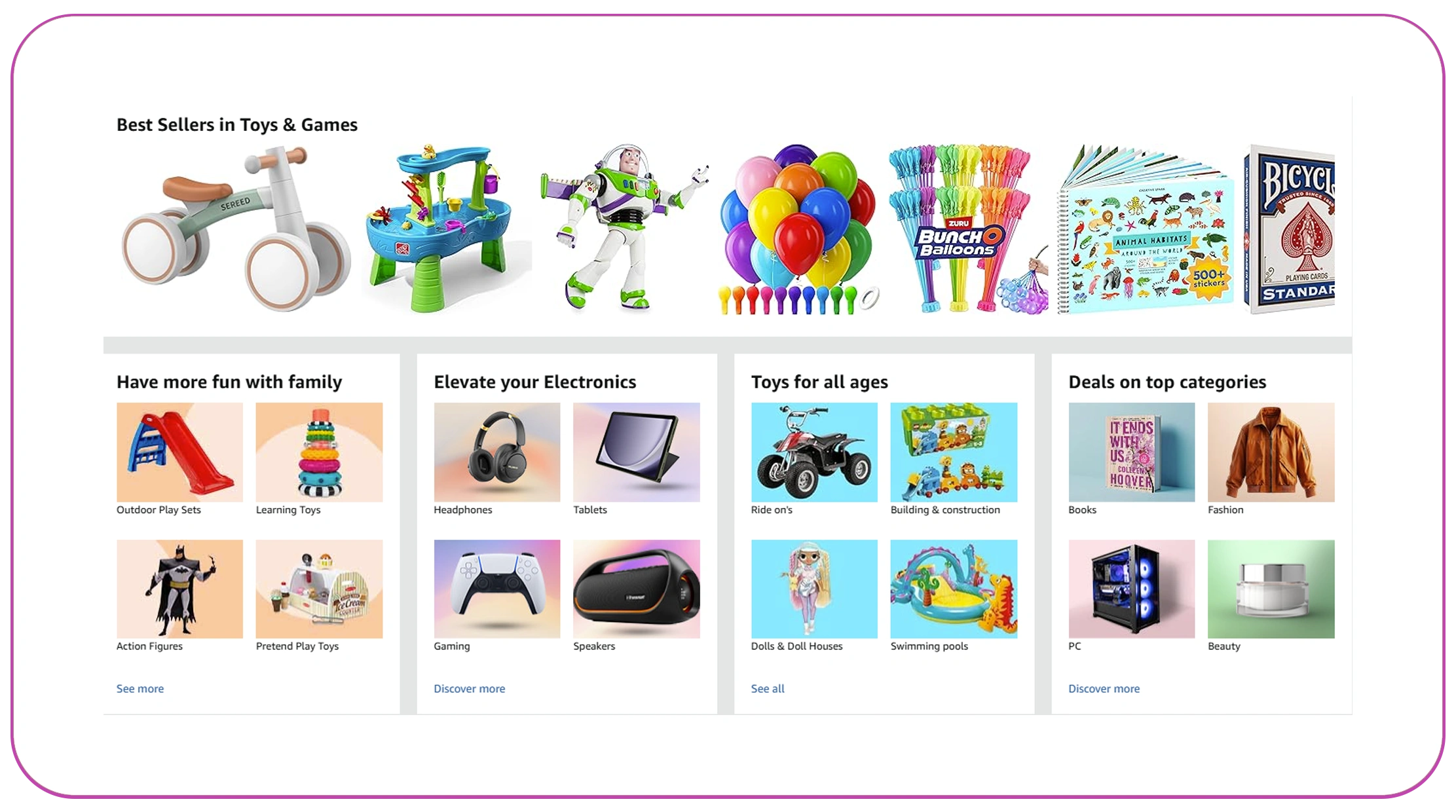
Amazon's localization isn't incidental — it's architectural. The platform has been built from the ground up to serve different experiences to different users based on geography. Understanding why this happens is the foundation for understanding why ZIP code-level data collection is so valuable.
Fulfillment Center Geography
Amazon operates over 200 fulfillment centers across the United States. The products stocked in each facility vary based on regional demand data. A customer in New Jersey (served by warehouses in Robbinsville, Carteret, and Staten Island) may see faster delivery windows, higher in-stock rates, and different seller rankings than a customer in Wyoming served by a more distant fulfillment network. Prime delivery speed — one-day, two-day, or standard — is directly tied to ZIP code proximity to stocked inventory.
Price Variation by Location
Amazon Product and Review Datasets prices fluctuate by ZIP code for several documented reasons: competitive price matching based on local retail competition, demand-based dynamic pricing, regional promotions, and tax-inclusive display pricing in jurisdictions where Amazon collects and remits sales tax. A product listed at $29.99 in one ZIP code may display at $31.47 in another once local tax is factored into the displayed price — a distinction that matters enormously for price comparison tools and competitive pricing strategies.
Availability and Delivery Windows
"In Stock" on Amazon is not a global status. A product can be available for next-day delivery in Chicago and only available for 5–8 day delivery in Albuquerque. Some products show as temporarily out of stock in certain ZIP codes while fully available in others. This geographic availability data is invisible unless you query Amazon from multiple ZIP code contexts.
Search Ranking and Sponsored Placement
Amazon Scraping API search algorithm incorporates location signals. A product's organic ranking for a given keyword can differ by ZIP code because relevance scoring partially factors in fulfillment speed — products that can be delivered quickly to the searcher's location get a ranking boost. Sponsored ad inventory also varies geographically. This means that competitive search ranking analysis is inherently incomplete without ZIP code-level sampling.
What Data Varies at the ZIP Code Level
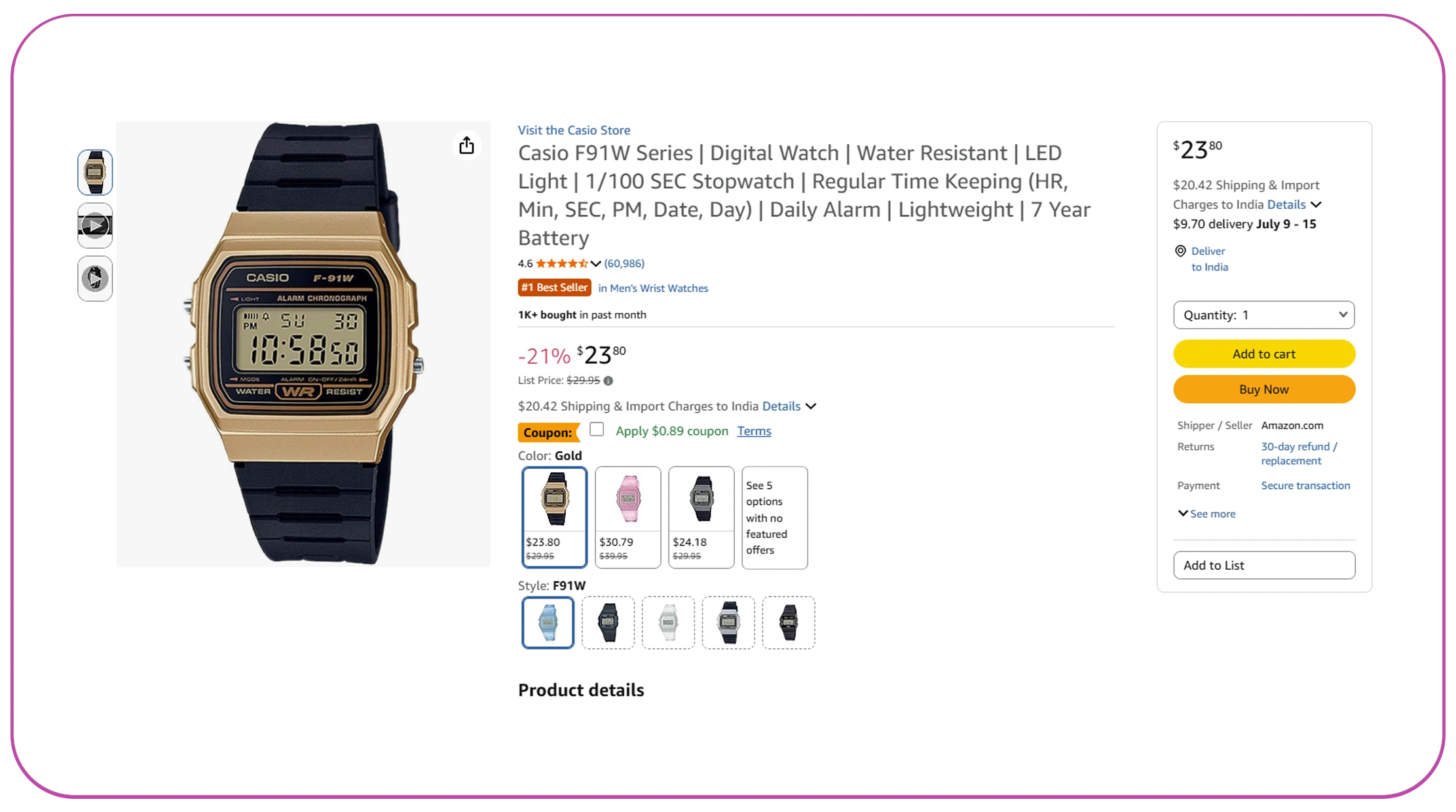
A comprehensive Amazon ZIP code-level data collection framework targets the following fields:
Pricing Data
- Listed price (regular and sale)
- Prime price vs. non-Prime price
- Tax-inclusive displayed price by ZIP code
- Lightning Deal and coupon availability by region
- Subscribe & Save pricing where available
- Price history variations across ZIP codes
Availability and Delivery Data
- In-stock status per ZIP code
- Prime delivery speed (same-day, next-day, two-day, standard)
- Estimated delivery date range
- Fulfillment type (Amazon FBA vs. seller-fulfilled) by location
- Out-of-stock frequency patterns by geography
Search and Ranking Data
- Organic search rank by keyword and ZIP code
- Sponsored product placement position
- "Amazon's Choice" badge presence by location
- Best Seller Rank within category by ZIP code
- Featured offer (Buy Box) winner by location
Seller and Offer Data
- Active seller count per product per ZIP code
- Buy Box winner per location (can vary by region)
- Seller-specific delivery options by geography
- Third-party seller pricing variation by ZIP code
Product Listing Data
- Product title, description, and bullet points
- Images and A+ content
- Review count and average rating (globally consistent, but useful as a baseline)
- Product variations (size, color, pack count)
- Category and subcategory placement
Real-World Use Cases
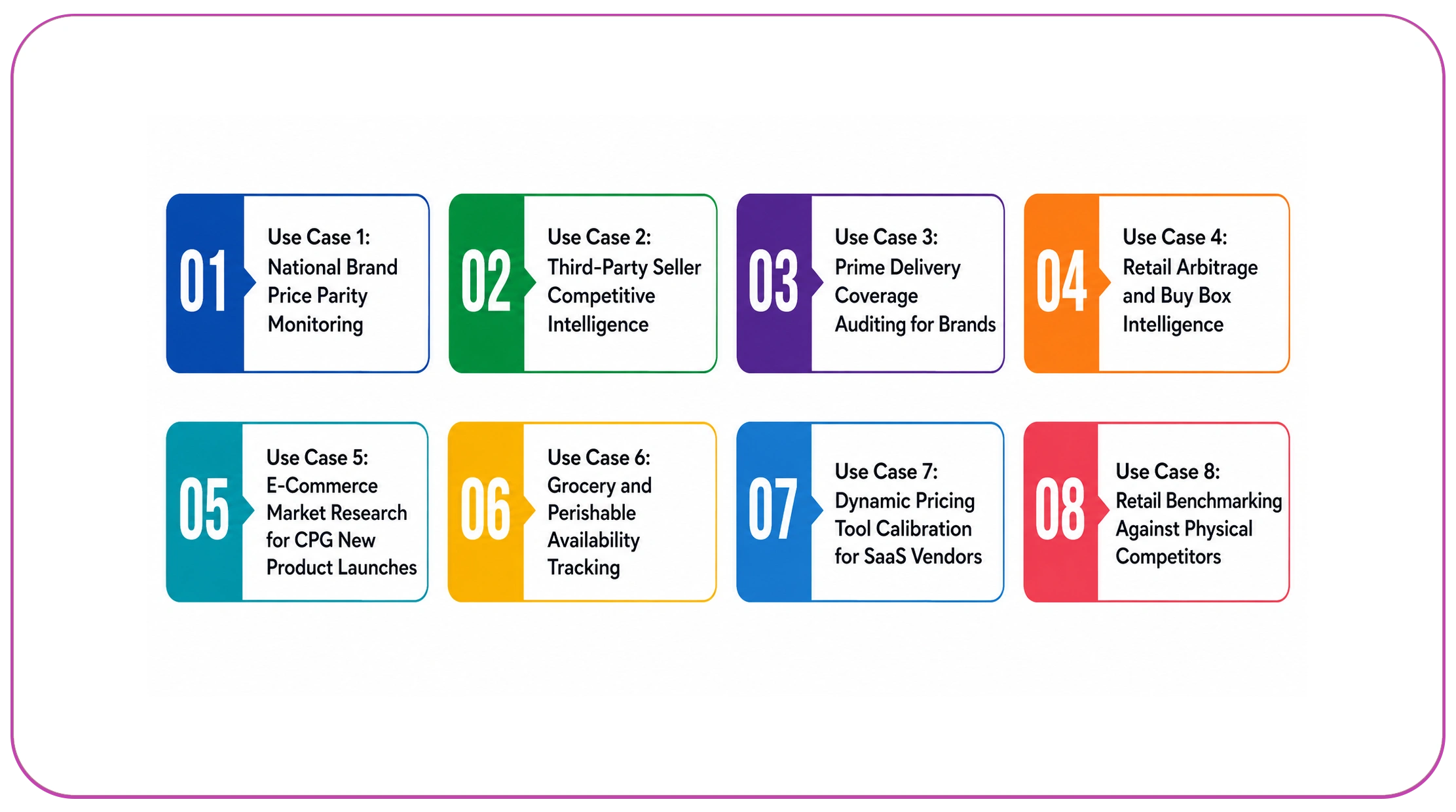
Use Case 1: National Brand Price Parity Monitoring
A leading consumer electronics brand selling through Amazon wants to ensure its products maintain consistent pricing across U.S. markets. Unauthorized third-party sellers sometimes undercut MAP (Minimum Advertised Price) policies in specific regions. By collecting Buy Box pricing data across 50 representative ZIP codes — covering every major metro and several rural markets — the brand's e-commerce compliance team can detect MAP violations at the regional level and take enforcement action before they spread nationally.
Without ZIP code-level data, MAP violations in secondary markets go undetected until they surface in national pricing dashboards — often too late.
Use Case 2: Third-Party Seller Competitive Intelligence
An Amazon third-party seller specializing in home improvement tools uses ZIP code-level data to optimize its dynamic pricing strategy. By tracking competitor prices across key ZIP codes in high-volume markets (New York, Los Angeles, Chicago, Houston, Phoenix), the seller identifies pricing patterns — for example, a competitor systematically dropping prices in Pacific Time Zone markets on Friday afternoons. This intelligence allows the seller to pre-position pricing adjustments before demand peaks, rather than reacting after the fact.
Use Case 3: Prime Delivery Coverage Auditing for Brands
A personal care brand that recently launched on Amazon FBA wants to understand its Prime delivery coverage across the country. By running ZIP code-level availability checks across a representative sample of 200 ZIP codes, the brand's Amazon account team can map exactly which markets have same-day or next-day delivery capability, which are limited to two-day, and which fall into standard delivery windows. This informs inventory placement decisions — requesting that Amazon rebalance stock across fulfillment centers to improve delivery speed in high-priority markets.
Use Case 4: Retail Arbitrage and Buy Box Intelligence
An Amazon reseller managing a diverse private-label catalogue uses ZIP code-level Buy Box data to understand where it wins and loses the featured offer. Buy Box algorithms factor in price, seller rating, fulfillment method, and delivery speed — all of which interact differently across geographies. By tracking Buy Box ownership across key ZIP codes, the seller can identify specific markets where a competitor consistently wins despite a higher price (suggesting fulfillment speed is the decisive factor) and adjust its FBA inventory positioning accordingly.
Use Case 5: E-Commerce Market Research for CPG New Product Launches
A CPG company preparing to launch a new line of functional beverages on Amazon uses ZIP code-level data to conduct pre-launch competitive analysis. By collecting search ranking data for target keywords ("adaptogen drinks," "nootropic beverages," "mushroom coffee") across 30 ZIP codes representing its target consumer demographics, the team identifies which competitors rank differently by region, where category demand is strongest, and which ZIP codes show the highest density of competing sponsored placements — helping to allocate launch advertising budgets by geography.
Use Case 6: Grocery and Perishable Availability Tracking
Amazon Fresh and Amazon Pantry availability varies significantly by ZIP code, with coverage concentrated in major metropolitan areas. A grocery brand distributing through Amazon Fresh monitors product availability daily across its target ZIP codes to track out-of-stock events, identify which ZIP codes have consistent fulfillment versus sporadic availability, and correlate availability patterns with sales velocity. This geographic availability dataset directly informs conversations with Amazon's grocery category team about inventory replenishment prioritization.
Use Case 7: Dynamic Pricing Tool Calibration for SaaS Vendors
A SaaS company building a repricing tool for Amazon sellers needs accurate, ZIP code-stratified price data to train its pricing models. Pricing algorithms that are calibrated on national-average data systematically underperform in markets with high local price variation. By integrating ZIP code-level Amazon pricing data from Real Data API, the SaaS vendor's models account for regional pricing variance — improving repricing recommendation accuracy and seller profitability outcomes.
Use Case 8: Retail Benchmarking Against Physical Competitors
Amazon's pricing is directly influenced by local brick-and-mortar competition in some categories. A retail analytics firm tracking price convergence between Amazon and physical retailers in grocery and home goods uses ZIP code-level Amazon pricing data alongside in-store price data from physical retailers to measure how closely Amazon prices track local market conditions. ZIP codes adjacent to Costco or Walmart locations show different Amazon pricing patterns than ZIP codes without major mass-market competition — a signal the analytics firm packages as insight for retail strategy clients.
Technical Challenges of ZIP Code-Level Amazon Data Collection
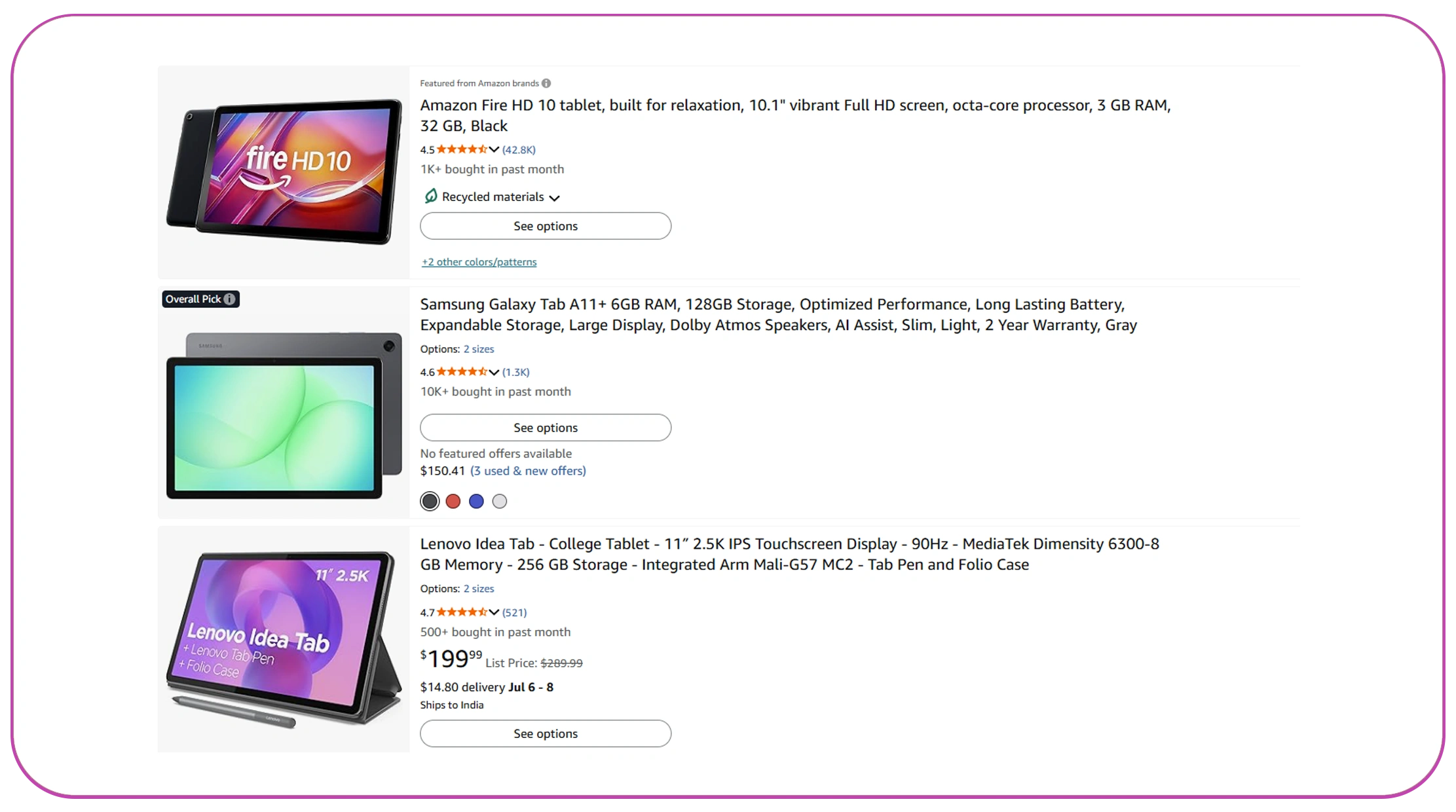
Collect Amazon dataset for market research at the ZIP code level introduces significant technical complexity beyond standard product extraction:
Session and Location Spoofing — Amazon uses multiple signals to determine a user's location: IP address, delivery address on the account, and ZIP code input in the delivery location selector. Reliable ZIP code-level extraction requires controlling all these signals simultaneously, not just IP geolocation.
Scale Multiplication — If you're tracking 10,000 products across 100 ZIP codes, that's 1,000,000 individual data points per extraction cycle. Infrastructure must scale accordingly, with intelligent prioritization to avoid unnecessary requests on fields that don't vary by location.
Anti-Bot Sophistication — Amazon runs among the most advanced bot detection systems in e-commerce. Behavioral fingerprinting, request rate analysis, JavaScript challenge-response, and CAPTCHA deployment are all in play. Production-grade ZIP code-level extraction requires sophisticated request management that mimics authentic browsing behavior.
Data Freshness Requirements — Amazon prices can change multiple times per day. ZIP code-level availability can flip from in-stock to out-of-stock within hours. Use cases that depend on near-real-time data (dynamic pricing, delivery window monitoring) require extraction frequencies that stress both infrastructure and anti-bot resilience.
ZIP Code Representativeness — The continental U.S. has over 41,000 ZIP codes. Full coverage is computationally impractical for most use cases. Designing a representative ZIP code sampling strategy — covering metro, suburban, and rural markets, all major fulfillment center regions, demographic diversity, and climate zones for seasonal goods — requires careful methodology to ensure data validity.
Result Consistency and Normalization — Amazon product pages vary in structure across categories, device types, and A/B test variants. ZIP code-level extraction pipelines must handle structural variation gracefully, normalizing heterogeneous page structures into a consistent output schema.
Designing a ZIP Code-Level Amazon Data Strategy
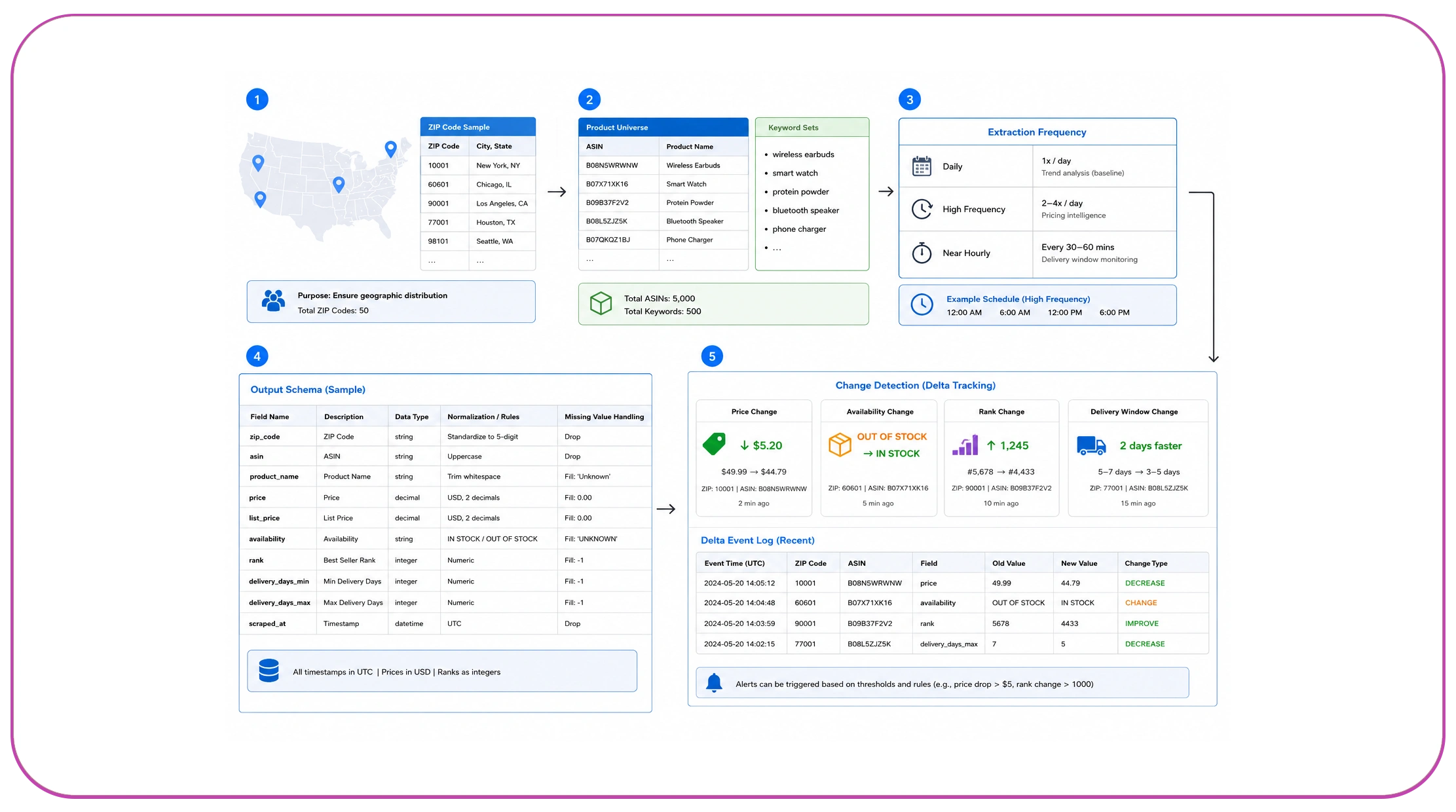
Before extracting data, defining a clear strategic framework prevents scope creep and ensures the extracted data actually answers the questions it was designed to address.
Step 1: Define the ZIP code sample. Select ZIP codes based on your business use case. A national brand needs geographic distribution. A regional seller needs depth in its core markets. A SaaS pricing tool needs demographic and competitive environment diversity.
Step 2: Define the product universe. Map the specific ASINs or keyword-driven product sets to monitor. The combination of product universe size and ZIP code sample size defines total extraction volume.
Step 3: Define extraction frequency. Daily is the minimum for meaningful trend analysis. Pricing intelligence use cases often require 2–4x daily. Delivery window monitoring may need near-hourly checks for high-priority ZIP codes.
Step 4: Define the output schema. Decide which fields matter for your analysis, how to handle missing values, and what normalization logic to apply to price, availability, and ranking data.
Step 5: Build for change detection. A ZIP code-level Amazon data pipeline that only captures current state is half as valuable as one that tracks changes over time. Delta detection — alerting when price, availability, or ranking changes — is often more valuable than the raw data itself.
Conclusion: Real Data API — Built for ZIP Code-Level Amazon Intelligence
Amazon ZIP code-level product data collection is where the gap between basic market intelligence and genuine competitive advantage lives. Businesses that understand how Amazon prices, ranks, and fulfills products differently across geographies are operating with a fundamentally more accurate picture of the competitive landscape than those relying on national averages and single-location snapshots.
Real Data API is purpose-built to deliver Amazon product data at ZIP code-level granularity — covering pricing, availability, delivery windows, Buy Box ownership, search rankings, and seller data across any ZIP code sample you define.
With Real Data API, you get clean, structured, normalized Amazon data delivered at the frequency your use case demands — from daily competitive pricing feeds to near-real-time availability monitoring. No infrastructure to build, no anti-bot headaches to manage, no data normalization pipelines to maintain. Just accurate, ZIP code-stratified Amazon product intelligence ready to integrate directly into your pricing engine, analytics dashboard, competitive intelligence platform, or machine learning model.
Whether you're a CPG brand enforcing MAP compliance across regional markets, a third-party seller optimizing Buy Box strategy by geography, a SaaS vendor calibrating repricing algorithms with local price data, or a retail analyst benchmarking Amazon against physical competitors — Real Data API gives you the ZIP code-level Amazon data precision that national-average datasets simply cannot provide.
The ZIP code is the unit of truth in modern Amazon intelligence. Real Data API makes it yours.
Latest posts

How Scrape Xiaohongshu Product Trends in Real Time Solves Product Discovery and Competitor Monitoring Challenges?

How to Scrape Taobao Product Data to Solve Pricing, Inventory, and Competitor Monitoring Challenges?
How to Extract grocery product listings Data from SPAR to Build Accurate Grocery Intelligence and Competitive Market Insights?

Scrape Douyin follower growth and engagement data to track influencer performance and trends







.png)



