.gif)
.png)
Quick Summary
- BigBasket scraper for competitor price analysis helps retailers organize comparable product prices, identify potential price gaps, and evaluate competitive positioning using structured marketplace observations.
- BigBasket Product Data Scraping can support repeatable grocery research by collecting available listing attributes, tracking price changes, and maintaining historical records, subject to authorized access and applicable platform rules.
- Reliable decisions depend on accurate product matching, location-specific comparisons, promotional context, and validated data. This guide explains how retailers can build a practical analysis workflow without relying on unsupported market assumptions.
Introduction
BigBasket scraper for competitor price analysis gives grocery retailers and FMCG brands a way to investigate how their products are priced relative to comparable online offers. Through BigBasket Product Data Scraping, businesses can organize observed prices, pack sizes, discounts, and product availability to identify potential price gaps and decide which differences deserve further investigation. The objective is not to match every competitor automatically; it is to make pricing decisions using consistent and relevant evidence.
BigBasket is an Indian online grocery and quick-commerce business offering products across categories such as fresh produce, packaged foods, household supplies, and personal care. Its official website describes its assortment and delivery services. Because grocery purchases frequently involve different brands, pack sizes, promotions, and delivery conditions, a useful competitor analysis must compare equivalent products rather than relying on product names alone.
Industry developments make this research increasingly relevant. McKinsey's 2022 overview of Indian grocery retail describes how digital adoption, changing consumer expectations, and new retail models have reshaped the sector. Its analysis highlights the importance of data analytics and digital capabilities for grocery retailers and consumer-goods companies. Source: McKinsey, The state of grocery retail in India.
For businesses working with Real Data API, the practical starting point is to define the products, locations, price fields, and collection frequency needed for a specific commercial decision. A structured workflow can then turn observations into comparable records, while validation and historical tracking help distinguish genuine competitive changes from listing errors or temporary promotions.
How can retailers identify meaningful competitor price differences?
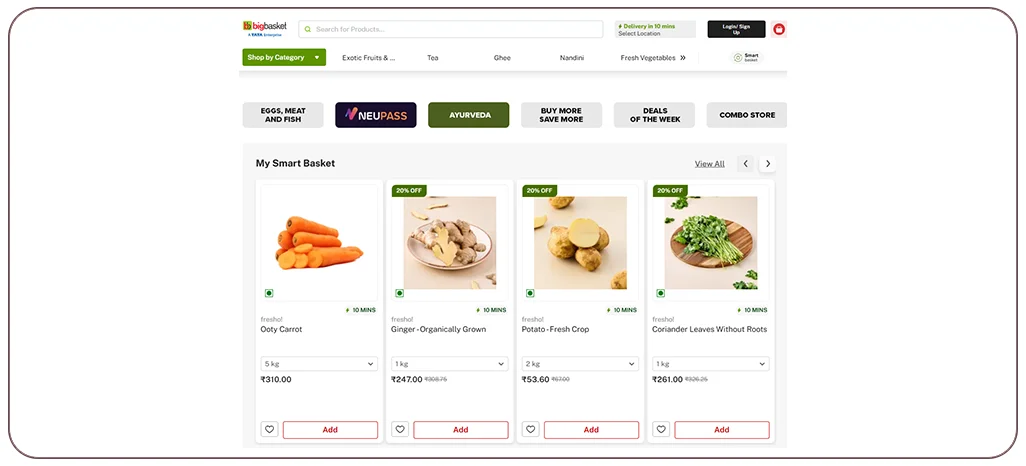
BigBasket web scraping for competitor price monitoring can help retailers collect and compare available product listings systematically. A useful workflow begins with a defined product list and records each comparable offer's product name, brand, pack size, listed price, discount details, seller or listing reference where available, delivery information, and observation timestamp.
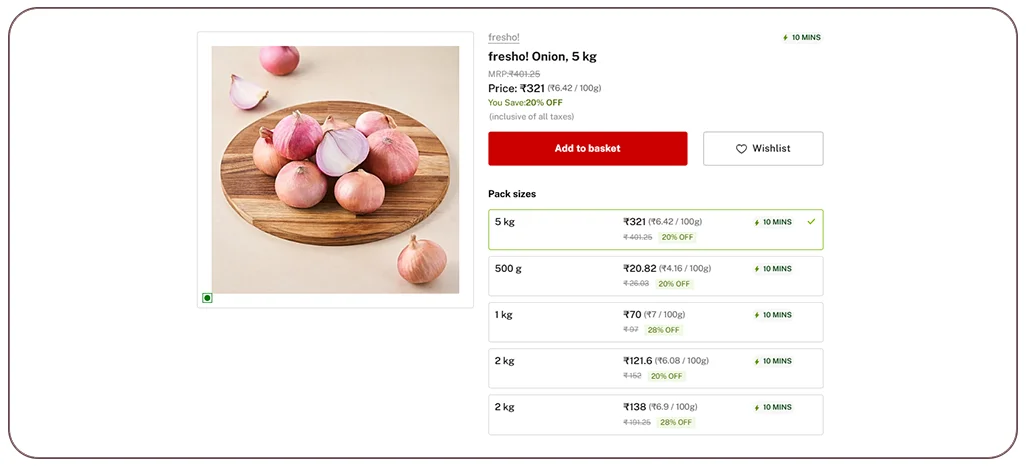
Product matching is particularly important in grocery retail. A 500-gram pack and a one-kilogram pack should not be compared using their total prices alone. Likewise, two products with similar titles may differ in ingredients, formulation, brand variant, or quantity. Normalize pack sizes and calculate unit prices when the information is available and comparable.
For example, the unit price of a product can be calculated as:
Unit price = comparable product price ÷ quantity
The quantity must use a consistent unit, such as grams, kilograms, millilitres, or litres. This method supports fair comparisons between differently sized packs, but it does not eliminate differences in quality, brand positioning, or promotional conditions.
Historical market context also matters. An August 2021 report by The Economic Times, citing Bain's ecommerce analysis, stated that online grocery growth in India had reached 80% in FY2021, compared with an earlier pre-pandemic expectation of 40%. This is a reported industry estimate for that period, not a BigBasket-specific price statistic. Source: The Economic Times.
A retailer can use validated comparisons to identify products priced above or below selected competitors, examine recurring differences, and prioritize reviews of important SKUs. Before changing a price, the team should confirm that the products match, the observations are current, and the comparison uses the same pricing basis.
How should grocery prices be compared across pack sizes and promotions?
BigBasket product price data extraction for retailers should preserve the information needed to explain why two displayed prices differ. The most useful records distinguish standard prices, visible discounted prices, pack quantities, promotional conditions, and other available charges instead of combining them into one ambiguous figure.
A retailer should also define the competitor set before analyzing the results. Comparing a premium branded product with a private-label alternative may reveal a market-positioning difference, but it does not necessarily demonstrate an actionable price gap. Comparisons are more reliable when brand, variant, quantity, and product specifications align.
The following table shows how to structure a comparison:
| Data field | Why it matters |
|---|---|
| Product name and brand | Helps identify the product being compared |
| Pack size and unit | Supports like-for-like and unit-price comparisons |
| Listed price | Records the displayed offer |
| Discount information | Helps separate promotional prices from standard prices |
| Unit price | Makes different pack sizes easier to compare |
| Availability | Identifies whether an offer was observed as available |
| Location or service area | Records geographic context when relevant |
| Timestamp | Shows when the observation was collected |
A retailer can calculate a competitor price gap using a consistent formula:
Price gap (%) = (Competitor price − Own price) ÷ Own price × 100
A positive value means the competitor's price is higher than the retailer's own price; a negative value means it is lower. The result should only be interpreted when both prices refer to comparable products and currencies.
Historical records help explain whether a difference is temporary or recurring. However, a sequence of observations collected from a particular date onward does not establish what prices were before collection began. Analysts should avoid presenting newly collected records as a complete historical market series.
Finally, price comparisons should feed into margin analysis. A competitor's lower price does not automatically justify matching it. Purchase cost, operating expenses, promotional funding, inventory levels, and business pricing rules all influence whether an adjustment makes commercial sense.
How can automated collection make grocery monitoring more consistent?
BigBasket API integration for automated grocery data collection can connect permitted data retrieval with validation, storage, and reporting. The goal is to reduce repetitive manual work while preserving the accuracy and traceability needed for pricing decisions.
The first step is to verify which data source can lawfully provide the required fields. An official API, an authorized data provider, and a permitted public-page collection workflow are not interchangeable. Access to one set of product records does not guarantee access to every competitor listing, location-specific price, or historical observation.
BigBasket's official website provides information about its consumer-facing grocery services, but public product pages alone should not be treated as proof that a particular public API or endpoint exists. Businesses should confirm available access methods, permitted uses, and technical requirements before implementation.
A practical automation workflow includes:
- Define requirements. List target products, locations, required fields, and the decisions the data will support.
- Collect permitted records. Use an authorized source and respect its applicable access limits.
- Validate observations. Check required fields, timestamps, currencies, pack sizes, and duplicate records.
- Store history. Retain observations with collection timestamps so later comparisons remain traceable.
- Generate reports. Flag material price changes and uncertain product matches for review.
Reliability also depends on handling collection failures. A missing record should not automatically be classified as a stockout, and an unchanged price should not be assumed to be current if the latest collection attempt failed. Systems should distinguish a confirmed observation from a failed or incomplete update.
Automated collection becomes commercially useful when it creates a consistent evidence trail. A pricing analyst should be able to trace a reported gap to the relevant product records, understand the observation time, and verify the basis of comparison before recommending an action.
Looking to streamline grocery data collection? Discuss your required fields, coverage, and update frequency with Real Data API before designing your monitoring workflow.
Get Insights Now!How can product-level research support better retail decisions?
Scrape BigBasket grocery data for retail analytics to investigate how prices, assortment, and product availability vary across the observations your business is permitted to collect. Retail analytics is most useful when it answers a specific commercial question rather than simply accumulating large quantities of product information.
For FMCG brands, research may focus on whether comparable products are offered at different prices, how frequently promotional labels appear, or which products are repeatedly unavailable in a monitored sample. Retailers may instead focus on assortment gaps, differences between pack sizes, and the positioning of competing brands.
The broader market provides context for these investigations. Bain & Company's How India Shops Online 2023 reported that quick commerce was expected to account for approximately 40%–50% of India's e-grocery gross merchandise value in 2023. This was an industry estimate published in 2023, not a measured BigBasket market share or a direct measure of pricing differences. Source: Bain & Company, How India Shops Online 2023.
For a retail analyst, the distinction between a forecast and a realized outcome matters. Industry projections can explain why a research question is relevant, but they cannot establish how a particular product performed. Product-level conclusions require observations that match the target market, timeframe, and comparison criteria.
A useful analysis should combine price information with clear definitions. For example, a promotional listing should be counted consistently, and the research should specify whether the measure includes only visible discounts or also conditional offers. If availability is tracked, the methodology should explain how missing observations are handled.
Retail teams can turn the findings into a review list containing the products with the largest verified price differences, the most frequent observed changes, and the weakest product-match confidence. This makes the output easier to use in merchandising meetings, category reviews, and pricing discussions.
What makes a product monitoring process dependable?
A BigBasket Scraper should be evaluated by the quality and relevance of the data it produces, not merely by the number of listings it can collect. For competitor analysis, incomplete records, inaccurate product matches, and stale observations can be more damaging than a smaller dataset with clear coverage and reliable timestamps.
Before selecting a collection method, retailers should establish a data quality checklist. Each record should include the fields necessary for the intended analysis, while uncertain values should remain identifiable rather than being silently replaced with assumptions.
A monitoring process should evaluate at least five areas:
- Accuracy: Do the collected fields correspond to the observed listing?
- Completeness: Are the required fields present?
- Freshness: When was the product last successfully observed?
- Consistency: Are prices, quantities, and currencies represented uniformly?
- Traceability: Can an analyst investigate the original observation behind a reported result?
The business should also define its collection scope. A sample of selected products from a single service area cannot automatically represent all products, cities, or customer experiences. Similarly, a product that is missing from one collection run should be treated as an unconfirmed observation until the reason is established.
Historical market figures illustrate the need to distinguish company-level metrics from pricing evidence. According to The Economic Times, BigBasket's consolidated operating revenue for FY2024 was reported at ₹10,062 crore, approximately 6% higher than the previous financial year. These figures provide company-level business context; they do not indicate its product-level prices or competitor price gaps. Source: The Economic Times, October 2024.
A dependable process records its limitations alongside its results. Retailers can then distinguish observed facts from assumptions and decide which findings are sufficiently reliable to influence pricing.
What do the available market figures reveal about grocery data needs?
A Bigbasket Grocery Dataset can help researchers examine product-level changes when it contains comparable observations collected over a documented period. However, market growth figures and company revenue figures must not be confused with product-level price histories. They describe different aspects of the market and answer different questions.
The following table summarizes selected published indicators spanning 2020–2026. It deliberately distinguishes historical reports, estimates, and projections rather than presenting them as one continuous, verified annual dataset.
| Year | Published indicator | Interpretation |
|---|---|---|
| 2020 | India's grocery retail sector experienced pandemic-related disruption and accelerated digital adoption. | Context for changes in shopping behavior. McKinsey |
| 2021 | Bain's analysis, reported by The Economic Times, put online grocery growth at 80% in FY2021. | A historical industry growth estimate, not BigBasket pricing data. Source |
| 2022 | McKinsey published an overview of the evolving Indian grocery retail landscape. | Highlights digital adoption and analytics as important retail capabilities. Source |
| 2023 | Bain estimated that quick commerce could account for 40%–50% of Indian e-grocery GMV. | A forecast published in 2023, not a verified final outcome. Source |
| 2024 | BigBasket's consolidated operating revenue was reported at ₹10,062 crore for FY2024. | Company-level revenue, not product pricing or market share. Source |
| 2025 | Bain and Flipkart's industry research estimated India's e-retail market at approximately US$60 billion in GMV for 2024 and described further growth opportunities. | Broader ecommerce context; not a BigBasket-specific metric. Report |
| 2026 | The calendar year is still in progress as of October 24, 2026. | A complete annual result for 2026 cannot yet be reported as finalized. |
The table shows why a pricing project needs its own dataset. Industry research can establish context, but it cannot reveal whether a specific product's price has changed by 5%, whether two retailers offer equivalent packs, or whether a discount is recurring. Those questions require direct, timestamped observations and a documented comparison method.
For useful analysis, businesses should store product-level records with observation dates, normalized units, price fields, location context where available, and matching confidence. They should also document missing data and changes in collection coverage. This makes it possible to interpret a measured price difference without overstating what the evidence proves.
Why Choose Real Data API?
A data provider should be selected according to the requirements of the business, the permitted data sources, and the quality standards necessary for reliable analysis. BigBasket API is a useful term when researching possible integration approaches, but it should not be taken as confirmation that a particular public endpoint exists or that every competitor field is accessible.
Real Data API is a potential provider to evaluate for structured data collection requirements. Before committing to a solution, retailers should confirm its actual capabilities directly rather than assume that every desired field or feature is supported.
Use these criteria during evaluation:
- Coverage: Can the service access the required products, categories, and relevant market areas?
- Field availability: Are prices, pack sizes, promotional details, and timestamps available where needed?
- Update frequency: What refresh intervals are supported, and how are failed updates reported?
- Data quality: Are duplicate listings, missing values, and uncertain product matches identified?
- Integration: Can the data be delivered in a format suitable for existing reporting or analytics systems?
- Compliance: Are collection methods consistent with platform terms, permissions, and applicable laws?
- Documentation: Are the supported fields, limitations, and service conditions clearly explained?
A small proof of concept is a sensible starting point. Select a defined group of products, manually verify a sample of returned records, and measure completeness, accuracy, and freshness. This gives the business concrete evidence for comparing providers.
The right solution is not necessarily the one that returns the most records. It is the one that provides suitable data, transparent limitations, and repeatable results for the pricing questions the business needs to answer.
Conclusion
BigBasket scraper for competitor price analysis can support smarter retail decisions by organizing comparable product prices, highlighting potential price gaps, and preserving observations for historical analysis. The greatest value comes from reliable product matching, consistent price calculations, and a clear distinction between observed facts and market assumptions.
For grocery retailers and FMCG brands, the process should begin with a defined set of products, documented comparison criteria, and an authorized collection method. Each finding should be traceable to its observation time and interpreted in the context of pack size, promotions, availability, and location.
Market reports can explain the broader growth of digital grocery retail, but they cannot substitute for validated product-level evidence. A carefully designed monitoring process helps teams identify which price differences deserve attention without assuming that every competitor change requires an immediate response.
Ready to improve your grocery pricing intelligence? Contact Real Data API to discuss your data requirements, validate the available collection options, and explore a practical workflow for competitor price monitoring!
Frequently Asked Questions
1. How does BigBasket scraper for competitor price analysis help retailers?
It organizes comparable product prices and listing attributes, helping retailers identify potential price gaps. Accurate product matching, current observations, and promotional context are essential for reliable decisions.
2. What is BigBasket Product Data Scraping?
It refers to collecting available product listing information for analysis, subject to permissions and applicable rules. The resulting records can support assortment research, price comparisons, and structured reporting.
3. How does BigBasket web scraping for competitor price monitoring work?
It collects permitted product observations at defined intervals, stores timestamps, and compares matched listings. Validation is necessary to distinguish genuine price changes from missing records or mismatched products.
4. Why use BigBasket product price data extraction for retailers?
It helps retailers structure product prices, pack sizes, and available promotional details for comparison. Normalized unit prices and historical observations make analysis more consistent across different product formats.
5. What should businesses check before BigBasket API integration for automated grocery data collection?
Verify available endpoints, authorized access, supported fields, update frequency, and service limits. Confirm that the intended collection method complies with applicable platform terms and data protection requirements.
Latest posts
HungerStation Food Data Scraping for Restaurant Market Research - Key Benefits and Insights
Shopee API for Competitive Pricing Optimization - How Seller Data Analysis Improves Product Price Tracking
BigBasket scraper for competitor price analysis - How to Identify Price Gaps and Improve Pricing Decisions
How Carrefour API Solutions for Retail Data Integration Improve Business Intelligence



.png)


