
Introduction
India's B2B marketplace ecosystem has become increasingly data-driven as businesses look for faster ways to identify suppliers, manufacturers, distributors, wholesalers, and potential customers. IndiaMART operates at significant scale, with its FY26 investor presentation reporting 230 million registered buyers, 41 million active buyers over the last 12 months, 8.7 million Indian supplier storefronts, 129 million live product listings, and 220,000 paying suppliers.
B2B data scraping from IndiaMART for sales leads can help sales teams convert this large marketplace into structured prospecting datasets. Instead of manually searching business listings, companies can collect relevant publicly available information and organize it according to industry, product category, geography, supplier type, and other research criteria.
An IndiaMART Scraper can support automated collection workflows for market research and lead intelligence. The objective is not simply to obtain a large number of records. The real value lies in identifying relevant prospects, standardizing business information, monitoring marketplace changes, and creating datasets that sales teams can use for segmentation and prioritization.
This report analyzes IndiaMART's marketplace growth from FY20 through FY26 and interprets the available operational metrics through a Real Data API perspective. The analysis focuses on how marketplace scale, business enquiries, supplier storefronts, product listings, and buyer growth can influence B2B prospecting strategies.
Expanding the Prospecting Universe Through Marketplace Intelligence
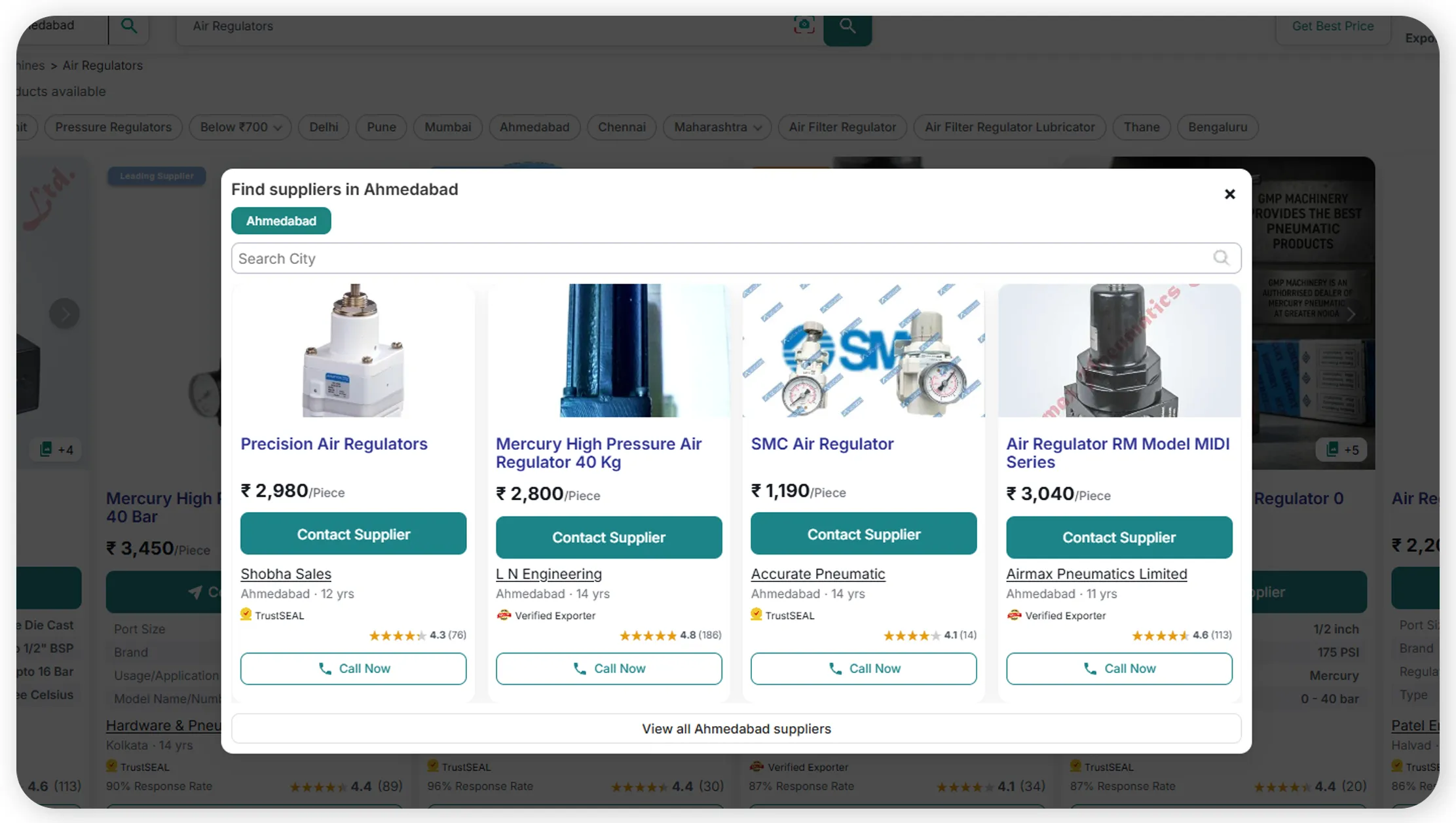
IndiaMART web scraping services for lead generation can help businesses build prospect databases from a marketplace containing millions of supplier storefronts and product listings. The scale of IndiaMART has expanded considerably over the last several years, creating a broad data environment for B2B research.
IndiaMART's reported operational metrics show that registered buyers increased from 102 million in FY20 to 230 million in FY26. During the same period, Indian supplier storefronts increased from 6.0 million to 8.7 million, while live product listings grew from 67 million to 129 million.
Real Data API Analysis: Marketplace Expansion
| Fiscal Year | Registered Buyers (M) | Supplier Storefronts (M) | Live Product Listings (M) | Real Data API Interpretation |
|---|---|---|---|---|
| FY20 | 102 | 6.0 | 67 | Established B2B discovery ecosystem |
| FY21 | 125 | 6.5 | 72 | Buyer and inventory coverage expanded |
| FY22 | 149 | 7.1 | 83 | Stronger prospecting universe |
| FY23 | 170 | 7.5 | 95 | More supplier and product-level signals |
| FY24 | 194 | 7.9 | 108 | Broadening addressable market |
| FY25 | 211 | 8.4 | 119 | Continued marketplace depth |
| FY26 | 230 | 8.7 | 129 | Large-scale B2B prospecting environment |
Source: IndiaMART investor presentations; figures are company-reported FY metrics.
Real Data API Insight: Registered buyers increased by approximately 125% from FY20 to FY26, while live product listings increased by approximately 93%. This indicates that the marketplace has become substantially larger from both the demand and supply sides.
For sales teams, this creates a much larger prospecting universe. However, a larger universe also increases the need for filtering. A raw database containing millions of businesses is not automatically a high-quality lead database. Businesses need structured fields and segmentation rules to identify prospects that match their ideal customer profile.
Scraping can therefore be designed around specific requirements. A manufacturer may focus on distributors in selected states, while a technology company may target businesses within particular industries. By collecting relevant business and product attributes, teams can create smaller, more actionable prospect segments.
Increasing Automation in Lead Discovery
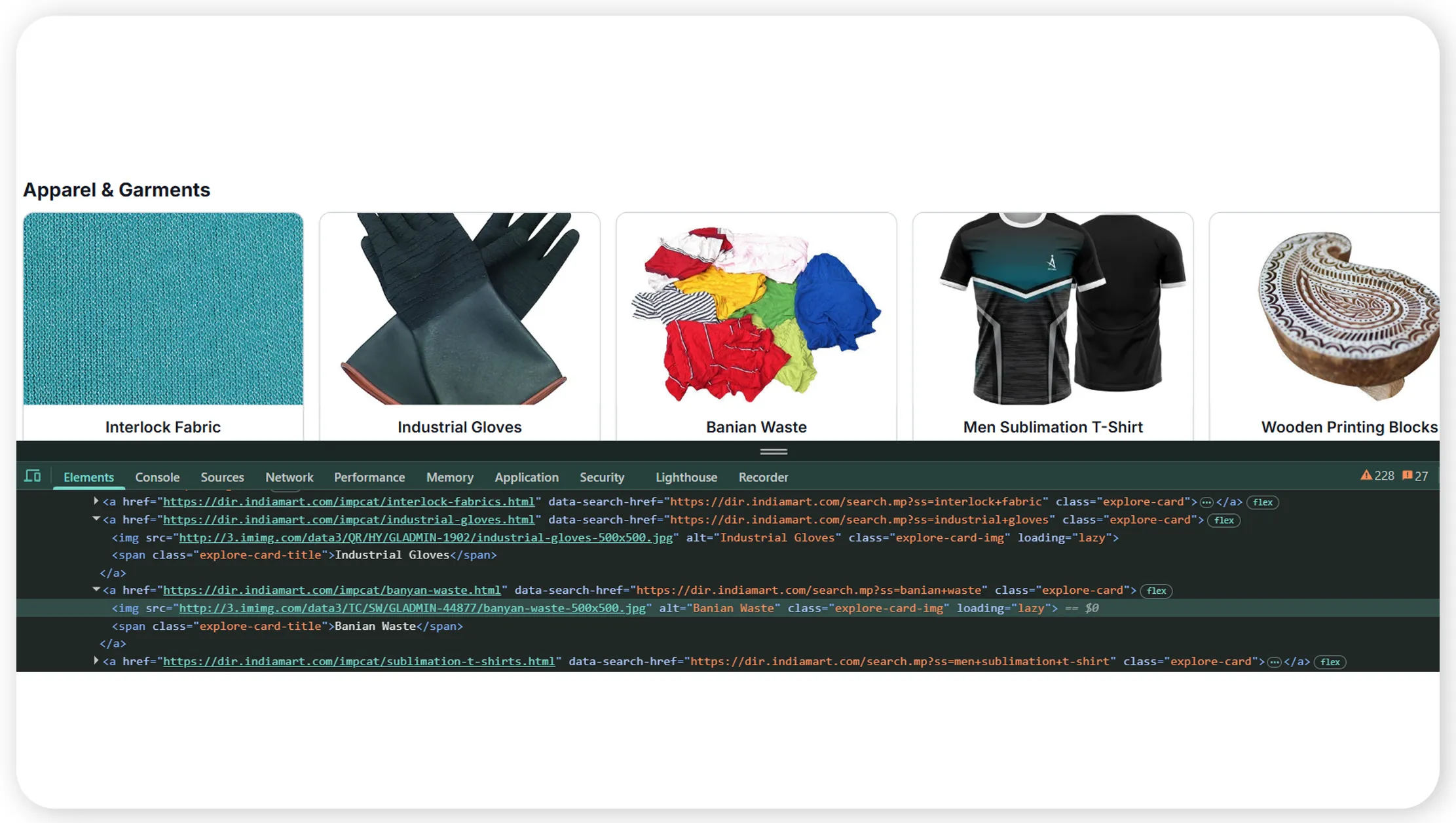
automated IndiaMART data scraping for lead generation can reduce the manual effort involved in discovering and organizing B2B prospects. IndiaMART's business activity metrics demonstrate why automation becomes increasingly useful as marketplace scale increases.
Unique business enquiries increased from 74 million in FY20 to 114 million in FY26, according to IndiaMART's reported operational metrics. Registered buyers also more than doubled during the same period.
Real Data API Analysis: Buyer and Enquiry Growth
| Fiscal Year | Registered Buyers (M) | Unique Business Enquiries (M) | Active Buyers – LTM (M) | Real Data API Interpretation |
|---|---|---|---|---|
| FY20 | 102 | 74 | 30 | Established baseline demand |
| FY21 | 125 | 96 | 35 | Demand signals accelerated |
| FY22 | 149 | 97 | 38 | High enquiry activity |
| FY23 | 170 | 88 | 37 | Post-peak normalization |
| FY24 | 194 | 93 | 39 | Demand recovered |
| FY25 | 211 | 106 | 43 | Strong prospecting signals |
| FY26 | 230 | 114 | 41 | Large enquiry ecosystem |
Source: IndiaMART investor presentations.
Real Data API Insight: Unique business enquiries rose approximately 54% from FY20 to FY26. The growth was not linear: enquiries reached 97 million in FY22, declined to 88 million in FY23, and subsequently recovered to 114 million in FY26.
This variation demonstrates why recurring data collection is more valuable than a one-time scrape. A single dataset can tell a company who exists in the marketplace, but recurring collection can help reveal how marketplace activity changes.
Automation can also help sales teams establish repeatable workflows. New businesses can be identified, existing records can be refreshed, and product categories can be monitored over time. This is particularly useful when organizations operate across multiple regions or product segments.
The objective should be to create a pipeline where collection, cleaning, categorization, and lead scoring work together. Such a system can help sales teams move from broad marketplace discovery to targeted prospecting.
Converting Business Listings Into Structured Sales Opportunities
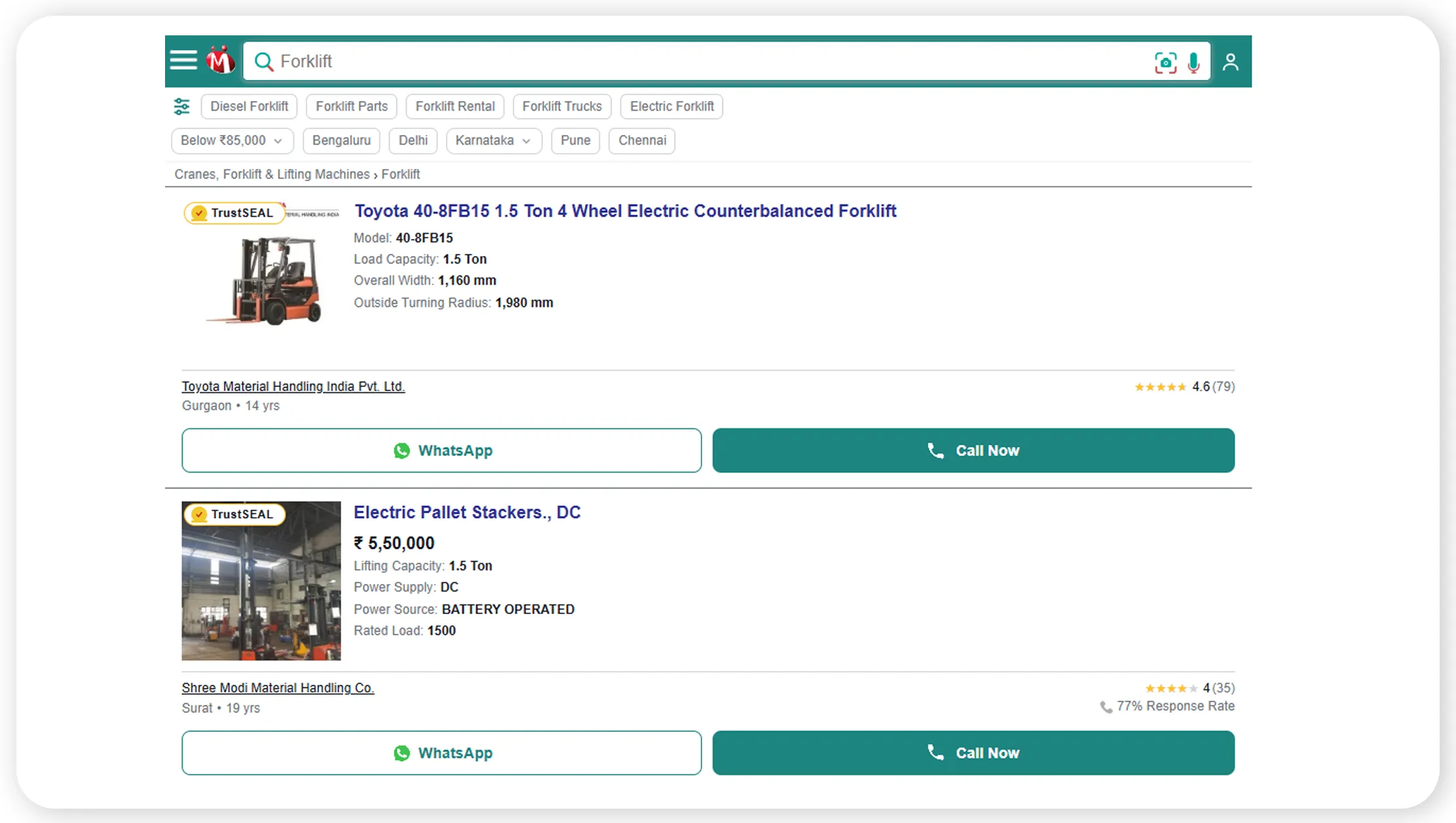
scrape IndiaMART business data for leads can enable organizations to build structured datasets around companies, products, categories, locations, and other available business information.
IndiaMART's supplier network grew from 6.0 million Indian supplier storefronts in FY20 to 8.7 million in FY26. Its live product listings almost doubled over the same period, increasing from 67 million to 129 million.
Real Data API Analysis: Supplier and Product Expansion
| Fiscal Year | Supplier Storefronts (M) | Live Product Listings (M) | Listings per Storefront* | Real Data API Interpretation |
|---|---|---|---|---|
| FY20 | 6.0 | 67 | 11.2 | Broad supplier coverage |
| FY21 | 6.5 | 72 | 11.1 | Stable product depth |
| FY22 | 7.1 | 83 | 11.7 | Expanding catalog |
| FY23 | 7.5 | 95 | 12.7 | Higher listing density |
| FY24 | 7.9 | 108 | 13.7 | Deeper product intelligence |
| FY25 | 8.4 | 119 | 14.2 | Increasing catalog richness |
| FY26 | 8.7 | 129 | 14.8 | Strong product-level prospecting |
*Calculated as live product listings divided by Indian supplier storefronts; it is a directional marketplace-density indicator, not an average supplied by IndiaMART. Source metrics: IndiaMART.
Real Data API Insight: The calculated product-listing-to-storefront ratio increased from approximately 11.2 to 14.8 between FY20 and FY26. This suggests that product-level intelligence has become increasingly valuable for prospecting.
A business directory can tell a salesperson that a company exists. Product-level information can help determine what that company sells. That distinction can significantly improve lead qualification.
For example, a packaging-material supplier may list several product categories, while a manufacturer may offer products that match a buyer's exact requirements. A structured dataset can make it possible to filter businesses according to those product signals.
Sales teams can use this information to create targeted prospect lists rather than broad company databases. Marketing teams can also use categorized business information to create industry-specific campaigns.
The more structured the underlying data, the easier it becomes to create useful segmentation. Product category, business location, company type, and other available listing attributes can be combined to identify prospects that better match a company's sales strategy.
Improving Prospect Prioritization With Business Enquiry Signals
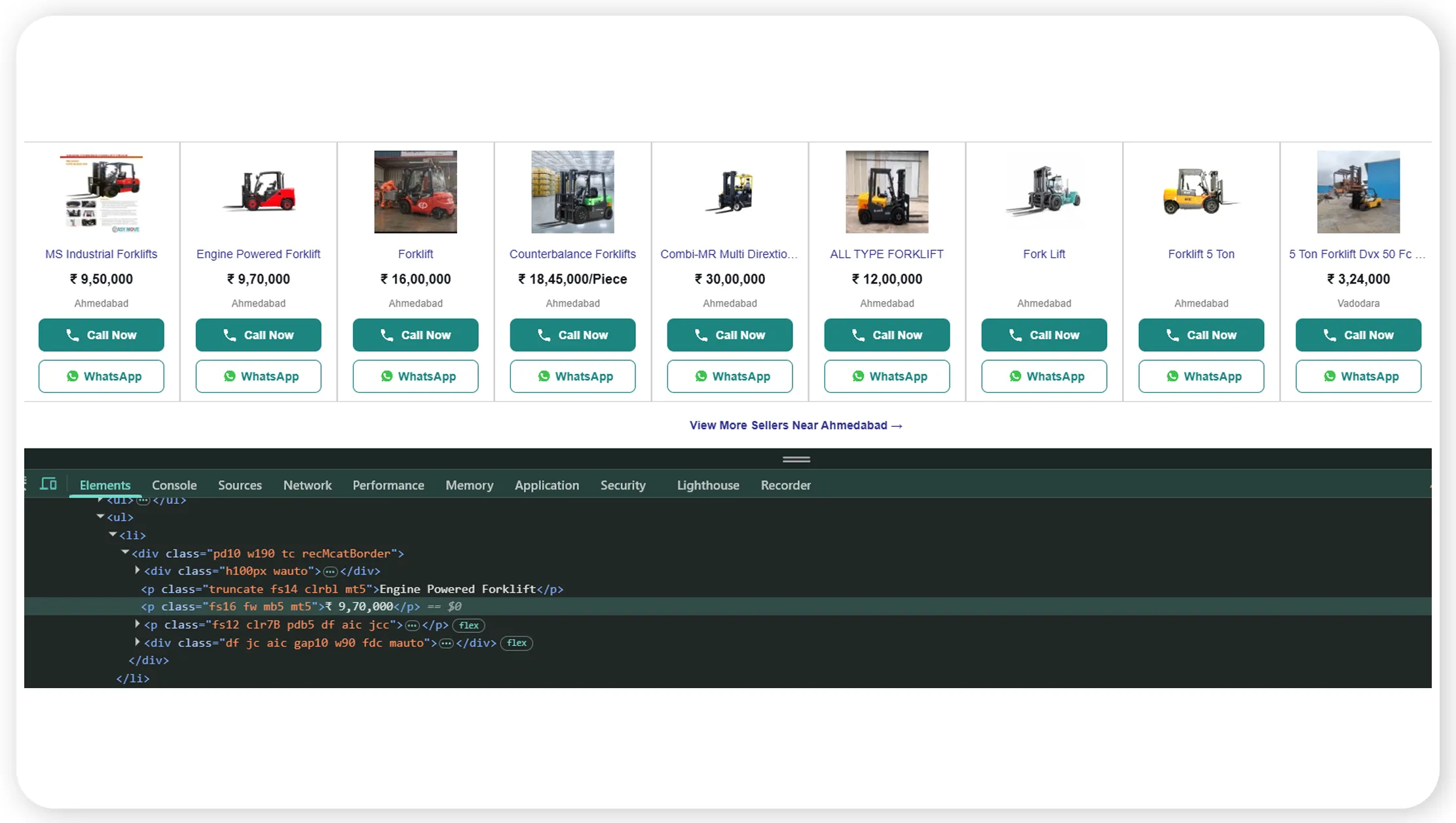
IndiaMART data extraction for sales prospecting can help companies connect marketplace supply information with demand-side indicators. IndiaMART's business enquiry metrics provide an important indication of the scale of commercial discovery taking place on the platform.
IndiaMART reported 114 million unique business enquiries in FY26, compared with 106 million in FY25 and 93 million in FY24.
Real Data API Analysis: Enquiry Momentum
| Fiscal Year | Unique Business Enquiries (M) | YoY Change | Real Data API Interpretation |
|---|---|---|---|
| FY20 | 74 | --- | Established enquiry base |
| FY21 | 96 | +29.7% | Significant demand acceleration |
| FY22 | 97 | +1.0% | Enquiry activity remained elevated |
| FY23 | 88 | -9.3% | Temporary normalization |
| FY24 | 93 | +5.7% | Demand recovery |
| FY25 | 106 | +14.0% | Stronger commercial activity |
| FY26 | 114 | +7.5% | Continued enquiry expansion |
Calculated from IndiaMART's reported FY metrics.
Real Data API Insight: Unique business enquiries grew approximately 54% from FY20 to FY26. More importantly for sales intelligence, growth accelerated again after FY23. This indicates that historical enquiry patterns can provide useful context when assessing marketplace opportunity.
For a lead-generation workflow, enquiry-related information can help prioritize categories and business segments that show stronger commercial activity. The purpose is not to assume that every enquiry represents a qualified lead. Instead, enquiry volume can act as a market-demand signal that complements supplier and product data.
A structured extraction system can therefore combine company-level information with product and category information to create prospect segments. Sales teams can then prioritize segments based on relevance, market activity, geography, and business characteristics.
This is where data extraction becomes more strategic than simple list building. The goal is to create a prospecting database that answers questions such as which businesses operate in a target category, where they are located, what products they offer, and which market segments appear most active.
Building Product and Customer Intelligence From Marketplace Data
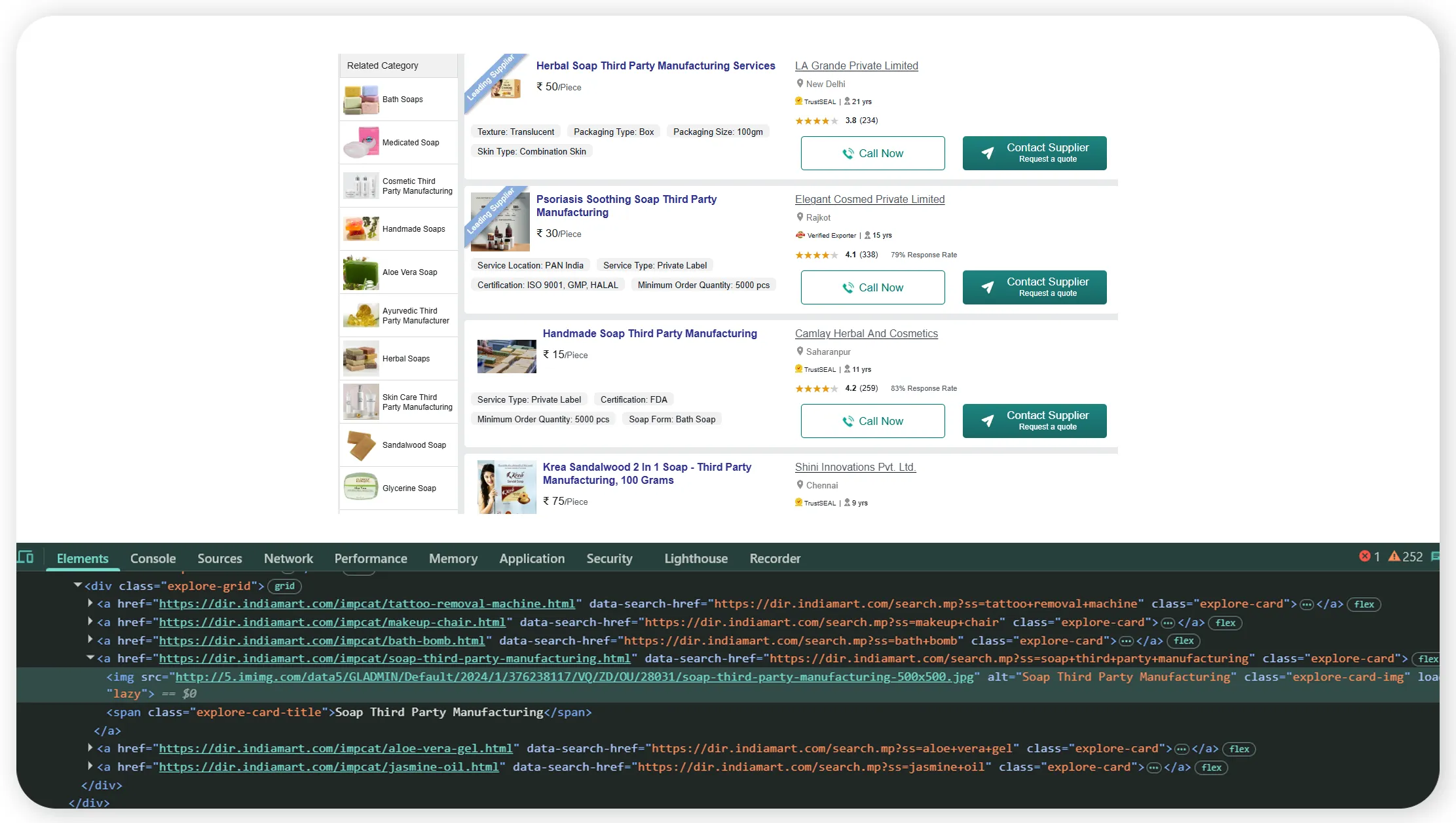
An IndiaMart Scraping API can provide a scalable architecture for collecting structured marketplace information, while IndiaMart Product and Review Datasets can add deeper product and customer intelligence to the prospecting process.
IndiaMART's product ecosystem has expanded from 67 million live product listings in FY20 to 129 million in FY26. The company also highlights product specifications, pricing, reviews and ratings, and other discovery features as part of its marketplace services.
Real Data API Analysis: Product Intelligence Growth
| Fiscal Year | Live Product Listings (M) | Supplier Storefronts (M) | Listing Density* | Real Data API Interpretation |
|---|---|---|---|---|
| FY20 | 67 | 6.0 | 11.2 | Product discovery foundation |
| FY21 | 72 | 6.5 | 11.1 | Stable catalog depth |
| FY22 | 83 | 7.1 | 11.7 | Expanding product coverage |
| FY23 | 95 | 7.5 | 12.7 | More detailed prospect signals |
| FY24 | 108 | 7.9 | 13.7 | Stronger product segmentation |
| FY25 | 119 | 8.4 | 14.2 | Increasing data richness |
| FY26 | 129 | 8.7 | 14.8 | High-volume product intelligence |
*Calculated indicator based on reported listings and storefronts.
Real Data API Insight: Product listings increased by approximately 93% between FY20 and FY26. This creates an opportunity to analyze B2B markets at the product level rather than relying only on company-level information.
Product datasets can help sales teams understand what businesses sell and how offerings are positioned. Review and rating information, where publicly available and collected in accordance with applicable requirements, can add another layer by indicating customer experiences and marketplace reputation.
For researchers, these datasets can support product benchmarking, category research, competitor analysis, and supplier discovery. For sales teams, product-level information can improve lead qualification by allowing businesses to identify companies whose offerings closely align with their target market.
The API layer also makes recurring collection possible. Rather than creating a static product database, organizations can schedule regular extraction and identify changes in listings, product descriptions, availability, or other relevant fields.
The resulting system can become a reusable B2B intelligence layer supporting sales, procurement, market research, and competitive analysis.
Creating a Sustainable Data-Driven Prospecting Workflow
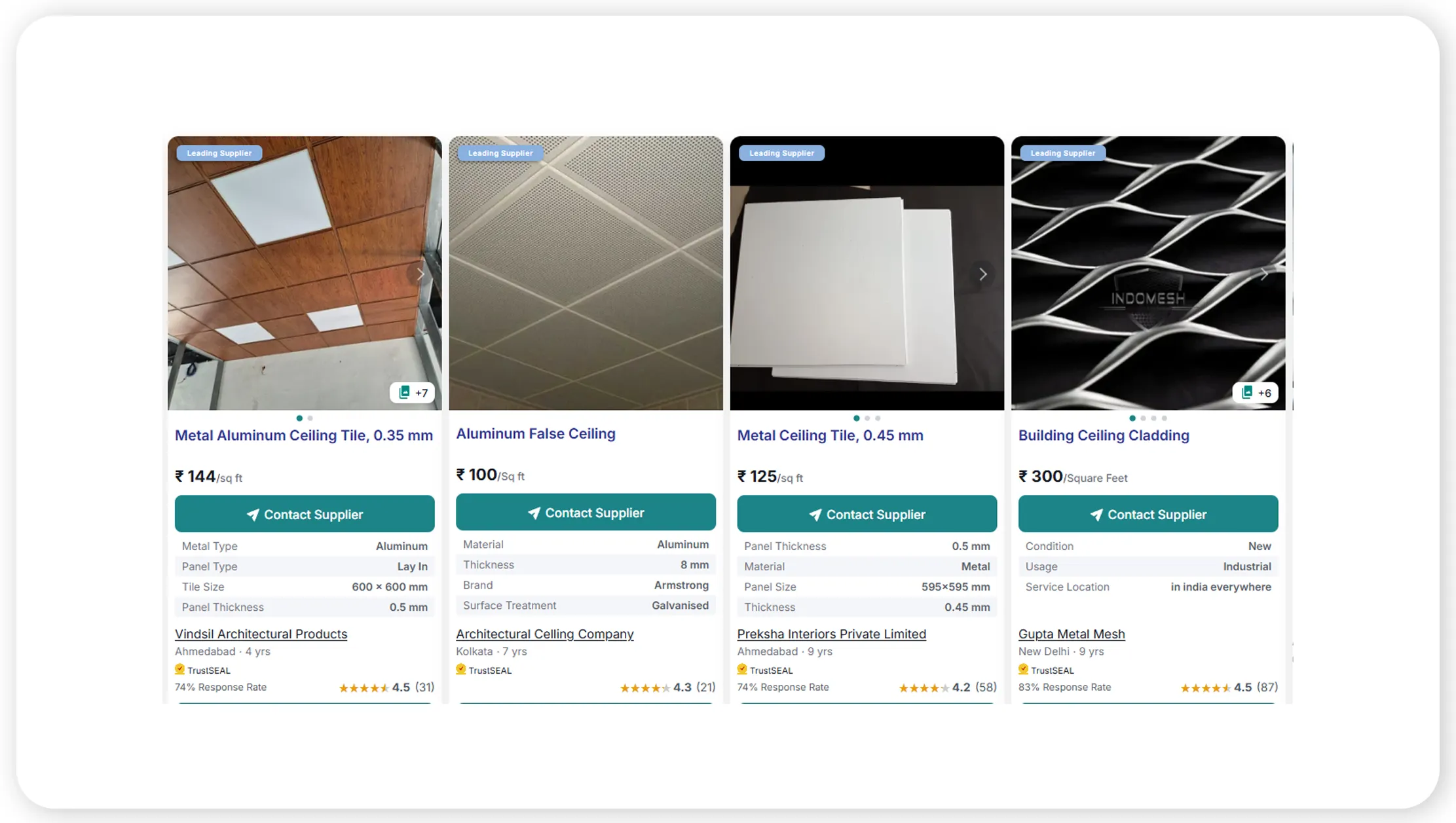
Web Scraping IndiaMART Data can support a repeatable prospecting process in which marketplace information is continuously collected, standardized, enriched, and analyzed.
IndiaMART's FY26 metrics demonstrate the scale of the opportunity: 230 million registered buyers, 41 million active buyers, 114 million unique business enquiries, 8.7 million Indian supplier storefronts, 129 million live product listings, and 220,000 paying suppliers.
Real Data API Analysis: FY20-FY26 Marketplace Scale
| Metric | FY20 | FY23 | FY26 | FY20-FY26 Change | Real Data API Interpretation |
|---|---|---|---|---|---|
| Registered Buyers | 102M | 170M | 230M | +125% | Much larger demand universe |
| Active Buyers | 30M | 37M | 41M | +37% | Sustained active buyer base |
| Business Enquiries | 74M | 88M | 114M | +54% | Stronger commercial discovery |
| Supplier Storefronts | 6.0M | 7.5M | 8.7M | +45% | Broader supplier universe |
| Live Product Listings | 67M | 95M | 129M | +93% | Nearly doubled product intelligence |
| Paying Suppliers | 147K | 203K | 220K | +50% | Larger monetized supplier base |
Source: IndiaMART FY20-FY26 operational metrics.
Real Data API Insight: The most significant finding is the simultaneous growth of buyers, suppliers, enquiries, and product listings. This creates a larger B2B discovery environment but also increases the complexity of finding relevant prospects.
A scalable workflow should therefore include data extraction, normalization, deduplication, categorization, validation, and historical storage. Once these processes are established, sales teams can create repeatable prospecting campaigns rather than repeatedly starting research from scratch.
For example, a company targeting industrial suppliers could collect relevant businesses, classify them by product category and location, remove duplicates, and create a prioritized prospect database. The same workflow could be repeated weekly or monthly to identify new businesses and changes in existing records.
This approach also creates opportunities for analytics. Teams can measure category growth, supplier density, geographic concentration, product availability, and other market signals. Over time, historical datasets can reveal changes that are difficult to identify through manual research.
The real advantage is therefore not just scraping more data. It is building a repeatable B2B intelligence workflow that converts marketplace information into usable sales and market insights.
Why Choose Real Data API?
Real Data API can help businesses build scalable data pipelines for B2B market research, competitive intelligence, supplier discovery, and sales prospecting. The value of a professional data solution lies in creating a repeatable workflow rather than relying on manual collection.
The IndiaMART marketplace contains millions of supplier storefronts and more than 100 million live product listings, making structured collection especially valuable for organizations operating at scale. IndiaMART reported 8.7 million Indian supplier storefronts and 129 million live product listings in FY26.
IndiaMart Product and Review Datasets can support businesses that need deeper product-level and customer-oriented intelligence. Such datasets can be used for product benchmarking, supplier research, market segmentation, competitive analysis, and lead qualification, subject to applicable data-access and compliance requirements.
Real Data API can position the scraping workflow around structured extraction, scalable processing, recurring collection, and integration with downstream analytics systems. This allows businesses to transform marketplace information into datasets that sales and research teams can actually use.
The goal is to reduce repetitive manual research while improving the consistency and scalability of B2B data collection.
Conclusion
IndiaMART has developed into a large-scale B2B discovery marketplace, with FY26 figures showing 230 million registered buyers, 41 million active buyers, 8.7 million supplier storefronts, 129 million live product listings, and 114 million unique business enquiries.
The six-year comparison also reveals substantial marketplace expansion. Registered buyers increased 125% from FY20 to FY26, while live product listings increased approximately 93% and unique business enquiries grew approximately 54%. These trends demonstrate why structured marketplace intelligence can become an important component of modern B2B prospecting.
IndiaMart Product and Review Datasets can add further depth by allowing businesses to analyze product-level information, marketplace positioning, and available review signals alongside company and supplier data.
The key takeaway is that effective prospecting is not about collecting the largest possible number of records. It is about creating relevant, structured, refreshed, and actionable prospect data. By combining business, product, category, geographic, and marketplace signals, organizations can build more targeted sales strategies.
Start building a scalable IndiaMART data pipeline with Real Data API and turn marketplace business, product, and review data into actionable B2B sales intelligence!
Latest posts

How Levi's Fashion Dataset Improves Fashion Intelligence Across Products, Prices, Categories, and Denim Market Trends?

How Myntra Fashion Dataset Solves Fashion Intelligence Challenges Across Products, Prices, Brands, and Fashion Market Trends?

How Hyatt Travel Dataset Helps Businesses Track Hotels, Room Prices, Amenities, Locations, and Travel Trends?

How Louis Vuitton Fashion Dataset Enables Better Analysis of Luxury Products, Prices, Brands, and Fashion Trends?






.png)



