.gif)
.gif)
Introduction
In the market for used phones and other devices, the price you see first is rarely the price you get. A resale platform shows an estimated value, then applies deductions for condition, age, damage, missing accessories and other factors, and sometimes adds bonuses or coupons. The final offer is the sum of many parts. For companies in recommerce, insurance, trade-in and device finance, understanding this price breakup is the key to understanding how the market values a device. Cashify-style price breakup data scraping captures the full chain from the base value to the final price.
For broader device-market coverage, mobile phone data scraping can complement resale quote data with structured phone product information.
This guide explains what price breakup data is, how it is collected from resale flows, what makes it technically demanding and how businesses use it.
What Is Price Breakup Data?
Price breakup data records how a final offer is built. A typical breakup might include:
- Base value: the starting price for a model, storage size and age
- Condition deductions: reductions for screen damage, body scratches, dents or functional faults
- Accessory adjustments: differences for having or lacking charger, box and bill
- Warranty adjustments: for remaining manufacturer warranty
- Platform bonuses or coupons: extra value added during campaigns or exchange offers
- Final price: what the seller would receive
Capturing each component, instead of only the final number, shows how sensitive the price is to different conditions.
How Resale Quote Flows Work
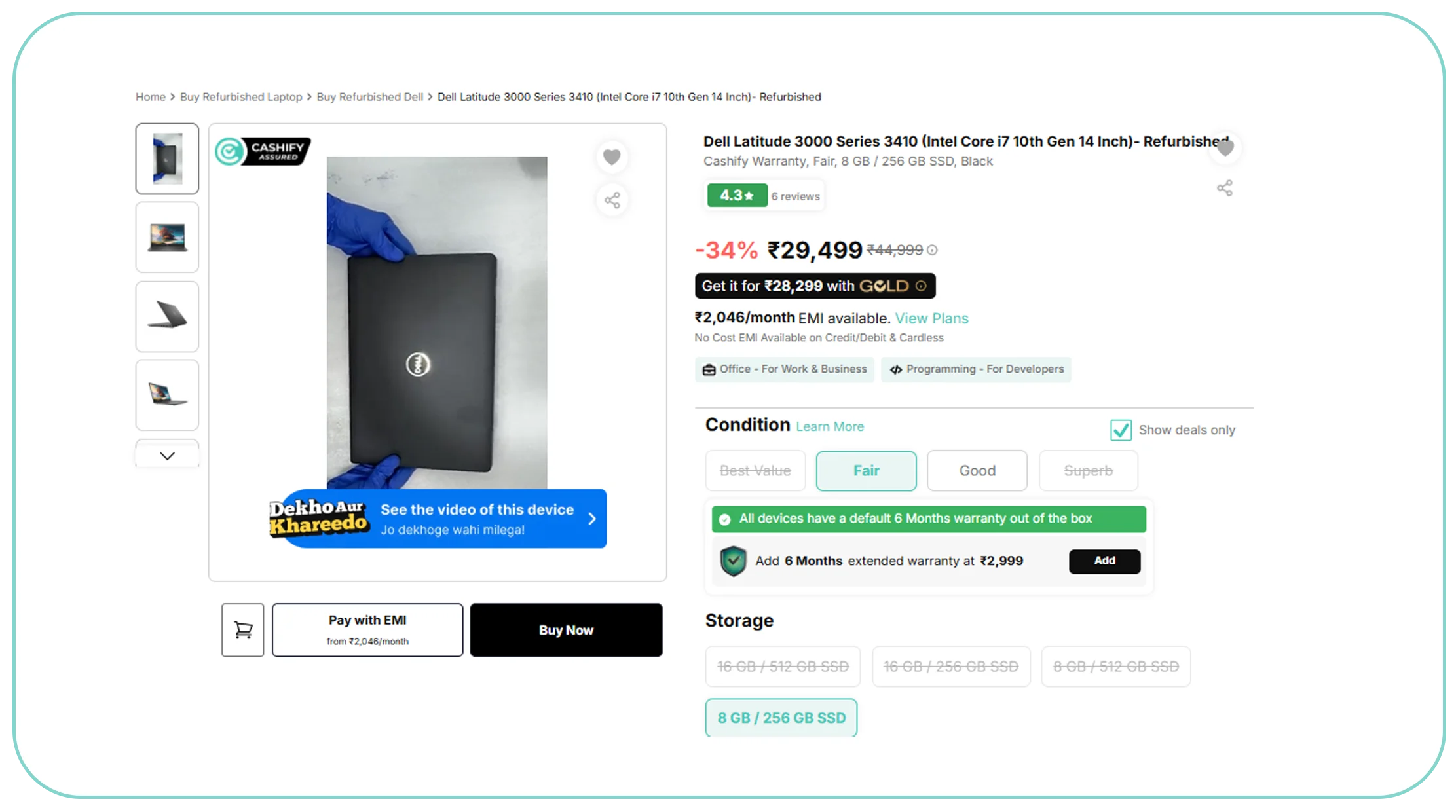
Most resale platforms use a question-based flow. The user selects the device type, brand, model and storage, then answers questions about condition and functionality. The platform then shows an estimated price. Each answer can change the price. Because the price depends on many inputs, a single quote is only one point in a large space. Scraping must therefore simulate many combinations to build a complete picture.
Data Fields To Collect
For broader catalogue-level analysis, product data scraping can help collect standardized device attributes alongside resale pricing.
Device identification: category (phone, laptop, tablet, watch), brand, model, storage, RAM and colour where asked, and age or purchase period.
Condition answers: screen condition, body condition, function checks such as touch, camera and battery, and presence of accessories.
Price data: base price, each deduction with label and amount, bonus or coupon with label and amount, and final price.
Context: city or pincode if the platform asks, date, time and the flow version.
Metadata: quote validity period and any terms displayed.
Building A Quote Matrix
Since the price depends on conditions, a good project builds a quote matrix. For each model and storage, define a set of standard condition profiles, such as:
- Like new: no visible wear and all functions working
- Good: light scratches and all functions working
- Fair: visible scratches or small dents and all functions working
- Damaged screen: cracked screen and other functions working
- Faulty: one or more functions not working
The scraper runs the flow for each profile and records the breakup. This gives you a clean grid of price against condition for every device.
Step-By-Step Scraping Workflow
When the output needs to feed automated systems, a web scraping API can make structured results easier to consume.
- Map the flow. Understand the steps and questions of the sell flow, including branching logic.
- Build the model list. Collect the list of supported brands, models and storage options from the platform.
- Define condition profiles. Convert the question answers into profiles.
- Automate the flow. For each model, storage and profile, run the flow and capture the price screen.
- Parse the breakup. Extract labels and amounts for each component of the price.
- Standardise. Map deduction labels into a common set, such as screen, body, battery, accessories and warranty.
- Store time series. Repeat on a schedule to track how prices change.
- Deliver. Provide matrices, price trends and APIs for lookup.
Technical Challenges
For wider electronics-market research, electronics data scraping can extend the analysis beyond resale quote flows.
- Interactive flows: the data is not on static pages. The scraper must click through steps and answer questions correctly.
- Combinatorial explosion: many models multiplied by storage sizes and condition profiles create thousands of runs. Smart sampling and prioritisation are needed.
- Frequent price changes: resale prices move quickly with new device launches and market demand.
- Changing flows: the questions and layout change, so the automation requires maintenance.
- Anti-bot controls and sessions: flows may require session handling and pacing.
- Label variations: the same deduction may be described differently across models or time.
- Platform terms: interactive flows often have stricter terms, so legal review is important before starting.
Use Cases
- Recommerce and refurbishment businesses: benchmark buy prices to set competitive but profitable offers.
- Device insurers and warranty providers: estimate fair market value for claims and replacements.
- Trade-in programmes of retailers and telecom operators: set exchange values with market data.
- Device finance and leasing companies: model residual values for devices.
- Market researchers and analysts: study depreciation curves and the impact of damage on value.
- Consumer apps: show users how their device value changes with condition.
Example: Building Depreciation Curves
A refurbishment company collects quotes for 60 popular phone models across five condition profiles every week for six months. It builds depreciation curves showing how fast values drop after a new model launches and how large the penalty is for a cracked screen. It uses the curves to set purchase prices that maintain its target margin.
Example: An Insurer's Replacement Value Tool
An insurer wants to settle device claims at fair market value. It maintains a price database from resale quote data and updates it weekly. When a claim comes in, adjusters check the model, storage and condition and look up a market-based value.
Sample Output
A record may contain: platform, category, brand, model, storage, condition profile, base price, screen deduction, body deduction, function deduction, accessory adjustment, bonus, final price, currency, quote date and city if applicable. A separate table lists each deduction label and amount, which makes analysis flexible.
Data Quality Checks
- Final price must equal base price minus deductions plus bonuses
- Prices should be monotonic: worse condition should not give a higher price than better condition
- Model and storage lists should be checked against the platform
- Outliers should be flagged for review
- Manual sampling should confirm that flows were answered correctly
Delivery And Refresh
For teams integrating multiple datasets into one workflow, ecommerce data scraping can provide additional product and pricing coverage.
Results can be delivered as CSV, Excel or JSON via API. Weekly collection suits trend analysis, while daily collection is useful around major device launches and sale seasons.
Responsible Data Collection
Use the process only for legitimate market research and pricing, avoid submitting real device identifiers or personal data in the flows, keep request volumes low and follow platform terms and applicable laws. Obtain legal advice before running interactive flows at scale.
Why Choose Real Data API For Price Breakup Data
Real Data API can also support broader data scraping services when a project requires multiple sources or data types.
Real Data API builds flow-automation scrapers, defines condition profiles with you and delivers structured breakup data. A pilot with 10 to 20 models shows you the data depth and what the full programme would involve.
Conclusion
Cashify-style price breakup data scraping shows how resale platforms value devices at every level of condition. With a quote matrix, careful flow automation and clear quality checks, recommerce, insurance and finance teams get the data they need to price and forecast with confidence.
Need resale price breakup data? Real Data API can scope a pilot for your device categories.
FAQs
Can you capture every deduction line?
Yes, wherever the platform shows the breakup. If it shows only a final price, we capture that and note the limitation.
How many models can you cover?
As many as the platform lists. Large model lists increase run time, so prioritisation is used.
Do you need real devices?
No. The flow is run with condition answers only, without any real device details.
How often should prices be collected?
Weekly for trends, daily during launches and festival sales.
Can this work for laptops and tablets too?
Yes. The same approach works for any category the platform supports.
Latest posts

Multi-Country, Multi-Brand Fashion Catalogue Scraping
Amazon & Zalando Germany Data for D2C Multi-Brand Tracking
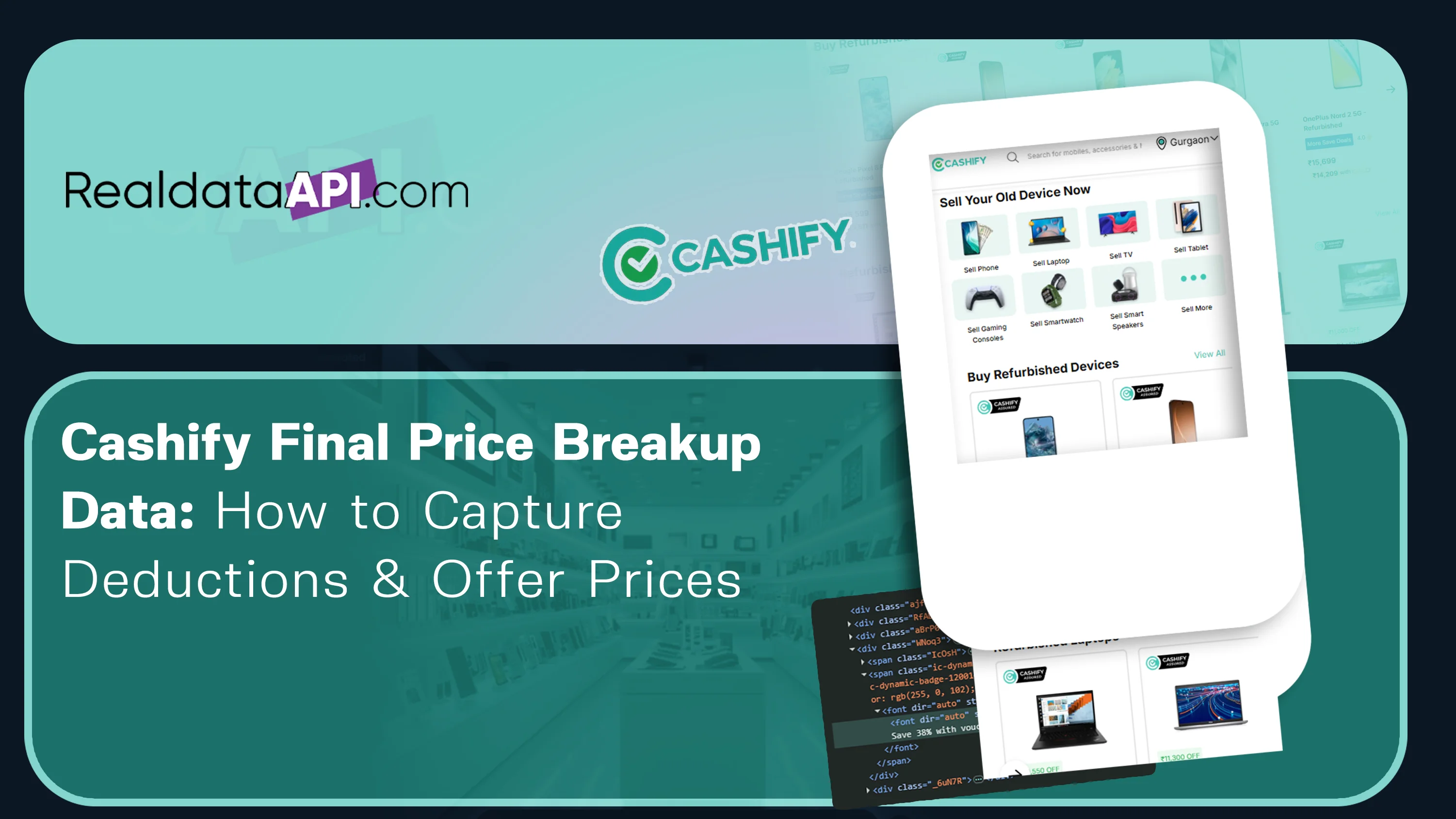
Cashify Final Price Breakup Data: How to Capture Deductions & Offer Prices

H&M Saudi Arabia Data Scraping: Men's & Women's Clothing




.png)


