.gif)
.gif)
Introduction
Etsy is the world's best-known marketplace for handmade, vintage and creative goods, and the United States is its largest market. Millions of listings cover everything from custom jewellery and wall art to wedding decor, digital downloads and craft supplies. For sellers, product developers, agencies and market researchers, Etsy is a live map of what people want to buy and how much they will pay. But the platform is vast and unstructured, which makes manual research slow. Etsy data scraping converts it into structured datasets for trend discovery, pricing and competitor analysis.
For broader marketplace coverage, ecommerce data scraping can extend the same structured approach to other online retail sources.
This guide explains what data is available, how Etsy scraping works, what the main technical and ethical concerns are and how teams use the data.
For automated delivery into downstream systems, an ecommerce scraping API can provide structured results without relying only on file exports.
Why Etsy Data Is Valuable
Etsy differs from general marketplaces in several ways:
- Niche and long-tail products: tens of thousands of micro-niches such as personalised pet portraits or minimalist ring boxes.
- Strong keyword culture: sellers optimise titles and tags carefully, so search terms reveal real demand.
- Visible social proof: shop sales counts, review counts and favourites indicate popularity.
- Seasonality and trends: wedding, holiday, graduation and back-to-school categories move predictably.
- Mix of physical and digital products: printable files, templates and fonts sit next to physical goods.
These features make Etsy ideal for trend research and product validation.
Data Fields Available
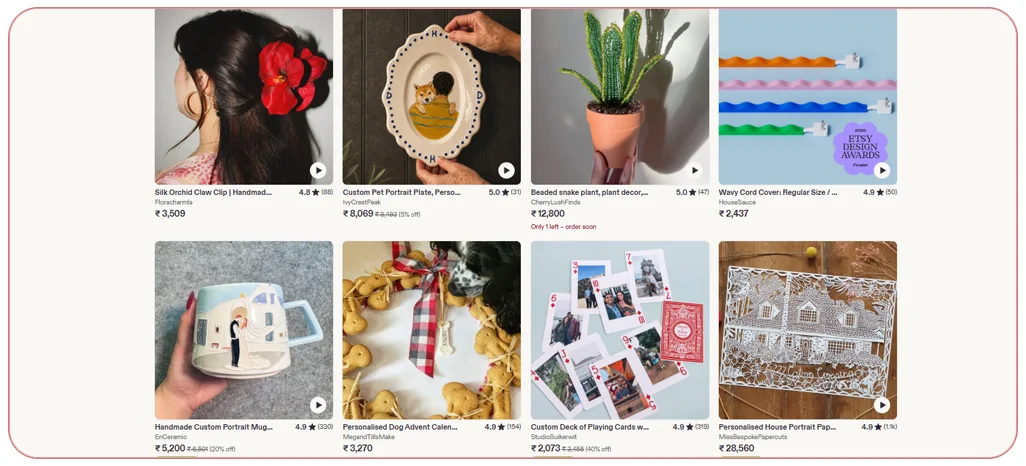
Listing data: listing ID, title, description, price, sale price, currency, quantity available, category path, tags (where shown), materials, processing time, shipping details, personalisation options, images and listing URL.
Variation data: options such as size, colour or material and their price differences.
Shop data: shop name, shop ID, location, year opened, total sales count, number of listings, shop rating, review count, admirers or followers and shop announcement text.
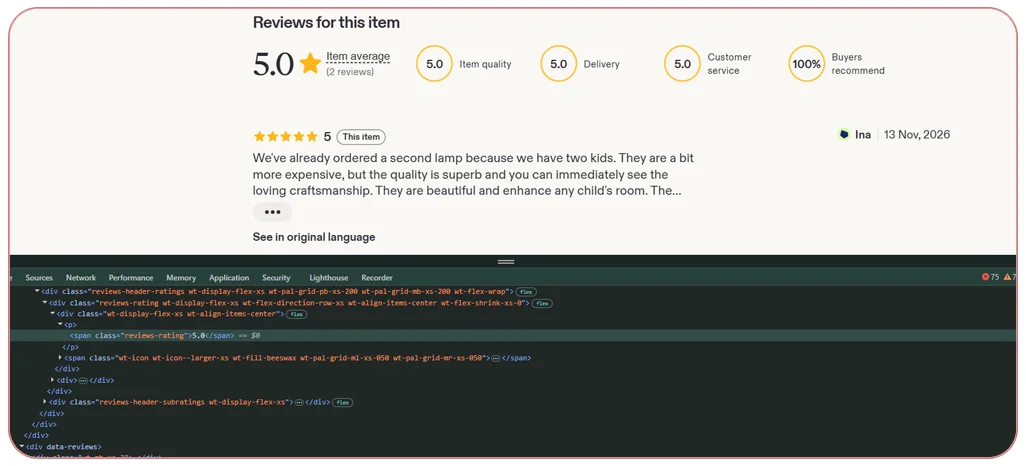
Popularity signals: number of favourites, reviews per listing, bestseller badges, star seller badges and the number of carts in which an item currently sits, when displayed.
Review data: rating and review text if required, with attention to volume and usage rights.
Search data: keyword, rank in results, ad or organic label and page number.
Common Project Types
Price benchmarking can also be strengthened with price data scraping across comparable marketplaces and retailers.
- Keyword and niche research: collect the top listings for a set of keywords and analyse prices, tags and shop sizes.
- Competitor shop tracking: follow listings, price changes and new products from selected shops.
- Trend discovery: compare listing counts and review velocity over time.
- Category-level datasets: collect a full category such as wedding invitations for market sizing.
- Seller prospecting: build a list of established shops for partnerships, supply or services.
How Etsy Scraping Works
- Define the scope. Choose keywords, categories or shops. For US focus, set the shipping destination and currency to United States and USD.
- Collect search or category listings. Page through results and capture listing cards with price, shop name and signals.
- Open listing pages. Collect the full description, variations, shipping, materials and review summary.
- Open shop pages. Collect shop-level data such as sales count, location and listing counts.
- Parse tags and attributes. Where tags are visible, extract them. Otherwise infer keywords from titles.
- Standardise. Normalise prices, categories, materials and shipping information.
- Track time series. Repeat collection to measure changes in prices, reviews, favourites and new listings.
- Deliver. Provide files or an API, with dashboards for trends if needed.
Metrics You Can Build
- Median price and price distribution for a keyword or category
- Share of listings with free shipping
- Average shop age and size for top results
- Review velocity, the number of new reviews over a period, as a proxy for sales
- Listing growth rate for a niche over time
- Keyword frequency in titles and tags of top listings
- Concentration: how much of the top results is held by a few large shops
Interpreting Popularity Signals Carefully
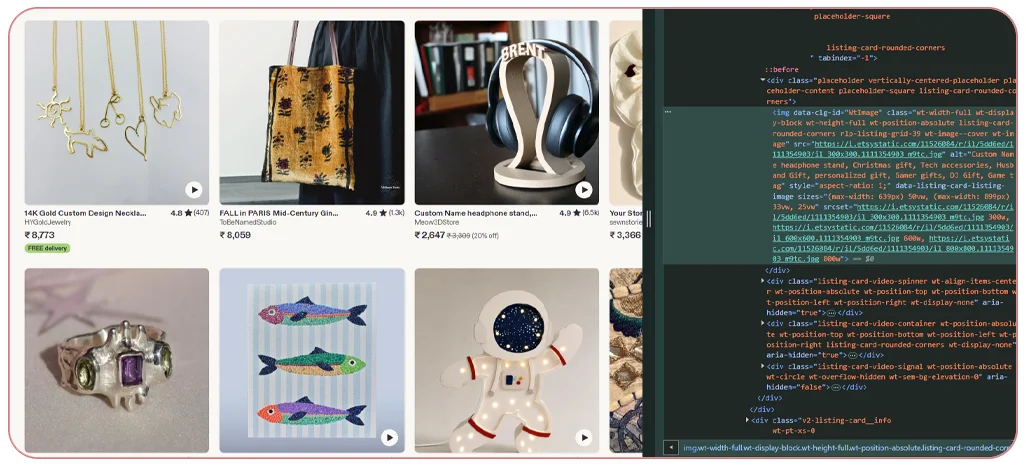
Etsy shows social proof, not exact sales for each listing. Review counts, favourites and shop sales counts are useful indicators, but they must be interpreted with care. A listing may share reviews with a shop, a bestseller badge may be temporary and an old listing may have many reviews but few current sales. Combining several signals and tracking them over time gives a more reliable view than any single number.
Technical Challenges
For high-volume projects, a web scraping API can help support scalable collection and data delivery workflows.
- Anti-bot protection: Etsy actively limits automated traffic, so collection requires careful pacing, rotation and monitoring.
- Personalised and geo-specific results: shipping destination, currency and ads change what is displayed.
- Dynamic content: listings load via scripts, and some fields appear only after interaction.
- Variations and personalisation: many listings have several option groups, each with its own price effect.
- Volume: keyword and category projects can include hundreds of thousands of listings.
- Changing layouts: Etsy updates its pages often, which requires regular scraper maintenance.
- Intellectual property: product images and designs belong to sellers, which matters for how you use the data.
Use Cases
For Etsy categories that overlap with apparel and accessories, fashion data scraping can provide additional competitive product and pricing context.
- New sellers: validate niches and price points before investing in inventory.
- Established shops: monitor competitors and adjust prices and tags.
- Product developers and brands: find trending styles and materials to inspire new lines.
- Print-on-demand and supply businesses: identify shops that might need your products or services.
- Marketing agencies and tool builders: power keyword research and analytics tools for sellers.
- Investors and analysts: study marketplace health, category growth and seller concentration.
Example: Validating A Wedding-Stationery Niche
A designer wants to launch custom wedding stationery. She collects the top 5,000 listings for ten wedding-related keywords, including prices, shipping, shop sizes and review counts. The data shows that the median price for her niche is higher than she expected, that most top shops offer personalisation and that listing titles with a particular style keyword grow faster. She sets prices and designs her listings accordingly.
Example: Monitoring Competitors
A candle-making shop tracks 20 competitor shops weekly. It records new listings, price changes and review growth. After a month, it notices that two competitors have launched a seasonal scent line with free shipping and are gaining reviews rapidly. The shop adjusts its seasonal range and shipping offers.
Sample Output
A row may include: keyword, rank, listing ID, title, price, sale price, currency, shipping cost, free shipping flag, category path, tags, materials, personalisation flag, shop name, shop location, shop sales count, shop rating, listing review count, favourites, star seller flag, bestseller flag, product URL and timestamp.
Data Quality Checks
- Confirm currency and shipping destination for each run
- Check that prices are numeric and that sale prices are lower than regular prices
- Compare listing counts per keyword with previous runs
- Review samples manually against live pages
- Flag duplicate listings and promoted placements
Delivery And Refresh
Teams that need ongoing multi-source collection can also use data scraping services for managed extraction and refresh cycles.
Data can be delivered as CSV, Excel or JSON via API, or as dashboards for trend analysis. Weekly collection suits trend research, while daily collection is better for competitor price monitoring or seasonal peaks.
Responsible Data Collection
Collect only publicly visible information, avoid personal data about buyers, keep request rates reasonable and follow Etsy's terms and applicable laws. Product images, descriptions and designs are protected by copyright and by sellers' rights, so do not copy listings or reuse images without permission.
Why Choose Real Data API For Etsy Data Scraping
Real Data API builds Etsy scrapers that handle listings, variations, shop data and time-series tracking. A pilot with a few keywords or a short competitor list helps you validate the metrics and plan the full project.
Conclusion
Etsy data scraping helps sellers, brands and analysts turn a huge, unstructured marketplace into usable insight. With structured listings, shop data and time-series tracking, you can validate niches, price products well and monitor competitors with evidence.
Need Etsy data for the US market? Real Data API can deliver a pilot for your keywords or competitor shops.
FAQs
Can you tell me how many sales a listing has?
Etsy does not show exact sales per listing. We capture shop sales counts, review counts, favourites and badges, which can be combined into estimates.
Can you collect tags?
Where tags are visible on the page, yes. Where they are not, we can extract keywords from titles and descriptions.
Can you target US shoppers specifically?
Yes. The shipping destination and currency can be set to the United States.
Can I track competitor shops over time?
Yes. Shops are monitored on a schedule, and changes in listings, prices and reviews are recorded.
Is Etsy data collection allowed?
Check Etsy's terms and applicable laws for your use case, and consider using Etsy's official programmes where they meet your needs.
Latest posts
Multi-Country, Multi-Brand Fashion Catalogue Scraping
Amazon & Zalando Germany Data for D2C Multi-Brand Tracking
Cashify Final Price Breakup Data: How to Capture Deductions & Offer Prices
H&M Saudi Arabia Data Scraping: Men's & Women's Clothing


.png)


