Introduction
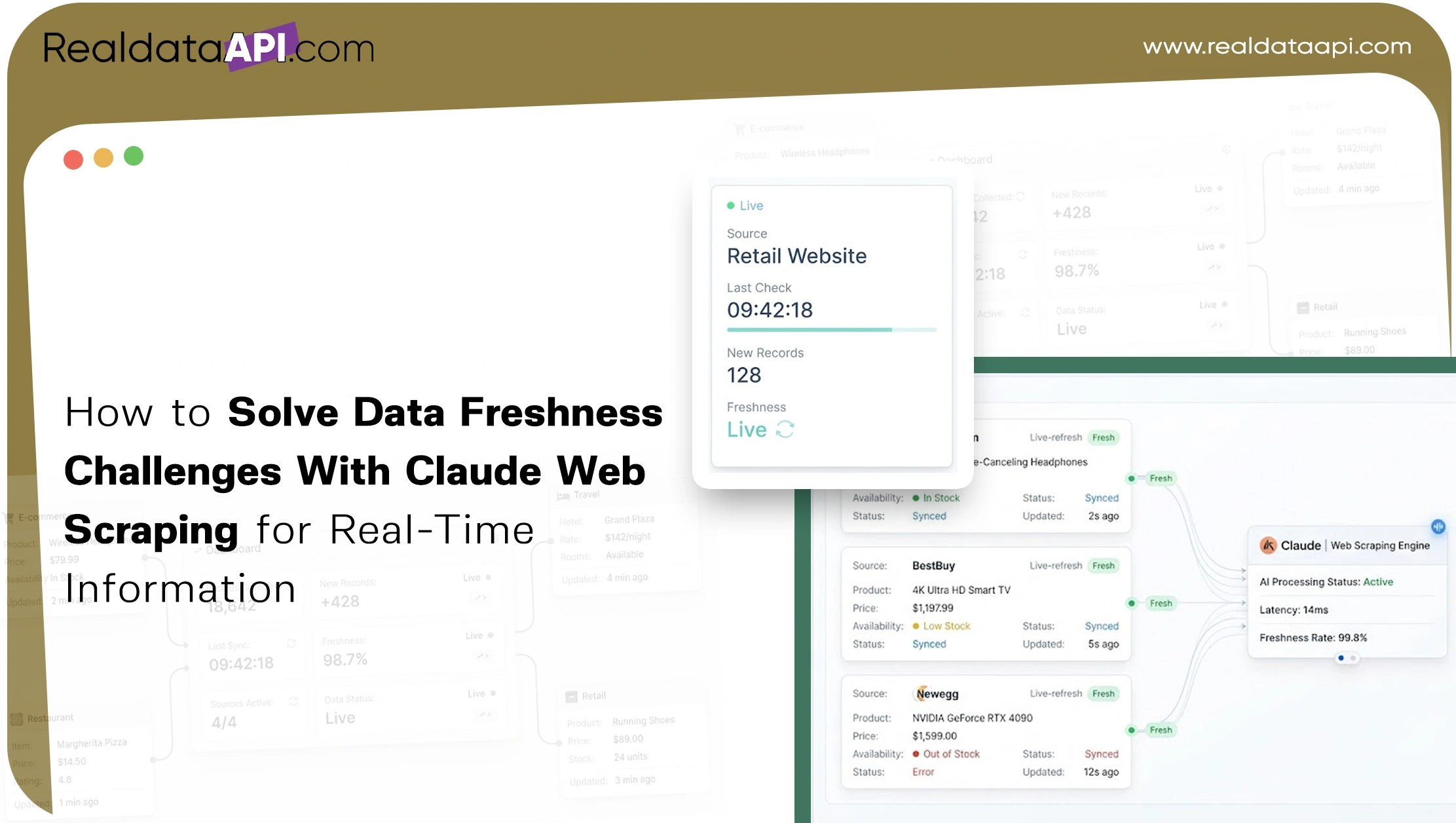
Businesses can solve data freshness problems by combining browser-based web extraction, structured data pipelines, validation, and AI-ready delivery. Claude web scraping for real-time information can help teams collect frequently changing web content and transform it into usable intelligence instead of relying on outdated datasets.
Modern AI applications need timely information. Product prices change throughout the day, inventory fluctuates, competitor pages are updated, travel availability moves rapidly, and market conditions evolve continuously. A model or analytics workflow that depends on stale information can produce less useful recommendations even when the underlying reasoning is strong.
Claude, developed by Anthropic, can be incorporated into workflows that analyze, summarize, classify, or reason over freshly collected web information. However, AI alone does not solve the data freshness problem. The collection layer must first retrieve relevant information, normalize it, validate it, and make it available to downstream applications.
This is where Real Data API can become valuable for businesses that need scalable web data infrastructure. A Claude Scraper workflow can connect web extraction with AI-oriented processing, allowing organizations to build pipelines for competitive intelligence, market research, ecommerce monitoring, pricing analysis, travel intelligence, and AI applications.
The most effective architecture separates collection, processing, storage, and AI reasoning. This approach makes freshness measurable and enables teams to refresh information according to business requirements.
Why Is Fresh Web Data Important for AI Applications?
AI systems are only as useful as the information supplied to them for a particular task. Static datasets can be valuable for historical analysis, but they may not reflect current prices, availability, product assortments, company announcements, listings, or market conditions.
For example, an ecommerce company could use an AI system to summarize competitor activity. If the underlying competitor data was collected several weeks ago, the resulting summary may not represent today's market. A continuously refreshed extraction pipeline can provide a more current information layer.
The same principle applies to travel companies tracking hotel availability, real estate companies monitoring rental listings, financial research teams analyzing public market information, and retailers monitoring promotions.
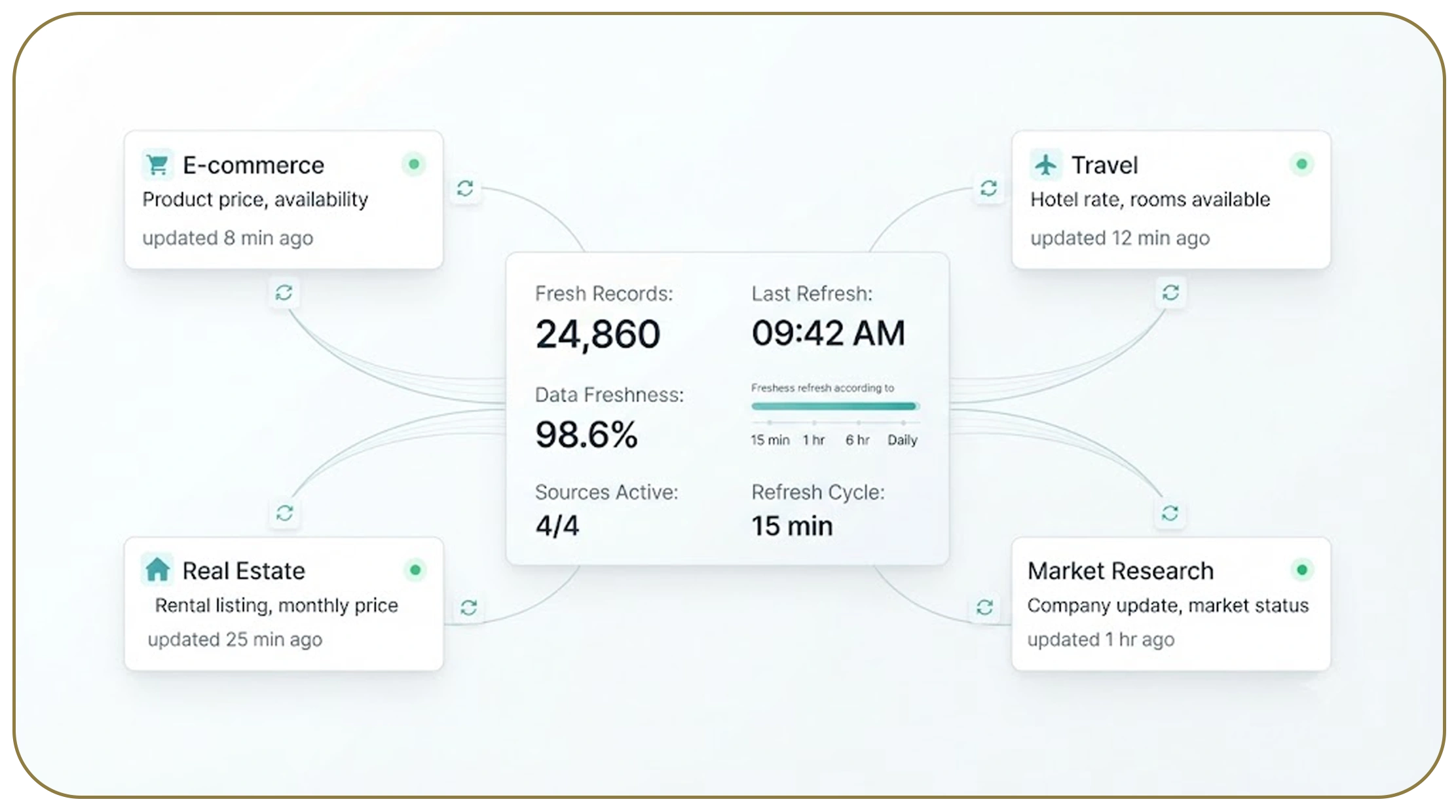
Real-time does not necessarily mean collecting every second. The appropriate refresh interval depends on how quickly the source changes and how quickly the business needs to react. A price-monitoring system may require hourly or more frequent updates, while a market research dataset may only need daily refreshes.
The objective is therefore decision-relevant freshness: collecting information frequently enough to support the intended business decision without creating unnecessary processing costs.
How Can Teams Prepare Better Web Information for AI Workflows?
Organizations looking to scrape web data for Claude AI should begin with the information requirement rather than the AI model. The first question should be: What information does the application need, and how frequently does that information change?
A retail intelligence application may require product title, SKU, price, discount, availability, seller, rating, and timestamp. A travel application could require property name, location, dates, room type, displayed rate, availability, and booking conditions.
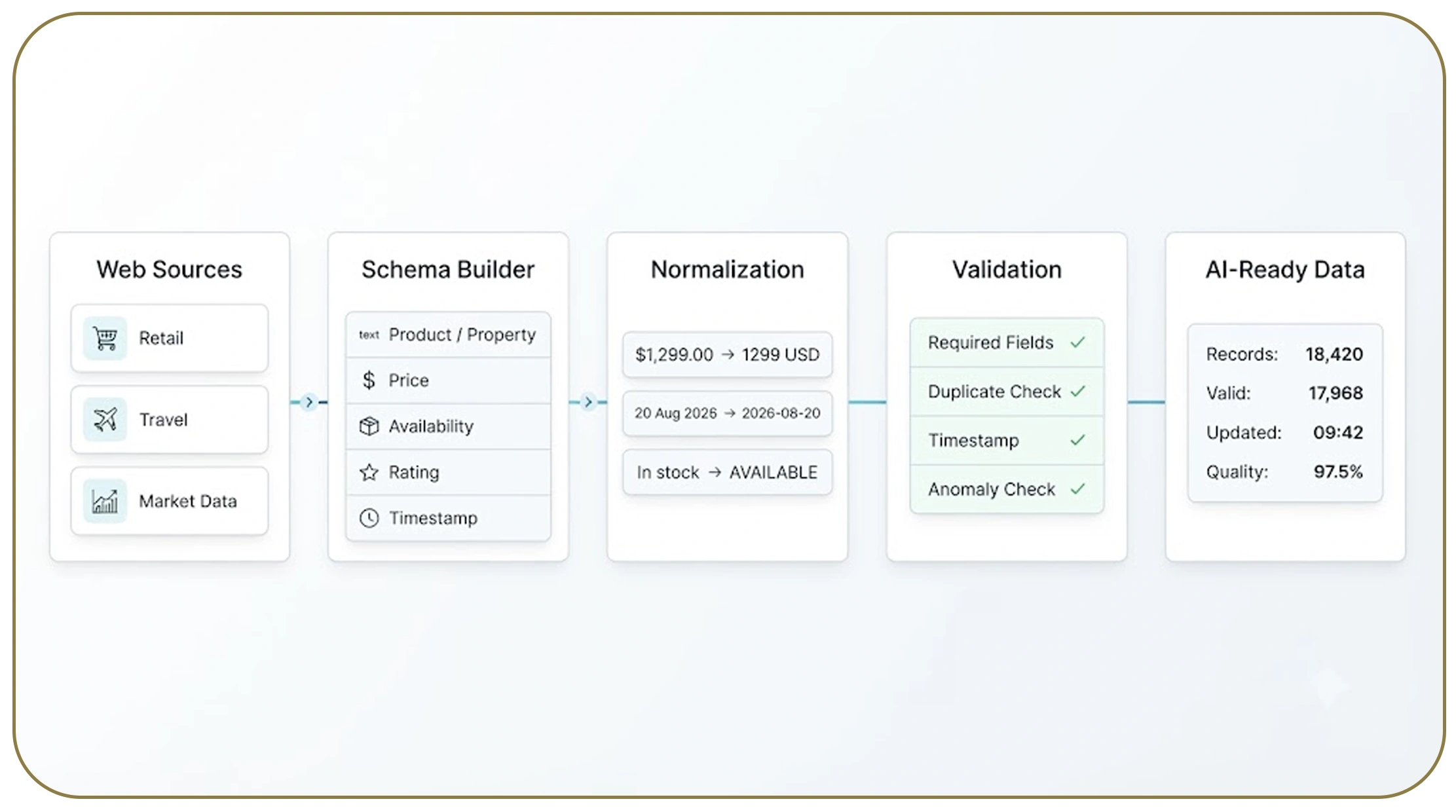
Once the schema is defined, the extraction layer can focus only on relevant fields. This reduces unnecessary processing and makes downstream AI analysis more consistent.
The data should then be normalized. Currency formats, dates, product identifiers, category names, and availability labels can vary between sources. Standardization makes records easier to compare and gives AI systems cleaner context.
Validation is equally important. A scraper that returns an empty price field should not automatically pass the record into an AI workflow. Required-field checks, duplicate detection, timestamp validation, and anomaly detection can identify potentially incomplete records.
The following figures are hypothetical planning data, not industry statistics. They demonstrate how a business could track the growth of an AI-ready data pipeline.
| Year | Monthly Records | AI-Ready Fields | Validation Coverage |
|---|---|---|---|
| 2020 | 100,000 | 8 | 60% |
| 2021 | 180,000 | 10 | 66% |
| 2022 | 350,000 | 12 | 72% |
| 2023 | 700,000 | 16 | 80% |
| 2024 | 1,300,000 | 20 | 87% |
| 2025 | 2,500,000 | 25 | 93% |
| 2026 | 4,500,000 | 30 | 97% |
The practical lesson is clear: AI performance depends on data quality as much as data volume. A smaller, well-validated current dataset can be more useful for operational decisions than a larger collection containing stale or inconsistent records.
How Can Businesses Maintain a Continuous Flow of Current Information?
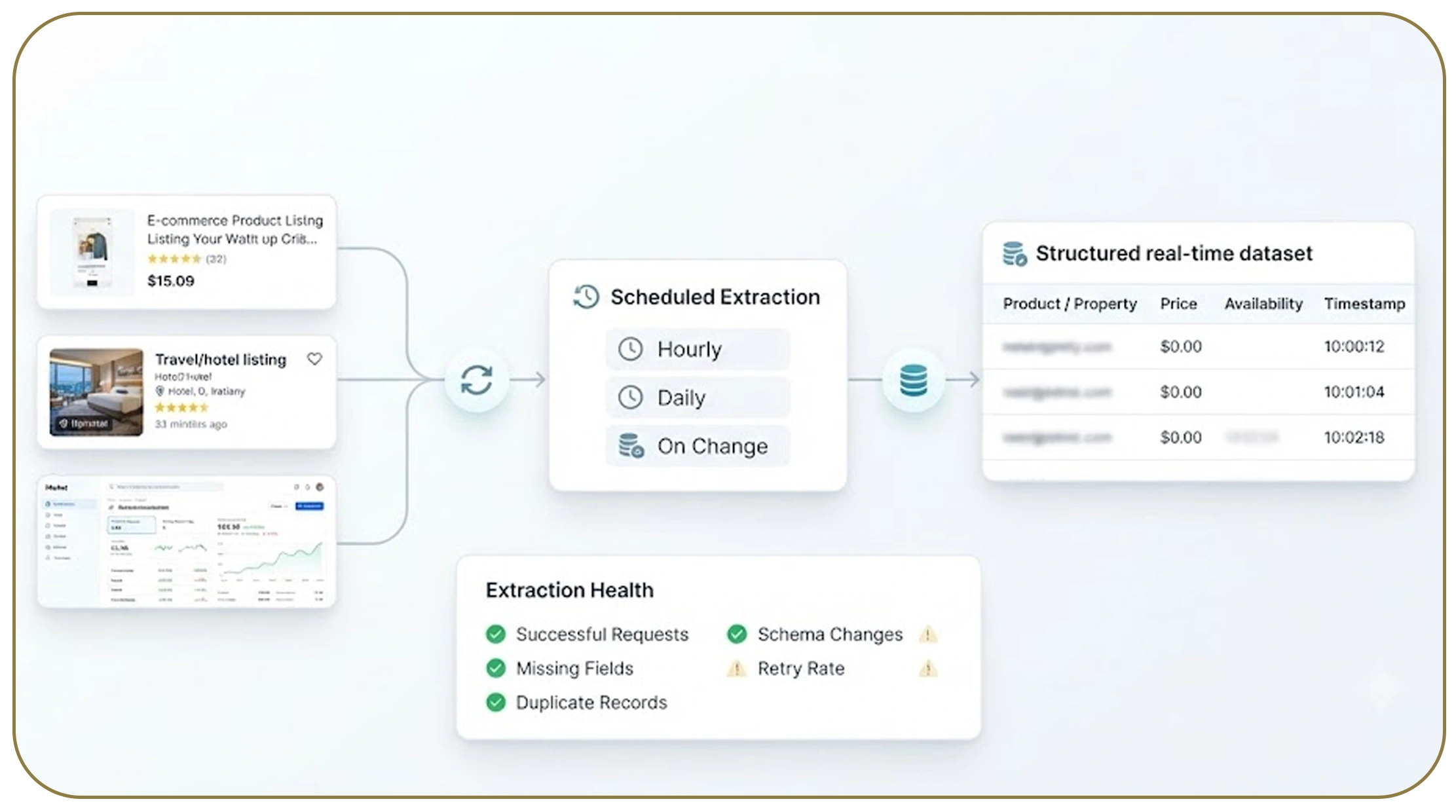
Real-time web data collection services can help organizations establish recurring extraction schedules for information that changes frequently. Instead of treating scraping as a one-time research project, businesses can create a repeatable pipeline that continuously refreshes selected sources.
A useful workflow starts with source discovery and prioritization. Businesses should identify which pages contain decision-critical information and assign refresh frequencies according to their volatility.
For instance, an online retailer may monitor high-priority products every hour while collecting broader category information once per day. A travel company may refresh selected routes and properties frequently while maintaining a less frequent historical catalog refresh.
The pipeline should record timestamps for every extraction. This creates an auditable history of changes and allows analysts to determine whether a particular price, listing, or availability state is current.
Monitoring should also measure extraction health. Useful metrics include successful requests, missing fields, response latency, duplicate records, schema changes, and retry rates.
The following hypothetical dataset illustrates how a company might increase collection frequency as its real-time intelligence program matures.
| Year | Refresh Frequency | Records/Month | Primary Use |
|---|---|---|---|
| 2020 | Weekly | 120,000 | Market research |
| 2021 | Daily | 300,000 | Competitor monitoring |
| 2022 | Daily | 700,000 | Product intelligence |
| 2023 | 4× Daily | 1,500,000 | Price monitoring |
| 2024 | Hourly | 3,500,000 | Operational intelligence |
| 2025 | Hourly | 7,000,000 | Automated alerts |
| 2026 | Near-real-time | 14,000,000 | AI-driven workflows |
These numbers are illustrative only. Actual requirements depend on website behavior, page complexity, data volume, technical constraints, and business objectives.
The key insight is that freshness should be engineered intentionally. Businesses should not automatically choose the highest possible collection frequency. They should choose the frequency that produces meaningful business value.
How Can Developers Connect Web Content With AI Processing?
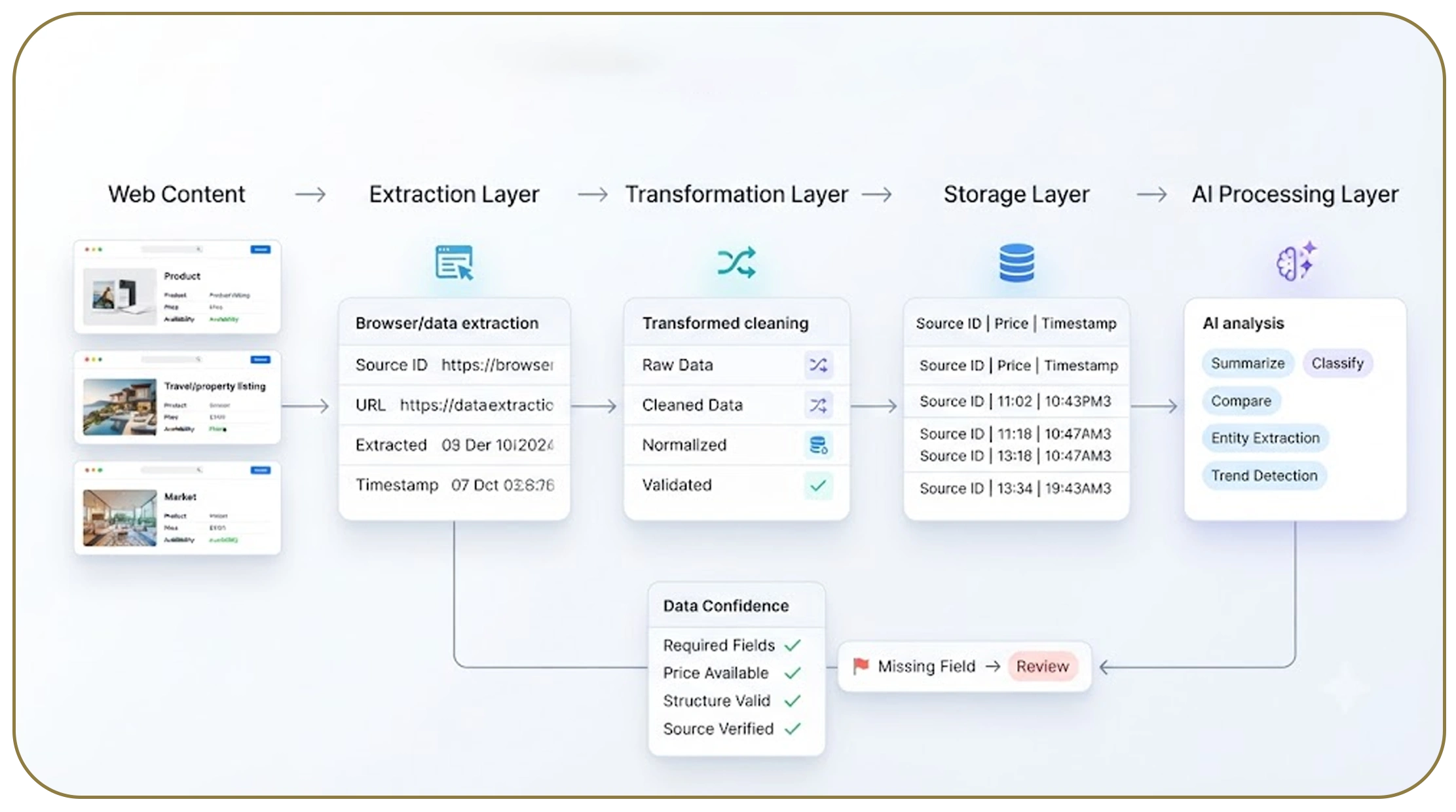
Teams that want to extract website data using Claude API workflows should treat web extraction and AI processing as separate but connected layers.
The extraction layer retrieves source information. The transformation layer cleans and structures it. The storage layer preserves current and historical records. The AI layer can then summarize, classify, compare, extract entities, identify trends, or answer questions using the prepared information.
This separation has several advantages. If a website changes its page structure, the extraction component can be updated without redesigning the AI application. If the business changes its AI prompt or analytical requirements, the underlying data pipeline can continue operating.
A timestamp and source identifier should accompany important records. These fields provide context for AI applications and help users understand the freshness and origin of information.
Businesses can also create confidence rules. For example, if a required price field is missing or the page returns an unexpected structure, the record can be flagged rather than sent directly into an automated decision workflow.
The following hypothetical data shows how a company could measure the expansion of an AI-integrated extraction pipeline.
| Year | Sources | Monthly Records | AI Processing Jobs |
|---|---|---|---|
| 2020 | 20 | 100,000 | 15,000 |
| 2021 | 35 | 220,000 | 35,000 |
| 2022 | 60 | 500,000 | 90,000 |
| 2023 | 90 | 1,000,000 | 180,000 |
| 2024 | 140 | 2,000,000 | 350,000 |
| 2025 | 200 | 4,000,000 | 750,000 |
| 2026 | 300 | 8,000,000 | 1,500,000 |
These figures are hypothetical and intended to demonstrate a measurement framework.
The strongest architecture avoids sending raw, noisy HTML directly into an AI model. Structured, relevant, validated information gives downstream applications a clearer context window and makes the overall system easier to monitor.
How Can Browser Rendering Improve Access to Dynamic Pages?
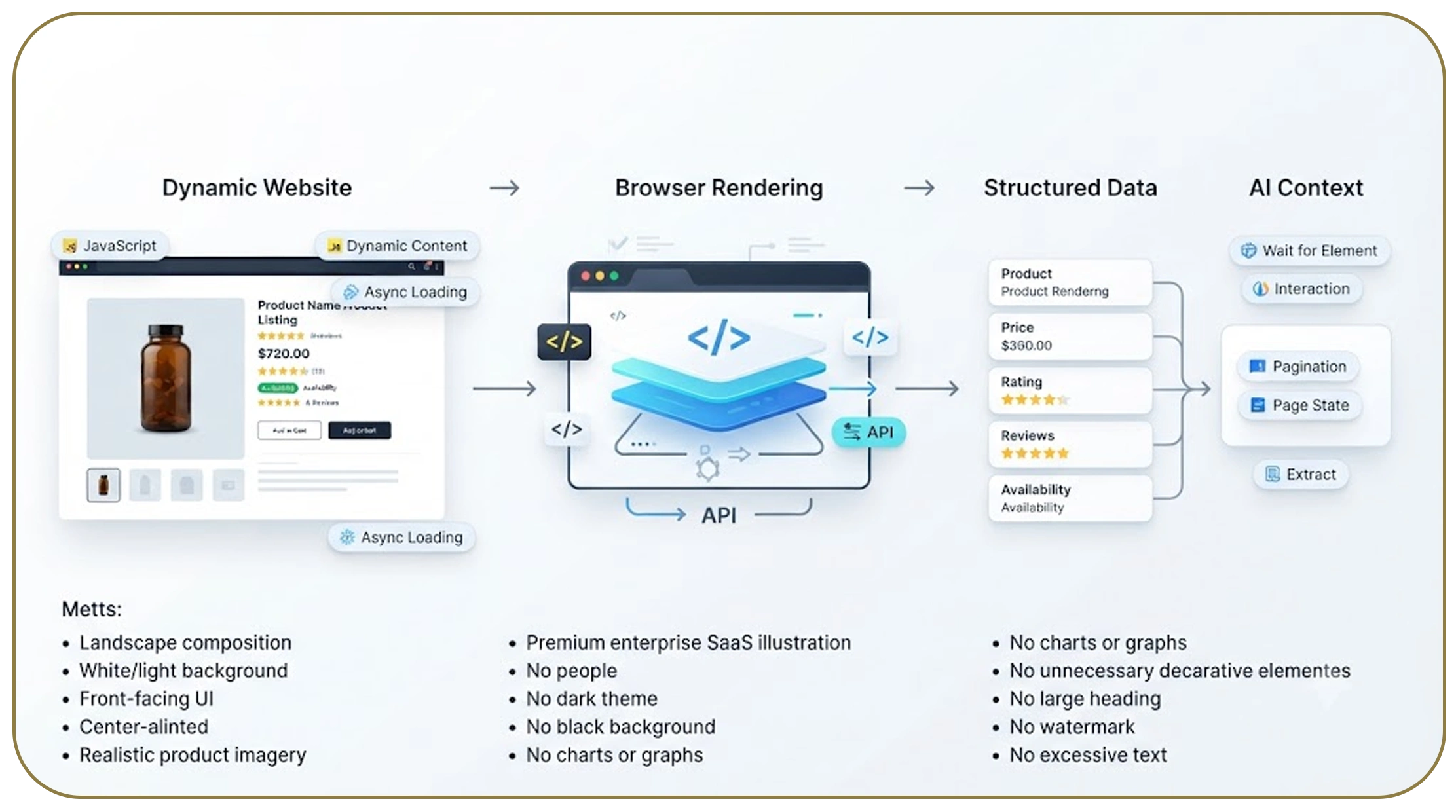
A Scraping Browser API can help businesses collect information from websites where content depends on JavaScript execution, browser rendering, user interaction, asynchronous requests, or dynamically generated page elements.
Traditional HTTP requests may retrieve the initial document without exposing the information a user sees after the page finishes loading. This can create missing prices, incomplete product catalogs, unavailable reviews, or empty listing fields.
Browser-based extraction addresses this challenge by allowing pages to load in an environment capable of executing client-side behavior. Depending on the use case, the workflow may also need to wait for specific elements, interact with filters, handle pagination, or capture content after a defined page state is reached.
For AI data pipelines, this capability is important because incomplete extraction can create incomplete AI context. If the price field is missing from a product record, an AI system cannot reliably reason about that price.
The following hypothetical performance framework demonstrates the type of metrics an engineering team could track.
| Year | Dynamic Pages/Month | Extraction Attempts | Validated Records |
|---|---|---|---|
| 2020 | 50,000 | 100,000 | 82,000 |
| 2021 | 100,000 | 220,000 | 185,000 |
| 2022 | 220,000 | 500,000 | 435,000 |
| 2023 | 400,000 | 1,000,000 | 900,000 |
| 2024 | 750,000 | 2,000,000 | 1,840,000 |
| 2025 | 1,400,000 | 4,000,000 | 3,760,000 |
| 2026 | 2,500,000 | 8,000,000 | 7,600,000 |
These values are hypothetical, not benchmark claims.
Businesses should evaluate browser-based collection according to the fields they need, the complexity of target pages, required refresh rates, and the quality controls surrounding extraction.
How Can Historical Datasets Make Real-Time Information More Valuable?
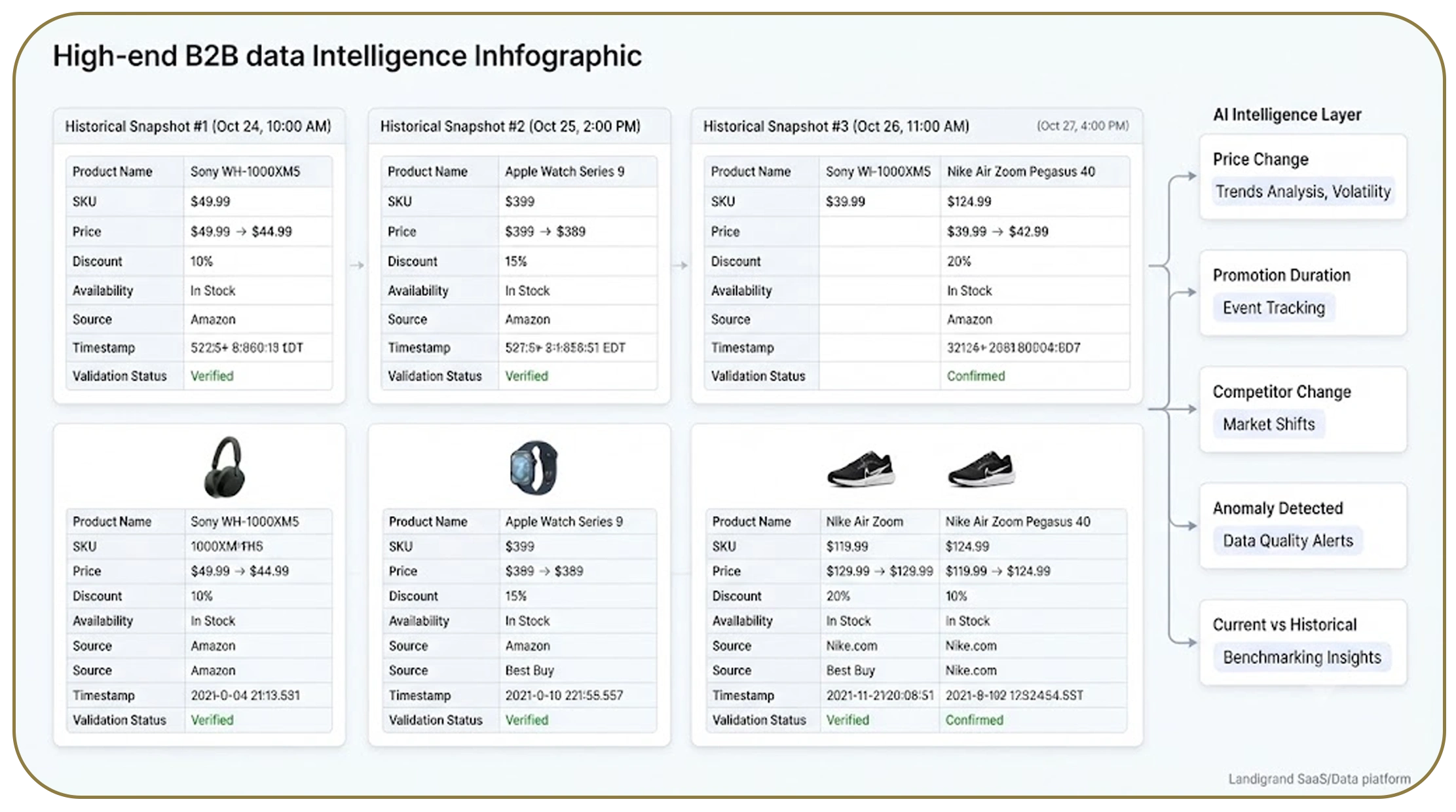
Web Scraping Datasets become more valuable when they preserve historical snapshots instead of replacing old information with every new collection.
A current product price tells a business what is happening now. A historical series can reveal how that price changed, when promotions started, how long discounts lasted, and whether a competitor repeatedly changed its strategy.
For AI applications, historical information provides context. A system can compare current conditions with previous observations, identify anomalies, summarize changes, or generate trend reports.
Businesses should design their storage layer around immutable snapshots where practical. Each record can include the source, timestamp, identifier, extracted fields, and validation status. This creates a foundation for historical analytics.
The following hypothetical dataset illustrates how a business could expand historical coverage.
| Year | Records Stored | Historical Days Available | Data Sources |
|---|---|---|---|
| 2020 | 500,000 | 90 | 15 |
| 2021 | 1,200,000 | 180 | 25 |
| 2022 | 3,000,000 | 365 | 45 |
| 2023 | 7,000,000 | 540 | 70 |
| 2024 | 15,000,000 | 730 | 110 |
| 2025 | 30,000,000 | 1,095 | 160 |
| 2026 | 60,000,000 | 1,460 | 220 |
These numbers are hypothetical examples.
Historical data also enables better alerting. Instead of simply saying that a price changed, an analytics system can determine whether the new price is unusual compared with previous observations.
This distinction is important for AI applications because meaningful answers often require both current information and historical context.
How Can Fresh Web Data Improve AI-Powered Customer Experiences?
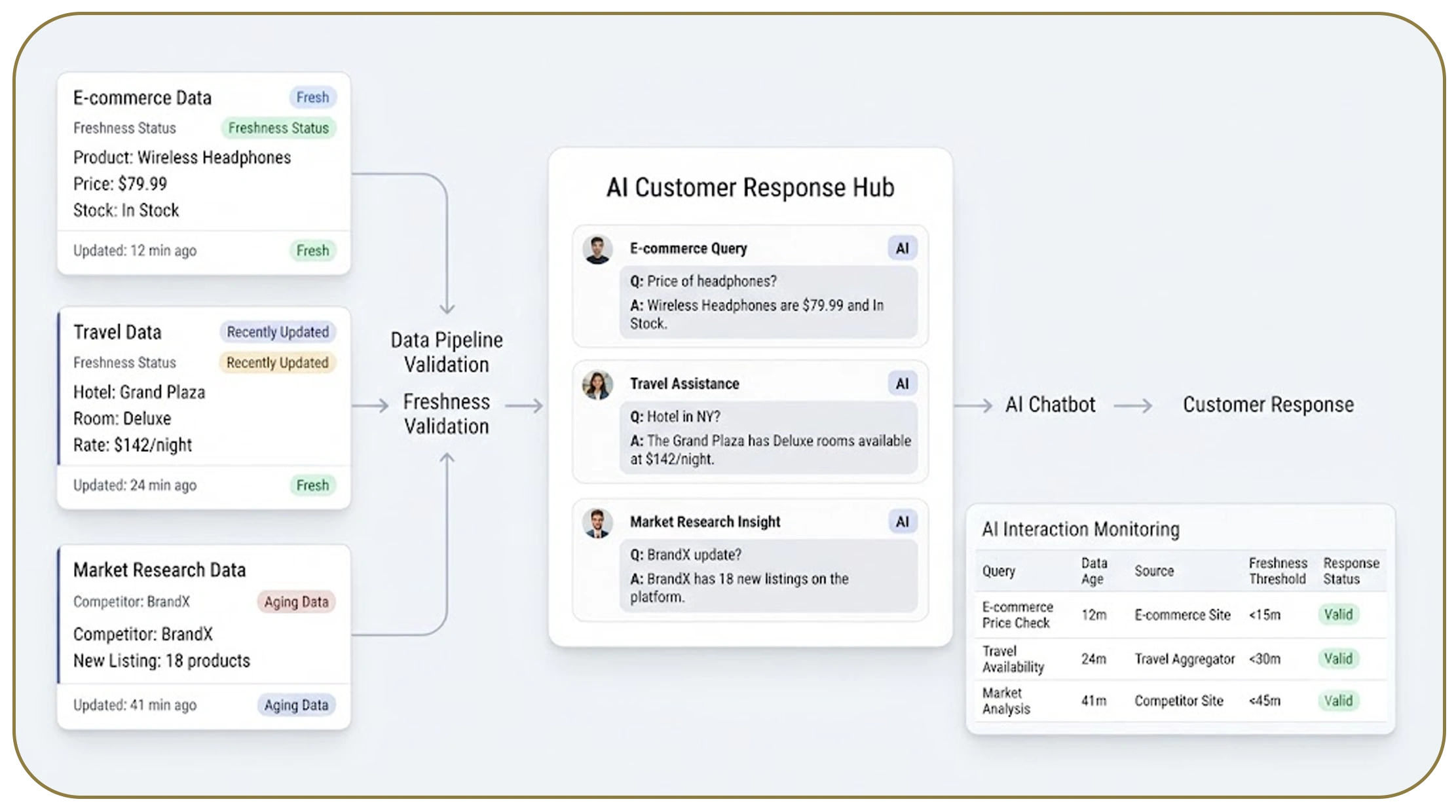
An AI Chatbot can become more useful when it has access to current, relevant information instead of relying exclusively on static knowledge.
For example, an ecommerce assistant may need current product availability and pricing. A travel assistant may need current property or route information. A market research assistant may need the latest competitor listings and announcements.
The architecture should distinguish between the AI reasoning layer and the information retrieval layer. The AI system interprets information, while the data pipeline supplies relevant and current records.
This creates an important design principle: freshness should be treated as a data attribute. Every record used by an AI application should have a timestamp or equivalent indicator that helps determine how current it is.
Businesses can also implement freshness thresholds. A chatbot answering a product availability question may require information collected within the last hour, while an application discussing long-term market trends may accept older records.
The following hypothetical data shows how an organization might monitor AI interactions supported by refreshed web information.
| Year | Monthly AI Queries | Queries Using Fresh Data | Freshness Target |
|---|---|---|---|
| 2020 | 50,000 | 20,000 | 7 days |
| 2021 | 120,000 | 60,000 | 3 days |
| 2022 | 300,000 | 180,000 | 24 hours |
| 2023 | 700,000 | 500,000 | 12 hours |
| 2024 | 1,500,000 | 1,200,000 | 6 hours |
| 2025 | 3,000,000 | 2,600,000 | 2 hours |
| 2026 | 6,000,000 | 5,400,000 | 1 hour |
These figures are illustrative and do not represent measured market performance.
The important point is that AI applications should have explicit freshness policies. Without one, a system may unknowingly combine current and obsolete information.
Why Should Businesses Choose Real Data API for Fresh Web Intelligence?
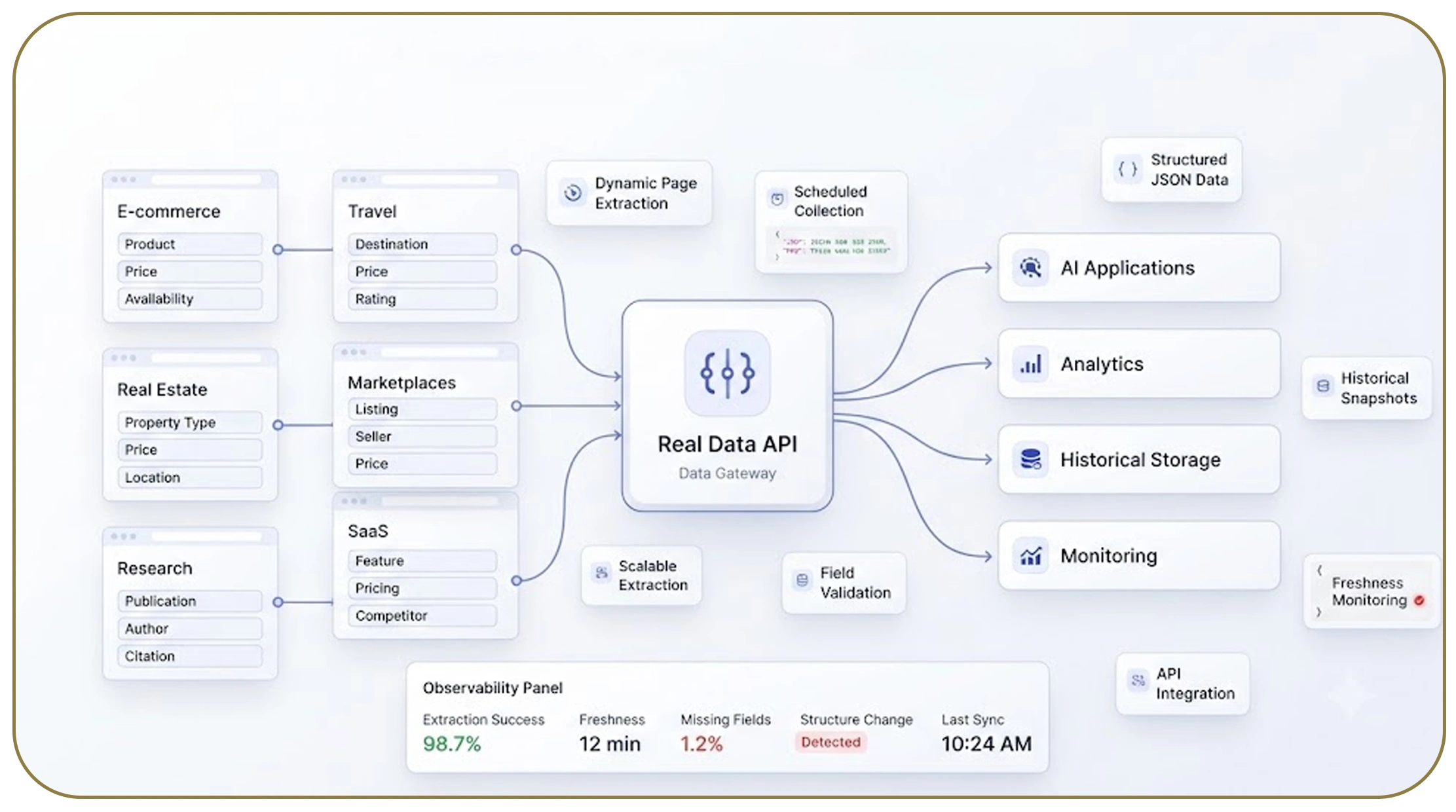
Real Data API can help businesses build structured web data workflows for use cases where information changes frequently and manual collection is inefficient.
For organizations exploring Claude web scraping for real-time information, the primary value is not simply collecting webpages. It is creating a dependable path from changing online information to structured records that can be analyzed, monitored, and supplied to AI workflows.
Real Data API can support projects requiring browser-based extraction, scheduled collection, structured datasets, historical snapshots, and integration with downstream analytics systems. This approach is relevant for ecommerce brands, marketplace intelligence providers, travel companies, real estate analysts, research firms, SaaS businesses, and AI product teams.
The buyer should evaluate a data provider using practical criteria: extraction coverage, scalability, data freshness, structured output, monitoring, reliability, integration options, and support for dynamic pages.
A successful implementation should also provide clear observability. Teams should know when extraction succeeds, when fields are missing, when page structures change, and when data freshness falls below the required threshold.
The goal is to create a production-oriented data layer rather than another isolated scraping script.
For companies building AI applications, this distinction matters. AI reasoning becomes more useful when the information supplied to it is relevant, current, structured, and traceable.
Conclusion
Data freshness is becoming a core requirement for businesses building modern analytics and AI applications. Static datasets remain useful for historical analysis, but they cannot always represent rapidly changing online conditions. Prices, inventory, listings, promotions, availability, product catalogs, and market information can change continuously.
The solution is not simply to scrape more pages. Businesses need a complete data pipeline that combines source discovery, browser-based extraction, structured schemas, validation, timestamps, historical storage, monitoring, and AI-ready delivery.
For organizations building AI assistants, competitive intelligence platforms, ecommerce analytics, market research systems, or automated decision-support applications, Claude web scraping for real-time information can be part of a broader architecture for supplying current external information to downstream workflows.
Real Data API helps businesses build scalable web data pipelines designed around these requirements. By combining reliable extraction with structured outputs and data-quality controls, organizations can reduce manual research and create a more dependable foundation for AI and analytics.
The most effective strategy is to begin with a measurable business problem, define the required freshness level, validate the data, and scale only after the workflow demonstrates value.
Explore Real Data API and build a reliable real-time data pipeline today using Claude web scraping for real-time information!
Latest posts
E-commerce data scraper for inventory analysis 2027 - Real-Time Stock Tracking and Demand Forecasting

How Meesho API data extraction for product research Helps E-Commerce Brands Improve Product Selection and Market Intelligence?

How AliExpress API integration for automated data collection Streamlines Product Monitoring, Price Tracking, and Seller Intelligence

How H&M data scraping for fashion retail analytics Enhances Stock Monitoring, Apparel Pricing, and Product Category Insights







.png)



