Introduction
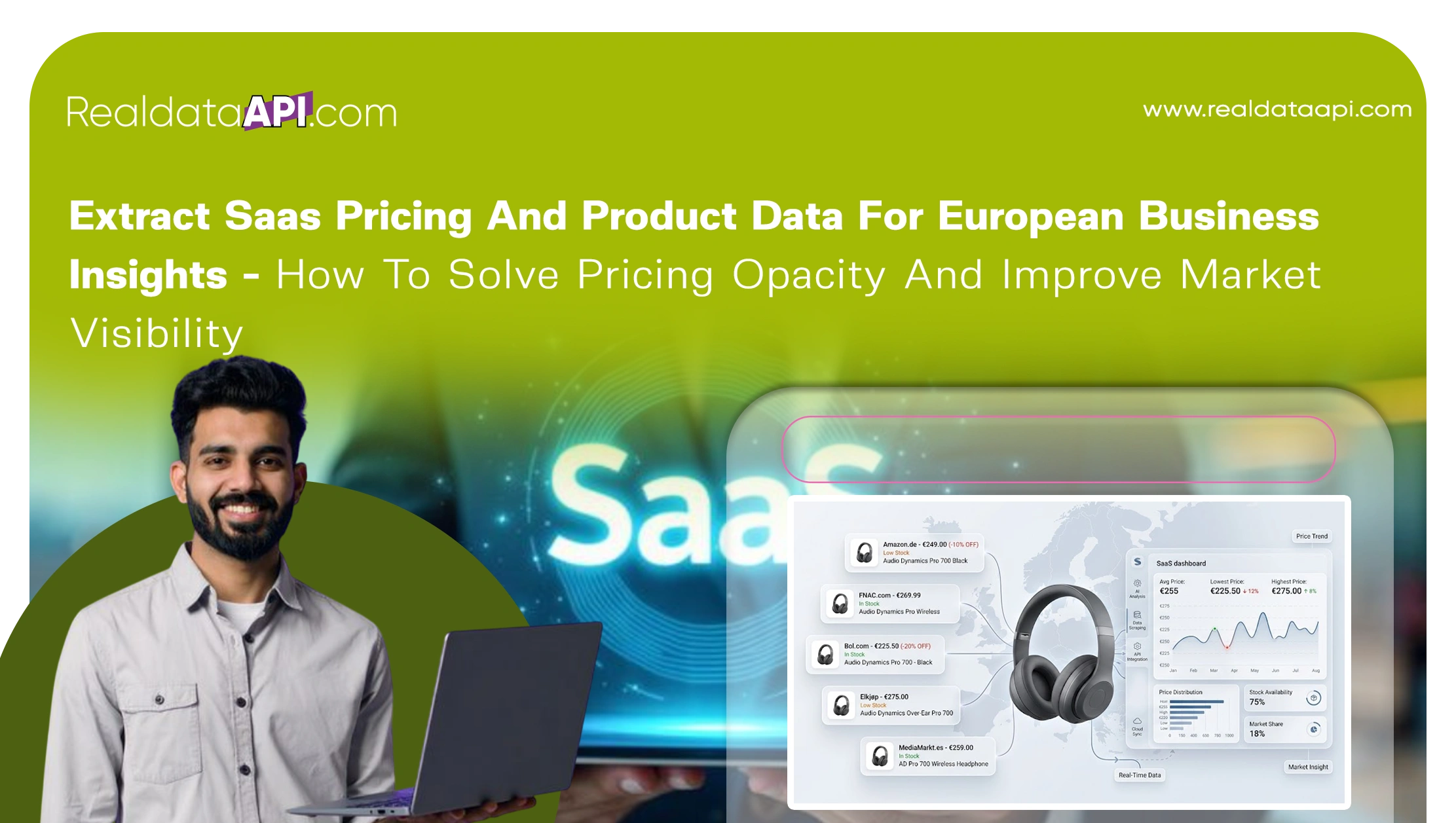
In today's competitive SaaS landscape, pricing transparency remains one of the biggest challenges for businesses operating across Europe. Companies often struggle to compare pricing tiers, feature bundles, and product positioning due to fragmented and inconsistent data sources. This is where extract SaaS pricing and product data for European business insights becomes a powerful strategy for gaining clarity and control over market positioning.
With growing competition and rapidly evolving SaaS models, businesses need continuous access to accurate and structured data. Leveraging real-time USA SaaS market data intelligence via API alongside European datasets enables organizations to benchmark pricing globally while adapting to regional dynamics. This dual perspective helps companies refine strategies and stay competitive.
By automating the extraction of pricing and product data, businesses can eliminate guesswork, uncover hidden trends, and make data-driven decisions. This blog explores how modern data solutions solve pricing opacity and improve market visibility across Europe's SaaS ecosystem.
Unlocking Market Visibility Through Structured Data
To gain a competitive edge, companies must rely on tools that support real-time SaaS business market intelligence data scraper europe capabilities. These tools help organizations collect structured pricing and product data across multiple SaaS platforms.
Between 2020 and 2026, the SaaS market in Europe has expanded significantly:
| Year | SaaS Companies (Europe) | Pricing Model Complexity Index |
|---|---|---|
| 2020 | 25,000 | Medium |
| 2022 | 35,000 | High |
| 2024 | 48,000 | Very High |
| 2026* | 65,000 (Projected) | Advanced |
This growth has led to increasingly complex pricing structures, making manual tracking inefficient. Automated data scraping consolidates pricing tiers, feature lists, and discount patterns into a single, unified dataset.
By leveraging structured data, businesses can identify pricing inconsistencies, track competitor changes, and analyze how products evolve over time. This enables better forecasting and strategic planning.
Ultimately, structured data collection transforms fragmented information into clear insights, helping companies improve market visibility and make smarter pricing decisions.
Gaining Competitive Clarity in Dynamic Markets
Understanding competitor strategies is critical for SaaS success. Using Web scraping for SaaS competitor analysis Europe, businesses can monitor pricing changes, feature updates, and product launches across competitors.
Competitive dynamics from 2020 to 2026:
| Year | Competitor Monitoring Adoption (%) | Pricing Update Frequency |
|---|---|---|
| 2020 | 30% | Quarterly |
| 2022 | 45% | Monthly |
| 2024 | 60% | Weekly |
| 2026* | 75% (Projected) | Real-Time |
As pricing updates become more frequent, businesses need automated systems to stay informed. Scraping tools provide continuous monitoring, ensuring that companies never miss critical changes.
For example, tracking competitor pricing tiers can reveal discount strategies or premium positioning. Similarly, analyzing feature updates can highlight innovation trends and gaps.
This level of competitive clarity allows businesses to adjust pricing strategies quickly and maintain a strong market position.
Identifying Trends That Shape Pricing Strategies
The ability to Analyze SaaS market trends Europe is essential for long-term success. Scraped data provides a comprehensive view of how pricing models and product offerings evolve over time.
Key trends between 2020 and 2026:
| Year | Subscription Model Adoption (%) | Freemium Model Usage (%) |
|---|---|---|
| 2020 | 55% | 28% |
| 2022 | 65% | 35% |
| 2024 | 72% | 42% |
| 2026* | 80% (Projected) | 50% |
These trends highlight the increasing popularity of flexible pricing models. By analyzing scraped data, businesses can identify which models perform best in specific markets.
For instance, freemium models may dominate in early-stage markets, while enterprise-focused pricing may be more effective in mature segments.
Understanding these patterns helps companies refine their pricing strategies and align them with market expectations.
Automating Data Collection for Efficiency and Accuracy
Manual data collection is time-consuming and prone to errors. By using tools to automate SaaS data Market data collection Europe, businesses can streamline their research processes and improve data accuracy.
Data collection efficiency trends:
| Year | Automation Adoption (%) | Data Accuracy Improvement (%) |
|---|---|---|
| 2020 | 25% | 15% |
| 2022 | 40% | 25% |
| 2024 | 58% | 35% |
| 2026* | 72% (Projected) | 45% |
Automation enables businesses to collect data at scale, covering multiple competitors and markets simultaneously. It also ensures consistency, reducing the risk of outdated or incomplete information.
For example, automated scraping can track pricing updates across hundreds of SaaS platforms in real time, providing instant insights.
This efficiency allows teams to focus on analysis and strategy rather than data collection.
Leveraging APIs for Seamless Data Integration
Modern businesses rely on Web Scraping API solutions to integrate data directly into their analytics systems. APIs provide structured, ready-to-use data that can be easily incorporated into dashboards and decision-making tools.
API adoption trends:
| Year | API Usage in SaaS Research (%) | Integration Efficiency Score |
|---|---|---|
| 2020 | 35% | Medium |
| 2022 | 50% | High |
| 2024 | 65% | Very High |
| 2026* | 80% (Projected) | Advanced |
Using APIs, businesses can automate data flows, ensuring that insights are always up to date. This is particularly important for pricing analysis, where even small changes can have significant impacts.
APIs also enable integration with AI and analytics tools, allowing for advanced forecasting and predictive modeling.
By leveraging API-based solutions, companies can enhance their data capabilities and improve decision-making processes.
Scaling Intelligence with Advanced Crawling Systems
For large-scale operations, Enterprise Web Crawling provides the infrastructure needed to handle massive datasets. This approach enables continuous monitoring of thousands of SaaS platforms across Europe.
Enterprise data trends:
| Year | Enterprise Adoption (%) | Data Sources Monitored |
|---|---|---|
| 2020 | 20% | 1,000 |
| 2022 | 32% | 2,000 | 2024 | 48% | 4,000 |
| 2026* | 65% (Projected) | 8,000 |
Enterprise crawling supports advanced analytics, including competitor mapping and predictive insights. It also ensures scalability, allowing businesses to expand their data operations as they grow.
This level of infrastructure is essential for maintaining a competitive edge in rapidly evolving SaaS markets.
Why Choose Real Data API?
Real Data API offers powerful solutions designed to meet the needs of modern SaaS businesses. With advanced Web Scraping Services, companies can efficiently collect, process, and analyze large volumes of data.
Additionally, extract SaaS pricing and product data for European business insights is fully supported, enabling businesses to gain clear visibility into pricing structures and market trends.
Key benefits include:
- High-quality structured datasets
- Real-time data access
- Scalable infrastructure
- Seamless API integration
- Compliance-ready solutions
By choosing Real Data API, businesses can simplify complex data challenges and focus on strategic growth.
Conclusion
In an increasingly complex SaaS ecosystem, extract SaaS pricing and product data for European business insights is essential for overcoming pricing opacity and improving market visibility. Automated data collection, real-time insights, and scalable infrastructure empower businesses to make smarter decisions and stay ahead of competitors.
Start using Real Data API today to unlock powerful SaaS pricing insights and transform your market strategy.
Latest posts
Why Brands Use Competitive Data Intelligence to Increase Market Share in Highly Competitive Markets?
How To Scrape Competitor Data To Support Market Entry Strategy And Expansion Planning For Data-Driven Business Growth?

How Hotel Occupancy Intelligence Through Public Data Sources Is Reshaping Revenue Management
The ZIP Code Advantage: How Hyper-Local Amazon Product Data Collection Is Redefining Retail Intelligence

Real Data API stands out as one of the premier global companies specializing in web data Scraping and web extraction.





.png)


Rating 4.7
Rating 4.7
Rating 4.5
Rating 4.7
Rating 4.7


Disclaimer : RealData API functions solely as an independent data infrastructure and technology solutions provider. We build customized automation workflows designed to collect publicly accessible web data based exclusively on client instructions. RealData API neither owns proprietary datasets nor engages in the sale or redistribution of extracted information. Our operations are limited strictly to lawful public web data processing and never involve unauthorized access to restricted systems or private networks. Any company names, trademarks, logos, or brand references displayed on this website are used purely for demonstrative and illustrative purposes to showcase our technical capabilities and do not imply endorsement, partnership, or affiliation. Use of our platform and services remains subject to our Terms of Service.