Introduction
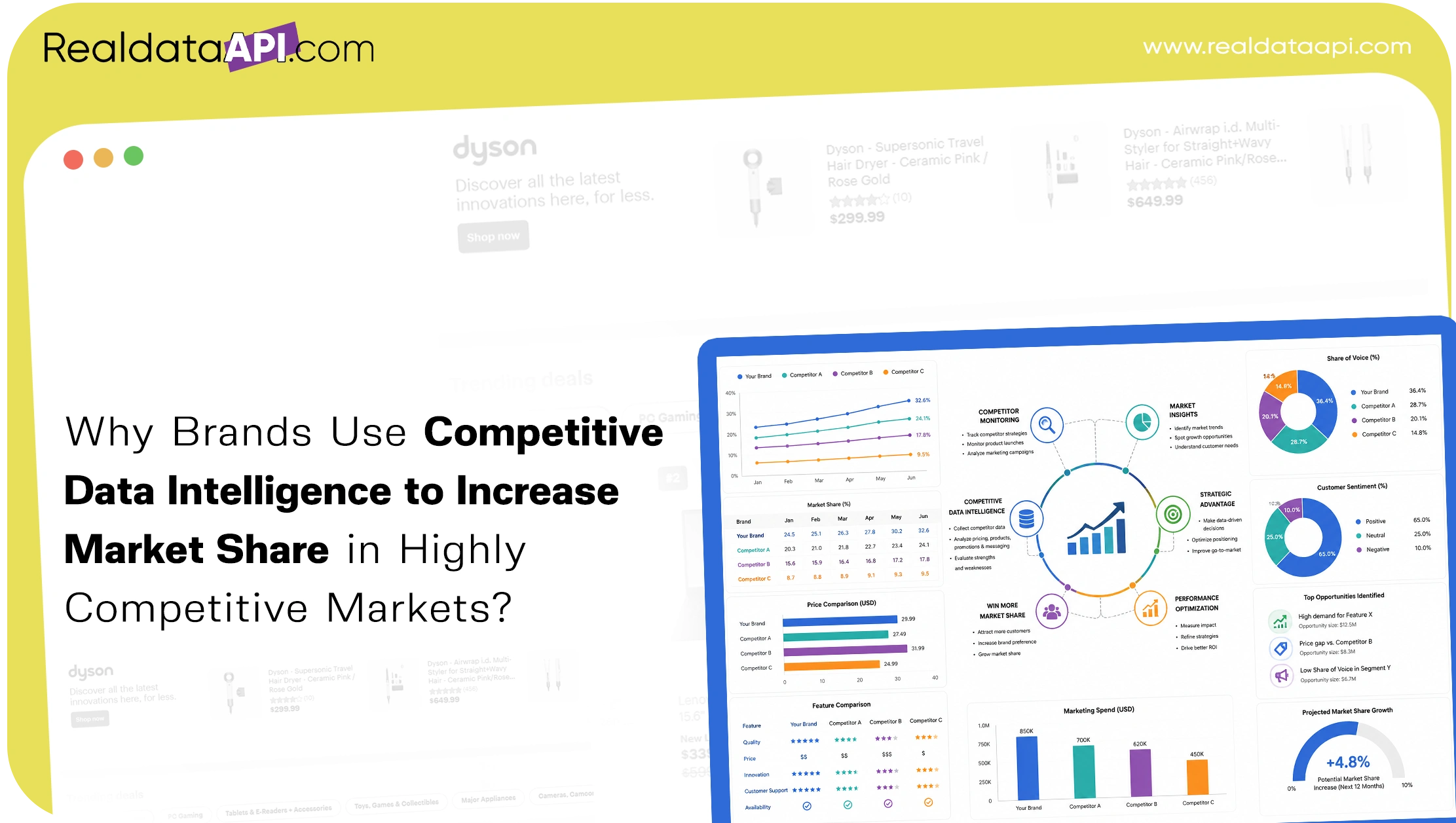
The fastest way to grow market share is by using competitive data intelligence. Brands that monitor competitor pricing, product availability, promotions, customer sentiment, and market trends can make faster and more informed decisions. This explains how brands use competitive data intelligence to increase market share in increasingly competitive digital markets.
Industry Insight: According to industry estimates, organizations using competitive intelligence platforms can improve pricing accuracy by up to 30%, increase campaign performance by 25%, and achieve market share growth of 10–15% faster than competitors between 2020 and 2026.
This article is designed for retail brands, e-commerce businesses, manufacturers, category managers, pricing analysts, and growth strategists looking to solve a critical challenge: gaining visibility into competitor activities and market trends before opportunities disappear.
Modern businesses depend on Enterprise Web Crawling technologies to collect large-scale market intelligence from websites, marketplaces, online retailers, and digital platforms. These insights help companies identify trends, benchmark competitors, optimize pricing, and improve customer acquisition strategies.
As competition intensifies across industries, data-driven decision-making has become essential for sustained growth and profitability.
How Can Businesses Understand Competitor Performance More Effectively?
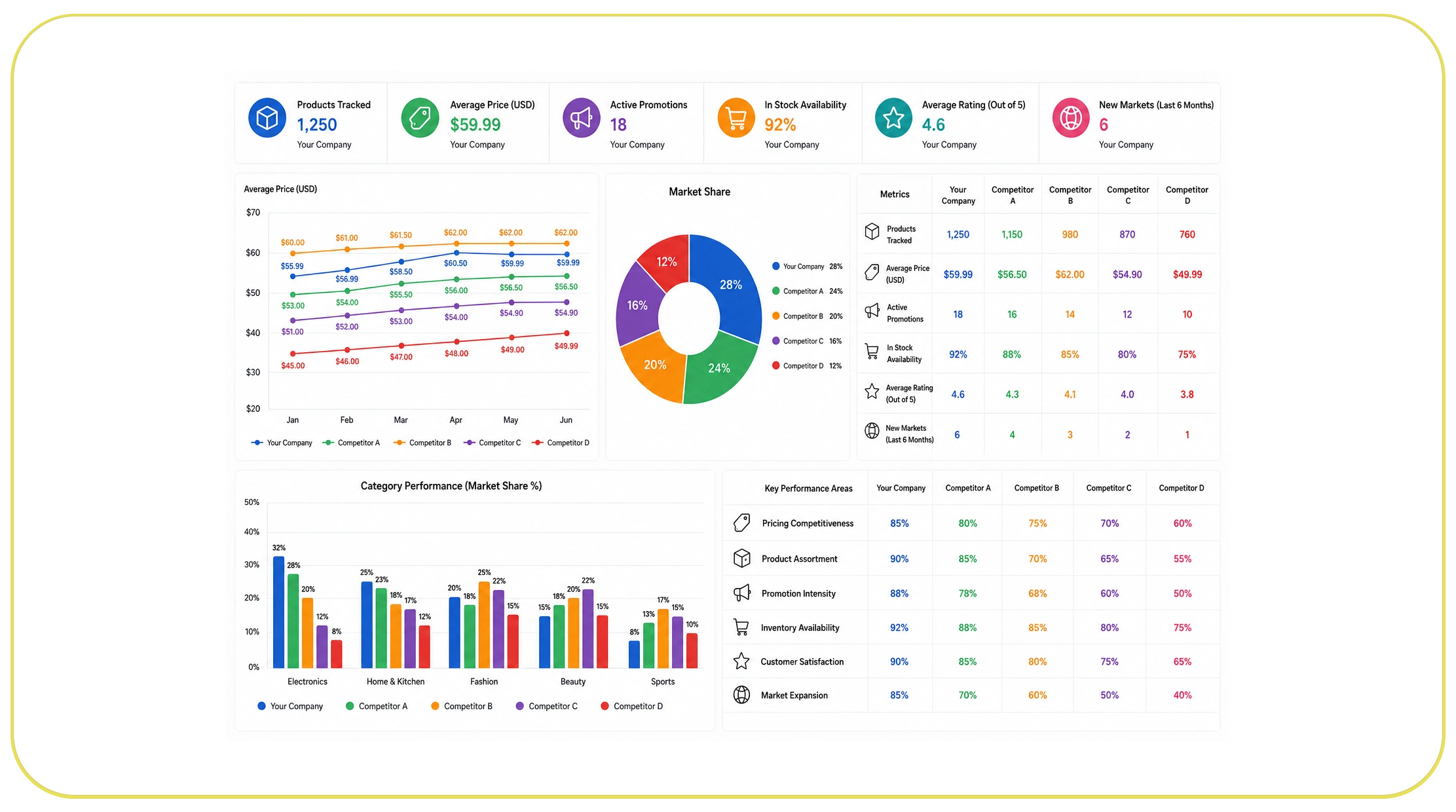
One of the primary reasons companies invest in competitive intelligence is to scrape competitor data for market share analysis. Understanding competitor behavior helps organizations identify strengths, weaknesses, and opportunities within their markets.
Companies monitor:
- Product assortments
- Pricing strategies
- Promotional campaigns
- Inventory availability
- Customer reviews
- Market expansion efforts
This information provides a clearer understanding of how competitors attract customers and gain market share.
Competitor Monitoring Adoption Trends (2020-2026)
| Year | Businesses Monitoring Competitors | Market Intelligence Investment Growth |
|---|---|---|
| 2020 | 38% | 5% |
| 2021 | 45% | 8% |
| 2022 | 53% | 11% |
| 2023 | 62% | 15% |
| 2024 | 70% | 18% |
| 2025 | 77% | 22% |
| 2026 | 84% | 26% |
Competitive monitoring allows businesses to discover:
- Emerging product categories
- Pricing opportunities
- Promotion effectiveness
- Market positioning gaps
- Customer demand shifts
Without competitor intelligence, businesses often rely on assumptions. With data-driven analysis, they gain objective market visibility. This leads to smarter strategies and stronger competitive positioning.
As markets become increasingly digital, competitor data has evolved from a useful resource into a strategic necessity.
How Does Market Intelligence Support Sustainable Business Growth?
Businesses seeking long-term growth increasingly invest in web scraping competitor insights for business growth because actionable intelligence helps reduce uncertainty in decision-making.
Market intelligence provides visibility into changing customer preferences and competitor strategies. Companies can identify trends before they become mainstream and act quickly to capture demand.
Growth Benefits from Competitive Intelligence
| Metric | 2020 | 2026 |
|---|---|---|
| Revenue Growth Impact | 5% | 18% |
| Customer Retention Improvement | 4% | 15% |
| Market Expansion Success Rate | 45% | 72% |
| Product Launch Accuracy | 52% | 83% |
Businesses use competitor insights to:
- Improve product development
- Optimize marketing campaigns
- Refine customer targeting
- Enhance promotional strategies
- Strengthen pricing decisions
For example, monitoring competitors' promotional calendars can help businesses launch campaigns at more strategic times. Tracking customer reviews can reveal unmet needs that competitors fail to address.
Data-driven organizations consistently outperform those relying solely on internal data. External market visibility provides a broader perspective on customer behavior and competitive dynamics.
As digital commerce expands globally, competitive intelligence becomes a core driver of sustainable business growth.
How Can Brands Measure Their Position in the Market?
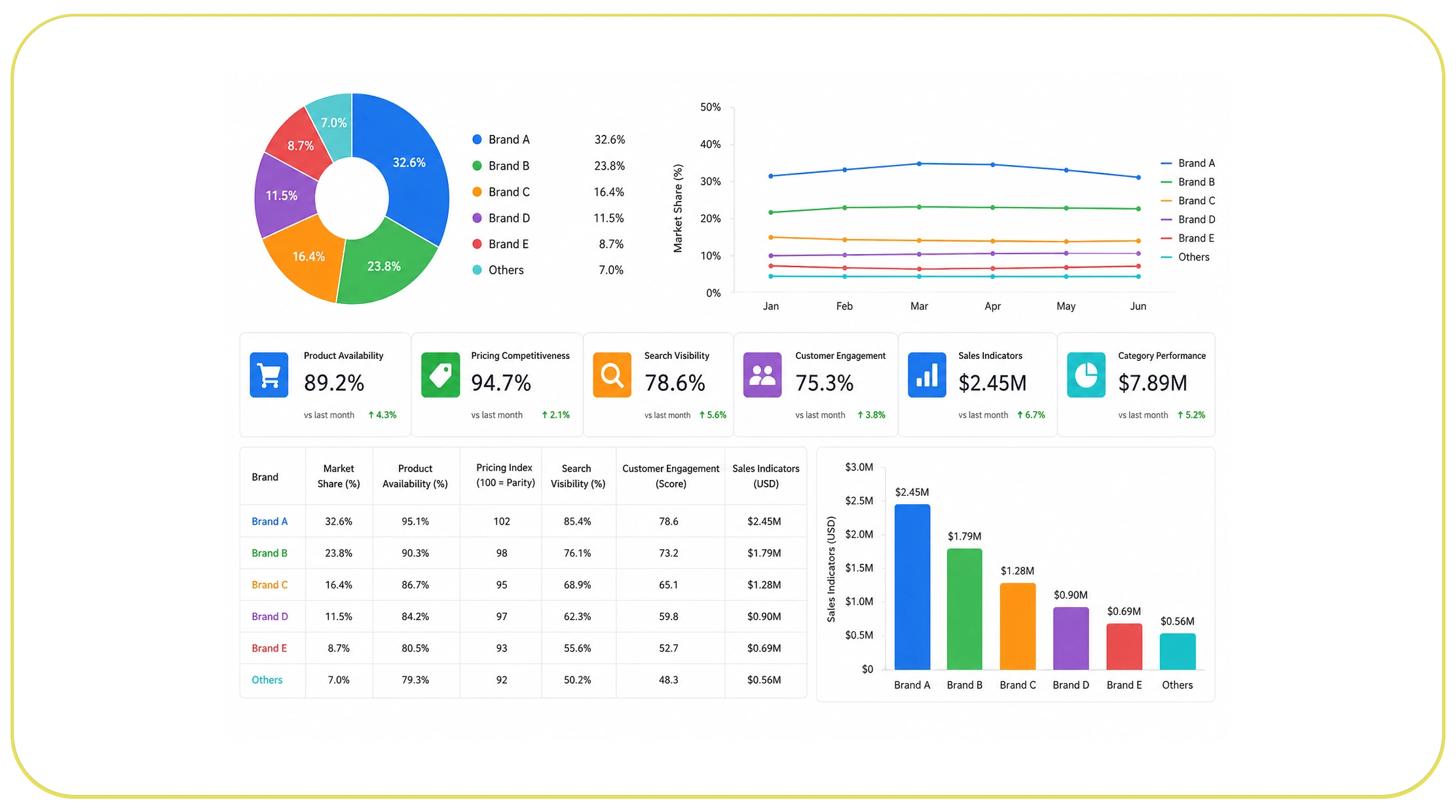
Measuring market position requires access to reliable data. A market share intelligence data scraper helps organizations track competitor performance and estimate their relative standing within specific categories.
Market share analysis involves examining:
- Product availability
- Pricing competitiveness
- Search visibility
- Customer engagement
- Sales indicators
- Category performance
Market Share Intelligence Adoption
| Year | Companies Using Market Share Intelligence |
|---|---|
| 2020 | 29% |
| 2021 | 37% |
| 2022 | 46% |
| 2023 | 57% |
| 2024 | 66% |
| 2025 | 74% |
| 2026 | 82% |
Key advantages include:
- Better market visibility
- Faster trend detection
- Competitive positioning analysis
- Improved investment decisions
- Enhanced strategic planning
Organizations can compare their product portfolios against competitors and identify areas where they gain or lose market presence.
Market share intelligence also supports executive decision-making by providing measurable benchmarks. Instead of relying on anecdotal observations, leaders gain data-backed insights into market performance.
This capability is becoming increasingly important as competition intensifies across retail, manufacturing, consumer goods, and e-commerce sectors.
Why Is Benchmarking Critical for Market Leadership?

Many businesses invest heavily in Competitive Benchmarking because comparing performance against competitors helps identify opportunities for improvement.
A major part of understanding how brands use competitive data intelligence to increase market share involves measuring performance across key metrics.
Benchmarking allows companies to evaluate:
- Pricing competitiveness
- Product assortment depth
- Promotion effectiveness
- Customer sentiment
- Inventory performance
- Category leadership
Benchmarking Impact on Strategic Decisions
| Year | Companies Using Benchmarking | Strategic Decision Accuracy |
|---|---|---|
| 2020 | 41% | 62% |
| 2021 | 48% | 66% |
| 2022 | 56% | 71% |
| 2023 | 64% | 77% |
| 2024 | 72% | 83% |
| 2025 | 79% | 88% |
| 2026 | 86% | 92% |
Benefits include:
- Faster identification of weaknesses
- Improved operational efficiency
- Better pricing strategies
- Increased customer satisfaction
- Enhanced market responsiveness
Benchmarking transforms raw market data into actionable performance indicators. Companies can determine where they outperform competitors and where improvements are needed.
As competition continues to increase, benchmarking provides a structured framework for continuous improvement and market leadership.
How Do Data Collection Solutions Improve Competitive Intelligence?

The quality of competitive intelligence depends heavily on the quality of collected data. This is why organizations rely on advanced Web Scraping Services to gather information from multiple digital sources.
Modern data collection solutions support:
- Real-time monitoring
- Large-scale data acquisition
- Multi-source aggregation
- Automated updates
- Market trend analysis
Growth of Automated Data Collection
| Year | Automated Data Collection Adoption |
|---|---|
| 2020 | 32% |
| 2021 | 40% |
| 2022 | 50% |
| 2023 | 61% |
| 2024 | 70% |
| 2025 | 78% |
| 2026 | 86% |
Collected data may include:
- Product descriptions
- Prices
- Ratings
- Reviews
- Inventory levels
- Promotions
This information allows businesses to maintain accurate market visibility without manual research.
Automated intelligence gathering reduces costs while improving data accuracy and scalability. Companies can monitor thousands of products and competitors simultaneously.
As digital ecosystems continue to expand, automated data collection becomes increasingly essential for maintaining competitive advantage.
What Role Does Automation Play in Future Market Intelligence?

Automation is transforming how organizations gather and analyze market intelligence. Modern businesses increasingly use a Web Scraping API to integrate competitive intelligence directly into business workflows.
Automated APIs provide:
- Continuous data delivery
- Structured datasets
- Real-time updates
- Scalable collection capabilities
- Seamless analytics integration
API-Driven Intelligence Adoption (2020-2026)
| Year | API-Based Intelligence Adoption |
|---|---|
| 2020 | 24% |
| 2021 | 33% |
| 2022 | 43% |
| 2023 | 56% |
| 2024 | 68% |
| 2025 | 78% |
| 2026 | 87% |
Organizations use APIs to:
- Monitor competitors continuously
- Improve forecasting models
- Support pricing optimization
- Enhance market analysis
- Power AI-driven decision systems
Automation eliminates delays associated with manual data collection and reporting. Decision-makers gain access to fresh market intelligence whenever needed.
Future market leaders will increasingly depend on automated intelligence systems to remain agile and responsive. Businesses that embrace API-driven intelligence gain a significant competitive advantage in rapidly evolving markets.
Why Choose Real Data API?
Real Data API helps organizations collect, analyze, and operationalize competitive intelligence at scale. Businesses seeking to understand how brands use competitive data intelligence to increase market share need reliable, accurate, and timely market data.
Key advantages include:
- Enterprise-grade data collection
- Large-scale web crawling capabilities
- Real-time competitor monitoring
- Market intelligence automation
- Custom data delivery formats
- Scalable infrastructure
- High data accuracy
- Seamless API integration
Real Data API empowers retailers, brands, manufacturers, and market research teams to transform raw market data into actionable business insights.
Whether tracking competitors, analyzing pricing trends, benchmarking performance, or identifying growth opportunities, Real Data API provides the intelligence foundation required for smarter decision-making and sustainable growth.
Conclusion
Competitive markets reward businesses that make faster and smarter decisions. Understanding how brands use competitive data intelligence to increase market share reveals why data-driven organizations consistently outperform competitors. By leveraging competitor monitoring, benchmarking, market share analysis, and automated intelligence systems, brands can identify opportunities, optimize strategies, and strengthen market positioning.
Ready to gain a competitive edge and grow your market share? Contact Real Data API today to unlock powerful competitive intelligence solutions tailored to your business needs!
Latest posts

How to Use a Meesho ecommerce scraper 2026 to Analyze Product Listings, Pricing, and Market Opportunities

How a Blinkit scraper for retail market research Helps Brands Track Competitor Pricing and Product Trends

Why Businesses Need a Flipkart India daily ecommerce dataset for market research for Smarter Retail Decisions
Grocery Data Scraping for Competitive Benchmarking - Key Strategies for Retail Success in 2027






.png)