TL;DR
- Prada Fashion Dataset helps fashion brands, retailers, and researchers organize product, pricing, category, and assortment information for competitive analysis.
- Prada fashion data Scraping can turn frequently changing online product information into structured, historical data for pricing and trend intelligence.
- From 2020–2026, digital retail, changing consumer behavior, and luxury-market volatility have increased the need for timely, comparable fashion data.
Introduction
Prada Fashion Dataset helps businesses answer practical market questions: Which products are available? How are prices positioned? Which categories are expanding? Which styles and assortments are attracting attention? For luxury brands, retailers, marketplace analysts, and fashion researchers, structured product intelligence makes these questions easier to investigate.
The need is particularly relevant because luxury fashion has experienced substantial changes since 2020. Prada Group reported €2.423 billion in net revenue for 2020, followed by €3.364 billion in 2021, representing a 41% increase at constant exchange rates. By 2024, Group net revenue reached €5.4 billion, and in 2025 it reached €5.718 billion. (PradaGroup)
At the same time, Prada fashion data Scraping can help convert publicly accessible online product information into structured records. These records may include product names, categories, prices, colors, materials, sizes, availability, URLs, and collection timestamps, subject to source accessibility and applicable terms.
For fashion businesses, the key challenge is not simply collecting information. It is making that information comparable, historical, searchable, and useful for decisions around pricing, assortment, category planning, and market research.
How Can Product-Level Data Improve Fashion Market Research?
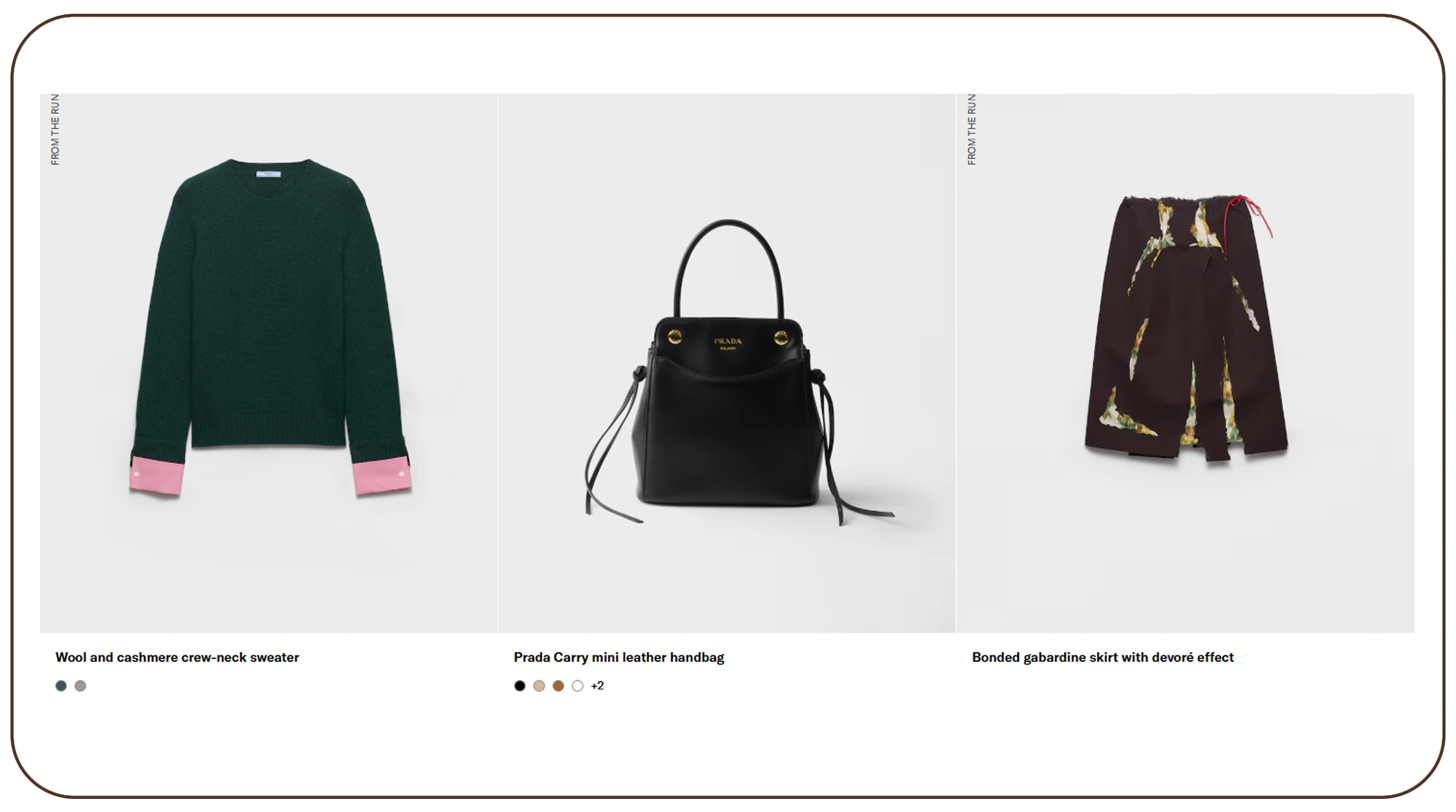
Scrape Prada product data for fashion market research to create a structured view of the brand's assortment, product attributes, categories, and market positioning. Instead of manually reviewing hundreds or thousands of product pages, analysts can work with standardized records that can be filtered, compared, and analyzed over time.
A product dataset can capture attributes such as product title, category, subcategory, product type, material, color, size, price, discount status where applicable, availability, and product URL. Historical timestamps add another important dimension because the same product can change status or price over its lifecycle.
Key Product Intelligence Fields
| Data Field | Market Research Application |
|---|---|
| Product name | Identify individual offerings |
| Category | Measure assortment distribution |
| Subcategory | Understand niche segments |
| Material | Study product composition |
| Color | Identify assortment patterns |
| Price | Evaluate price positioning |
| Availability | Track assortment changes |
| Product URL | Maintain source reference |
| Timestamp | Build historical records |
From 2020 to 2026, luxury businesses have had to interpret market conditions that changed substantially. Prada Group reported that online sales increased by more than 200% in FY2020, while its total net revenue declined 24% at constant exchange rates that year. (PradaGroup) By 2025, Prada Group reported 843 directly operated stores across its brands and total net revenue of €5.7 billion. (PradaGroup)
This progression illustrates why historical product intelligence matters. A researcher studying only the current assortment may miss how products, categories, and retail channels evolved after the pandemic.
For a fashion retailer or market research team, historical product records can support assortment benchmarking, competitor research, new-product identification, and category-level reporting. They can also help analysts distinguish temporary assortment changes from longer-term patterns.
The practical benefit is a shift from page-by-page observation to structured market research. Instead of asking what is currently listed, teams can investigate how assortment composition has changed and which attributes repeatedly appear across collections.
How Can Pricing Data Strengthen Luxury Market Analysis?
Extract Prada pricing data for luxury market analysis to establish a structured reference for studying price positioning across products and categories. Luxury pricing requires careful interpretation because price is only one component of brand positioning, but historical price observations can still reveal useful market signals.
A pricing dataset can connect product identifiers with prices, categories, materials, colors, product types, availability, and collection periods. This allows analysts to compare products on a more consistent basis.
Example Pricing Intelligence Structure
| Metric | Possible Insight |
|---|---|
| Current price | Current price positioning |
| Historical price | Price movement |
| Category price range | Category benchmarking |
| Median price | Typical category positioning |
| Price dispersion | Range within a category |
| Product availability | Supply-side context |
| Collection period | Seasonal comparison |
Prada Group's reported financial trajectory provides useful context for why pricing analysis matters. Group net revenue increased from €2.423 billion in 2020 to €3.364 billion in 2021, then reached €5.4 billion in 2024 and €5.718 billion in 2025. (PradaGroup)
However, company revenue should not be interpreted as a direct measure of individual product pricing. Product-level datasets provide a different layer of information by showing how individual items are positioned.
The 2020–2026 period also demonstrated that luxury markets can behave differently across regions. Bain reported that China's mainland personal luxury market declined an estimated 18%–20% in 2024, while different luxury categories experienced varying levels of pressure. (Bain Preprod CMS)
For international retailers and researchers, regional price observations can therefore be useful when combined with market and currency context.
A historical pricing dataset can help identify products that consistently occupy premium price bands, categories with wider price ranges, and changes in assortment architecture. Analysts can also compare price with material, product type, and category to understand whether higher-priced products are concentrated in specific segments.
The result is a more granular approach to luxury market analysis—one that combines product attributes with observable pricing information rather than relying only on headline market statistics.
How Can Live Product Signals Support Fashion Trend Analysis?
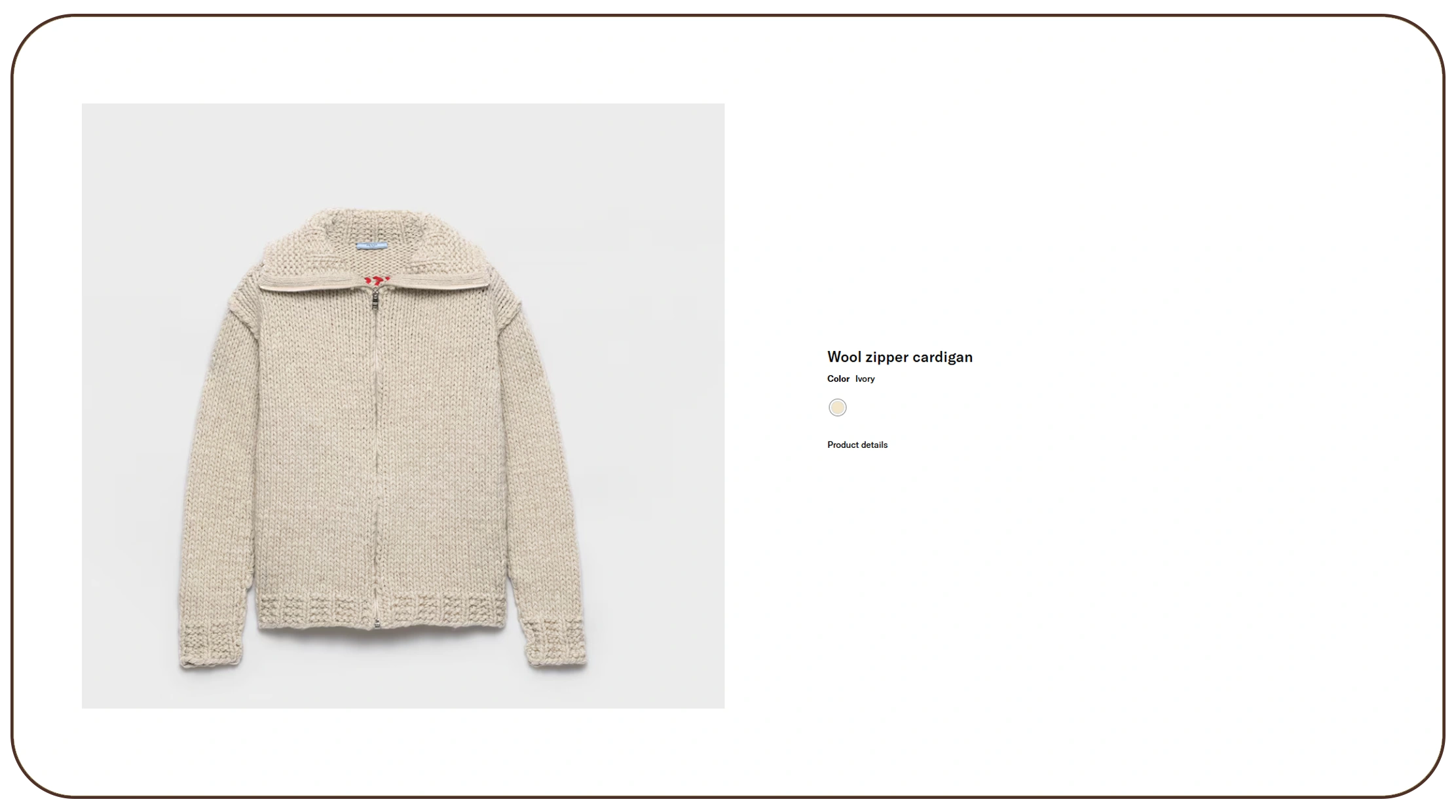
Real-time Prada product and price data for fashion trend analysis can help analysts identify assortment changes sooner than periodic manual research. In fast-moving digital fashion environments, a product appearing, disappearing, changing price, or becoming unavailable can represent a useful market signal.
Real-time or scheduled collection does not necessarily mean every product changes every minute. Instead, it means businesses can collect information at a frequency appropriate to their analytical objective.
Monitoring Frequency and Use Cases
| Frequency | Potential Application |
|---|---|
| Weekly | Broad assortment research |
| Daily | Product and pricing monitoring |
| Multiple times daily | High-change product tracking |
| Event-based | Campaign or collection monitoring |
| Historical snapshots | Trend analysis |
The shift toward digital channels accelerated during 2020. Prada Group reported online sales growth of more than 200% in FY2020. (PradaGroup) The following years brought renewed physical retail growth alongside continued digital investment.
By 2025, Prada Group reported 843 directly operated stores across its brands and stated that retail remained the primary engine of growth. (PradaGroup)
This creates an interesting research environment: digital product visibility can be analyzed alongside broader retail developments.
For trend analysts, useful signals may include newly listed products, recurring colors, category additions, material changes, price movements, product availability, and assortment turnover. These signals become more valuable when collected consistently rather than as isolated observations.
For example, if a particular product type appears repeatedly across newly observed assortments, analysts can flag it for further investigation. That does not prove it is a consumer trend, but it provides a measurable product-level signal that can be combined with search behavior, social engagement, sales data, or other sources.
Build a structured luxury fashion intelligence workflow to monitor product, pricing, assortment, and trend signals across relevant digital sources.
Get Insights Now!How Can Category-Level Data Reveal Assortment Opportunities?
Prada data extraction for fashion category analysis can organize individual products into broader groups such as leather goods, footwear, clothing, and other relevant product classifications. This makes it easier for researchers to understand how a luxury assortment is structured.
Prada Group states that its brands design and produce ready-to-wear, leather goods, footwear, and jewellery collections, while eyewear and beauty are operated through licensing arrangements. (PradaGroup)
Category Analysis Framework
| Category Dimension | What Analysts Can Examine |
|---|---|
| Product category | Assortment breadth |
| Subcategory | Product concentration |
| Product count | Relative assortment size |
| Price range | Category positioning |
| Materials | Product composition |
| Colors | Visual assortment |
| Availability | Current assortment depth |
| New listings | Category development |
From 2020 to 2026, category analysis became increasingly relevant as luxury consumers moved through changing preferences and economic conditions. Bain's 2024 analysis of China found that all luxury categories faced challenges, although the impact differed, with beauty showing greater resilience while watches and jewelry experienced stronger pressure. (Bain Preprod CMS)
This demonstrates why category-level analysis should not rely on a single aggregate luxury-market number.
A structured dataset can reveal how many products belong to each category, how price bands differ, which materials appear most frequently, and whether certain subcategories expand or contract over time.
For retailers and fashion researchers, these observations can support competitive assortment mapping. A retailer planning a new luxury category, for example, can examine competitor product breadth, price architecture, and material distribution before deciding how to structure its own assortment.
Category analysis can also support content and merchandising teams. Product attributes can be grouped into reusable taxonomies, allowing analysts to create consistent dashboards and reports across different collection periods.
The main advantage is comparability. Once product information has been standardized, analysts can compare categories across time rather than repeatedly interpreting individual product pages.
How Can a Structured Dataset Support Long-Term Fashion Intelligence?
Prada Fashion Dataset can serve as a historical foundation for research covering products, pricing, categories, and assortment changes. Its value increases when records are collected consistently and stored with timestamps.
A useful dataset should not only contain product names and prices. It should preserve relationships between products and attributes so analysts can perform deeper queries.
Recommended Dataset Architecture
| Layer | Example Data |
|---|---|
| Product | Name, URL, SKU/product ID |
| Classification | Category, subcategory |
| Attributes | Color, material, size |
| Commercial | Price, MRP where available |
| Availability | In-stock/out-of-stock |
| Temporal | Date and timestamp |
| Source | Website/source reference |
| Analytical | Historical change indicators |
From 2020 through 2026, Prada Group's financial and retail footprint changed considerably. The Group's revenue increased from €2.423 billion in 2020 to €5.718 billion in 2025. (PradaGroup) Its 2025 reporting also showed Prada brand net revenue of approximately €3.796 billion and Miu Miu net revenue of approximately €1.787 billion. (PradaGroup)
These figures describe company-level performance, whereas a product dataset operates at a much more granular level. The two forms of information can complement each other.
Historical product records can help answer questions such as:
- How does assortment breadth change by season?
- Which categories maintain the largest number of listed products?
- How are prices distributed within individual categories?
- Which products remain available over extended periods?
- Which attributes appear repeatedly in newly observed products?
- How does product availability change over time?
The dataset can also be integrated with broader research sources. Search trends, social-media engagement, consumer reviews, resale-market activity, and company reports can be joined conceptually or technically with product-level observations.
For AI-powered analytics, structured fields are especially useful because they allow systems to retrieve and summarize specific attributes. Clean taxonomy, consistent naming, timestamps, and documented provenance make datasets easier for dashboards, machine-learning workflows, and language-model-based research systems to interpret.
Why Choose Real Data API?
Fashion intelligence requires consistent collection, structured outputs, and scalable workflows. Fashion Data Scraping can help businesses transform publicly accessible fashion information into organized datasets suitable for market research, assortment analysis, pricing studies, and competitive intelligence.
Real Data API can be positioned around the practical requirements of data-driven fashion research: structured extraction, recurring collection, normalization, historical storage, and analytics-ready delivery.
For teams studying luxury brands, Prada Fashion Dataset workflows can reduce the manual effort involved in reviewing large product catalogs and repeatedly recording changes.
Key Capabilities to Prioritize Include:
- Automated product data collection
- Price and availability monitoring
- Product categorization
- Attribute normalization
- Historical data storage
- Scheduled data refreshes
- Structured output formats
- Scalable SKU-level processing
- Analytics-ready datasets
- Custom fields based on business requirements
The right architecture should also preserve timestamps and source references. This helps analysts distinguish current observations from historical records and improves traceability when datasets are used for research or reporting.
For luxury retailers, market research companies, fashion analysts, and data teams, the objective is straightforward: create reliable product intelligence that can be connected to existing analytical workflows.
Conclusion
The luxury fashion market has changed significantly from 2020 to 2026, with digital commerce, shifting consumer behavior, regional differences, and evolving category dynamics creating new data requirements. Prada Group's revenue progression—from €2.423 billion in 2020 to €5.718 billion in 2025—illustrates the scale of change taking place during this period. (PradaGroup)
A Prada Fashion Dataset provides a structured way to investigate product assortments, prices, categories, attributes, and historical changes. When product observations are collected consistently, businesses can move beyond one-time catalog research toward repeatable fashion intelligence.
For retailers, luxury analysts, market researchers, and fashion-data teams, the most useful approach is to combine product-level observations with company reports, market research, consumer signals, and historical context.
Contact Real Data API to create a customized luxury fashion data solution for product research, pricing intelligence, category analysis, and trend monitoring!
FAQs
What is a Prada Fashion Dataset?
A Prada Fashion Dataset is a structured collection of product information such as names, categories, prices, attributes, availability, URLs, and timestamps for fashion research.
How does Prada fashion data Scraping support research?
Prada fashion data Scraping can organize publicly accessible product information into structured records, enabling researchers to analyze assortment, pricing, categories, availability, and historical product changes.
How can Real Data API help with fashion datasets?
Real Data API can help businesses collect, structure, normalize, and deliver fashion information for research workflows, dashboards, competitive intelligence, pricing analysis, and recurring product monitoring.
Why are Fashion Datasets useful for trend analysis?
Fashion Datasets allow analysts to compare product attributes, categories, prices, and assortments across time, helping identify measurable signals that can be combined with other trend indicators.
What is the role of Fashion Data Scraping in luxury research?
Fashion Data Scraping can reduce manual catalog research by creating structured product records, supporting recurring monitoring, historical comparisons, category analysis, and pricing intelligence when source access permits.
Latest posts
How Prada Fashion Dataset Helps Businesses Track Luxury Products, Prices, Categories, and Fashion Trends for Better Market Insights
How Snapdeal E-commerce Dataset Helps Analyze Products, Prices, Sellers, and Marketplace Trends?
.webp)
How Uniqlo Fashion Dataset Helps Analyze Products, Prices, Categories, and Apparel Trends?

How Travel Dataset Solves Destination Intelligence Gaps with Flights, Hotels, Prices, Destinations, and Travel Market Trends







.png)