.gif)
.jpg)
Quick Summary
- Accurate sports odds tracking helps betting platforms, sports analysts, and researchers identify changing bookmaker prices, compare markets, and reduce inconsistencies in sports datasets.
- A structured OddsPortal sports data API workflow can help organize odds information, while Real-Time OddsPortal data extraction for sports intelligence supports market analysis, historical comparisons, and informed monitoring decisions.
- Reliable source validation, timestamp management, and consistent data formats are essential for building dependable sports analytics systems.
Introduction
Sports betting markets change continuously as bookmakers adjust prices in response to team news, player availability, market demand, and match developments. For sports analytics companies, betting platforms, and data-driven businesses, inaccurate odds information can create problems in market comparisons, reporting, and decision-making. A dependable OddsPortal sports data API integration can help organize available odds information and support structured monitoring across sporting events and bookmakers.
However, collecting sports odds is not simply about retrieving numbers. Businesses must also consider bookmaker coverage, market definitions, timestamps, historical records, and data validation. Real-Time OddsPortal data extraction for sports intelligence can help create a more consistent information pipeline when supported by authorized data access and appropriate update schedules.
This article explains the challenges of inaccurate odds tracking, the importance of structured data collection, and how businesses can improve sports market monitoring through reliable extraction and validation workflows.
Why do sports odds become inaccurate across different sources?
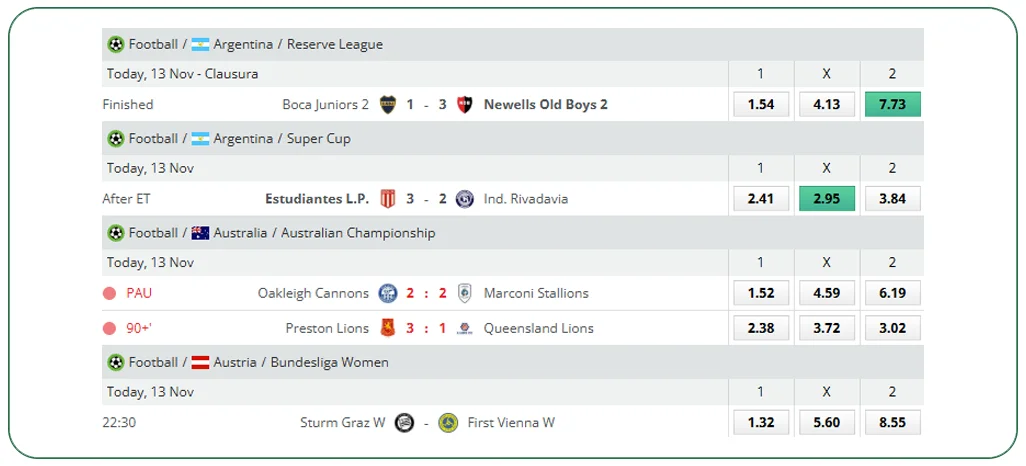
Sports odds inaccuracies often occur when data platforms collect information from multiple bookmakers without aligning event identifiers, market definitions, timestamps, and odds formats. Even when two sources describe the same match, their records may represent different observation times or market conditions.
For example, a football match can have separate records for full-time results, first-half results, Asian handicaps, and total goals. Comparing prices from different markets as though they were identical creates misleading results. Similarly, a bookmaker's latest update may not match the time when an aggregator last refreshed its information.
A reliable OddsPortal data collection services workflow should begin with consistent event identification. Every match should have a unique internal identifier linked to the sport, competition, participating teams, and scheduled start time. This prevents duplicate events and incorrect comparisons.
Another important step is preserving the original bookmaker update timestamp. A record should contain both the source's update time and the time when the collection system retrieved it. This distinction helps analysts identify stale information and investigate delays.
Businesses should also normalize odds formats. Decimal, fractional, and American odds represent prices differently. Converting them into a common analytical format makes cross-bookmaker comparisons easier.
Research published in Finance Research Letters in 2020 examined odds from 51 online bookmakers across more than 16,000 English football matches. The study found that bookmaker prices generally reflected match outcomes without systematic bias, while individual bookmakers did not fully incorporate information available in competitors' odds. This demonstrates why comparing multiple sources can be valuable for market analysis.
Practical accuracy checks include:
- Match and competition identification.
- Market and outcome matching.
- Bookmaker-level timestamp validation.
- Odds-format normalization.
- Duplicate event detection.
- Missing-value and outlier checks.
How can businesses improve the freshness of changing prices?
Sports odds are dynamic information. A price collected several minutes ago may no longer represent the latest available bookmaker quote. Businesses therefore need an update strategy based on event status, market importance, and source availability.
A structured real-time OddsPortal odds data monitoring workflow should distinguish between pre-match and in-play information. Pre-match markets can be monitored according to scheduled refresh intervals, while live events may require more frequent checks, subject to the provider's permitted access and actual update frequency.
The most important consideration is that a frequent collection schedule does not automatically guarantee fresh data. If the original source has not updated its price, repeatedly collecting the same record adds processing costs without improving accuracy.
A better approach uses timestamp-based monitoring. Each record should preserve:
- Event start time.
- Bookmaker name.
- Market and outcome.
- Displayed odds.
- Source update timestamp, when available.
- Collection timestamp.
- Data validation status.
What does historical data availability show between 2020 and 2026?
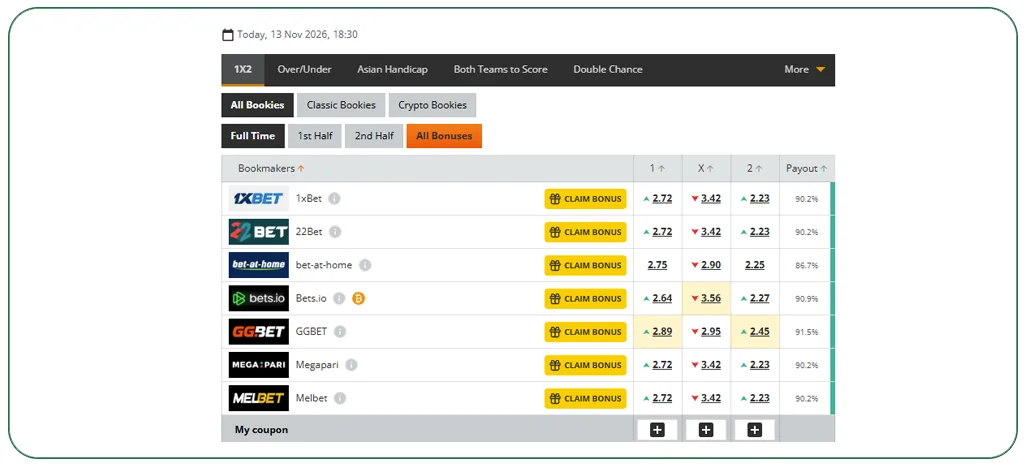
Historical odds documentation from The Odds API provides a useful, independently documented example of how sports data archives have evolved. These figures describe The Odds API, not an official OddsPortal API or OddsPortal's historical coverage.
| Year | Verified historical data milestone |
|---|---|
| 2020 | Historical featured-market odds coverage begins on June 6, with 10-minute snapshots. |
| 2021 | The historical archive continues to provide timestamp-based snapshots. |
| 2022 | From September, featured-market snapshots move to 5-minute intervals. |
| 2023 | Additional markets, including player props and period markets, become available from May 3, with 5-minute snapshots. |
| 2024 | The documented historical endpoint supports timestamp-based market research. |
| 2025 | The API documentation continues to show bookmaker and market-level update timestamps. |
| 2026 | Current documentation includes historical odds endpoints and examples with 2026 market timestamps. |
Source: The Odds API historical data documentation and API reference. These milestones must not be interpreted as OddsPortal coverage statistics.
The historical timeline demonstrates why businesses should evaluate snapshot frequency before purchasing or integrating a sports data feed. A five-minute archive, for example, cannot establish every individual price movement occurring between snapshots.
The key recommendation: Match the refresh schedule to the analytical requirement instead of assuming that more frequent collection always means better information.
How can businesses identify the correct market information?
A major reason for inaccurate sports analytics is incorrect market mapping. Two records may relate to the same event but represent different betting conditions.
For example, a football match may contain:
- Match winner or head-to-head.
- Double chance.
- Asian handicap.
- Total goals.
- Both teams to score.
- First-half winner.
- Correct score.
These markets have different outcome structures. A sports analytics platform must not compare a match-winner price with a total-goals price simply because both records share the same event identifier.
To extract sports market information accurately, businesses should establish a standardized market taxonomy. Each source-specific market name should map to an internal market category, settlement period, and outcome definition.
A useful event-market structure includes the following fields:
| Field | Purpose |
|---|---|
| Event ID | Identifies the sporting event |
| Sport | Identifies football, cricket, tennis, etc. |
| Competition | Identifies the tournament or league |
| Home/away or participants | Establishes event identity |
| Market type | Defines the betting market |
| Outcome | Identifies the available selection |
| Odds value | Stores the quoted price |
| Bookmaker | Identifies the originating operator |
| Timestamp | Establishes data freshness |
Market definitions should also account for differences in participant naming. Team abbreviations, alternative spellings, and tournament naming variations can create duplicate or incorrectly matched records.
The 2024 research paper Comparing Two Methods for Testing the Efficiency of Sports Betting Markets explains why the mathematical interpretation of odds matters. Its analysis compares normalized probabilities with inverse decimal odds and finds that the normalized probability method provides a more suitable test of strong market efficiency.
This is particularly relevant for businesses developing probability models. Raw odds should not automatically be treated as probabilities because bookmaker margins must also be considered.
Improve your sports analytics with structured, validated odds information. Explore customized data solutions from Real Data API.
Get Insights Now!How can automated collection reduce manual monitoring errors?
Manual sports odds monitoring becomes difficult when businesses need to track several competitions, events, bookmakers, and betting markets simultaneously. Analysts may overlook price changes, record outdated information, or accidentally combine data belonging to different events.
An OddsPortal sports data scraper concept can help automate permitted information collection, but the implementation must respect the source's access conditions. This distinction is especially important for OddsPortal.
Important access and compliance consideration: OddsPortal's published terms state that its content is for personal use, prohibit commercial use, and restrict scraping, aggregating, embedding, or recreating its content without express consent, subject to applicable law. The terms also state that OddsPortal does not provide its content for external applications. Therefore, businesses should obtain explicit authorization before using OddsPortal information commercially. An independently licensed sports odds provider is an alternative when such authorization is unavailable.
An automated workflow using an authorized source can include the following components:
- 1. Event discovery and identification
The system identifies available sporting events and maps them to internal event identifiers. It checks competition names, participants, and scheduled start times to prevent incorrect associations.
- 2. Structured odds collection
The collection process retrieves permitted bookmaker and market information. It stores prices in a consistent format and preserves source timestamps.
- 3. Automated validation
Quality checks identify missing prices, duplicate records, unexpected changes, and invalid market combinations. Suspicious entries can be flagged for further review instead of being automatically accepted.
- 4. Data storage and distribution
Validated records are stored in structured databases. Applications can then access the information through internal services or authorized API connections.
Automation is most useful when it reduces repetitive collection work while maintaining a clear record of where information originated. It should not be treated as a guarantee that every bookmaker price will be available or updated simultaneously.
How does historical comparison improve sports market research?
Historical odds provide context that individual live prices cannot offer. Businesses can use archived information to examine how bookmaker prices changed before an event, compare opening and closing prices, and evaluate differences between market participants.
Market Research becomes more useful when historical records contain consistent event identifiers, market definitions, bookmaker details, and observation timestamps.
For example, an analyst studying football markets may investigate whether prices changed following publicly reported team news. To conduct this research reliably, the analyst needs time-stamped observations and a clearly defined comparison period. A final match result alone cannot establish when a price changed or what information was available at that time.
Historical data also supports:
- Opening and closing price analysis: Compare early market prices with prices recorded near event commencement.
- Line movement research: Identify changes in handicap and total-goals markets.
- Bookmaker comparison: Evaluate differences between prices for equivalent outcomes.
- Model backtesting: Test analytical models against historical observations without using future information.
- Market efficiency research: Examine how prices reflect information available to market participants.
Which historical data measurements matter?
| Measurement | Analytical purpose |
|---|---|
| Opening odds | Establishes the initial recorded price |
| Closing odds | Provides a final pre-event comparison point |
| Price movement | Measures changes between observations |
| Implied probability | Converts odds into an unadjusted probability estimate |
| Overround | Helps identify the bookmaker margin |
| Snapshot interval | Shows how frequently historical observations were recorded |
For a multi-outcome market, the sum of implied probabilities can exceed 100%. This difference is commonly described as the overround.
A useful real-world research reference is the historical odds archive documented by The Odds API. Its featured-market archive begins in June 2020, with documented changes in snapshot frequency and additional market coverage in 2022 and 2023. Businesses should verify the archive's actual coverage before using it for a specific sport or competition.
Historical research should also avoid look-ahead bias. A model must only use information that would have been available at the time of the prediction. Otherwise, backtesting results may overstate the model's actual predictive performance.
How can mobile applications maintain consistent odds information?
Sports applications need consistent data presentation across devices. A user checking an event on a smartphone should not see contradictory prices simply because the application and backend use different update schedules or data formats.
Mobile App Scraping and data integration workflows can help businesses organize information from authorized sources for mobile application use. However, the most important work often happens in the backend rather than on the mobile interface.
A reliable mobile sports data architecture should include:
Centralized data processing: Incoming information should pass through a common backend that handles event matching, market normalization, and validation.
Timestamp visibility: The application should distinguish between the source's last update and the time the platform retrieved the record. This helps users understand whether displayed information is current.
Consistent market labels: Market names and selections should follow a standard internal taxonomy so that users can compare equivalent information across screens.
Efficient API responses: The backend should return only the fields required by each application screen. This reduces unnecessary data transfer and simplifies mobile integration.
Error handling: When a source is unavailable or a market has no current price, the application should display an appropriate unavailable or delayed status rather than presenting an old value as live information.
What should businesses test before launching?
| Testing area | What to verify |
|---|---|
| Data accuracy | Correct event, outcome, and odds mapping |
| Refresh performance | Actual delay between source updates and display |
| Device compatibility | Consistent display across supported devices |
| API reliability | Appropriate handling of timeouts and failures |
| Data security | Protected credentials and authorized access |
| User transparency | Clear stale-data and unavailable-market indicators |
For sports technology businesses, mobile performance depends on the quality of the underlying information pipeline. A well-designed backend helps maintain consistency across websites, dashboards, mobile applications, and analytical tools.
Why Choose Real Data API?
Real Data API focuses on helping businesses organize and access structured information for data-driven applications. For sports technology companies, the quality of an odds monitoring system depends on reliable source selection, consistent data processing, and clear delivery requirements.
The following capabilities are important when evaluating a sports data partner.
- 1. Customized Data Collection
Every business has different requirements. A sports analytics company may need football odds, while another platform may focus on cricket, basketball, or tennis. A customized collection workflow can be designed around the required sports, competitions, markets, and data fields.
- 2. Data Accuracy and Validation
Reliable datasets require more than collecting prices. Validation should identify missing information, duplicate events, inconsistent market labels, and outdated records. Source timestamps also help businesses evaluate information freshness.
- 3. Price Monitoring
Price Monitoring helps businesses examine changing bookmaker prices and identify differences across equivalent markets. A structured monitoring solution can organize opening prices, subsequent observations, and closing prices for analytical comparisons.
- 4. Flexible Data Integration
Businesses may require information for dashboards, reporting platforms, databases, and mobile applications. Structured delivery formats and API-based integration can simplify the movement of validated information into existing technology systems.
- 5. Scalable Data Workflows
Sports platforms frequently expand their coverage as they add competitions, markets, and analytical features. A scalable workflow should support additional data requirements without compromising existing validation and standardization processes.
Real Data API can be approached as a data solution partner for businesses looking to develop structured sports intelligence workflows. The specific source permissions, coverage, update frequency, and delivery capabilities should be confirmed before implementation.
Conclusion
Inaccurate sports odds tracking can affect market comparisons, sports analytics, historical research, and application performance. Businesses can address these challenges through consistent event identification, timestamp validation, market normalization, and structured data integration. An authorized OddsPortal sports data API workflow requires particular attention to source permissions and commercial usage conditions. Choosing the right data architecture helps organizations build more dependable sports intelligence systems.
Looking to improve sports odds monitoring and data accuracy? Connect with Real Data API to discuss customized sports data collection, validation, and integration solutions!
FAQs
1. What is an OddsPortal sports data API?
An OddsPortal sports data API refers to an API-style approach to accessing structured odds information. Commercial integration requires appropriate authorization from the relevant data provider.
2. Why is Real-Time OddsPortal data extraction important?
Real-Time OddsPortal data extraction for sports intelligence helps organize time-sensitive odds observations. Timestamp validation is essential for identifying delayed or outdated information.
3. How do OddsPortal data collection services improve accuracy?
OddsPortal data collection services can support structured validation, event matching, duplicate detection, and standardized records when collection is properly authorized.
4. What information is available through real-time odds monitoring?
Real-time OddsPortal odds data may be analyzed across event prices, bookmaker information, market categories, and timestamps, subject to authorized source coverage.
5. How can businesses extract sports market information?
Businesses can extract sports market information through licensed data feeds, structured APIs, and validation workflows that organize events, markets, outcomes, and prices.
Latest posts
Blinkit SKU Data Scraping: City-Wise & Dark-Store-Wise Multi-SKU Tracking
Walmart & Costco Grocery Category API: Pull Entire Departments in One Call
USA Grocery Category API: Product, Price & Availability by ZIP Code

How an Automated e-commerce web data scraper for businesses Prevents Stockout Errors and Competitor Pricing Gaps



.png)


